📢 Disclosure: CoinCodeCap may earn affiliate commission when you sign up via links in this article. Our reviews remain editorially independent — we test products, validate claims, and report honestly. Trading derivatives involves substantial risk of loss; capital is at risk. This article is for educational purposes only and is not financial advice. Consult a SEBI-registered advisor for personalised guidance.
CoinDCX is technically safe — ISO 27001 certified, FIU-IN registered, 100% cold storage for user funds, and it proved its financial resilience in July 2025 when a $44 million internal wallet was hacked and CoinDCX covered the entire loss from its own treasury without touching a single user’s balance. That said, ‘safe’ and ‘risk-free’ are not the same thing.
US Stock Futures carry leverage risk, there is no SIPC or SEBI investor protection equivalent, customer support has a documented history of slow responses, and the regulatory framework for the futures product itself is still evolving. This article breaks all of it down so you can make an informed decision before you deposit. (For the broader trading context, start with our How to Trade US Stock Futures from India pillar guide.)
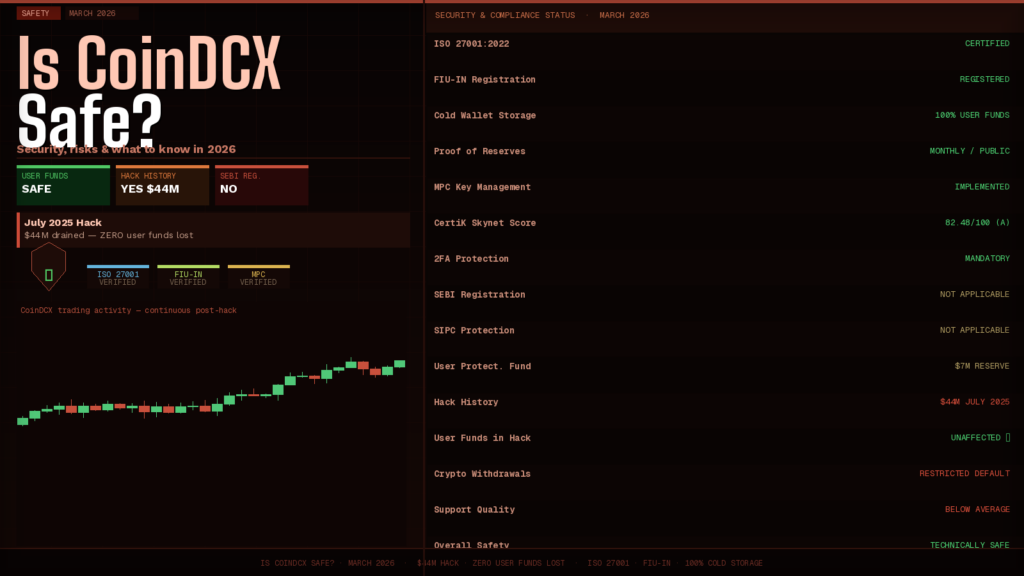
⚡ TL;DR — Is CoinDCX Safe in 2026?
Short answer: Yes for active trading with proper risk management. No for passive long-term investment — wrong product. The platform’s security architecture is sound; the biggest risks are leverage and product-level, not custody.

- Security: ISO 27001:2022 certified · 100% cold-wallet storage with MPC keys · monthly proof-of-reserves · CertiK A grade (82.48/100)
- July 2025 hack: $44.2M stolen from operational wallet · zero user funds touched · CoinDCX covered the loss from $100M+ treasury
- Regulation: FIU-IN registered (AML/KYC) · NOT SEBI-regulated · no SIPC / no investor protection fund
- Disclosure delay: ~17 hours after the breach began — fair criticism, not a fund-safety issue
- Product risk: up to 20x leverage means a 5% adverse move wipes out margin · tight stops are non-negotiable
- Insolvency risk: $100M+ reserves make near-term collapse unlikely · still structurally weaker than FINRA/SIPC custody (Vested, INDmoney)
- Customer support: below-average response times, restricted crypto withdrawals — known weak points
- Right use: active US stock futures trading, earnings plays, hedging · Wrong use: long-term wealth building (use Vested / INDmoney instead)
📖 How We Researched This Safety Analysis
This article is built on primary-source verification across nine evidence streams: (1) CoinDCX’s official ISO 27001:2022 certification documentation and FIU-IN registration disclosures, (2) the CoinDCX security blog and public CEO statements following the July 2025 incident, (3) on-chain forensic analysis from ZachXBT and independent blockchain researchers tracing the $44.2M stolen funds across Solana and bridge protocols, (4) CertiK Skynet’s published score and methodology, (5) CoinDCX’s monthly proof-of-reserves reports and the underlying Merkle-tree verification methodology, (6) WazirX comparative incident data from the Singapore restructuring filings and SEBI reporting, (7) the SEBI VDA TDS revenue reporting that quantifies CoinDCX’s compliance scale, (8) regulatory framework analysis under PMLA, FEMA, and SEBI’s published guidance, and (9) cross-referenced user complaints from Trustpilot, Reddit r/IndiaInvestments, and Google Play Store reviews to validate customer-support and withdrawal-restriction claims. We do not accept compensation for editorial coverage or favourable framing — the affiliate disclosure above is transparent.
CoinDCX Security Incident Timeline at a Glance
| Date | Event | Customer Impact | Resolution |
|---|---|---|---|
| 2018–2024 | No reported security incidents during 6+ years of operation | None | Continuous operation |
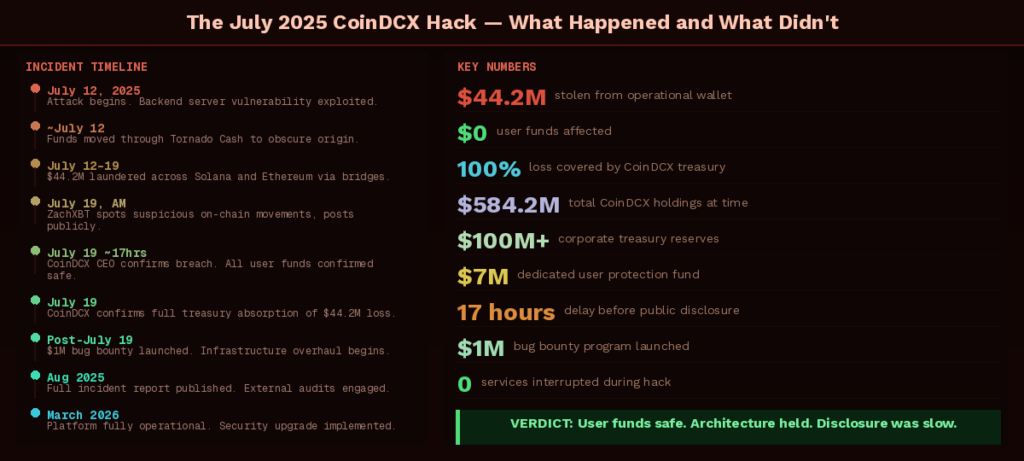
| July 12, 2025 | $44.2M stolen from internal operational hot wallet via backend server exploit | Zero — user funds in cold storage | Loss absorbed from treasury; $1M bug bounty launched; infrastructure hardened |
| July–Dec 2025 | Post-hack security overhaul, third-party audit of full stack, MPC migration completion | None | Operations continued normally |
| 2026 (current) | No new incidents · monthly proof-of-reserves continues · ISO 27001:2022 maintained | None | Active operation with $100M+ treasury |
The $44 Million Hack of July 2025 — What Actually Happened
Let’s deal with the elephant in the room first, because it’s the question on every cautious investor’s mind. On July 12, 2025, CoinDCX was hit by what it described as a ‘sophisticated server breach.’ Attackers penetrated its backend infrastructure, gained access to an internal operational hot wallet used exclusively for liquidity provisioning on a partner exchange, and drained approximately $44.2 million in USDC and USDT across the Solana blockchain.
⚠️ KEY FACT: No customer funds were affected. The compromised wallet was completely separate from user balances, which are held in offline cold wallets. CoinDCX absorbed the entire $44.2 million loss from its own treasury. Every customer could still trade, deposit, and withdraw throughout the incident.
On-chain sleuth ZachXBT spotted the suspicious transactions first. CoinDCX didn’t publicly confirm the breach until about 17 hours after the attack began — a disclosure delay that drew sharp criticism in the crypto community. When CEO Sumit Gupta did speak, he confirmed the loss, the containment, and the commitment to cover it entirely.
How the Attack Worked
- This wasn’t the kind of hack where someone steals a private key or brute-forces a password. The attackers exploited server-side vulnerabilities in CoinDCX’s backend infrastructure — the systems managing liquidity operations and partner exchange connectivity.
- By penetrating these systems, they got unauthorized access to the operational hot wallet. Once inside, the funds were moved through Tornado Cash to obscure origins, then laundered across multiple chains using cross-chain bridges.
- The laundering pattern resembled techniques previously associated with the Lazarus Group, though attribution was never officially confirmed.
Why User Funds Were Safe
- The reason customers weren’t affected comes down to architecture. CoinDCX stores 100% of customer assets in offline cold wallets — physically and technically isolated from any internet-connected system.
- The hacked wallet was an operational float used for liquidity: company money, not customer money. Cold wallets require multi-party, multi-location physical and digital approvals to access, making remote compromise essentially impossible.
- This segregation is the same reason major crypto exchanges that have been hacked — including Binance in 2019 — were still able to protect customer assets.
The Disclosure Delay — A Legitimate Criticism
- CoinDCX’s 17-hour delay before publicly confirming the hack is a fair criticism. On-chain analysts and blockchain reporters knew something had happened hours before the exchange said a word.
- While CoinDCX was likely conducting containment and internal verification during that window, the community expected faster communication. By comparison, when Coinbase had a data breach in 2024, they disclosed within hours.
- The delay doesn’t change the safety of user funds — but it raises a question about incident response transparency that prospective users should weigh.
The $7 Million User Protection Fund vs the $44 Million Loss
- Here’s a detail that rarely gets mentioned. At the time of the hack, CoinDCX’s proof-of-reserves disclosure showed a user protection fund of approximately $7 million — a reserve specifically designated to compensate users in the event of a breach. The hack cost $44 million.
- CoinDCX covered the full loss from its broader treasury ($100M+ reserves), but the dedicated user protection fund would not have been sufficient on its own. The company’s overall financial health meant this wasn’t a crisis — but traders relying on the user protection fund as their safety net should understand that $7 million provides limited coverage against a platform-level event.
- CoinDCX total holdings at time of hack: $584.2 million across 20 million registered users. Company treasury: $100M+. The $44M loss represented about 7.5% of total holdings — material, but absorbed without any service interruption or customer impact.
CoinDCX’s Security Infrastructure — What’s Actually in Place

Cold Wallet Storage — 100% of Customer Funds
CoinDCX stores all customer assets in cold wallets — offline storage with no direct internet connection. This is the single most important security measure any exchange can implement. Every major exchange that lost customer funds in a hack (Mt. Gox, Bitfinex 2016, WazirX 2024) did so because customer assets were in hot wallets or insufficiently segregated systems.
💡 The architectural reason it worked: CoinDCX’s cold wallet architecture is why the July 2025 hack, despite its scale, didn’t touch a single user’s balance. The wallets use multi-party computation (MPC) — a cryptographic technique where no single party holds a complete private key. The key is split across multiple parties, and any transaction requires a threshold of those parties to sign simultaneously. Even if one server or one employee is compromised, the cold wallet cannot be accessed.
ISO 27001:2022 Certification
CoinDCX holds ISO 27001:2022 certification — the internationally recognised standard for information security management systems. This is a formal third-party audit of an organisation’s entire approach to data security: access controls, risk management, incident response, employee training, and physical security.
Certification requires ongoing compliance and annual re-audits. It’s not a guarantee that nothing bad will happen, but it means the internal processes meet a verified international standard. Most crypto exchanges operating in India don’t hold this certification.
FIU-IN Registration
CoinDCX is registered with India’s Financial Intelligence Unit (FIU-IN) as a reporting entity under the Prevention of Money Laundering Act (PMLA). This registration requires CoinDCX to maintain AML/KYC processes, report suspicious transactions, and cooperate with financial intelligence requests.
CoinDCX was one of the first exchanges in India to receive this designation, and it contributed 66.7% of the total ₹105 crore in VDA TDS revenue collected by SEBI in one reporting period — indicating meaningful scale of compliance activity.
FIU-IN registration is not the same as SEBI regulation. SEBI governs securities brokers. CoinDCX operates as a virtual digital asset service provider, not a SEBI-registered broker. This distinction matters for the US Stock Futures product specifically — the regulatory framework governing those contracts is still being established.
CertiK Skynet Score: 82.48/100 (A Grade)
CertiK’s Skynet platform independently assesses crypto exchanges on security fundamentals, code quality, regulatory compliance, and operational practices. CoinDCX scored 82.48 out of 100, earning an A grade.
This is a useful data point, though CertiK scores are one input among many. Bybit also had strong security scores before the $1.4 billion Lazarus Group hack in February 2025 — exchange security is not a solved problem, and no score eliminates platform risk.
Proof of Reserves — Monthly, Publicly Verifiable
CoinDCX publishes monthly proof-of-reserves reports. Users can independently verify that the exchange holds at least 1:1 reserves against all user balances — meaning every rupee and every token you hold in your account is backed by real assets on-chain. The methodology is publicly documented and uses a Merkle tree structure that allows individual users to verify their own balance inclusion. This level of transparency is materially better than what most Indian crypto platforms publish.
Two-Factor Authentication and Account Controls
2FA is mandatory for all CoinDCX accounts. The platform supports authenticator app-based 2FA (Google Authenticator, Authy) — more secure than SMS-based 2FA, which is vulnerable to SIM swap attacks.
| Security Feature | Status | Industry Benchmark |
|---|---|---|
| Cold wallet storage (100%) | ✅ Confirmed | Standard for top-tier exchanges |
| MPC key management | ✅ Confirmed | Best practice — few exchanges implement this |
| ISO 27001:2022 certification | ✅ Certified | Above average — most Indian exchanges lack this |
| FIU-IN registration | ✅ Registered | Mandatory for Indian crypto exchanges |
| Proof of Reserves | ✅ Monthly, publicly verifiable | Above average — many exchanges don’t publish POR |
| 2FA (authenticator-based) | ✅ Mandatory | Standard |
| SIPC-equivalent protection | ❌ Not applicable | Only for FINRA-registered US brokers |
| SEBI regulation | ❌ Not a SEBI broker | N/A for crypto/futures platforms |
| User protection fund | ⚠️ $7M fund (small vs platform scale) | Below what some global platforms hold |
| Hack history | ⚠️ $44M July 2025 (user funds unaffected) | Relevant context — disclosed, absorbed |
| Crypto withdrawal availability | ⚠️ Restricted by default | CoinDCX-specific policy, not industry norm |
| Customer support response time | ⚠️ Documented complaints | Below average vs top-tier exchanges |
Is CoinDCX Regulated? The Regulatory Reality for Indian Traders
Regulation is where things get genuinely complex, and most articles either oversimplify (‘yes it’s regulated’) or overcomplicate (‘the entire legal status is unclear’). Here’s the precise picture.
What FIU-IN Registration Actually Means
- CoinDCX is registered with India’s Financial Intelligence Unit as a reporting entity under PMLA. This means it must conduct KYC on all users, report suspicious financial activity, and maintain records for regulatory review. It does not mean CoinDCX is supervised like a bank or a SEBI-registered broker.
- The FIU monitors financial intelligence — it is not a prudential regulator. So CoinDCX meets AML/CFT compliance standards, but there is no regulatory body continuously overseeing its financial health, capital adequacy, or product structure the way SEBI oversees stockbrokers.
The SEBI Gap — and Why It Matters for US Futures
- SEBI regulates securities brokers, futures exchanges, and market intermediaries in India. CoinDCX is not registered with SEBI and does not operate as a SEBI-regulated entity. This means the US Stock Futures product — where you’re trading derivative contracts linked to Apple, NVIDIA, and Tesla — exists outside the SEBI framework. There’s no investor grievance mechanism with SEBI, no access to SEBI’s investor protection fund, and no SEBI oversight of how the contracts are priced or margined.
- This is not a unique situation. Most crypto derivatives platforms globally operate outside traditional securities regulators. But for Indian investors who are accustomed to SEBI’s protections when trading F&O on NSE or BSE — protections like circuit breakers, settlement guarantees, and grievance redressal — the contrast is significant. (For an upcoming SEBI-regulated alternative, see our CoinDCX vs Zerodha GIFT City comparison.)
- On CoinDCX US Futures, if something goes wrong with the contract pricing, the settlement, or the platform itself, your recourse is to CoinDCX directly, not a regulator.
RBI and FEMA Compliance for US Futures
CoinDCX’s US Stock Futures are settled in INR. No money leaves India. No foreign currency is involved. This means the product does not fall under FEMA’s LRS provisions — there is no requirement to use the Liberalised Remittance Scheme, no TCS applicability, and no RBI reporting obligation for users.
Your money stays in India. From an RBI/FEMA perspective, this product is treated like any other INR-denominated derivative transaction.
ℹ️ Regulatory Summary for Indian Users
- FIU-IN registered (AML/KYC compliance)
- ISO 27001:2022 certified
- Not SEBI-registered (no investor protection fund)
- US Futures are INR-settled — no FEMA/LRS implication
- No RBI complaint escalation mechanism for futures losses
Risks Specific to CoinDCX US Stock Futures
Platform security and regulatory status are two parts of the picture. The third — and for most retail traders, the most immediately relevant — is the risk built into the product itself.
Leverage Risk and Liquidation
CoinDCX US Futures offer up to 20x leverage. This is the most direct way traders lose money on this platform. A 5% adverse price move on a 20x leveraged position wipes out your entire margin. On individual stocks during earnings season, 5% moves happen in minutes. Tesla has moved 15% in a single session multiple times in 2025. Palantir regularly gaps 8%–12% on earnings days.
Entering a leveraged position in these stocks without a stop-loss is not trading — it’s gambling. The platform will liquidate your position automatically when your margin falls to the maintenance threshold, and the loss is final. (For walkthroughs of specific event-driven strategies, see our guides on trading NVIDIA earnings, shorting Tesla, and shorting Meta.)
Overnight Funding Rate — The Slow Drain
Perpetual futures positions carry a funding rate — a periodic payment that keeps the contract price anchored to the underlying stock price. On CoinDCX US Futures, this runs at 4%–8% per annum. For a position held overnight, the cost is negligible. (Full mechanics in our funding rate explainer.)
For a swing trade held two to three weeks, the funding rate starts to noticeably erode returns. For a position held a month or longer at high leverage, the funding cost becomes a meaningful drag. Many traders enter a position, watch it move sideways, and lose money not because the stock fell but because the funding ate into their margin.
Platform Risk — What Happens If CoinDCX Has Problems
The July 2025 hack proved CoinDCX can absorb a $44 million shock without impacting customer balances. But platform risk has other dimensions. The most operationally relevant one: app performance during high-volatility sessions.
CoinDCX’s updated futures interface has received consistent criticism for being slow and difficult to navigate when you need to close positions quickly. Multiple users reported difficulty exiting trades during fast-moving sessions in late 2025. If you hold an open leveraged position and cannot close it during a gap move, the consequences are real.
At a more extreme level: what happens if CoinDCX faces insolvency? Unlike Vested Finance or INDmoney — where your shares sit at a US FINRA member custodian under SIPC protection — CoinDCX futures positions are exchange-held derivatives. In an insolvency scenario, your position’s value is a claim against CoinDCX’s assets. The company has $100M+ in reserves as of mid-2025, so this risk is not imminent — but it exists structurally in a way that doesn’t exist with direct stock ownership.
Counterparty Risk in Futures Contracts
When you go long on NVIDIA futures on CoinDCX, you’re not buying NVIDIA shares. You’re entering a contract with CoinDCX as the counterparty (or with other traders, with CoinDCX as intermediary). CoinDCX’s funding mechanism, liquidation engine, and P&L settlement are all internal platform processes.
If there’s a pricing discrepancy between CoinDCX’s NVIDIA futures price and the actual NASDAQ price — due to low liquidity, a technical glitch, or manipulation — that’s a platform issue with no external arbiter. On regulated exchanges like NSE, there are circuit breakers, price bands, and settlement guarantees. Here, the guardrails are CoinDCX’s own systems.
Crypto Withdrawal Restrictions
Unrelated to US Futures directly, but relevant to your overall assessment of CoinDCX: crypto withdrawals are restricted by default. Users must apply to have crypto withdrawal capability enabled, and CoinDCX’s internal review process can reject or delay this.
For traders using the platform purely for US Stock Futures in INR, this is irrelevant — you’re depositing and withdrawing INR. But for anyone using CoinDCX as a combined crypto and US Futures platform, the withdrawal restriction is a known friction point with significant user complaints documented across Reddit, Trustpilot, and app store reviews.
CoinDCX vs WazirX — Why the Comparison Matters
Anyone researching CoinDCX safety in 2026 will inevitably land on WazirX. The comparison is fair and instructive.
| Factor | CoinDCX (July 2025) | WazirX (July 2024) |
|---|---|---|
| Amount stolen | $44.2M from operational hot wallet | $230M from user multi-sig wallets |
| Were user funds affected? | No — completely segregated cold wallets | Yes — direct user wallet compromise |
| Company response | Covered entirely from treasury ($100M+) | Could not cover — exchange collapsed |
| Disclosure timeline | ~17 hours after breach began | Within hours, but with disputed details |
| Current operational status | Fully operational, March 2026 | Non-operational; Singapore restructuring rejected |
| User assets recovery | N/A — users were not affected | Still unresolved as of March 2026 |
| Post-incident action | $1M bug bounty, infrastructure overhaul | Legal disputes, founder accusations |
The fundamental difference: CoinDCX’s hack hit company money. WazirX’s hack hit user money. That distinction exists because of CoinDCX’s cold wallet segregation architecture.
The outcome was dramatically different. WazirX’s collapse is the cautionary tale that illustrates exactly what can go wrong when user funds and operational funds are not properly separated. CoinDCX passed that test in July 2025.
How to Protect Yourself as a CoinDCX US Futures Trader
Platform security is the exchange’s responsibility. Account security and trade risk management are yours. Here’s what every CoinDCX US Futures trader should do before and during trading.
Account Security Setup
- Enable 2FA with an authenticator app, not SMS. Google Authenticator or Authy. SMS-based 2FA is vulnerable to SIM swap attacks — authorising it takes a fraudulent call to your telecom provider, and India’s SIM swap fraud rate is documented and growing.
- Set a withdrawal address whitelist. Lock withdrawals to specific bank accounts and pre-approved wallet addresses. Any change to the whitelist should require email + 2FA confirmation.
- Use a strong, unique password. A password manager generates and stores this. Never reuse passwords across any financial platform.
- Enable login alerts via email and SMS for every new device. If you get a notification you didn’t initiate, act immediately.
- Regularly review your active sessions in account settings. Revoke any unrecognised devices.
Trade Risk Management for Futures
- Every open position must have a stop-loss set at entry. No exceptions. The stop-loss is your maximum acceptable loss on that trade. Set it before you open the position, not after.
- Never use maximum leverage on single-stock positions. Individual stocks can gap 10%–20% on earnings or macro events. At 20x leverage, a 5% move liquidates you. Most experienced futures traders cap at 2x–5x on single stocks. (See our leverage trading comparison for sane defaults.)
- Size your positions to risk 1%–2% of your total futures wallet per trade. If you have ₹30,000, your maximum loss per trade should be ₹300–₹600.
- Avoid holding leveraged positions over earnings releases if you don’t have a clear earnings-based thesis. Earnings gaps are the most common cause of sudden liquidations.
- Check the funding rate before entering any swing trade. At 8% annualised on a ₹50,000 position held for 30 days, you’re paying ₹329 in funding before the stock moves at all.
How Much to Keep on the Platform
Keep only what you’re actively trading on the platform. There’s no reason to leave idle capital sitting in your CoinDCX futures wallet. If you’re trading ₹10,000 worth of positions, keep ₹12,000–₹15,000 on the platform as margin buffer. The rest sits in your bank account or a more regulated investment vehicle. This isn’t specific to CoinDCX — it applies to any exchange-held derivative product.
⚠️ Critical: Never treat your CoinDCX futures wallet as a savings or investment account. It is a trading margin account. The risks are leverage, liquidation, funding costs, and platform dependencies. If you want long-term US stock exposure, use an LRS-route platform like Vested Finance or INDmoney where actual shares are held in your name at a regulated US custodian.
The Honest Safety Verdict
| Question | Answer |
|---|---|
| Has CoinDCX been hacked? | Yes — July 2025, $44M from operational wallet. Zero user funds affected. |
| Are user funds safe from hacks? | Yes — cold wallet segregation worked in a real test. The architecture is sound. |
| Is CoinDCX regulated? | Partially. FIU-IN registered (AML/KYC) but not SEBI-registered. No investor protection fund. |
| Is there SIPC-equivalent protection? | No. Not applicable to exchange-held futures. |
| Can CoinDCX go bankrupt? | Possible but not imminent. $100M+ treasury, profitable India business, VC-backed. |
| Is the US Futures product legally compliant? | INR-settled — no FEMA/LRS issue. Regulatory framework for the product is still evolving. |
| Is customer support reliable? | No — documented delays, unresolved tickets, and restricted crypto withdrawals are recurring complaints. |
| Is it safe for active US stock futures trading? | Yes, with proper risk management. The product risk (leverage) is greater than the platform risk. |
| Is it safe for long-term US stock investing? | No — wrong product. Use Vested Finance, INDmoney, or Winvesta for long-term ownership. |
Frequently Asked Questions
Is CoinDCX safe in 2026?
Technically, yes. CoinDCX is ISO 27001:2022 certified, FIU-IN registered, uses 100% cold storage for user funds, publishes monthly proof-of-reserves, and demonstrated in July 2025 that its architecture protects customer assets even when the company itself is breached. The caveats: no SEBI regulation, no SIPC protection, customer support is consistently below expectations, and the US Futures product operates in an evolving regulatory framework. Safe to trade with proper risk management — not the right platform for passive, long-term investment.
Has CoinDCX ever been hacked?
Yes. On July 12, 2025, attackers exploited backend server vulnerabilities and drained approximately $44.2 million from an internal operational hot wallet used for liquidity provisioning. No user funds were affected — customer balances are held in cold wallets completely segregated from operational systems. CoinDCX absorbed the full loss from its treasury. The breach was disclosed about 17 hours after it occurred, which drew criticism. A $1 million bug bounty program was launched in response, and infrastructure security was overhauled.
What happens to my money if CoinDCX shuts down?
For US Stock Futures positions, your balance is an exchange-held derivative — a claim against CoinDCX. In an insolvency scenario, this would be treated as an unsecured creditor claim, not protected assets. This is meaningfully different from LRS-route platforms like Vested Finance, where your actual shares are held at a FINRA-regulated US custodian under SIPC protection (up to $500,000). CoinDCX’s current financial position is strong — $100M+ reserves, profitable India business, institutional investors — so this isn’t a near-term concern, but it’s a structural reality.
Is CoinDCX regulated by SEBI?
No. CoinDCX is registered with the Financial Intelligence Unit (FIU-IN) for AML/KYC compliance but is not registered with SEBI as a stockbroker, derivatives exchange, or investment advisor. This means the investor protections that apply to NSE/BSE F&O trading — SEBI oversight, investor protection fund, grievance mechanisms — do not apply to CoinDCX. For US Stock Futures trading on CoinDCX, your recourse in case of disputes is the company’s internal support process, not a regulatory body.
Is my money safe from a CoinDCX hack?
Based on the July 2025 incident, the answer is yes — as long as the cold wallet segregation holds. CoinDCX’s architecture keeps customer funds in offline cold wallets that were not touched despite the exchange suffering a $44 million server breach. The cold wallet system uses multi-party computation, meaning no single server, employee, or system can access it unilaterally. This is the strongest protection any exchange can offer for held assets.
Why can’t I withdraw crypto from CoinDCX?
Crypto withdrawals on CoinDCX are restricted by default as an AML risk management measure. Users must apply to have the feature enabled and pass an internal review. This is a CoinDCX-specific policy, not an industry standard. For US Stock Futures traders, this is irrelevant — you’re depositing and withdrawing INR, not crypto. For anyone using CoinDCX as a combined crypto trading and futures platform, this restriction is a known friction point.
How does CoinDCX compare to Zerodha or NSE for futures safety?
NSE and BSE futures (traded via Zerodha, Angel One, etc.) operate under SEBI’s full regulatory framework: exchange-guaranteed settlement, circuit breakers, position limits, investor protection fund access, and SEBI grievance redressal. CoinDCX US Futures operate without any of these. The platform is technically secure, but the regulatory safety net is significantly thinner. For traders accustomed to NSE F&O protections, this is the most important gap to understand. Zerodha’s GIFT City product, when it launches, will offer SEBI/IFSCA-regulated US stock access via the UDR route.
Is CoinDCX safe for a beginner investor?
CoinDCX as a spot crypto platform — buying Bitcoin or Ethereum — is accessible to beginners, and the cold wallet security architecture protects those holdings well. CoinDCX US Stock Futures is not beginner-appropriate unless you understand how leverage, liquidation, and funding rates work. Beginners who open leveraged positions without stop-losses on stocks like Tesla or NVIDIA are effectively betting on short-term price direction with money they can lose completely in a single session. If you’re new to investing and want US stock exposure, start with Vested Finance or INDmoney for actual stock ownership without leverage.
💡 Bottom Line
CoinDCX is safe enough to use — provided you use it for what it’s designed for. The platform’s security architecture passed the toughest test it’s ever faced (a $44M server breach) without touching a single user’s balance. Cold wallet segregation, MPC key management, ISO 27001:2022 certification, and monthly proof-of-reserves are all best-in-class for an Indian crypto platform.
The risks that should actually concern you are not the platform — they’re the product. 20x leverage on single US stocks during earnings season is a different beast from holding spot crypto. Set stops on every position, never use max leverage on single names, size at 1%–2% of your wallet per trade, and keep only your active trading capital on the platform.
If you want passive, long-term US stock exposure with FINRA-regulated custody and SIPC protection, CoinDCX is the wrong tool — switch to Vested Finance or INDmoney. If you want active leveraged trading, shorting, or 24/7 access to US stock prices in INR, CoinDCX is currently the only retail option in India that does it well. Read the trading pillar, the user-perspective review, and the funding rate explainer before you deploy meaningful capital.
Continue Reading
- Foundation: How to Trade US Stock Futures from India · CoinDCX US Futures Review · Funding Rate Explained
- Comparisons: vs Vested Finance · vs INDmoney · vs Zerodha GIFT City · vs Pi42 & Delta
- How-to buy: AI Stocks (NVDA, PLTR, AMD) · NASDAQ 100 · S&P 500
- Strategies: NVIDIA Earnings · Short Tesla · Short Meta · Short NASDAQ 100
For on-demand analysis of any cryptocurrency, join our Telegram channel.