Editorial · Q2 2026 Derivatives Rankings
Where pros actually trade perps, futures and options.
We ranked the 8 best crypto derivatives exchanges on the things that decide whether a leveraged trade survives. We looked at order-book depth and open interest, perp taker fees and funding, max leverage and product range, insurance-fund and solvency history, and which regions can actually sign up.
By Gaurav Agarwal · · ● Perps are now ~78% of all crypto derivatives volume
How we ranked them.
We use five criteria built for leveraged trading rather than spot. Each venue scored on the things that protect a position when the market moves against you.
Liquidity & open interest
Order-book depth, 24h derivatives volume, and open interest. Deep books mean tighter spreads and less slippage when you size up or get liquidated.

Fees & funding
Perp maker/taker fees, funding-rate behaviour, and how aggressively a venue discounts. We weight taker fees, since most leveraged entries cross the spread.
Leverage & products
Max leverage caps, plus whether the venue offers perps, dated futures, and options. More product range lets you hedge and run multi-leg books in one place.
Security & solvency
Insurance-fund design, liquidation model, ADL behaviour, and the venue record of covering losses without socializing them onto traders.
Regulation & access
Enforcement history, licensing posture, and which regions can actually open an account. A great venue you cannot legally use scores low for you.
The podium — our top 3 picks

Bybit
Deepest non-Binance liquidity · strong USDC-margined perp suite

Binance
Deepest liquidity and the widest altcoin perp catalog anywhere. The default for serious derivatives traders outside blocked regions.

MEXC
Highest leverage + 0% maker pairs · broadest fast-listing altcoin perp roster
8 Best Derivatives Exchanges Compared
| Venue | Score | Perp Taker | Max Leverage | Products | Best For | |
|---|---|---|---|---|---|---|
01 |
4.7 |
0.05% | 125x | Perps · Futures · Options | Deepest liquidity, widest alt perps | Trade → |
02 |
4.6 |
0.055% | 125x | Perps · Futures · Options | USDC-margined perp suite | Trade → |
03 |
4.5 |
0.02% / 0% pairs | 500x | Perps | Long-tail alts & max leverage | Trade → |
04  |
4.5 |
0.05% | 100x+ | Perps · Futures · Options | US-accessible post-settlement | Trade → |
05  |
4.5 |
Tiered | ~5.7x | Perps · Event contracts | US traders who need CFTC regulation | Trade → |
06  |
4.5 |
0.075% | ~50x | Options · Perps · Futures | Crypto options & portfolio margin | Trade → |
07  |
4.4 |
~0.045% | ~40x | Perps (on-chain) | Self-custody & transparent funding | Trade → |
08  |
3.9 |
0.055% | 200x | Perps | High leverage + on-chain bridge | Trade → |
Mechanics
Leverage & liquidation, in plain English.
Before you size a leveraged trade, six moving parts decide whether it survives, and they apply on every venue below.
Perpetual swaps
A perpetual swap, or perp, is a futures contract with no expiry. You can hold it as long as your margin survives. It tracks spot through a funding mechanism BitMEX invented in 2016, and it is now the dominant crypto derivative.
Funding rate
Funding is a small payment swapped between longs and shorts, usually every 8 hours. If the perp trades above spot, longs pay shorts to push the price back down; below spot, shorts pay longs. It is the glue that keeps a perp pinned to the underlying.
Liquidation
Leverage means you post only a fraction of the position as margin. When losses eat through that margin buffer, the engine force-closes your position to stop you going negative. Higher leverage shrinks the buffer, so a small move can trigger it.
Insurance fund
When a liquidation cannot be filled at a good price, the insurance fund absorbs the shortfall so winning traders still get paid in full. A well-funded insurance fund is what keeps a venue from socializing losses onto profitable accounts.
ADL (auto-deleveraging)
If the insurance fund cannot cover a cascade, auto-deleveraging kicks in. The engine closes some profitable opposing positions to balance the book. It is a last resort, and getting ADL’d out of a winning trade is a real risk in violent moves.
On-chain vs CEX settlement
On a CEX the engine runs on private servers. On a perp DEX like Hyperliquid, the order book, funding, and liquidations settle on-chain, so anyone can verify them. The trade-off is governance: a decentralized venue can still intervene in a crisis.
In-depth reviews
All 8 venues, in detail.
Each card lists perp fees, max leverage, the product mix, what works well, the catches, and a link to the full review. They run in order of overall score.
Binance
Binance is the largest derivatives venue. USDⓈ-M and COIN-M perps, dated futures, and options span BTC, ETH, and 300+ alts, with roughly $59B in 24h futures volume and ~$25.5B open interest on a typical day. Depth is what you’re paying for, because you can move size on majors without much slippage. It even runs TradFi Perps on tokenized equities and indices now.
+ What works
- Deepest order book and OI in crypto
- 0.02% / 0.05% perp fees, near-0% at VIP 9
- Perps, futures, options + TradFi Perps
- Large insurance fund, no socialized-loss event on the book
− What to watch
- Futures blocked across the EU, UK, US and ~44 regions
- KYC required; Binance.US has no futures
- 2023 US settlement left a compliance monitor in place
Bybit
Bybit is the deepest book that isn’t Binance. It runs 800+ perpetual contracts across USDT, USDC, and inverse margin, plus dated futures and options, and it usually holds 18-20% of global BTC/ETH futures open interest. Active retail and pro traders like its USDC-collateralized suite and fast matching. Its February 2025 hack was a custody breach, not a trading-engine failure, and Bybit covered every withdrawal.
+ What works
- Deepest non-Binance liquidity
- Strong USDC-margined perp suite
- Perps, futures and options in one account
- Stayed solvent and covered the Feb 2025 shortfall
− What to watch
- Restricted in the US, UK and several regions
- Feb 2025 $1.4B custody hack is a counterparty data point
- Options book is small next to Deribit
MEXC
MEXC chases volume with the most aggressive fees and leverage on this list. Perps run 0% maker / 0.02% taker, with 140+ pairs at 0% on both sides, and the headline cap reaches 500x. It also carries the broadest fast-listing altcoin roster (900+ pairs), which makes it the place people go for long-tail and new-listing trades. It runs 24h futures volume in the ~$16-25B range depending on the source.
+ What works
- Highest headline leverage (500x)
- 0% maker and many 0%/0% perp pairs
- Broadest fast-listing altcoin perp roster
- Optional/low-KYC reputation
− What to watch
- 500x leverage is a fast way to get liquidated
- Not a meaningful options venue
- Restricted in some jurisdictions; verify access
OKX
OKX pairs a top-tier perp and futures book (~$25.9B 24h futures volume, ~$8.3B OI) with one of the cleanest unified trading accounts in the business and a large self-custody Web3 wallet. It offers BTC/ETH options through an RFQ block-trade marketplace too. After a ~$505M US settlement in February 2025, OKX re-entered the US, opened a California HQ, and floated a US IPO.
+ What works
- Best-in-class unified trading account
- Perps, futures and options plus block trades
- Re-entered the US with a compliance push
- Web3 wallet bridges to on-chain liquidity
− What to watch
- Feb 2025 ~$505M US settlement is recent history
- Options are second-tier behind Deribit
- Global services run via an offshore entity
Kalshi
Every other venue on this list asks a US trader to accept offshore exposure. Kalshi is the exception: on 3 June 2026 its BTCPERP contract went live as the first CFTC-regulated perpetual future in American history, after the commission cleared the product on 29 May. It did $100M in the first 24 hours and passed $1B inside a week. The lineup is now 13 crypto perps priced off CF Benchmarks indices, with margin held in protected futures accounts at Kinetic Markets, Kalshi’s affiliated FCM, and at the clearinghouse. The catch is that leverage is deliberately modest and the product is closed to everyone outside the United States.
+ What works
- Only CFTC-regulated perpetual futures in the US
- Margin sits in protected futures accounts, not on the exchange balance sheet
- CF Benchmarks index pricing, not a single-venue feed
- Funding capped at 2% per 8h period
− What to watch
- US residents only; no international access at all
- Leverage tops out near 5.7x BTC, ~4.3x ETH, 2-3x mid-caps
- 13 markets, so no long-tail altcoin coverage
- Separate margin account required; state-level legal challenges ongoing
Deribit
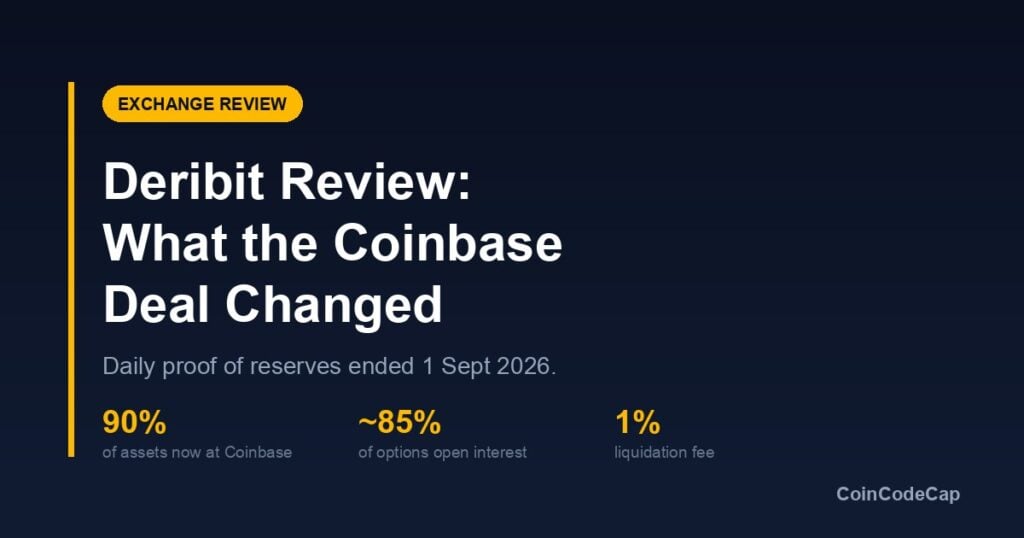
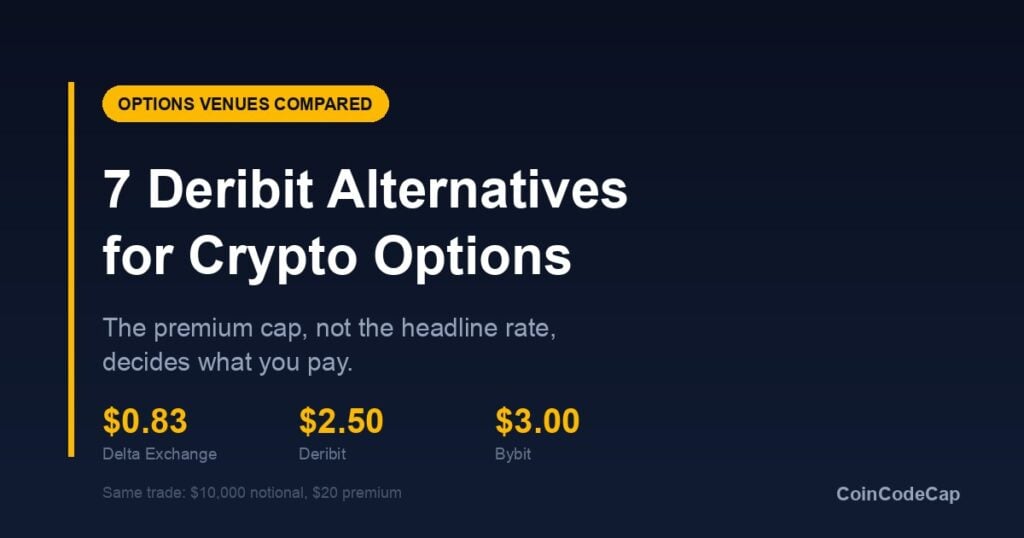
If you trade options, Deribit is the venue. European-style BTC, ETH and SOL options plus perps and futures, with portfolio margin that prices risk across your whole book, a big edge for hedged or multi-leg positions. It traded ~$1.875T in 2025 and has never had a socialized-loss event. Coinbase closed its $2.9B acquisition of Deribit on August 14, 2025, making Coinbase the global derivatives leader by options OI.
+ What works
- Deepest options book in crypto
- Portfolio margin across options + futures
- Stepwise 12.5% partial liquidations soften wicks
- No socialized-loss event in its history
− What to watch
- Lower leverage than retail CEXs (~50x)
- IBIT options overtook it on BTC OI in Apr 2026
- Institution-oriented; less retail-friendly UX
Hyperliquid
Hyperliquid proved a perp DEX can rival a CEX. It runs a full on-chain central-limit order book on its own Layer-1, with sub-second finality and no gas on trades. Volume runs north of $170B/month with $9B+ open interest, the largest of any perp DEX. You keep self-custody and every fill, funding payment, and liquidation settles on-chain where you can verify it.
+ What works
- CEX-grade speed with on-chain settlement
- Self-custody; no KYC, wallet login only
- Largest open interest of any perp DEX
- Transparent on-chain funding and liquidations
− What to watch
- Mar 2025 JELLY episode exposed governance risk
- Validators can force-settle a market in a crisis
- Perps only; no options, lower leverage caps
BYDFi
BYDFi bundles 200x perps, optional KYC, and a built-in on-chain bridge into one app. Its MoonX engine (launched April 2025) routes to DEX liquidity on Solana, BNB Chain, and Base, so you can trade memecoins on-chain without leaving the CEX interface. It’s a smaller venue than the majors, and it’s perps-focused rather than an options house, but the combination appeals to on-chain traders who want a familiar UX.
+ What works
- 200x leverage, above Binance and Bybit
- MoonX bridges CEX to on-chain DEX liquidity
- Optional/low-KYC onboarding
- One app for perps and memecoin trades
− What to watch
- Smaller liquidity than the top venues
- 200x leverage is high-risk by design
- Not an options venue; verify regional access
Full disclosure
Incidents & enforcement, on the record.
We list the rap sheets in full. Red = hack. Amber = enforcement or governance event. Green = ownership change worth knowing. Below is what happened at venues on this list, with our reason each one still made the cut.
An ETH cold wallet was drained via a manipulated Safe multisig signing screen; the FBI tied it to North Korea’s Lazarus Group. It was a custody breach, not a trading-engine failure. Bybit covered the shortfall and kept withdrawals running, so it stays as a counterparty-risk data point, not a solvency failure.
The biggest derivatives enforcement case to date. The entity settled with the CFTC and FinCEN for $100M in 2021; the three co-founders pleaded guilty to Bank Secrecy Act violations and settled for $30M total in 2022. In March 2025 President Trump pardoned the founders and the company. It stays on the list on historic pedigree, with the record stated plainly.
OKX paid roughly $505M (~$84M penalty + ~$421M forfeiture) to settle charges of running an unlicensed money-transmitting business for US customers. It then re-entered the US, opened a San Jose HQ, and floated a US IPO. The settle-then-onshore path is why it still ranks top-three.
A trader squeezed the thin JELLY token onto the HLP vault, pushing unrealized loss to ~$13.5M. Validators voted to delist JELLY perps and force-settle at $0.0095 versus a ~$0.50 oracle, and the foundation made non-flagged users whole. It exposed the governance tension of a “decentralized” venue intervening, and Hyperliquid has since tightened vault limits and ADL triggers.
Coinbase closed its acquisition of Deribit on August 14, 2025 for $2.9B (~$700M cash + ~11M COIN shares), making Coinbase the global leader in crypto derivatives by options OI. Not an incident, but a structural change worth knowing before you route options flow there.
None of these is a trading-engine solvency failure.
The Bybit hack was custody, not the matching engine. The BitMEX and OKX cases were licensing settlements that both venues paid and moved past. Hyperliquid’s JELLY event was contained and reimbursed. Deribit’s clean solvency record is intact under Coinbase. For context on the broader history of exchange failures, see our best crypto exchanges guide.
The big picture
7 trends reshaping crypto derivatives right now.
The market that produced these eight venues is shifting fast. These are the shifts moving through 2026, and what they mean for where you trade.
Perp DEXs are eating CEX share
DEX share of perp open interest climbed from ~2% in early 2024 to ~10-13% by early 2026, and CEX share of OI fell from 96.4% to ~86.5%. Hyperliquid leads, but newcomers like Aster, Pacifica, and Extended are each grabbing a few points. It’s fragmentation, not one winner.
Perps dominate the whole stack
Perpetuals are now roughly 78% of all crypto derivatives volume. Combined perp volume rose about 75% in two years, from $4.14T to $7.24T monthly. Dated futures keep shrinking in relative terms as traders default to perps.
Options are going institutional
Options OI keeps climbing. Deribit still owns 90%+ of ETH options, but in April 2026 BlackRock’s IBIT options OI ($27.61B) passed Deribit’s BTC options OI ($26.9B), the first time a regulated US venue led offshore on BTC. The offshore monopoly is cracking.
TradFi and xStocks perps
Tokenized-equity and index perpetuals jumped from ~0.03% to ~1.72% of derivatives volume in a single quarter, led by Binance TradFi Perps and Kraken’s xStocks Perp. It’s a new product line and a fresh regulatory question, not a passing fad.
Funding-rate arbitrage goes mainstream
Persistent funding spreads, between CEXs and perp DEXs and between perps and spot, now anchor large delta-neutral carry books. Transparent on-chain funding makes cross-venue arb easier to run at scale, so more capital sits in these strategies.
Settle, comply, then onshore
MiCA locks derivatives out of the EU without a license, and the US extracted big settlements from OKX and earlier BitMEX. But post-settlement, OKX re-entered the US and Coinbase and Kraken are building compliant derivatives. Hong Kong licensed a batch of platforms. The pattern is clear.
Fees are compressing toward zero
MEXC’s 0% pairs, Binance promos, and perp-DEX pressure are pushing taker fees down across the board. At the top end, fees no longer separate venues. Liquidity and product range do, which is why depth and options access carry more weight in our scoring.
Use-case picker
Pick the venue for your situation.
Find the scenario that fits how you trade. Each card shows the venue we’d reach for and why.
Deepest liquidity for size
You move seven figures on majors and care most about spread and slippage on entry and exit.
Trading options seriously
You run BTC/ETH options, multi-leg spreads, or hedged books and need portfolio margin.
On-chain & self-custody
You want CEX-grade speed without giving up custody, and verifiable on-chain funding.
Maximum leverage & new listings
You chase long-tail alts and want the highest leverage and 0% maker pairs.
US-accessible after re-entry
You’re in the US and want a major venue that settled and came back onshore.
High leverage + on-chain bridge
You trade memecoins on-chain but want a familiar CEX UX and 200x perps in one app.
USDC-margined perp suite
You want the deepest non-Binance book and a strong USDC-collateralized derivatives stack.
US traders who need regulation
You are in the US and want a perp without a VPN, an offshore account or a grey-zone workaround.
FAQ
7 questions traders ask us most.
What is a crypto derivatives exchange?
A crypto derivatives exchange lets you trade contracts whose value tracks an asset like Bitcoin without owning it. The main products are perpetual swaps and futures plus options. Leverage lets you size positions larger than your deposit, which raises both potential profit and liquidation risk.
Which exchange has the deepest derivatives liquidity?
What is the highest leverage I can use?
Where do I trade crypto options?
Deribit is the options venue. It has historically held the deepest BTC and ETH options books and still holds over 90% of ETH options. As of April 2026, regulated US venues led Deribit on BTC options open interest, so the BTC side is now contested while ETH stays locked up.
What is a funding rate?
A funding rate is a small periodic payment between long and short traders that keeps a perpetual swap pinned to spot. When the perp trades above spot, longs pay shorts; when it trades below, shorts pay longs. Most venues settle funding every 8 hours, a model BitMEX introduced in 2016.
Is an on-chain perp DEX like Hyperliquid safe?
Hyperliquid gives you self-custody and transparent funding, settlement, and liquidations. The trade-off is governance risk: its March 2025 JELLY episode showed validators can force-settle a market, which is fast in a crisis but raises centralization questions. There has been no protocol hack to date.
Which derivatives exchanges accept US traders?
Access shifts fast. OKX re-entered the US after its February 2025 settlement and opened a California office. Binance Futures is blocked across the EU and many regions, and US users can’t access it. Check the venue’s own legal page for your country before depositing, not their marketing.
The bottom line
For most traders, Binance is the default: the deepest book, the widest perp catalog, and tight funding, as long as you can legally access it. Bybit is the strongest backup and the better home for a USDC-margined book, and OKX is the pick if you need a major venue that’s back onshore in the US.
From there it gets specific. Trade options on Deribit. Want self-custody and on-chain transparency? Hyperliquid. Chasing maximum leverage or long-tail listings? MEXC or BYDFi, with eyes open about the risk. And if you are a US trader who wants a perp without going offshore, Kalshi is the only CFTC-regulated venue that lists them.
One rule cuts across all eight. Leverage magnifies mistakes, so size small, keep a margin buffer, and never risk money you can’t lose. Discipline matters more than the venue you pick.
Editorial note: volume, open-interest, and fee figures are 2025-2026 snapshots that move daily; treat them as order-of-magnitude and verify on the venue before you trade. Leverage caps, regional availability, and product menus change often. We earn affiliate commissions on some links, which never affects rankings or the incidents we disclose.
Related reading
Pillar guides
- Best crypto exchanges (spot-first ranking and security history)
- Best crypto futures exchanges (perps and dated futures deep-dive)
- Best decentralized exchanges (on-chain trading, including perp DEXs)
- Best crypto trading bots (automate perp and futures strategies)
Venue reviews
- Binance review (deepest derivatives book)
- Bybit review (USDC-margined perps)
- OKX review (unified account, US re-entry)
- Deribit review (crypto options leader)
On-chain & high-leverage
- Hyperliquid review (benchmark perp DEX)
- MEXC review (500x and 0% maker pairs)
- BitMEX review (the original perp venue)
- BYDFi review (200x + MoonX bridge)
Risk & security
- Best hardware wallets (self-custody for funds off the venue)
- Best crypto tax software (track perp PnL and funding)