Chainalysis Reactor is the tool most investigators picture when they think about following money on-chain. It’s the incumbent, but it’s stopped being the obvious choice. Talk to people who use it and the same complaints come up: the price is steep, access is gated behind a sales call, the interface is heavy, and the entity labels aren’t always as current or as accurate as the marketing suggests. For a lot of teams, what they’re paying for and what they actually get out of it no longer line up.
That gap is why tools like MoneyFlow Lite keep coming up in the “we switched and prefer it” conversations. This isn’t only about spending less. It’s about getting a cleaner trace, faster, with fewer clicks and less onboarding, from a tool you can open and use in the next five minutes. The value isn’t the discount. It’s that a free tool now does the core job, tracing where funds went, as well or better than the license you were about to sign for.
You don’t need a Reactor contract to trace a wallet. A handful of free tools cover multi-hop tracing, entity labels, and visual money-flow graphs without the enterprise overhead. Below are five worth knowing, starting with the one built specifically for no-code fund tracing.
1. MoneyFlow Lite by Bitquery
MoneyFlow Lite is the closest free stand-in for Reactor’s core job. You give it an address, and it shows where the money came from and where it went, hop by hop, as a visual graph. It’s a no-code front end for Bitquery’s Coinpath® money-flow engine, so you get the same tracing logic that sits behind audits and exchange compliance checks, without writing a single query.
Getting started is about as simple as it gets. You paste in an address, pick a blockchain, optionally set a date range, and hit Create MoneyFlow. That’s the whole setup. No query language, no onboarding call.

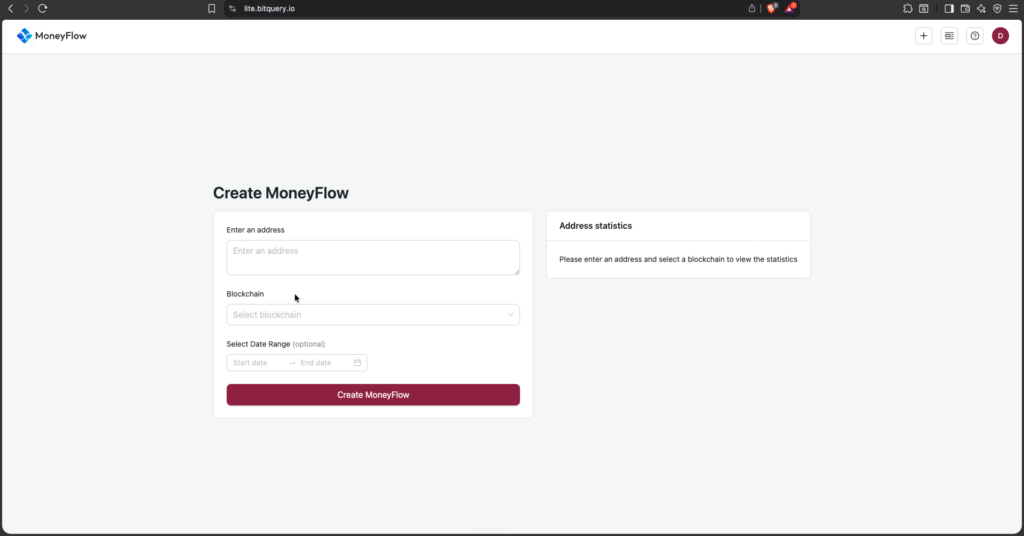
Starting a trace in MoneyFlow Lite: enter an address, choose the chain, set an optional date range, and go.
What you get back is a Sankey diagram of the money flow. Every trace is saved to the tasks view so you can re-open and tag old investigations. In this example trace, an origin address pushes USDT out across several hops, and MoneyFlow Lite resolves the endpoints to named entities like an OKX hot wallet, Binance, and ChangeNOW, instead of leaving you staring at raw hex addresses. The right-hand panel keeps a running inflow, outflow, and tracing balance for the address group.

A trace from a single origin address: $58K USDT moving toward an OKX hot wallet, plus $37K splitting into smaller downstream transfers. Inflow, outflow, and tracing balance are shown per address.
Click any flow between two nodes and the panel switches to edge details: the sender, the exact amount, the receiver, and a currency-by-currency breakdown. The transactions table underneath lists every underlying transfer with its hash, depth, and tracing amount, so you can go from the big-picture graph down to a single on-chain transaction without leaving the page.
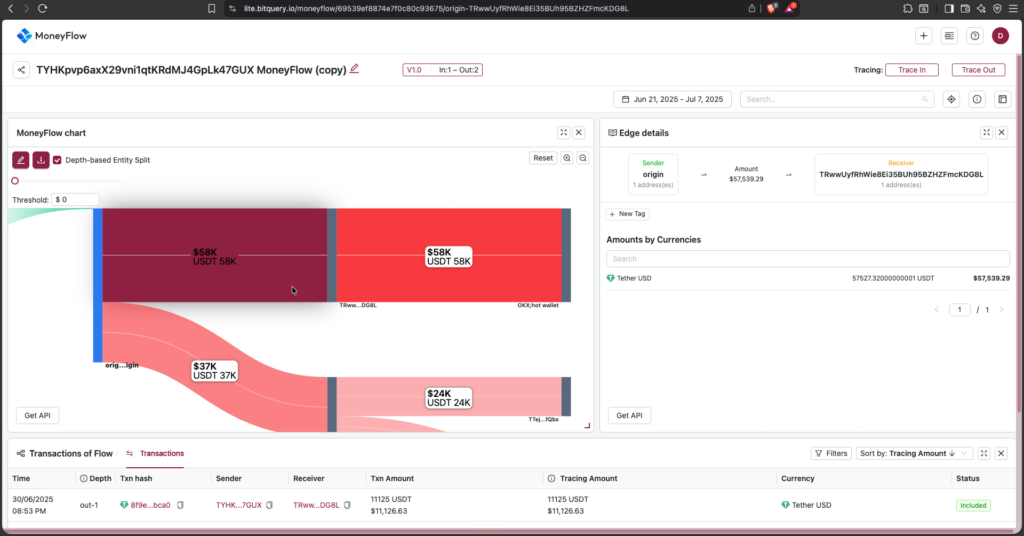
Clicking a flow reveals the exact transfer: $57,539.29 in USDT from the origin to an intermediary wallet, with the full transaction list below.
What makes it a real Reactor alternative:
- Multi-hop tracing in and out. Use “Trace In” and “Trace Out” to walk backwards to the source of funds or forward to the cash-out point.
- Entity labels. Exchange, mixer, and service addresses come named, so you can spot funds hitting Binance or ChangeNOW without cross-referencing a spreadsheet.
- Depth and date controls. Scope an investigation to a specific window and number of hops so the graph stays readable.
- Threshold filtering. Hide dust and small transfers to focus on the flows that matter.
- Drill-down to the transaction. Click any edge to see the exact sender, receiver, amount, currency, and underlying transactions.
- Report generation. Turn a trace into a shareable report straight from the interface.
- Multi-chain. Bitcoin, Ethereum, Tron, BSC, and more. The same tool across chains, which matters when funds bridge or move to Tron for USDT.
- Chain-aware tracing. Coinpath uses a different algorithm per chain model (LRFS for EVM, proportional input-output attribution for UTXO, multi-currency path extraction for ledger chains), so the amounts on the graph reflect how each chain actually moves value.
One detail that separates it from generic explorers: Coinpath doesn’t apply one blanket tracing method to every chain. It runs a different algorithm depending on how the chain actually represents value. On EVM chains like Ethereum, BSC, and Polygon, it uses Last-Received First-Spent (LRFS), matching incoming balance changes to outgoing ones in the order they arrived. On UTXO chains like Bitcoin, Litecoin, and Dogecoin, it uses proportional input-output attribution, splitting each transaction’s amount across its inputs and outputs. On ledger-based chains like Ripple and Stellar, it uses multi-currency path extraction to handle cross-currency payments inside a single transaction. That per-chain logic is why a trace holds up whether you’re following USDT on Tron or a single BTC payment fanning out across a dozen UTXOs, rather than forcing every chain through the same account-based assumption.
Because it runs on Coinpath®, anything you find in the no-code tool you can later reproduce and automate through Bitquery’s GraphQL API, or test live in the GraphQL IDE. Most free tools don’t offer that. You can start by clicking and later graduate to scripting the exact same trace, using the tracing logic that already backs exchange compliance work and newsroom investigations.
Best for: anyone who wants Reactor-style visual tracing with named entities, for free, and the option to scale into an API later.
Try it: lite.bitquery.io
2. MetaSleuth by BlockSec
MetaSleuth is one of the most polished free tracing tools out there. Paste an address and it draws a fund-flow graph you can expand node by node, following money across multiple chains with a click. It leans heavily on risk scoring and stolen-fund tracking, which makes it a favorite for incident response after a hack or a scam.
The free tier covers most casual investigations. You’ll hit limits on saved graphs and advanced monitoring, but for tracing a single case it holds up well.
Best for: fast visual investigations and stolen-fund tracing with risk context.
Try it: metasleuth.io
3. Breadcrumbs
Breadcrumbs is a community-powered analytics platform built around collaborative investigation. You can build and annotate money-flow graphs, monitor addresses, and share your work, which makes it useful for open-source research where several people contribute to the same case.
Its free tier is generous enough for straightforward tracing, and the community labels add context that raw explorers miss.
Best for: collaborative, shareable investigations and address monitoring.
Try it: breadcrumbs.app
4. Arkham Intelligence
Arkham’s strength is entity attribution. It’s aggressive about tying wallets to real-world names, funds, and companies, so if your question is “who owns this address,” Arkham often has an answer where other tools show only a hash. It’s free to use, with a clean interface for exploring an entity’s holdings and transaction history.
The trade-off is that its labels are opinionated and not always sourced transparently, so treat attributions as leads rather than proof.
Best for: identifying the entity behind a wallet quickly.
Try it: arkhamintelligence.com
5. Etherscan (and its sibling block explorers)
Every investigation eventually touches a block explorer. Etherscan for Ethereum, plus BscScan, Tronscan, and the rest, is always free and always current. You won’t get a money-flow graph or entity clustering, but you will get the ground truth: every transaction, token transfer, and internal call for an address, with some public labels for known contracts and exchanges.
This is the manual, no-frills option. It’s slow for multi-hop work, but indispensable when you need to confirm exactly what a specific transaction did.
Best for: verifying raw transaction detail.
Try it: etherscan.io
Which one should you use?
If you want a Reactor-style experience for free, meaning a visual graph, named entities, and tracing both in and out, MoneyFlow Lite is the place to start, especially if you might automate the same trace through an API later. Pair it with Arkham when you need to put a name to a wallet, drop into Etherscan to confirm the raw details, and reach for MetaSleuth or Breadcrumbs when a case calls for risk scoring or collaboration.
None of these replace a full enterprise compliance stack. But for the specific job of tracing where the money went, you can get surprisingly far without paying for one.