- Best all-round: the Crypto.com Visa holds both a MiCA licence and its own Maltese e-money licence, and it is available across most of the EEA.
- Best newcomer: Kraken’s Krak Card pairs a clean Irish MiCA licence with instant cashback, a virtual IBAN and no annual fee.
- Best for self-custody: Gnosis Pay spends straight from a Safe wallet you control; the MetaMask Card is the app-native alternative.
- Watch out for: cards whose issuer is not yet on the register after the 1 July 2026 deadline, and reward programs that pay in a thin in-house token you can barely withdraw.
Crypto cards in Europe at a glance
Here is the shortlist at a glance. Every card below is tied to a MiCA or e-money licence we could verify on a regulator’s register. The detailed write-ups, fees and cashback maths follow underneath.
| Card | Regulator / licence | Network | Cashback | Annual fee | Custody |
|---|---|---|---|---|---|
| Crypto.com Visa | MiCA CASP + EMI (Malta, MFSA) | Visa | 0–5% in CRO | Free to €249.90 | Custodial |
| Kraken Krak | MiCA CASP (Ireland, CBI) | Mastercard | 0.5–2% in EUR/GBP/BTC | None | Custodial |
| Bybit EU | MiCA CASP (Austria, FMA) + EMI | Mastercard | 1% base, up to 10% VIP | None | Custodial |
| Nexo | MiCA-aligned (BaFin oversight) | Mastercard | Up to 2% (credit mode) | None | Custodial |
| Bitpanda | MiCA CASP (BaFin/MFSA/FMA) | Visa | 1% on crypto spend | None | Custodial |
| OKX | MiCA CASP + Malta PI | Mastercard | 2–5% on USDG only | None | Custodial |
| Gnosis Pay | EMI (Monavate, FCA) | Visa | Up to 5% in GNO | None | Self-custody |
| MetaMask | EMI via Baanx | Mastercard | ~1–3% | None | Self-custody |
| Deblock | MiCA CASP + EMI (France, ACPR) | Visa | Account perks | None | Self-custody wallet |
| Ledger CL | EMI (Monavate, Lithuania) | Mastercard | 1% in BTC/USDT | None | Custodial after top-up |
| Rates and fees change often. Confirm the current terms on the issuer’s site before applying. | |||||
Why “after MiCA” changes how you pick a card
On 1 July 2026 the last of Europe’s MiCA transition windows closed. France, Italy, Spain and Malta had run the full 18-month grandfathering period, so as of this week every firm serving EEA customers needs a full crypto-asset service provider (CASP) authorisation. There is no extension. For a card shopper that turns one boring compliance question into the first filter: is the company behind this card actually on the register?
The demand is real. Visa says card spend across its crypto partners grew more than 500% through 2025, and Mastercard data pulled by one issuer put the average crypto-card purchase at about €23.70, below the €33.60 average for a normal bank card. People are using these things for coffee and groceries, not just flexing. That makes the boring stuff, licensing and fees, matter more than the flashy cashback number.
It also explains the graveyard. The Binance Visa card shut across the EEA in December 2023. BlockFi’s card died with its bankruptcy. Monolith closed its non-custodial Visa in October 2024, and Trastra went insolvent in 2025. The cards that are left are the ones that did the regulatory work, so this list is deliberately short on hype and long on paperwork.
Three licences worth knowing (the 30-second version)
- MiCA CASP licence covers the crypto side: custody and the crypto-to-euro swap. It forces the firm to keep your crypto separate from its own money.
- E-money (EMI) licence covers the euros loaded on the card. Those funds must be safeguarded 1:1 at a bank, though that is not the same as deposit insurance.
- Bank licence is the only one that brings the €100,000 EU deposit guarantee. Almost no crypto card has this, so don’t assume your balance is protected like a savings account.
One more thing that changed: MiCA’s stablecoin rules pushed exchanges to drop USDT for EEA users in early 2025. So a card that still wants you to top up in USDT is a small red flag. The compliant path is USDC, EURC or a euro stablecoin. If you want to go deeper on the payment side, our guide to stablecoin crypto cards covers that shift.

The 10 best crypto cards in Europe after MiCA
1. Crypto.com Visa: best all-round, fully licensed
Crypto.com is the cleanest regulatory story in the group. Its exchange arm (Foris DAX MT) was the first major global platform to get a full MiCA licence from Malta’s MFSA in January 2025, and a separate Maltese entity holds the e-money licence that issues the card itself. That “two licences, one card” setup is exactly what MiCA wants to see.
- Visa prepaid, physical and virtual, works with Apple Pay and Google Pay.
- Cashback runs from 0% on the free Midnight Blue tier up to 5% on the top tiers, paid in CRO.
- The catch: higher tiers now need both a 12-month CRO lockup and a monthly plan fee, and mid-tier cashback is capped (Ruby’s 2% stops at roughly €1,250 of monthly spend).
- FX is 0.2% on euro and sterling payments, 2% on other currencies. Free ATM limits scale with your tier.
The honest knock on Crypto.com is that it has cut card rewards several times since 2022, most recently in November 2025 when the old non-staking rates went away. Read the current tier before you lock any CRO. Our full Crypto.com Visa card review breaks down the maths tier by tier.
✅ Pros
- MiCA CASP plus its own EU e-money licence
- Available across most of the EEA, physical card included
- Up to 5% cashback and Spotify/Netflix rebates at higher tiers
❌ Cons
- Repeated reward cuts; check the live rate
- Top tiers need a big CRO lockup plus a plan fee
- Cashback paid in CRO, so its value moves with the token
2. Kraken Krak Card: best newcomer
Kraken built the Krak Card for Europe first, not as a US afterthought. It launched to UK and EU residents in November 2025 and runs on Kraken’s Irish MiCA licence (Payward Europe), authorised by the Central Bank of Ireland in June 2025. That is a straightforward, register-verifiable licence.
- Mastercard debit, virtual and physical, with a metal option at the top tier.
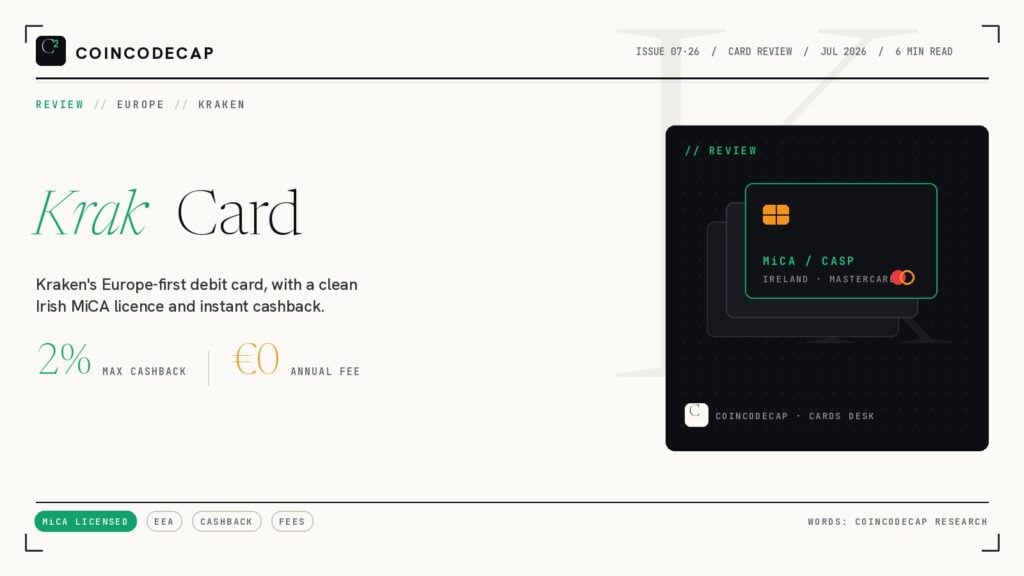
- Cashback is tiered by your 30-day balance across Kraken products: 0.5% at €200, 1% at €1,000, up to 2% at €50,000, paid instantly in euro, sterling or BTC with no monthly cap.
- No monthly or annual fee, and Krak adds a virtual IBAN plus salary deposits in a growing list of EU countries.
- The fine print: a variable conversion spread applies when you spend from crypto, and there is 0% cashback below a €200 balance.
For someone who wants a bank-like account with real cashback and clean licensing, Krak is the most interesting launch in two years. Support is still young, so expect the odd teething issue. Full detail in our Krak Card review.
✅ Pros
- Clean Irish MiCA licence, EU-first product
- Instant cashback in euro, sterling or BTC, no cap
- Virtual IBAN, salary deposits, no annual fee
❌ Cons
- Top 2% rate needs a €50,000 balance
- Conversion spread on crypto-funded spending
- Young support operation
3. Bybit EU Card: clean licence, simple 1% base
Bybit is a MiCA comeback story. It pulled back from the EEA before the deadline, then got an Austrian FMA licence (Bybit EU GmbH) in May 2025 and relaunched through bybit.eu. The card itself rides on a French e-money issuer, Harmoniie, under Mastercard. Existing EEA cardholders had to migrate to the new EU card during early 2026.
- Mastercard, virtual free, physical for a small one-off fee.
- 1% base cashback with no monthly cap; the advertised “up to 10%” applies only to high VIP tiers with their own caps.
- Fees when spending from crypto: about 0.9% conversion plus 0.5% FX abroad, which eats most of the 1%.
- Free ATM allowance is low, around €100 a month, then 2%.
If you already trade on Bybit, the card is a tidy add-on. Just read the “up to 10%” as marketing and plan around the 1% you’ll actually get. See our Bybit card review for the tier detail.
✅ Pros
- Austrian MiCA licence plus French EMI issuer
- 1% base cashback, uncapped
- No annual fee
❌ Cons
- “Up to 10%” is VIP-only with caps
- Conversion plus FX fees erode cashback
- Forced migration and low free ATM limit
4. Nexo Card: best dual credit and debit
Nexo’s card is unusual because it switches between debit mode (spend your balance) and credit mode (borrow against your crypto without selling it). It is available across the EEA and the UK on Mastercard, issued via DiPocket, and Nexo moved its EEA structure under German BaFin oversight in 2026 to line up with MiCA.
- Cashback up to 2% in NEXO or 0.5% in BTC, but only on credit-mode spending and only at the top loyalty tier.
- No monthly, annual or inactivity fees; FX is 0.2% on weekdays for EEA and UK users.
- Free ATM allowance scales from €200 to €2,000 a month by tier.
- The trade-off: meaningful cashback needs a sizeable portfolio and, for the best rate, holding the NEXO token.
Credit mode is genuinely useful if you don’t want to trigger a taxable sale every time you tap. Our Nexo card review explains how the borrow rate works.
✅ Pros
- Switches between debit and borrow-against-crypto credit
- No account fees, low weekday FX
- MiCA-aligned under BaFin oversight
❌ Cons
- Top cashback needs the NEXO token and a big balance
- Cashback only in credit mode
- Borrowing carries liquidation risk
5. Bitpanda Card: the regulated European incumbent
Bitpanda is about as licensed as a European crypto firm gets. Its asset-management arm holds MiCA licences from Germany’s BaFin, Malta’s MFSA and Austria’s FMA, and the Visa card is issued through a Maltese e-money provider. It was one of the first big retail platforms to clear BaFin’s MiCA process.
- Visa debit that spends in real time from your Bitpanda balance, so you can’t run up debt.
- 1% cashback on crypto-funded spending; payments funded with euro, stablecoins, metals or stocks earn nothing.
- No card fee, 0% Bitpanda FX markup (Visa’s own rate still applies), 2% ATM fee.
- Availability is euro-area residents only, which locks out the UK and non-euro EEA countries like Sweden and Poland.
The quiet cost is the trading spread: every crypto-funded payment triggers a sale at Bitpanda’s usual spread, which roughly cancels the 1% headline. The reward tiers that used to boost this (BEST, then Vision) have been retired. Details in our Bitpanda card review.
✅ Pros
- Triple MiCA licensing, strong EU reputation
- Real-time debit, no debt possible
- No card fee, no Bitpanda FX markup
❌ Cons
- Euro-area residents only
- Trading spread cancels much of the 1%
- Boosted reward tiers discontinued
6. OKX Card: stablecoin-native, zero fees
OKX launched its card across the EEA in January 2026, backed by a MiCA licence from Malta and a separate Maltese payments licence for the card side. It is built around stablecoins: there is no top-up step, the card just spends USDC or USDG held in OKX Pay and converts to euro at the till.
- Mastercard, but virtual-only for now, so no ATM cash and no use where a physical card is required.
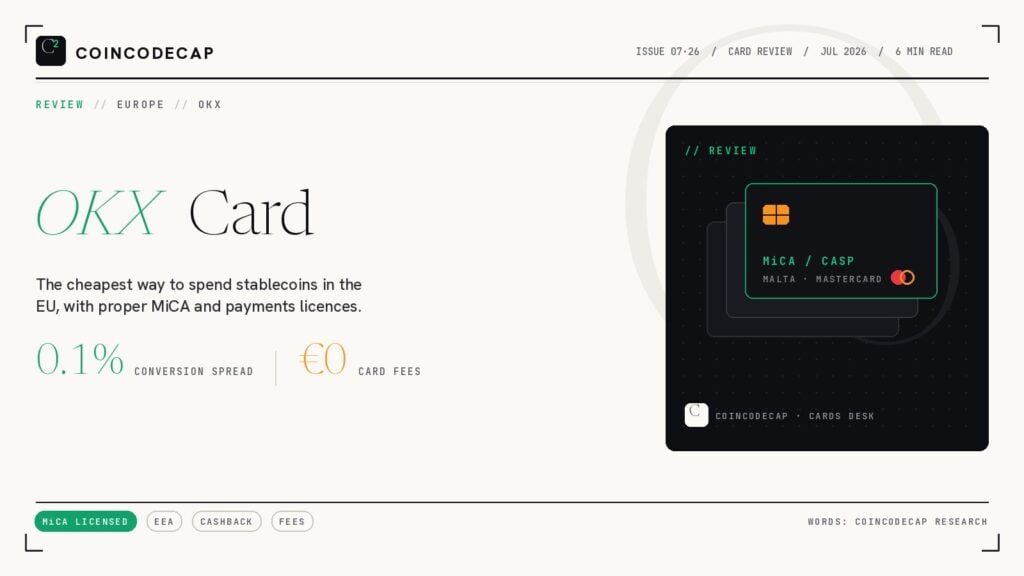
- No issuance, monthly, annual, transaction or FX fees; just a small conversion spread around 0.1%.
- Cashback is 2% to 5% by VIP tier on USDG spending only, capped at €10 a month for non-VIP users; USDC spend earns nothing.
- Runs entirely on a custodial OKX Pay balance.
It’s an excellent near-zero-fee way to spend stablecoins, though the cashback is close to decorative unless you’re a high-tier VIP. Note too that the Malta entity took a €1.05M AML penalty in early 2026 for historical failings. See our OKX Card review for the full breakdown.
✅ Pros
- MiCA CASP plus a Malta payments licence
- Effectively zero fees, tiny conversion spread
- Clean stablecoin-native spending
❌ Cons
- Virtual-only, no ATM access
- Cashback capped at €10/month for most users
- Custodial balance; historical AML penalty on the entity
7. Gnosis Pay: best for self-custody
Gnosis Pay is the pick if you refuse to hand your crypto to an exchange. It is a Visa debit card issued by Monavate, an FCA-authorised e-money firm, but the money sits in your own Safe smart account on Gnosis Chain. The issuer never takes custody of your assets.
- Visa, available across the EEA and UK, spending the EURe euro stablecoin from a wallet you control.
- Cashback up to 4% in GNO based on how much GNO you hold, with a possible extra 1% for early-NFT holders.
- No FX, gas or off-ramp fees claimed on EURe spend, though a small stabilisation cost applies.
- Check the current cashback program before you count on it; the earlier funded program ran to mid-2026 and terms can shift.
This is the most genuinely non-custodial card that still spends anywhere Visa is accepted. Our Gnosis Pay review walks through the Safe setup, and if self-custody is your priority the non-custodial crypto cards guide compares the whole category.
✅ Pros
- Genuine self-custody via your own Safe wallet
- Visa acceptance, EEA and UK
- Up to 5% in GNO with the NFT boost
❌ Cons
- Cashback needs GNO holdings and can change
- Small stabilisation cost on EURe spend
- More setup than an app-only card
8. MetaMask Card: the app-native self-custody option
If Gnosis Pay is the power-user’s self-custody card, the MetaMask Card is the friendly one. It spends stablecoins directly from your MetaMask wallet on Mastercard, built with Baanx, and after a long pilot it is now available across the full EEA plus the UK and Switzerland.
- Mastercard, spending USDC and other stablecoins from the MetaMask wallet you already use.
- Cashback is advertised around 1% to 3%; confirm the live rate in-app before relying on it.
- The card and e-money leg run through Baanx and its EU e-money partner.
- One caveat: Baanx has not publicly announced a MiCA CASP authorisation for the crypto leg, so keep an eye on the register.
For the tens of millions who already keep funds in MetaMask, this is the shortest path from wallet to checkout. See the MetaMask card review for supported chains and limits.
✅ Pros
- Spends straight from your MetaMask wallet
- Full EEA, UK and Switzerland coverage
- No exchange account needed
❌ Cons
- No announced MiCA CASP for the crypto leg
- Cashback rate not clearly published
- Depends on the Baanx program
9. Deblock: best for France and the euro core
Deblock is a French neobank with a twist: one app holds a normal current account with a French IBAN and a non-custodial Web3 wallet where you keep the seed. It got the first French MiCA CASP authorisation in May 2025 and is also an ACPR-authorised e-money firm, so both legs are licensed at home.
- Free Visa card, French IBAN and free SEPA Instant transfers.
- Non-custodial wallet you can withdraw to Ledger or MetaMask, alongside the fiat account.
- First French bank to combine an e-money licence with a MiCA CASP licence.
- Availability is France-first, with Germany, Austria, Ireland and Benelux on the roadmap after a 2025 funding round, so check signup in your country.
For someone in the euro core who wants a real bank account and self-custody in one place, Deblock is a standout. Our Deblock review has the account detail.
✅ Pros
- First French MiCA CASP plus an e-money licence
- French IBAN and a non-custodial wallet in one app
- Free card and SEPA Instant
❌ Cons
- France-first; other countries still rolling out
- Fewer rewards perks than exchange cards
- Newer, smaller operation
10. Ledger CL Card: the hardware-wallet brand’s card
The Ledger CL Card, powered by Baanx, carries the trust of the best-known hardware wallet brand and markets a self-custody feel. In the EEA the card is issued by Monavate’s Lithuanian e-money entity, and it is widely available across Europe with a flat 1% cashback paid in BTC or USDT, no staking needed.
- Mastercard in the UK and EEA, virtual free, physical available.
- Flat 1% cashback in BTC or USDT, with no tier or lockup.
- No annual fee, but expect a conversion fee plus FX on crypto-funded spending that can outweigh the 1%.
- Two caveats: the “self-custody” claim really means self-custody until you top up, and Baanx has not announced a MiCA CASP authorisation for the crypto leg.
It earns a spot for brand trust and simple flat cashback, but Trustpilot shows a cluster of deposit-delay and account-freeze complaints in 2025 and 2026, so start small. Full detail in our Ledger CL card review.
✅ Pros
- Trusted Ledger brand, simple flat 1%
- No staking or annual fee
- Wide European availability
❌ Cons
- No announced MiCA CASP for the crypto leg
- Conversion and FX fees can beat the 1%
- Notable freeze and delay complaints
Cards to approach with caution
A few well-known names didn’t make the list, and it’s worth saying why so you don’t get caught out.
- Wirex: its MiCA CASP application went through Italy and the transitional window ended on 30 June 2026, so confirm its status on the register before signing up. Rewards also pay in the WXT token, which has a withdrawal minimum that leaves small spenders unable to cash out.
- Plutus: fiat withdrawals have been suspended for roughly two years, and the rewards model has been repeatedly changed. We can’t recommend it until withdrawals reliably resume.
- Coinbase Card: Coinbase holds a MiCA licence, but its own EEA country pages currently show the card as US-only for new signups. Check in-app eligibility before assuming you can get one.
- Uphold: the card is a UK product, and Uphold’s EEA arm paused crypto and fiat deposits from 1 July 2026 while its MiCA application is pending.
- Bitget Card: Bitget only filed its Austrian MiCA application in June 2026 and says it won’t serve EEA customers until authorised. The exchange card is invite-only anyway.
How to choose the right crypto card in Europe
- Check the licence first. Find the legal entity in the card’s terms, then search it on the ESMA register. No entry, no card.
- Read the real cashback, not the banner. Most “up to X%” numbers need a token lockup, a subscription tier or a huge balance. Work out the rate you’ll actually earn.
- Add up the spend cost. Conversion spread plus FX can quietly beat a 1% reward. A “zero-fee” card with a 1.5% spread isn’t free.
- Decide on custody. Exchange cards are simplest; Gnosis Pay, MetaMask and Deblock keep you closer to your own keys.
- Match it to where you live. Bitpanda is euro-area only, Deblock is France-first, OKX is virtual-only. Availability varies more than the marketing suggests.
Frequently asked questions
Are crypto cards legal in Europe after MiCA?
Yes, as long as the issuer is authorised. Since 1 July 2026 any firm serving EEA customers needs a MiCA CASP licence for the crypto side and usually an e-money licence for the card side. The cards in this list are tied to named, register-verifiable entities.
What does MiCA actually protect for a cardholder?
MiCA forces the company to keep your crypto separate from its own assets, and an e-money licence means the euros on your card are safeguarded 1:1 at a bank. Neither is the same as the €100,000 deposit guarantee, which only applies to money held at a licensed bank.
Which crypto card has the lowest fees in the EU?
OKX charges effectively no fees beyond a roughly 0.1% conversion spread, and Kraken’s Krak and Bitpanda advertise 0% FX markup. Watch the crypto conversion spread, though, since that is where the real cost usually hides.
Do crypto cards report to tax authorities?
Increasingly, yes. DAC8 crypto reporting applies from January 2026, so EU providers report user transactions to tax authorities. Each card payment is also a taxable disposal in most EU countries, so keep records of your cost basis.
Can I still use USDT to top up a crypto card in Europe?
Often not. MiCA’s stablecoin rules pushed regulated platforms to drop USDT for EEA users in 2025. Compliant cards top up in USDC, EURC or a euro stablecoin, so a card still pushing USDT for EEA users is worth a second look.
What is the best crypto card for self-custody in Europe?
Gnosis Pay spends from a Safe smart account you control, which is the most genuinely non-custodial option that still works on Visa. MetaMask Card and Deblock also keep you closer to your own keys than an exchange card does.
Why did my old crypto card stop working in Europe?
Several cards left the EEA rather than complete MiCA authorisation. Binance’s Visa card shut in December 2023, Monolith closed in 2024, and others migrated users to new licensed entities. If your card stopped, the issuer likely exited or restructured for MiCA.
Editorial note: fees, cashback tiers and licensing status change frequently in this market. Everything here was checked against issuer and regulator sources at the time of writing; always confirm the current terms in-app before you apply.
Related reading
Card reviews
- Crypto.com Visa card review (tier-by-tier cashback maths)
- Krak Card review (Kraken’s EU launch)
- OKX Card review (cheapest stablecoin spend)
- Bybit card review (EU migration and rewards)
- Nexo card review (credit vs debit mode)
- Bitpanda card review (the regulated incumbent)
- Gnosis Pay review (self-custody setup)
- MetaMask card review (wallet-native spending)
By card type
- Non-custodial crypto cards (keep your own keys)
- Stablecoin crypto cards (spend USDC and euro stablecoins)
- No-KYC crypto debit cards (privacy trade-offs)
- Top crypto Visa cards and top crypto Mastercards
Regulation and regions
- Top 10 MiCA-licensed crypto exchanges (the exchange side of the same rulebook)
- Best crypto cards for US users (the American equivalent of this guide)
- Deblock review (French MiCA neobank)
- Ledger CL card review (hardware-wallet brand card)