Disclosure: CoinCodeCap may earn a commission if you sign up through links on this page. Risk warning: Self-custody wallets put YOU in control. Lose your seed phrase and your ETH is gone permanently — no recovery, no support hotline. Smart contract wallets (Safe, Argent, Coinbase Smart Wallet) reduce some of this risk through social recovery, but every wallet has trade-offs. Read carefully before moving meaningful capital.
How I Picked These Wallets: I tested each wallet directly on Ethereum mainnet and at least one L2 (Base, Arbitrum, or Optimism), ran real transactions through DEXs and dApps, verified hardware wallet pairing, checked transaction-simulation safety features, and stress-tested seed phrase recovery flows. Where I cite metrics (active users, audit history, dApp integrations), I source from public docs and on-chain analytics. The wallet landscape shifts fast — this guide reflects May 2026 reality, including ERC-4337 Account Abstraction adoption, Coinbase Smart Wallet’s passkey rollout, and MetaMask’s Snaps ecosystem.
The Ethereum wallet landscape in 2026 doesn’t look like it did even two years ago. The EOA-vs-smart-wallet split that used to be a niche developer debate is now a real choice for anyone using Ethereum. MetaMask still dominates by user count, but Rabby has eaten serious market share among power users. Coinbase Smart Wallet shipped passkey-based recovery — no seed phrase needed. Safe has become the default for any treasury or multisig setup. And the old guard from 2021 — Fortmatic (rebranded to Magic, mostly dev-focused now), Ledger Nano S (discontinued), Trezor Model One (replaced) — are no longer the right answers.
This guide covers the wallets I’d actually recommend in May 2026 across four categories: EOA software wallets (MetaMask, Rabby, Rainbow, Trust Wallet, Phantom), smart contract wallets (Coinbase Smart Wallet, Safe, Argent), hardware wallets (Ledger Stax/Flex/Nano S Plus, Trezor Safe 3/Safe 5, Cypherock X1), and multi-chain wallets with strong ETH support (Bitget Wallet, Frame, Zerion). For broader context, see our best hardware wallets roundup, our best smart contract wallets guide, and our companion piece on Solana wallets.
| Wallet | Type | Best For | Headline 2026 Feature |
|---|---|---|---|
| MetaMask | EOA software | Default ETH choice, mass-market | MetaMask Card + Snaps ecosystem |
| Rabby | EOA software | DeFi power users | Pre-sign transaction simulation, multi-EVM |
| Rainbow | EOA software | Best mobile UX, NFTs | Rainbow Pay (smart wallet integration) |
| Trust Wallet | EOA software | Mobile-first, multi-chain | 10M+ assets, Binance ecosystem |
| Coinbase Smart Wallet | Smart contract (AA) | Onboarding, no seed phrase | Passkey-based recovery — no seed phrase |
| Safe | Smart contract (multisig) | Treasuries, DAOs, joint funds | Industry-standard multisig, $100B+ assets secured |
| Argent | Smart contract (AA) | L2 native users | Daily limits, social recovery, gas sponsorship |
| Ledger (Stax/Flex/Nano S Plus) | Hardware | Long-term holders | Touchscreen Stax, Bluetooth Flex |
| Trezor (Safe 3, Safe 5) | Hardware | Open-source preference | Safe 5 color touchscreen, secure element |
| Cypherock X1 | Hardware | Seed-phrase-free hardware | 4-card distributed key system, no seed phrase |
| Bitget Wallet | EOA software | Multi-chain memecoin trading | 90+ chains, MEV protection |
| Frame | EOA desktop | Desktop power users | System-wide ETH connector, transaction transparency |
| Zerion | EOA software | Portfolio tracking + wallet | Best portfolio dashboard built into wallet |
| 📌 My quick verdict — MetaMask + Ledger Stax for most users. Rabby for active DeFi. Coinbase Smart Wallet for newcomers wanting no seed phrase. Safe for any shared funds. | |||
EOA vs Smart Contract Wallets — Why This Matters in 2026
Before picking a wallet, understand the split that’s reshaping the Ethereum wallet landscape:

EOA wallets (Externally-Owned Accounts). The classic model. A private key directly controls funds. MetaMask, Rabby, Rainbow, Trust Wallet — all EOAs. Familiar, fast, supported everywhere. Trade-off: lose your 12-word seed phrase and your funds are unrecoverable. No daily limits, no social recovery, no gas sponsorship. The seed phrase is the entire security model.
Smart contract wallets. A programmable contract on-chain decides what counts as a valid transaction. Coinbase Smart Wallet, Safe, Argent — all smart wallets. ERC-4337 Account Abstraction is the standard that mainstreamed them in 2024 and 2025. Capabilities EOAs can’t replicate: social recovery (designate guardians who can recover access), daily spending limits, gas sponsorship (someone else pays the fee, or you pay in USDC), session keys for games and dApps, multi-factor approval. Trade-off: contract risk (smart wallet code can have bugs), slightly higher gas on first deployment, narrower dApp compatibility (most dApps now support both, but legacy ones occasionally don’t).
The right call in 2026 isn’t pick one and ignore the other. It’s: use EOA wallets for daily activity (MetaMask + Rabby), smart wallets for shared/treasury funds (Safe), and a hardware wallet for the long-term bag.
EOA Software Wallets
1. MetaMask — The Default ETH Wallet
MetaMask is the most-used Ethereum wallet by a wide margin and remains the right default pick for the majority of users in 2026. Browser extension (Chrome, Firefox, Brave, Edge), iOS, and Android. Open-source, audited, free. Connects to virtually every dApp on Ethereum and EVM-compatible chains. The 2024–2026 expansion added Snaps (a plugin system that lets MetaMask connect to non-EVM chains like Solana, Bitcoin, and Cosmos), MetaMask Card (Mastercard debit linked to your wallet, launched on Linea L2), and improved transaction simulation that previews what each transaction will actually do before you sign.
- ✅ Most-supported wallet across dApps — works everywhere
- ✅ MetaMask Snaps adds Solana, Bitcoin, Cosmos, and other non-EVM support
- ✅ MetaMask Card — Mastercard debit, USDC top-up, Linea L2-native
- ✅ Hardware wallet support: Ledger, Trezor, Lattice, Keystone
- ✅ Built-in swap aggregator and bridge to L2s (Base, Arbitrum, Optimism, Linea, etc.)
- ⚠️ Transaction simulation is decent but Rabby’s is more granular
- ⚠️ Mobile app pop-ups can lag on heavily congested networks
- 📌 Best for: Default pick for ETH users, mass-market, DeFi beginners
2. Rabby — DeFi Power Users’ Choice
Built by the DeBank team, Rabby is what serious DeFi users switch to when MetaMask starts feeling clunky. The flagship feature: pre-sign transaction simulation shows exactly what a transaction will do — token approvals, balance changes, contract interactions — before you sign. This catches a meaningful share of phishing attacks and malicious dApp setups that MetaMask’s simulation misses. Multi-EVM by design (Ethereum, Arbitrum, Optimism, Base, Polygon, BNB, and 70+ others), built-in DEX aggregator, gas estimator, and a clean portfolio view. Browser extension and (since 2024) mobile.
- ✅ Best-in-class transaction simulation — catches malicious approvals before signing
- ✅ Multi-EVM out of the box — no manual network adding
- ✅ Built-in security warnings for phishing sites and unverified contracts
- ✅ Gas tracker and DEX aggregator integrated
- ✅ Free and open-source
- ⚠️ Smaller user base than MetaMask — occasional dApp compatibility gaps (rare in 2026)
- ⚠️ Less polished mobile experience than Rainbow or Trust Wallet
- 📌 Best for: Active DeFi users, anyone signing 10+ transactions a week
3. Rainbow — Best Mobile UX
If MetaMask is the default and Rabby is the power user pick, Rainbow is the wallet that actually looks and feels good to use on a phone. iOS, Android, and a Chrome extension. The mobile experience is genuinely the best in the EOA category — clean swipe interactions, smooth NFT gallery, sensible defaults. Rainbow Pay added smart wallet features in 2024–2025 (gasless transfers, simpler onboarding for new users), bridging the gap between EOA and smart wallet experiences. Strong NFT support, ENS integration, and a good built-in swap aggregator.
- ✅ Cleanest mobile UX in the Ethereum wallet space
- ✅ Rainbow Pay adds smart wallet features (gasless, onboarding)
- ✅ Strong NFT support — gallery view, OpenSea/Blur integrations
- ✅ ENS-native experience
- ✅ Multi-EVM support (Ethereum, Base, Optimism, Arbitrum, Polygon, more)
- ⚠️ Smaller dApp support than MetaMask for legacy desktop dApps
- ⚠️ Limited hardware wallet integration compared to MetaMask
- 📌 Best for: Mobile-first users, NFT collectors, beginners wanting beautiful UX
4. Trust Wallet — Mobile Multi-Chain
Trust Wallet is owned by Binance and remains one of the most-downloaded crypto wallets on iOS and Android. The pitch: 10M+ assets across 70+ blockchains in one mobile app. For ETH specifically, Trust Wallet is fine — supports the major L2s, DEX integrations, NFT viewing, hardware wallet pairing. The strongest case for Trust Wallet is when ETH is one of many chains you use, not your primary chain. If your portfolio looks like ETH + Solana + BNB + Polygon + Bitcoin, Trust Wallet handles all of them in one mobile interface.
- ✅ 10M+ assets, 70+ blockchains in one wallet
- ✅ Strong mobile UX (iOS, Android)
- ✅ Built-in dApp browser, staking, swap aggregator
- ✅ Native NFT support across multiple chains
- ⚠️ Owned by Binance — adds centralization perception some users dislike
- ⚠️ Browser extension exists but less mature than mobile
- 📌 Best for: Multi-chain mobile users, casual ETH activity within broader portfolio
5. Phantom — Multi-Chain with Native ETH
Phantom started as the dominant Solana wallet but added native Ethereum support in 2024 alongside Bitcoin and Polygon. For users coming from Solana who want to add ETH activity without switching apps, Phantom is the easiest on-ramp. Token swaps, NFT support, and a clean interface all work well across the supported chains. For ETH-only users, MetaMask or Rabby are still the better picks. For Solana-primary users adding ETH as a secondary chain, Phantom is the cleanest option.
- ✅ Native Solana + Ethereum + Bitcoin + Polygon in one wallet
- ✅ Polished mobile and browser extension UX
- ✅ Strong NFT support across chains
- ✅ Built-in swap aggregator with cross-chain routing
- ⚠️ ETH dApp support is good but slightly behind dedicated ETH wallets
- ⚠️ Less granular EVM network coverage than Rabby or MetaMask (Snaps)
- 📌 Best for: Solana-primary users adding ETH, multi-chain memecoin traders
Smart Contract Wallets (Account Abstraction)
6. Coinbase Smart Wallet — No Seed Phrase
Coinbase Smart Wallet is the most user-friendly entry point into Ethereum self-custody in 2026. Created in 2024, it pairs an ERC-4337 smart contract wallet with passkey-based recovery — your phone or laptop’s biometric (Face ID, Touch ID, Windows Hello) replaces the traditional seed phrase. No 12 or 24 words to write down. Recovery is via your device’s secure enclave, with the option to add additional recovery factors. This is genuinely a different product from Coinbase’s older Coinbase Wallet (which is still available and is a normal EOA wallet).
For new users entering Ethereum, this removes the single biggest source of lost funds (seed phrase mismanagement). For experienced users, it’s still useful as a hot wallet for daily activity, paired with a hardware wallet for the long-term bag.
- ✅ No seed phrase — passkey-based recovery via device biometric
- ✅ Works across browser, iOS, Android via passkey sync
- ✅ Sponsored gas on Base (Coinbase’s L2) — many transactions are free
- ✅ Open-source ERC-4337 contracts, audited
- ✅ Coinbase exchange integration for fiat onramp
- ⚠️ Newer product — smaller dApp support than MetaMask (improving fast)
- ⚠️ Tied closely to Coinbase ecosystem; not maximally decentralized
- 📌 Best for: Beginners, mainstream users, anyone who’s lost a seed phrase before
7. Safe — The Industry-Standard Multisig
Safe (formerly Gnosis Safe) is the wallet of choice for any meaningful shared fund on Ethereum. DAOs, protocol treasuries, joint family funds, business multisigs — Safe is the default. Over $100B in assets are secured by Safe contracts as of early 2026. Configurable as N-of-M multisig (require 2 of 3 signers, 3 of 5, etc.). Web app + mobile app. Pairs cleanly with hardware wallets (Ledger + Trezor + others) for the individual signer security. Deeply integrated with Safe Apps — a curated dApp directory specifically built to work well with multisigs.
- ✅ Industry-standard multisig — over $100B secured
- ✅ Configurable N-of-M signing requirements
- ✅ Hardware wallet support for individual signers
- ✅ Safe Apps directory of multisig-friendly dApps
- ✅ Multi-chain: Ethereum, all major L2s, BNB, Polygon, more
- ⚠️ Not the right fit for individual day-to-day spending — designed for shared funds
- ⚠️ Initial deployment costs gas; subsequent transactions are normal cost
- 📌 Best for: DAOs, treasuries, business funds, family multisigs
8. Argent — Smart Wallet on L2s
Argent is one of the longest-running smart contract wallets in the Ethereum ecosystem. Mobile-first, built around L2s (Argent for L2s like Linea, zkSync, Polygon zkEVM, plus Argent X for Starknet). Features that are hard to replicate on EOAs: daily transaction limits (transactions above your set limit require additional confirmation), guardian-based social recovery (designate friends or hardware wallets to help recover access), session keys for games and dApps, and gas sponsorship on supported chains. For users coming to Ethereum from a banking-app mental model, Argent’s UX is the closest match.
- ✅ Daily limits + guardian-based social recovery
- ✅ Gas sponsorship on supported L2s — many transactions are free
- ✅ Audited smart contracts, longest track record among AA wallets
- ✅ Argent X for Starknet (separate app, see our Braavos vs Argent X review)
- ⚠️ L2-focused — not the strongest for Ethereum mainnet activity
- ⚠️ Mobile-first; desktop UX less polished
- 📌 Best for: L2 native users, smart wallet adopters, banking-app-style UX preference
Hardware Wallets for Ethereum
For any meaningful ETH balance — anything more than you’re willing to lose — pair a hot wallet with a hardware wallet. The current 2026 lineup is significantly different from the 2021 Trezor Model One / Ledger Nano S era. Below are the models I’d actually recommend.
9. Ledger (Stax / Flex / Nano S Plus / Nano X)
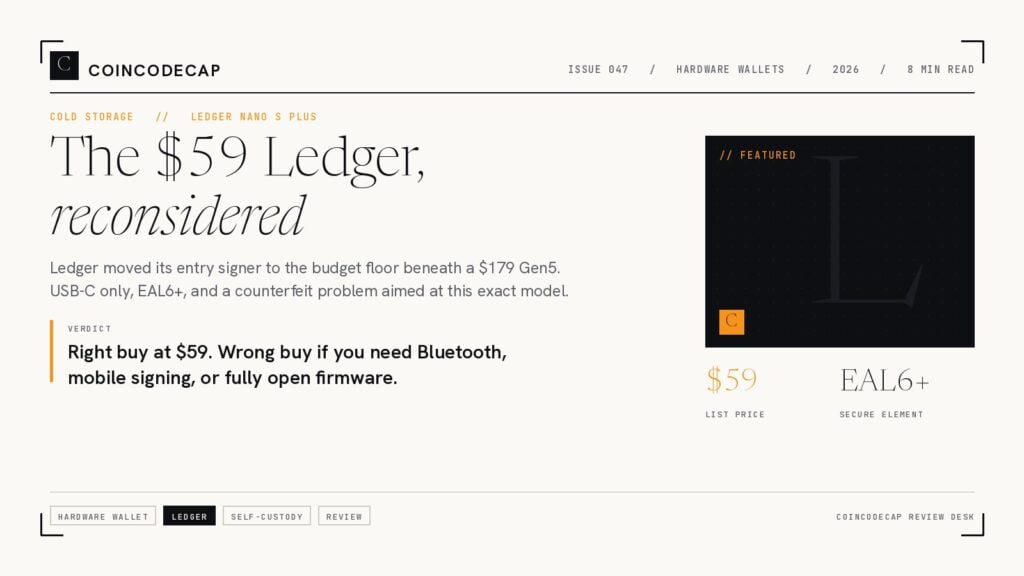
Ledger remains the largest hardware wallet brand and runs the broadest hardware-wallet app ecosystem. Current 2026 lineup: Ledger Stax (premium, curved E-ink touchscreen, ~$399), Ledger Flex (smaller E-ink touchscreen, ~$249), Nano X (Bluetooth, ~$149), and Nano S Plus (entry-level USB, ~$79). All four use Ledger’s Secure Element chip and integrate with MetaMask, Rabby, Rainbow, Safe, and most other ETH wallets. Ledger Live is the companion app — manage assets, swap, stake. The 2023 “Recover” service (optional, off by default) generated controversy among self-custody purists; you can ignore it entirely if you don’t want it.
- ✅ Largest hardware wallet brand — broadest dApp/wallet integration
- ✅ Stax: premium curved E-ink touchscreen for high-volume users
- ✅ Flex: solid mid-range with touchscreen at sub-$250
- ✅ Nano S Plus: solid entry-level at sub-$80
- ✅ Pairs with MetaMask, Rabby, Rainbow, Safe — every major ETH wallet
- ⚠️ Closed-source firmware (Trezor is open-source)
- ⚠️ Past data breach (2020) leaked customer addresses — not key material, but relevant context
- 📌 Best for: Long-term ETH holders wanting wide ecosystem support
10. Trezor (Safe 3 / Safe 5)
Trezor’s current 2026 lineup is the Safe 3 (~$79, button-based, secure element added in this generation) and Safe 5 (~$169, color touchscreen, full secure element). Both replaced the older Model One and Model T from the 2021 era. The Trezor distinguishing pitch remains: open-source firmware (you can audit the code), strong recovery via Shamir Backup (optional, splits seed across multiple shares), and competitive pricing. For ETH specifically, Trezor pairs with MetaMask, Rabby, Safe, Rainbow, and most major wallets. Trezor Suite is the companion app.
- ✅ Open-source firmware — auditable codebase
- ✅ Safe 3 and Safe 5 added secure element chips (older models lacked this)
- ✅ Shamir Backup optional — split seed across multiple shares
- ✅ Strong reputation in self-custody community
- ✅ Pairs with MetaMask, Rabby, Safe, Rainbow
- ⚠️ Smaller in-app ecosystem than Ledger Live
- ⚠️ Older Model One and T discontinued — buy current Safe series
- 📌 Best for: Open-source advocates, ETH holders preferring auditable firmware
11. Cypherock X1 — Seed-Phrase-Free Hardware
Cypherock X1 is the most novel hardware wallet on this list. Instead of a single seed phrase, the X1 splits your private key across four cryptographically separated cards. To sign a transaction, you tap the X1 device with one of the cards. Lose any single card and you can recover using the remaining cards. There’s no traditional seed phrase to write down or memorize — the cards are the seed. For users who’ve lost (or worry about losing) seed phrases, this is genuinely a different security model. Pairs with MetaMask and other ETH wallets like any other hardware wallet.
- ✅ No seed phrase — 4-card distributed key system
- ✅ Loss-tolerant — recover from any single card after losing others
- ✅ Air-gapped (NFC tap to sign), no cables or Bluetooth
- ✅ Pairs with MetaMask and major wallets via Cypherock app
- ⚠️ Smaller user base — less ecosystem coverage than Ledger or Trezor
- ⚠️ Card-based system requires physical card storage discipline
- 📌 Best for: Users who’ve lost or worry about seed phrases, novel security model
Multi-Chain Wallets with Strong ETH Support
12. Bitget Wallet — 90+ Chains in One App
If your ETH activity is one part of a broader multi-chain portfolio (especially if memecoin trading is involved), Bitget Wallet is the strongest single-app solution. 90+ chains supported, built-in DEX aggregator with MEV protection, contract risk scanning that catches honeypot tokens before you trade, and native NFT marketplace. Self-custodial, browser extension + mobile + Telegram mini-app. For pure ETH-only use, MetaMask or Rabby are the better picks. For active multi-chain trading where you might hold positions on Ethereum + Solana + Base + Arbitrum simultaneously, Bitget Wallet is hard to beat.
- ✅ 90+ chains in one wallet — broadest coverage on this list
- ✅ MEV protection and honeypot/contract-risk scanning
- ✅ Native NFT marketplace inside the wallet
- ✅ Mobile + browser ext + Telegram mini-app access
- ⚠️ Owned by Bitget exchange — adds centralization perception
- ⚠️ Not as ETH-focused as MetaMask or Rabby
- 📌 Best for: Multi-chain memecoin traders, cross-chain power users
13. Frame — Desktop Power User Wallet
Frame is a desktop-native Ethereum wallet that runs system-wide rather than as a browser extension. It connects to dApps in any browser via standard JSON-RPC and to native desktop apps. Best feature: the most transparent transaction UI on this list — every detail of every transaction is visible before you sign, with full data decoding. Pairs natively with hardware wallets (Ledger, Trezor, Lattice, Keystone). Free, open-source, and one of the few wallets specifically built for users who want maximum visibility into what they’re signing.
- ✅ System-wide ETH connector — works in any browser or desktop app
- ✅ Most transparent transaction UI of any wallet on this list
- ✅ Native hardware wallet support (Ledger, Trezor, Lattice, Keystone)
- ✅ Free, open-source
- ⚠️ Desktop-only — no mobile app
- ⚠️ Power user-focused — overkill for casual users
- 📌 Best for: Desktop power users, security-focused users wanting maximum signing transparency
14. Zerion — Wallet + Portfolio Dashboard
Zerion has the strongest portfolio dashboard built into a wallet. If your usage pattern involves frequent checking of positions across DeFi protocols, NFT collections, and L2s, Zerion shows everything in one view in a way no other wallet on this list does. The wallet itself is a competent EOA wallet with multi-EVM support and decent dApp connectivity. Mobile + browser extension. Free.
- ✅ Best built-in portfolio dashboard of any ETH wallet
- ✅ Aggregates DeFi positions, NFTs, tokens across all major chains and L2s
- ✅ Multi-EVM support (Ethereum, Arbitrum, Optimism, Base, Polygon, more)
- ✅ Free, mobile + browser ext
- ⚠️ DApp connectivity not as deep as MetaMask
- ⚠️ Less feature-rich for active trading vs Rabby
- 📌 Best for: Portfolio-tracking heavy users, DeFi position monitoring
Side-by-Side Comparison
| Wallet | Type | Hardware Support | L2 Coverage | Smart Wallet? | Best For |
|---|---|---|---|---|---|
| MetaMask | EOA | Ledger, Trezor, Lattice, Keystone | All major L2s | No (EOA only) | Default ETH pick |
| Rabby | EOA | Ledger, Trezor | 70+ EVM chains | No (EOA only) | DeFi power users |
| Rainbow | EOA | Limited | Major L2s | Rainbow Pay (hybrid) | Mobile UX, NFTs |
| Trust Wallet | EOA | Ledger | Major L2s | No | Multi-chain mobile |
| Phantom | EOA | Ledger | ETH + L2s + Solana + BTC | No | Solana-primary + ETH |
| Coinbase Smart Wallet | Smart contract (AA) | Limited | Base, Ethereum | ✅ Passkey recovery | Beginners, no seed phrase |
| Safe | Smart contract (multisig) | Ledger, Trezor (signers) | All major L2s | ✅ Multisig | Treasuries, DAOs |
| Argent | Smart contract (AA) | — | Linea, zkSync, Polygon zkEVM | ✅ Daily limits, social recovery | L2 native users |
| Ledger (hardware) | Hardware | Self | All major L2s via apps | — | Long-term holders |
| Trezor (hardware) | Hardware | Self | All major L2s via Suite | — | Open-source preference |
| Cypherock X1 | Hardware | Self (4-card) | Major L2s | — | Seed-phrase-free hardware |
| Bitget Wallet | EOA | Limited | 90+ chains | No | Multi-chain memecoin trading |
| Frame | EOA desktop | Ledger, Trezor, Lattice, Keystone | All major L2s | No | Desktop power users |
| Zerion | EOA | Ledger | All major L2s | No | Portfolio tracking |
How to Choose: My Routing Verdict
- “I’m new to Ethereum and want the easiest setup.” → Coinbase Smart Wallet. Passkey recovery means no seed phrase to lose. For traditional EOA: MetaMask.
- “I’m an active DeFi user signing transactions weekly.” → Rabby for the simulation safety, paired with a Ledger Stax or Flex for the long-term holdings.
- “I want the best mobile experience.” → Rainbow for ETH-only or Phantom if you want ETH + Solana + BTC in one app.
- “I’m setting up a DAO treasury, joint family fund, or business multisig.” → Safe. Industry standard, $100B+ secured. No close substitute.
- “I want self-custody without managing a seed phrase.” → Coinbase Smart Wallet (passkey) or Cypherock X1 (4-card hardware).
- “I hold ETH long-term, $10k+.” → Pair any hot wallet with Ledger Stax/Flex or Trezor Safe 5. Don’t keep meaningful capital in a hot wallet alone.
- “I trade memecoins across ETH, Base, Solana, BNB.” → Bitget Wallet for the chain coverage, paired with hardware for any holdings.
- “I want maximum visibility into what I’m signing.” → Frame on desktop. Best transaction transparency on this list.
- “I want to track my full DeFi portfolio in one place.” → Zerion. Best portfolio dashboard built into a wallet.
For most active ETH users in 2026, my recommended setup is: MetaMask or Rabby (hot wallet for daily activity) + Ledger Stax or Flex (cold storage for long-term holdings) + Safe (if you have any shared funds). Three wallets, three different roles, none competing with each other.
Frequently Asked Questions
What’s the safest Ethereum wallet?
For long-term holdings: a hardware wallet (Ledger Stax/Flex/Nano S Plus, Trezor Safe 3/Safe 5, or Cypherock X1) paired with a software wallet for the user interface. For shared funds: Safe with multisig spread across hardware wallets. For users who lose seed phrases: Coinbase Smart Wallet’s passkey recovery removes that failure mode entirely. The “safest” wallet is whichever one matches the security model you’ll actually maintain — a hardware wallet you forget the PIN on isn’t safer than a passkey wallet that just works.
MetaMask vs Rabby — which should I pick?
If you’re new to Ethereum or use ETH casually: MetaMask. Wider dApp support, more familiar, the default everywhere. If you’re signing 10+ transactions a week or interacting with newer/unaudited contracts regularly: Rabby. Its pre-sign transaction simulation catches phishing and malicious approvals MetaMask sometimes misses. Many active users run both — MetaMask for general use, Rabby for active DeFi.
What is Account Abstraction (ERC-4337)?
ERC-4337 is the Ethereum standard that lets smart contract wallets work without changes to the underlying Ethereum protocol. In practice, it enables features that traditional EOA wallets can’t have: social recovery, daily spending limits, gas sponsorship (someone else pays your fee, or you pay in USDC), session keys, and passkey-based authentication. Coinbase Smart Wallet and Argent are the most prominent ERC-4337 wallets in 2026. Account Abstraction has been live and growing since 2023 — it’s mainstream now, not experimental.
Do I need a hardware wallet?
If you hold more ETH than you’d be okay losing entirely: yes. Software wallets store keys on internet-connected devices, exposing them to malware, phishing, and clipboard hijackers. Hardware wallets isolate the keys to a dedicated device that signs transactions offline. The price floor is around $79 (Ledger Nano S Plus or Trezor Safe 3). For balances above ~$5,000, the cost-benefit is overwhelming. Below that threshold, a careful software wallet setup paired with a smart wallet’s social recovery features is reasonable.
Is Fortmatic still around?
Fortmatic rebranded to Magic in 2021 and is now primarily a developer-facing identity infrastructure (passwordless wallet SDK for dApp builders). It’s still operational but not really a consumer wallet anymore. If you used Fortmatic in 2021–2022, your wallet is recoverable via Magic’s interface. For new users, it’s not on the recommended list — Coinbase Smart Wallet, Rainbow, or Argent are the modern equivalents for the “simple, no-seed-phrase ETH wallet” niche Fortmatic originally targeted.
Can I use the same wallet for Ethereum mainnet and L2s?
Yes. All wallets on this list support Ethereum mainnet plus the major L2s (Base, Arbitrum, Optimism, Polygon, Linea, zkSync). Your address is the same across networks — you just switch the network in the wallet UI. Bridging between mainnet and L2 (or between L2s) requires a bridge — most wallets have built-in bridge aggregators now. Funds on each network are separate; ETH on mainnet is not the same as ETH on Arbitrum until you bridge it.
What happened to Ledger Nano S?
Discontinued. Ledger replaced the original Nano S with the Nano S Plus in 2022, then introduced Stax (curved E-ink touchscreen) and Flex (smaller touchscreen) in 2023–2024 as the premium and mid-tier offerings. The Nano X (Bluetooth) is still active. If you’re buying new in 2026, the answer is Stax for premium, Flex for mid-range, or Nano S Plus for entry-level. The original Nano S still works if you have one, but Ledger no longer ships software updates for it.
What’s the best wallet for NFTs?
Rainbow has the cleanest NFT gallery experience of any wallet on this list. Phantom is also strong, especially for cross-chain NFT viewing (ETH + Solana). For high-value NFT collections, pair the hot wallet with a Ledger or Trezor for cold storage. For deeper NFT-focused options, see our best NFT wallets roundup.
The Ethereum wallet landscape in 2026 has more good options than it did in 2021, but the right choice still depends on what you’re actually doing with ETH. Casual users → MetaMask or Coinbase Smart Wallet. Active DeFi users → Rabby. Long-term holders → hot wallet + hardware combo. Treasuries and shared funds → Safe. Multi-chain memecoin traders → Bitget Wallet. The 2021 default of “MetaMask + Ledger Nano S” is still roughly right in spirit — just with newer hardware (Stax, Flex, Nano S Plus, Trezor Safe series) and the option of layering in smart wallet features (social recovery, passkey auth, gas sponsorship) where they help.
The thing that’s genuinely changed: smart contract wallets are no longer experimental. Coinbase Smart Wallet, Safe, and Argent are mature products with real user bases and meaningful capital secured. For new users entering Ethereum in 2026, starting with a smart wallet is a reasonable choice — and removes some of the ways people lose funds in the EOA model. For everyone, treating the seed phrase as the absolute single point of failure remains the right mindset, regardless of which wallet you pick.
Reviewed by Gaurav Agarwal, founder of CoinCodeCap. Gaurav has covered crypto exchanges, DeFi protocols, and self-custody wallets since 2018. Wallet feature claims and product mechanics in this guide reflect direct testing through May 2026.
⚡ Bottom Line: The 2026 Ethereum wallet landscape is split across four categories: EOA software (MetaMask, Rabby, Rainbow, Trust Wallet, Phantom), smart contract / Account Abstraction (Coinbase Smart Wallet, Safe, Argent), hardware (Ledger Stax/Flex/Nano S Plus, Trezor Safe 3/Safe 5, Cypherock X1), and multi-chain (Bitget Wallet, Frame, Zerion). For most users: MetaMask or Coinbase Smart Wallet (depending on whether you want a seed phrase) + Ledger Stax or Flex for cold storage. Active DeFi users: switch hot wallet to Rabby for transaction simulation. Shared funds: Safe is the only right answer. Old guard from 2021 (Fortmatic, Ledger Nano S, Trezor Model One) are no longer current — pick from this list instead.
Related Reading
📋 Wallet Reviews & Comparisons: Best Hardware Wallets | Best Smart Contract Wallets | Braavos Wallet Review | Best Telegram Wallets
🔧 Wallet-Specific Guides: Trust Wallet vs MetaMask | MetaMask vs Coinbase Wallet | Different Types of Crypto Wallets
💰 Multi-Chain & NFTs: Best Solana Wallets for Memecoins | Best NFT Wallets | Best Multisig Wallets