Disclosure: CoinCodeCap may earn a commission if you sign up through links on this page. Hardware wallet warning: Trezor and Ledger are self-custody wallets — losing your 24-word seed phrase means permanent loss of funds. Always purchase directly from manufacturer websites (ledger.com, trezor.io) to avoid tampered devices. The 2020-era Trezor One, Trezor Model T, and original Ledger Nano S have been discontinued — buy current models only. This guide covers wallet specifications and trade-offs, not investment advice.
How I Reviewed These Wallets: I have hands-on experience with the current 2026 Ledger lineup (Nano S Plus, Nano X, Stax, Flex) and Trezor lineup (Safe 3, Safe 5, Safe 7). This review reflects May 2026 reality: Trezor One and Trezor Model T were discontinued in 2024, replaced by the Trezor Safe family. Ledger Nano S was replaced by Nano S Plus. Ledger launched the premium Stax in April 2024 and Flex in late 2024. Modern alternatives like Cypherock X1, Tangem, Arculus, Bitkey, and COLDCARD have meaningfully changed the competitive landscape. Both Ledger and Trezor have weathered significant 2023-2024 security events that this comparison addresses honestly.
Trezor and Ledger remain the two most established hardware wallet manufacturers in the crypto industry — both with over a decade of track record, mature ecosystems (Ledger Live and Trezor Suite), wide coin support, and substantial third-party integrations. The 2026 question isn’t “Trezor vs Ledger” in the abstract — it’s which specific current model fits your needs, and whether you’d be better served by one of the modern alternatives that have emerged since 2023 (Cypherock X1, Tangem, Bitkey, COLDCARD).
This guide covers the current 2026 Ledger lineup (Nano S Plus $79, Nano X ~$149, Flex $249, Stax $399), the current Trezor lineup (Safe 3 $79, Safe 5 $169, Safe 7), and how both compare against 2026’s modern alternatives. We’ll cover honest security history including Ledger’s Connect Kit hack (December 2023), the Ledger Recover controversy (May 2023), Trezor’s SIM-swap X account attack (January 2024), and Unciphered’s disclosed Trezor T vulnerability. Both brands have weathered these events transparently — but they matter for your purchasing decision in 2026.
| Quick Verdict | 2026 Reality |
|---|---|
| Discontinued (do NOT buy) | Original Ledger Nano S · Trezor One · Trezor Model T |
| Current Ledger lineup | Nano S Plus ($79) · Nano X (~$149) · Flex ($249) · Stax ($399) |
| Current Trezor lineup | Safe 3 ($79) · Safe 5 ($169) · Safe 7 (premium) |
| Best entry-level (under $100) | Tie: Ledger Nano S Plus vs Trezor Safe 3 — both excellent at $79 |
| Best premium | Ledger Stax ($399) for premium UX · Trezor Safe 5 ($169) for value |
| Open-source winner | Trezor (full open-source firmware on GitHub) |
| Coin support winner | Ledger (5,500+ coins) vs Trezor (1,800+ coins) |
| Mobile ecosystem winner | Ledger Live (mature on iOS + Android) · Trezor Suite mobile newer |
| Bluetooth | Ledger Nano X only · Trezor has none in current lineup |
| 2026 modern alternatives | Cypherock X1 (seedless SSS) · Tangem (NFC card) · Bitkey (multisig) · COLDCARD (Bitcoin-only) |
| 📌 Recommended for most users: Ledger Nano S Plus ($79) for broader coin support + mature mobile ecosystem, OR Trezor Safe 3 ($79) for full open-source firmware. Both excellent. For Bitcoin maximalists: COLDCARD or Foundation Passport. For multisig: Bitkey or Casa. | |
2026 Reality Check: Discontinued Products
Before diving into the comparison, three important discontinuations to understand:

- Trezor One (discontinued 2024) — Replaced by Trezor Safe 3 ($79). The Safe 3 inherits Trezor One’s form factor + adds CC EAL6+ secure element + improved durability. If you’re shopping for “Trezor One” in 2026, buy the Safe 3 instead.
- Trezor Model T (discontinued 2024) — Replaced by Trezor Safe 5 ($169). The Safe 5 inherits the touchscreen UX + adds color display + secure element. Note: Unciphered disclosed a vulnerability in the Trezor T in 2023 involving physical extraction of seeds — this contributed to the Safe family launch with hardware-level secure elements.
- Original Ledger Nano S (discontinued 2022) — Replaced by Ledger Nano S Plus ($79). The Plus has more storage for apps (so you can install more coin apps simultaneously) + USB-C connector + larger display. Same secure element architecture.
If you find old listings selling Trezor One, Trezor Model T, or original Ledger Nano S in 2026, they’re either remaining inventory (legitimate but unsupported) or potentially counterfeit. Buy current models direct from manufacturer websites.
Current 2026 Ledger Lineup
| Model | Price | Display | Connectivity | Key Differentiator |
|---|---|---|---|---|
| Ledger Nano S Plus | $79 | 128×64 OLED + 2 buttons | USB-C | Entry-level, broad coin support, more app storage than original Nano S |
| Ledger Nano X | ~$149 | 128×64 OLED + 2 buttons | USB-C + Bluetooth + battery (100mAh) | Bluetooth for mobile use, wireless freedom |
| Ledger Flex | $249 | 2.84″ e-ink touchscreen | USB-C + Bluetooth + NFC | Mid-tier touchscreen, launched late 2024 |
| Ledger Stax | $399 | 3.7″ curved e-ink touchscreen | USB-C + Bluetooth + NFC + wireless charging | Premium UX, NFT lock screen, launched April 2024. See Ledger Stax review |
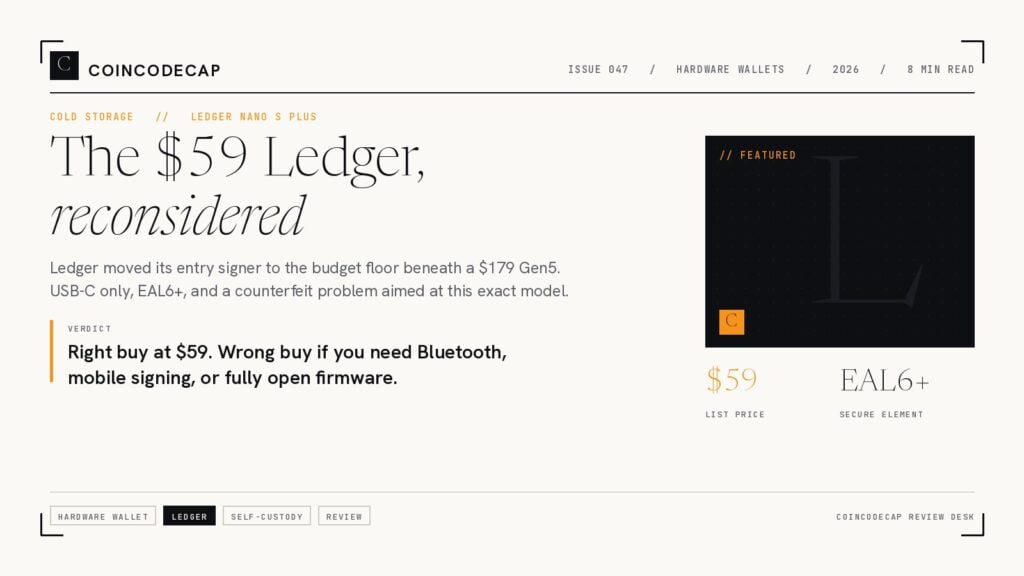
All Ledger devices use CC EAL5+ certified secure elements (BOLOS proprietary OS), support 5,500+ cryptocurrencies via Ledger Live, and integrate with Ledger Live mobile (iOS + Android) and Ledger Live desktop. Closed-source firmware core (this is a real trade-off vs Trezor’s full open-source).
Current 2026 Trezor Lineup
| Model | Price | Display | Connectivity | Key Differentiator |
|---|---|---|---|---|
| Trezor Safe 3 | $79 | OLED + 2 buttons | USB-C | Entry-level, replaced Trezor One, full open-source firmware, EAL6+ secure element (NEW) |
| Trezor Safe 5 | $169 | 1.54″ color touchscreen | USB-C | Color touchscreen, replaced Trezor T, EAL6+ secure element |
| Trezor Safe 7 | Premium tier | Larger color touchscreen | USB-C | Newest premium model, expanded features |
Trezor Safe family added CC EAL6+ secure elements — a major upgrade over the original Trezor One/T which lacked secure elements (and contributed to the Unciphered vulnerability disclosure). All Trezor devices use full open-source firmware (publishable on GitHub, reproducible builds), support 1,800+ cryptocurrencies, and integrate with Trezor Suite (desktop + mobile). No Bluetooth in the current Trezor lineup. SatoshiLabs (Trezor’s parent company) has partnered with Wasabi Wallet for CoinJoin integration — see our Wasabi Wallet review for the post-zkSNACKs landscape.
Head-to-Head: Ledger Nano S Plus vs Trezor Safe 3 ($79 each)
| Category | Winner | Reason |
|---|---|---|
| Coin Support | Ledger Nano S Plus | 5,500+ coins (Ledger Live) vs 1,800+ (Trezor Suite) |
| Open-Source Firmware | Trezor Safe 3 | Full open-source on GitHub vs Ledger’s closed-core BOLOS |
| Secure Element Tier | Trezor Safe 3 | CC EAL6+ vs Ledger’s CC EAL5+ (one tier higher) |
| Mobile App Maturity | Ledger Nano S Plus | Ledger Live mature on iOS + Android; Trezor Suite mobile is newer |
| Display | Tie | Both 128×64 OLED with 2 buttons |
| Build Quality | Ledger Nano S Plus | Brushed stainless steel + plastic vs Trezor’s reinforced plastic |
| Privacy / CoinJoin | Trezor Safe 3 | SatoshiLabs partnership with Wasabi for native CoinJoin integration |
| App Storage | Ledger Nano S Plus | More memory for installing multiple coin apps simultaneously |
| DeFi Integration | Ledger Nano S Plus | Broader MetaMask + WalletConnect ecosystem maturity |
| Trust History | Tie | Both brands have weathered 2023-2024 security events transparently (see security section below) |
Recommendation: For most users, both are excellent at $79. Choose Ledger Nano S Plus if you hold multi-chain portfolios (5,500+ coins matters), want broader DeFi integrations, or value mature mobile apps. Choose Trezor Safe 3 if you prioritize open-source firmware transparency, want the higher EAL6+ certification, or plan to use CoinJoin via Wasabi for Bitcoin privacy.
Head-to-Head: Ledger Stax vs Trezor Safe 5
This is a different-tier comparison: Ledger Stax is the premium $399 product; Trezor Safe 5 is the mid-tier $169 product. Both have color touchscreens but represent different price/feature philosophies.
| Category | Ledger Stax ($399) | Trezor Safe 5 ($169) |
|---|---|---|
| Display | 3.7″ curved e-ink touchscreen | 1.54″ color touchscreen |
| NFT Lock Screen | ✅ Display your NFTs as lock screen | ❌ Not available |
| Connectivity | USB-C + Bluetooth + NFC + wireless charging | USB-C only |
| Build | Premium aluminum unibody | Reinforced plastic |
| Coin support | 5,500+ | 1,800+ |
| Open-source | Closed-core firmware | Full open-source on GitHub |
| Secure element | CC EAL5+ | CC EAL6+ |
| Best for | Premium UX seekers, NFT collectors, users who value design | Open-source advocates, value-focused premium buyers |
Recommendation: If $399 fits your budget and you value premium build + NFT display + Bluetooth — Ledger Stax is genuinely the most polished consumer hardware wallet on the market. See our Ledger Stax review for the deep dive. If you want premium UX at less than half the price and value full open-source firmware — Trezor Safe 5 delivers excellent value at $169.
Major 2023-2024 Security Events (You Need to Know)
Ledger Connect Kit Hack (December 2023)
In December 2023, Ledger’s Connect Kit JavaScript library (used by many DeFi dApps to integrate Ledger hardware wallets) was compromised via a phishing attack on a former Ledger employee’s npm credentials. The malicious code was injected into the library and propagated to dApps for several hours before being detected and removed. Affected users who connected their Ledger to compromised dApps during the window saw funds drained — initial estimates suggested ~$600K stolen. Ledger responded transparently, restored the library, helped affected users recover where possible, and tightened employee security protocols. The Ledger hardware itself was never compromised — this was a software supply-chain attack on a JavaScript library used by integrating dApps, not a flaw in Ledger devices.
Ledger Recover Controversy (May 2023)
In May 2023, Ledger announced “Ledger Recover” — an optional paid service where users could split their seed phrase into encrypted shards stored across three custodians (Ledger, Coincover, EscrowTech). Critics argued this contradicted Ledger’s earlier marketing claims that seed phrases never leave the device, and raised concerns that Ledger COULD theoretically extract user seeds via firmware updates if compelled by law enforcement. The community backlash was significant. Ledger’s response: Recover is opt-in only; users who don’t enable it have identical security to before; no firmware can extract seeds without the user explicitly initiating Recover and providing biometric ID verification. Two years later, the controversy persists for some users — but no actual seed extractions have been reported.
Trezor SIM-Swap Attack on X Account (January 2024)
In January 2024, Trezor’s official X (Twitter) account was compromised via a SIM-swap attack on a SatoshiLabs employee. Attackers posted phishing links from the verified account for several hours before regaining control. This was a social media account compromise, not a hardware compromise — but users who clicked the malicious links and entered seed phrases lost funds. Trezor responded with a public post-mortem, tightened account security, and the X account has been secure since.
Unciphered Trezor T Vulnerability Disclosure (2023)
Security firm Unciphered demonstrated in 2023 that they could extract seeds from a Trezor Model T device with physical access using specialized lab equipment. The attack required hours of work with $50K+ equipment and was publicly disclosed with details. The vulnerability was specific to Trezor T’s lack of a secure element — the device used a general-purpose ARM Cortex-M microcontroller for key storage, which is more vulnerable to physical extraction than dedicated secure elements. Trezor’s response: the Safe 3 / Safe 5 / Safe 7 family was launched with EAL6+ certified secure elements specifically to address this class of attack. Old Trezor One/T devices remain vulnerable to a determined physical attacker — this is one of the strongest reasons to upgrade if you still own one.
What This Means for Your 2026 Purchase
- Both Ledger and Trezor have weathered 2023-2024 security events transparently — public post-mortems, user notifications, root-cause fixes
- The Ledger hardware itself has not been compromised — Connect Kit was a software supply-chain attack on a JavaScript library
- Old Trezor One/T are vulnerable to physical extraction (Unciphered) — current Safe family with EAL6+ secure elements addresses this
- Both brands are legitimate; the security events argue for buying CURRENT models (Nano S Plus / Stax / Trezor Safe family) rather than older inventory
2026 Modern Alternatives to Ledger and Trezor
The competitive landscape has changed significantly since 2023. Several new hardware wallet architectures now offer compelling alternatives to the traditional Ledger/Trezor single-key model:
| Alternative | Price | Architecture | Best For |
|---|---|---|---|
| Cypherock X1 | $99-$250+ | Vault + 4 NFC cards · 2-of-5 Shamir Secret Sharing · seedless | Multi-coin holders wanting distributed redundancy without seed phrases. See Cypherock X1 review |
| Tangem 3-Card | ~$70 | 3 NFC cards · multi-card clones (seedless) · 16,000+ coins | Beginners, mobile-first users, broadest chain coverage. See Tangem review |
| Arculus | $99 | Single metal NFC card · 3-Factor Authentication · CompoSecure (NASDAQ: CMPO) | Premium metal build at sub-$100. See Arculus review |
| Bitkey | $150 | True 2-of-3 multisig (Block Inc / NYSE: XYZ) · Bitcoin-only | Bitcoin holders wanting consumer-grade multisig with inheritance. See Bitkey review |
| COLDCARD | $158-$249 | Bitcoin-only · dual secure elements · 100% open-source · fully air-gap capable | Bitcoin maximalists wanting maximum security. See COLDCARD review |
| Foundation Passport | $259 | Bitcoin-only · fully air-gapped via QR codes (no USB on Core) | Bitcoin holders wanting premium air-gapped UX |
For broader hardware wallet context, see our best hardware wallets guide, best cold wallets guide, and multi-signature wallets guide.
2026 Comprehensive Pricing Comparison
| Model | Price (USD) | Tier |
|---|---|---|
| Tangem 3-Card | ~$70 | Budget |
| Ledger Nano S Plus | $79 | Entry |
| Trezor Safe 3 | $79 | Entry |
| Cypherock X1 Basic | $99 | Entry-Mid |
| Arculus | $99 | Entry-Mid |
| Ledger Nano X | ~$149 | Mid (Bluetooth) |
| Bitkey | $150 | Mid (multisig) |
| BitBox02 | ~$150 | Mid |
| COLDCARD Mk4 | $158-$178 | Mid (Bitcoin-only) |
| Trezor Safe 5 | $169 | Mid (touchscreen) |
| Cypherock X1 Standard | ~$159-$200 | Mid |
| Ledger Flex | $249 | Premium |
| COLDCARD Q | $249 | Premium (Bitcoin-only) |
| Foundation Passport | $259 | Premium (Bitcoin-only) |
| Ledger Stax | $399 | Premium (luxury) |
Decision Matrix: Which Hardware Wallet for Your Use Case?
- Beginner / first hardware wallet → Tangem 3-Card ($70) for seedless simplicity OR Ledger Nano S Plus ($79) for traditional model with mature ecosystem
- Multi-coin holder ($1,000-$25,000) → Ledger Nano S Plus ($79) for 5,500+ coins or Trezor Safe 3 ($79) for open-source firmware
- Multi-coin holder ($25,000+) → Cypherock X1 for distributed Shamir + 9,000+ coins, or Ledger Stax for premium UX + 5,500+ coins
- Bitcoin maximalist → COLDCARD Mk4/Q for sovereign self-custody, OR Bitkey for consumer multisig, OR Foundation Passport for premium air-gapped
- Privacy-focused Bitcoin user → Trezor Safe 3 + Wasabi Wallet for CoinJoin, or COLDCARD + Sparrow Wallet for power-user setup. See Wasabi Wallet review
- Mobile-first user → Tangem for seedless mobile UX, Arculus for premium metal NFC card, or Bitkey for Bitcoin-only mobile multisig
- NFT collector → Ledger Stax ($399) for NFT lock screen + Bluetooth + premium UX
- Open-source advocate → Trezor Safe 3 ($79) for full transparency, or COLDCARD for reproducible builds
- Multisig collaborative custody (Casa, Unchained) → COLDCARD + 2 other HW wallets for true M-of-N. See multisig wallets guide
- Inheritance planner → Bitkey for built-in inheritance features, or Casa multisig with documented succession plan
- Frequent traveler → Tangem for slim card form factor, or Ledger Nano X for Bluetooth flexibility
Frequently Asked Questions
Is Ledger or Trezor better in 2026?
Both legitimate, both audited. Choose Ledger if you want broader coin support (5,500+ vs 1,800+), mature mobile ecosystem (Ledger Live), Bluetooth (Nano X), or premium UX (Stax). Choose Trezor if you prioritize fully open-source firmware (vs Ledger’s closed-core), higher EAL6+ secure element certification (vs Ledger’s EAL5+), or planned CoinJoin integration via SatoshiLabs+Wasabi partnership. For most users at the $79 entry-level, both Nano S Plus and Safe 3 are excellent. The differentiation matters more at higher tiers — Ledger’s $399 Stax has no direct Trezor equivalent for premium UX.
What replaced the Trezor One and Trezor Model T?
Both were discontinued in 2024. Trezor One was replaced by Trezor Safe 3 ($79) — same form factor, but with added CC EAL6+ secure element (the One had no secure element). Trezor Model T was replaced by Trezor Safe 5 ($169) — touchscreen UX retained, color display added, secure element added. The Safe family launched specifically to address the secure element gap that Unciphered’s 2023 vulnerability disclosure highlighted. If you currently own a Trezor One or Model T, your funds are secure as long as the device remains in your physical possession — but upgrading to the Safe family is recommended for users worried about physical extraction attacks.
What replaced the original Ledger Nano S?
Ledger Nano S Plus ($79) replaced the original Nano S in 2022. The Plus has more memory for installing multiple coin apps simultaneously (the original Nano S had limited memory and required uninstalling apps to add new ones), USB-C connector (vs the original’s micro-USB), and a larger display. Same secure element architecture. For new buyers in 2026, the Nano S Plus at $79 is the entry-level Ledger recommendation. If you currently own an original Nano S, your funds are secure but you may want to upgrade for the better app management UX.
Trezor open-source vs Ledger closed-source — does it matter?
It depends on your threat model. For most users, the practical security of Ledger and Trezor is similar — both have EAL5+/EAL6+ secure elements, both have decade+ track records, both have weathered security events transparently. For users who specifically value: reproducibility (compile firmware yourself, verify what’s running), community auditability (third parties can review code for backdoors), or independence from manufacturer servers — Trezor’s full open-source firmware is meaningful. Ledger’s closed-core BOLOS proprietary OS argument is “the secure element vendor cryptographically signs firmware updates” — but this requires trusting Ledger’s signing process. For Bitcoin maximalists who want maximum transparency, COLDCARD’s reproducible builds + dual secure elements take this even further than Trezor.
Should I buy Ledger Stax or Trezor Safe 5?
Different price tiers. Ledger Stax ($399): premium 3.7″ e-ink touchscreen, NFT lock screen, Bluetooth + NFC + wireless charging, aluminum unibody. Trezor Safe 5 ($169): 1.54″ color touchscreen, USB-C only, reinforced plastic. Stax delivers premium UX at 2.4x the price. If $399 fits your budget and you value premium build + NFT display + Bluetooth — Stax is genuinely the most polished consumer hardware wallet on the market. If you want premium UX at less than half the price and value full open-source firmware — Safe 5 delivers excellent value. See our Ledger Stax review for the deep dive on what justifies the $399 price.
Are there better alternatives to Ledger and Trezor in 2026?
For specific use cases, yes. Cypherock X1 offers seedless distributed-key architecture (2-of-5 Shamir Secret Sharing) — superior to traditional seed phrase backup if you find seed management intimidating. Tangem offers seedless multi-card backup at $70 — cheapest serious hardware wallet with broadest chain coverage (16,000+ coins across 85+ chains). Bitkey offers true 2-of-3 multisig with built-in inheritance for Bitcoin holders — superior recovery model vs single-seed wallets. COLDCARD offers Bitcoin-only sovereignty with dual secure elements + reproducible builds — superior security for Bitcoin maximalists. For most users, Ledger or Trezor at $79 remains an excellent choice. For specific use cases (seedless backup, Bitcoin-only specialization, multisig), the alternatives have meaningfully changed the landscape since 2023.
Is the Ledger Connect Kit hack a reason to avoid Ledger?
No. The December 2023 Connect Kit hack was a software supply-chain attack on a JavaScript library used by integrating dApps — not a flaw in Ledger hardware. The attacker compromised a former Ledger employee’s npm credentials via phishing and injected malicious code into the Connect Kit library. Affected users who connected their Ledger to compromised dApps during a several-hour window saw funds drained (~$600K total). Ledger responded transparently with a public post-mortem, restored the library, helped affected users, and tightened employee security protocols. Users who didn’t interact with affected dApps during the window were never at risk. Two years later, Ledger Connect Kit is widely used and has not been compromised again. The Ledger hardware secure element architecture remains intact.
Is the Ledger Recover service safe?
Ledger Recover is opt-in only. If you don’t enable it, your wallet has identical security to before — your seed never leaves the device. If you DO enable Recover, your seed is encrypted and split into shards across three custodians (Ledger, Coincover, EscrowTech). The community concern (raised May 2023) was that Recover demonstrates Ledger’s firmware CAN be updated to extract seeds — this raised theoretical concerns about future government compulsion or vendor coercion. Ledger’s response: firmware updates require user consent and cannot extract seeds without the user explicitly initiating Recover and providing biometric ID verification. Two years later, no actual seed extractions have been reported. The decision to enable Recover comes down to your trust model: if you want institutional recovery as a backup, Recover provides it. If you want pure self-custody with no third-party servers ever touching anything, don’t enable it (your wallet works identically without it).
What’s the difference between Trezor Safe 3, Safe 5, and Safe 7?
Tiered product line. Trezor Safe 3 ($79): entry-level, OLED + 2 buttons, replaced Trezor One. Trezor Safe 5 ($169): mid-tier, 1.54″ color touchscreen, replaced Trezor Model T. Trezor Safe 7: newest premium model with expanded display. All three share the same security architecture (CC EAL6+ secure element, full open-source firmware, USB-C, no Bluetooth). Differences are display size + form factor + UX tier. For most users, Safe 3 at $79 is excellent. Safe 5 is worth the upgrade if you specifically want a color touchscreen for transaction verification. Safe 7 is for users wanting the largest display + premium feel.
Verdict: Ledger vs Trezor in 2026
Both Ledger and Trezor remain excellent choices in 2026. The decade+ track records, mature ecosystems, wide coin support, and substantial third-party integrations make either a legitimate self-custody starting point. The 2023-2024 security events (Ledger Connect Kit hack, Recover controversy, Trezor SIM-swap, Unciphered T vulnerability) were handled transparently by both companies, with root-cause fixes shipped in current product lines.
For most users, the $79 entry-level decision is between Ledger Nano S Plus (broader coin support, mature mobile) and Trezor Safe 3 (open-source firmware, EAL6+ certification). Both are excellent. For premium UX, Ledger Stax ($399) is the most polished consumer hardware wallet on the market. For a more value-focused premium tier, Trezor Safe 5 ($169) delivers most of the touchscreen UX at less than half the price.
The 2026 reality is that “Ledger vs Trezor” isn’t always the right question. For specific use cases, modern alternatives have meaningfully improved on the traditional single-key model: Cypherock X1 for distributed Shamir backup, Tangem for seedless mobile-first UX, Bitkey for consumer multisig, COLDCARD for Bitcoin maximalist sovereignty, Foundation Passport for Bitcoin air-gapped premium. Whichever you choose, buying direct from the manufacturer, verifying tamper-evident packaging, and testing recovery flows with small amounts before depositing significant funds remains the universal best practice.
Reviewed by Gaurav Agarwal, founder of CoinCodeCap. Direct hands-on experience with the current 2026 Ledger lineup (Nano S Plus, Nano X, Flex, Stax) and Trezor lineup (Safe 3, Safe 5, Safe 7). Status (Trezor One/T discontinued 2024 → Safe family with EAL6+ secure elements; Ledger Nano S replaced by Nano S Plus; Ledger Stax launched April 2024; Ledger Flex launched late 2024; Ledger Connect Kit hack December 2023; Ledger Recover controversy May 2023; Trezor SIM-swap X account January 2024; Unciphered Trezor T vulnerability disclosure 2023; SatoshiLabs+Wasabi CoinJoin partnership; modern alternatives Cypherock X1, Tangem, Arculus, Bitkey, COLDCARD, Foundation Passport) reflects direct research and verification through May 2026.
⚡ Bottom Line: 2026 Ledger vs Trezor comparison — both excellent, but the right product depends on your needs. Discontinued (do NOT buy): Trezor One, Trezor Model T, original Ledger Nano S. Current Ledger: Nano S Plus ($79), Nano X (~$149), Flex ($249), Stax ($399). Current Trezor: Safe 3 ($79), Safe 5 ($169), Safe 7. Best for most users: Ledger Nano S Plus or Trezor Safe 3 at $79 — both excellent. Best premium: Ledger Stax ($399) for premium UX, Trezor Safe 5 ($169) for value. Modern alternatives meaningfully changed the landscape: Cypherock X1 (seedless Shamir), Tangem (cheapest seedless), Bitkey (Bitcoin multisig), COLDCARD (Bitcoin maximalist). Both Ledger and Trezor weathered 2023-2024 security events transparently — buy current models, not old inventory.
Related Reading
📋 Single-Wallet Reviews: Ledger Stax Review | Cypherock X1 Review | Tangem Wallet Review | Arculus Wallet Review | Bitkey Review | COLDCARD Review | Wasabi Wallet Review | Coinbase Wallet Review
📋 Wallet Roundups by Type: Best Crypto Wallets (Pillar) | Best Hardware Wallets | Best Cold Wallets | Best Multisig Wallets | Best Non-Custodial Wallets | Best Staking Wallets | Best Smart Contract Wallets
🌍 Regional Wallet Guides: Canada | UAE | Germany | India
🔧 Wallet Roundups by Chain: Ethereum | Solana | Cardano | Monero | Anonymous Bitcoin
📘 Wallet Education: Different Types of Crypto Wallets