Disclosure: CoinCodeCap earns a commission if you open an account through the Kraken, Xapo Bank, Binance or Coinbase buttons on this page, and that can influence which products we feature. We have no deal with CryptoStake. Every fee and rate below comes from the provider’s own pages.
Stake Solana through Coinbase and Coinbase keeps 35% of what the network pays you. Kraken keeps 25% to 30%. Binance takes 10% on Ethereum. Most lists of the best crypto staking platforms print the headline yield and leave that cut out, so this one starts with it.
We checked five platforms against their own fee pages on 2 October 2026. Xapo Bank, and parts of Binance Earn, pay interest instead of network rewards, and we flag that wherever it matters. Gemini Earn and Vauld were on the old version of this list. Both froze customer withdrawals in 2022, so they’re gone.
How we reviewed this: commissions, lock-ups and rates were read on 2 October 2026 from Kraken’s support pages (last updated 19 August 2026), Coinbase’s fee disclosures, Binance Earn, CryptoStake’s rate table and Xapo Bank’s site. We did not deposit funds, so nothing below describes payout speed or support. The page was researched and drafted with AI assistance, and every figure was re-checked against those sources before publication.
TL;DR: Kraken is the best all-round pick, with more than 20 assets and a 25% to 30% cut of rewards. Xapo Bank is for Bitcoin holders, who can’t stake at all: it pays 4.1% on dollars (4.6% for a new member’s first 90 days) and 0.25% on BTC, but charges $1,000 per year. CryptoStake suits people who want to hold their own keys. Binance has the widest menu and doesn’t accept US residents. Coinbase is the simplest to use and the most expensive, at 35%.

5 best crypto staking platforms compared
| Platform | What it is | Its cut | Getting out | Best for |
|---|---|---|---|---|
| Kraken | Custodial exchange | 30% flexible, 25% bonded under $1M | Any time on flexible; 3+ days on bonded | Most people |
| Xapo Bank | Licensed bank paying interest | $1,000 per year to be a member | No lock-up on USD Savings | Large Bitcoin balances |
| CryptoStake | App where you hold the keys | Not published on its site | Instant (ADA) to 28 days (AVAIL) | Self-custody |
| Binance | Custodial exchange | 10% on ETH rewards | Flexible or fixed terms | Widest choice, outside the US |
| Coinbase | Custodial exchange | 35%, or 25.25% to 31.75% with Coinbase One | Free after unbonding, or pay to exit at once | Beginners |
What the platform’s cut costs you
Say a network pays 6% per year and you put in $10,000. Here’s what is left after each platform takes its share.
| Platform and tier | Cut of rewards | Your rate | You earn per year |
|---|---|---|---|
| Kraken bonded, under $1M | 25% | 4.50% | $450 |
| Coinbase One Premium | 25.25% | 4.49% | $448.50 |
| Kraken flexible or Auto Earn | 30% | 4.20% | $420 |
| Coinbase standard | 35% | 3.90% | $390 |
The 6% is only an example; real network rates move daily. The gap between the first and last row is $60 per year on $10,000, and it grows with your balance. One catch on Kraken’s flexible tier: on assets with an unbonding period it earns rewards on only up to half of what you put in, so the real flexible yield is lower than the 4.20% shown.
1. Kraken: best all-round pick
Kraken lets you stake more than 20 assets, from ETH and SOL to newer ones such as HYPE and SUI, and it prints its cut in plain numbers. On flexible staking and Auto Earn it keeps 30% of rewards. Bonded is cheaper: 25% if you have under $1 million staked, 20% from $1 million to $5 million, 10% up to $50 million, 5% up to $100 million and nothing above that.
Flexible means you can pull your coins out at any time. Bonded pays the full network rate, less the commission, but you wait out the unbonding period, which Kraken puts at three days or more depending on the asset. Rewards arrive once per week.
Kraken also offers Bitcoin staking through Babylon. Read the terms before you get excited. Rewards come in Babylon’s BABY token instead of BTC, Kraken takes 10% to 26%, and bonded BTC needs about seven days to release. It’s open to customers in the US (except Maine and New York), the UK, Australia and the UAE.
There’s history here. In February 2023 Kraken shut its US program and paid $30 million to settle with the SEC. It has since brought the service back for US customers, though what you see depends on where you live. Our Kraken review covers the exchange as a whole.
2. Xapo Bank: up to 4.6% on USD, paid in Bitcoin
Bitcoin runs on proof of work, so you can’t stake it the way you stake ETH. Xapo Bank is our pick for holders who want their BTC to earn anyway. It’s a bank regulated by the Gibraltar Financial Services Commission, and it pays interest on Bitcoin and on US dollars. That interest lands in BTC every day, which makes it a different product from the other four here (we compare the two models in crypto lending vs crypto staking).
Dollars earn the most. A new member who pays the fee between 22 September and 23 October 2026 gets 4.6% per year on the first $100,000 in USD Savings for 90 days. On a full $100,000 that comes to about $1,100, which covers the first year’s fee. After the 90 days the rate is a variable 4.1%, or $4,100 per year on the same balance. Xapo pays the interest in BTC, so a cash balance slowly turns into sats without you having to buy any. The Bitcoin Savings account pays 0.25% per year, and Xapo says it never lends those coins out.
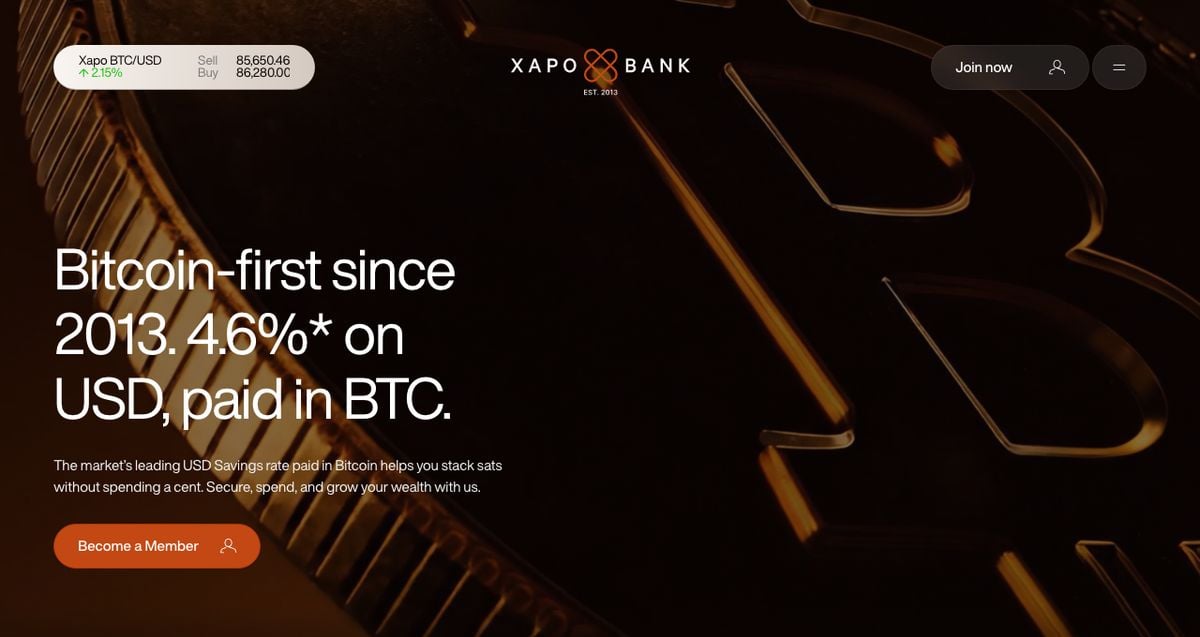
Then there’s the fee. Xapo charges $1,000 per year to be a member, which means the maths only works on bigger balances: at 4.1% you’d need about $24,400 in USD Savings before the interest covers the fee, and on Bitcoin alone, at 0.25%, you’d need $400,000 worth. Below those numbers the fee costs more than you earn.
- Xapo offers a full refund of the fee if you leave within the first 30 days.
- USD Savings has no lock-up, and both accounts pay interest daily.
- A separate BTC Credit Fund targets up to 4% per year by lending Bitcoin out. Xapo calls that figure a target and doesn’t guarantee it.
- The Gibraltar Deposit Guarantee Scheme covers dollar balances up to the equivalent of £120,000. It doesn’t cover Bitcoin balances or the Credit Fund.
- Everything runs through Xapo’s own app, on Android and iOS.
3. CryptoStake: best for holding your own keys
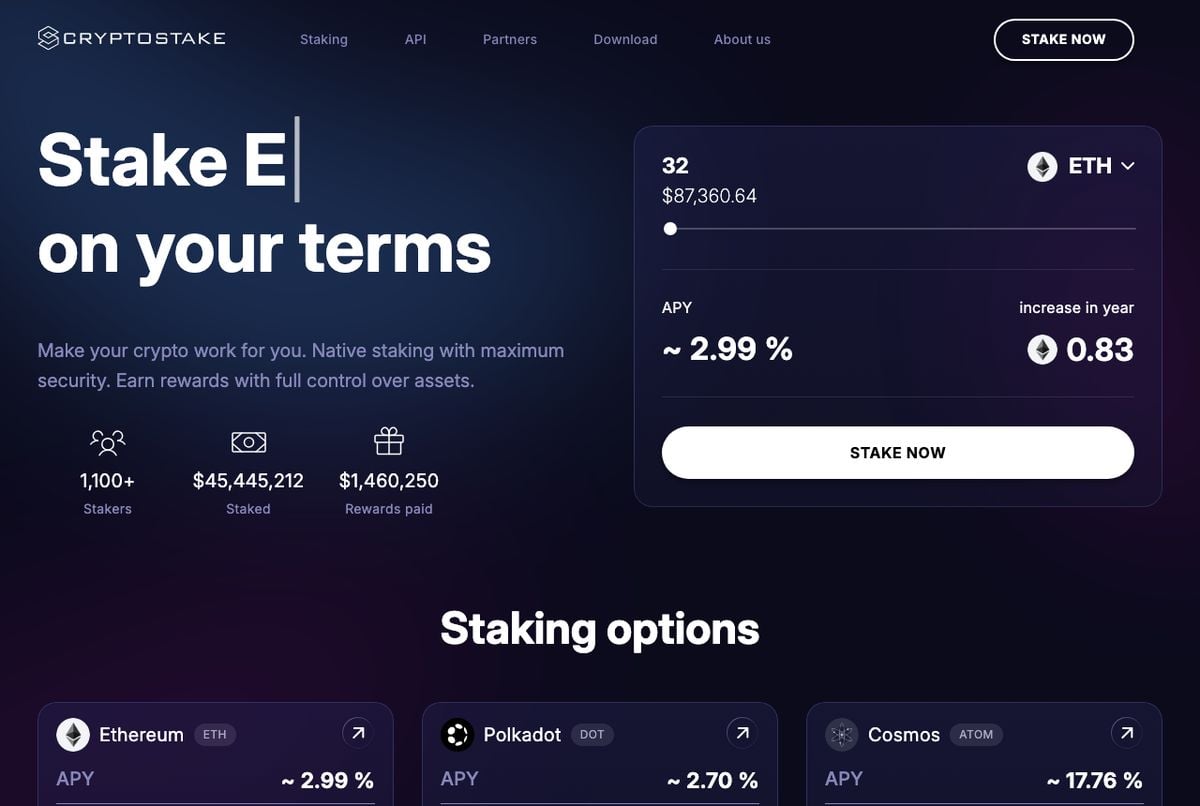
CryptoStake is the only option here that doesn’t take custody of your coins. It’s an app from a company based in Zug, Switzerland, that runs its own validators and says you keep full control of your assets while they earn. The company also says Hacken audited the platform.
It’s small. The site counted just over 1,100 stakers and $45.4 million staked when we looked on 2 October 2026, with $1.46 million paid out in rewards so far. Two of the minimums are steep: 32 ETH and 288 DOT.
| Network | Estimated APY | Minimum | Time to unstake |
|---|---|---|---|
| Ethereum (ETH) | 2.99% | 32 ETH | 9 days |
| Polkadot (DOT) | 2.70% | 288 DOT | 3 days |
| Cosmos (ATOM) | 17.76% | 10 ATOM | 21 days |
| Cardano (ADA) | 1.34% | 10 ADA | Instant |
| Solana (SOL) | 2.63% | 1 SOL | 5 days |
| NEAR | 4.86% | 50 NEAR | 4 days |
| Avail (AVAIL) | 9.19% | 1,350 AVAIL | 28 days |
CryptoStake’s homepage doesn’t publish its commission, so treat those rates as estimates and confirm the net figure in the app before you commit. Look at the exits too. Twenty-one days for ATOM and 28 for AVAIL is a long time to sit through a falling market. We go deeper in our CryptoStake review.
4. Binance: widest choice outside the US
Binance Earn covers more than 300 assets, far more than anyone else on this list. Not all of it is staking. The Earn menu mixes on-chain products (ETH Staking, SOL Staking) with Flexible and Locked savings products and riskier ones such as Dual Investment, so check which one you’re buying.
ETH Staking showed a reference APR of 2.21% on 2 October 2026, and Binance takes a 10% fee on ETH rewards before it pays them out. You get WBETH in return, a token that gains value against ETH as rewards build up, and you can trade it or use it as collateral in the meantime. Locked SOL showed 4.3%, and flexible BTC paid up to 0.26%.
The same Earn page advertises ranges as high as 104.62% on ETH. We couldn’t tie those figures to plain staking, where the reference rate is 2.21%, so we’d leave them out when you compare platforms.
Binance.com doesn’t accept US residents, who are sent to the separate Binance.US. For more detail, see our Binance review and the guide to how safe it is to stake on Binance.
5. Coinbase: easiest to use, highest cut
Coinbase is the easiest place to start and the most expensive. There’s no fee to stake, but Coinbase keeps 35% of the rewards on ADA, ATOM, AVAX, DOT, ETH, MATIC, SOL and XTZ. The rate you see in your account is already net of that.
A Coinbase One subscription lowers the cut on six of those assets: 31.75% on the Basic tier, 28.5% on Preferred and 25.25% on Premium. Even the top tier only gets you to roughly what Kraken charges everyone on bonded.
Leaving is free if you wait out the network’s unbonding period. If you want out at once, Coinbase charges an instant-unstake fee and shows it when you ask. Our Coinbase review and the Kraken vs Coinbase comparison cover the rest of the exchange.
4 ways it can go wrong
Rewards come from proof of stake networks paying validators to confirm transactions (our guide to how it works covers the mechanics). Four things can cost you money along the way.
- The coin’s price can fall by more than you earn. A 5% yield doesn’t help much in a 40% drop.
- You can’t always leave quickly. On the platforms above, unbonding runs from three days to 28.
- Validators that break the rules get slashed, which means the network takes part of the stake. Kraken lists this among its own risk warnings.
- The platform itself can fail while it holds your coins.
That last one is why two names left this list. Gemini Earn stopped withdrawals on 16 November 2022 when its lending partner Genesis froze, and customers waited until May 2024 to get their assets back. Vauld halted withdrawals on 4 July 2022. Both were lending products sold under an “earn” label, so the table at the top now marks interest accounts apart from staking.
If you’d rather not hand coins to a company at all, liquid staking and staking from your own wallet are the alternatives.
Tax on staking rewards
In the US, rewards are income. Under IRS Revenue Ruling 2023-14, you report their fair market value in the year you gain control of them, and that includes rewards earned through an exchange. We covered the decision in our report on the IRS ruling. Other countries treat them differently, so check local rules, or use crypto tax software to log each payout.
Pros and cons of using a platform
| ✅ Pros | ❌ Cons |
|---|---|
| No validator hardware to run, and no need for 32 ETH on an exchange | The platform keeps 10% to 35% of your rewards |
| One account covers many networks: 20+ on Kraken, 300+ assets on Binance Earn | Your coins sit with a custodian, except on CryptoStake |
| Rewards arrive on their own, weekly on Kraken | Unbonding can take up to 28 days |
| Flexible options let you leave at any time | Rates are variable and never guaranteed |
Expert tip: before you pick by APY, check two numbers the rate table won’t show you: the platform’s cut and the time it takes to get out. A 25% commission with a three-day exit can beat a higher headline rate that you can’t leave for four weeks.
6 questions about crypto staking platforms
Which crypto staking platform is best for beginners?
Coinbase is the simplest to use, but it keeps 35% of your rewards. Kraken takes a little more setup and charges 25% on bonded balances or 30% on flexible ones, which leaves you with more.
Can you stake Bitcoin?
Not directly, because Bitcoin uses proof of work. Kraken offers a Babylon-based product that pays its rewards in the BABY token. Interest accounts are the other route: Xapo Bank pays 0.25% per year on BTC, and Binance’s flexible product paid up to 0.26% on 2 October 2026.
How much do staking platforms charge?
They take a share of what you earn. Coinbase keeps 35%, or 25.25% to 31.75% for Coinbase One members. Kraken keeps 30% on flexible and 25% on bonded balances under $1 million. Binance takes 10% on ETH rewards. Xapo Bank charges a flat $1,000 per year instead.
Is crypto staking safe?
It carries real risk. The coin’s price can drop, your funds can be stuck for days or weeks while they unbond, validators can be slashed, and a custodial platform can fail. Gemini Earn and Vauld each stopped paying customers out in 2022.
How long does it take to unstake?
It depends on the network. On CryptoStake, ADA is instant, SOL takes 5 days, ATOM 21 and AVAIL 28. Kraken puts bonded exits at three days or more. Coinbase lets you skip the wait for a fee.
Are staking rewards taxed?
In the US, yes. IRS Revenue Ruling 2023-14 treats them as income at fair market value in the year you gain control of them, whether you earn them on your own or through an exchange. Rules differ in other countries.
Bottom line: for most people, Kraken is the place to start. It has a wide asset list and a published commission that undercuts Coinbase. Pick Xapo Bank only if you hold enough Bitcoin or dollars for the $1,000 fee to make sense, CryptoStake if self-custody matters more to you than convenience, Binance if you live outside the US and want the widest menu, and Coinbase if ease of use is worth a 35% cut. Whichever you choose, compare the cut and the exit time before the headline rate.
Checked 2 October 2026 against Kraken’s support pages, Coinbase’s fee disclosures, Binance Earn, CryptoStake’s site and Xapo Bank’s site. Rates and commissions change, so confirm them with the provider before you deposit. Crypto prices are volatile and rewards aren’t guaranteed. Nothing here is financial advice.
Related reading
Reviews of the platforms above
- Kraken review (fees, security and funding)
- Kraken staking review (a closer look at the rewards program)
- Binance review (the full exchange)
- Coinbase review (pricing and ease of use)
- CryptoStake review (the wallet app, step by step)
How it works
- Crypto staking guide (the basics from scratch)
- Proof of stake explained (why some coins pay rewards)
- Liquid staking (earning while your coins stay tradable)
- Coinbase staking guide (a walkthrough)
What to stake and where to hold it
- Best crypto staking coins (by yield and risk)
- 10 best cryptocurrencies for staking (a longer list)
- Best crypto wallets for staking (self-custody options)
- 5 best apps for crypto staking (phone-first picks)
Exchange comparisons
- Binance vs Kraken (fees and features side by side)
- Kraken vs Coinbase (which suits US users)
- Binance vs Coinbase (range against simplicity)
- Best crypto exchanges (our full ranking)
Lending, interest and tax
- Crypto lending vs crypto staking (how the risks differ)
- Crypto lending platforms (interest accounts and loans)
- Best crypto tax software (for tracking reward income)
- IRS ruling on staking rewards (the 2023 decision)