Disclosure: CoinCodeCap may earn a commission if you sign up through links on this page. Risk warning: Indian exchange-integrated wallets are custodial — the exchange holds your private keys. Self-custody wallets put YOU in control. Lose your seed phrase and your Bitcoin is gone permanently. Both Indian exchanges (CoinDCX July 2025, WazirX July 2024) and global wallets (Atomic Wallet June 2023) have suffered major hacks in recent years. For meaningful holdings, keep funds in a self-custody hardware wallet, not on an exchange.
How I Picked These Wallets: I tested each Indian exchange and self-custody wallet from an India-based account, completed KYC where required, ran INR deposits via UPI, made test BTC purchases and withdrawals, verified TDS deduction handling, and checked FIU-IND registration status. For self-custody options, I tested seed phrase setup, hardware wallet pairing, and Indian customs/import logistics. The wallet landscape changed significantly in 2024–2025 — this guide reflects May 2026 reality including the post-WazirX-hack environment, CoinDCX’s July 2025 incident, and Binance/Coinbase’s re-entry into the Indian market.
The 2026 Indian Bitcoin wallet landscape is meaningfully different from even two years ago. WazirX — once the most popular Indian exchange and a wallet I’d previously recommended — suffered a $234.9 million hack in July 2024 and remains in court-supervised restructuring with phased withdrawals. CoinDCX had its own incident in July 2025 ($44.2M lost from a hot wallet via insider social engineering), though customer funds were absorbed by the company. Atomic Wallet lost over $100M to a hack in June 2023. The clear lesson: don’t keep meaningful Bitcoin on any exchange wallet, Indian or otherwise.
This guide covers two distinct wallet categories Indian users actually need: Indian exchange-integrated wallets (CoinDCX, ZebPay, Mudrex, CoinSwitch, Bitbns, Unocoin) for INR onramp and small trading balances, and self-custody wallets (Ledger, Trezor, NGRAVE Zero, MetaMask, Trust Wallet, Phantom) for serious holdings. I also cover what to avoid, the 1% TDS rule, the 30% tax framework, and how to legally use both types together. For broader context, see our best hardware wallets roundup and our best Ethereum wallets guide.
| Wallet | Type | Custody | Best For |
|---|---|---|---|
| CoinDCX | Indian exchange wallet | Custodial | Active traders, INR onramp, BitGo cold storage |
| ZebPay | Indian exchange wallet | Custodial | Long-time users, 98% cold storage, since 2014 |
| Mudrex | Indian exchange wallet | Custodial | Beginners, Coin Sets, SIP-style investing |
| CoinSwitch | Indian exchange wallet | Custodial | Simplest mobile UX, beginners |
| Bitbns | Indian exchange wallet | Custodial | Pro traders, futures, deep liquidity |
| Unocoin | Indian exchange wallet | Custodial | BTC-focused, oldest Indian exchange (2013) |
| Ledger Stax / Flex / Nano S Plus | Hardware wallet | Self-custody | Long-term BTC holders |
| Trezor Safe 3 / Safe 5 | Hardware wallet | Self-custody | Open-source advocates |
| NGRAVE Zero | Premium hardware wallet | Self-custody | EAL7-certified, air-gapped, large holdings |
| MetaMask | Software wallet | Self-custody | Ethereum + L2s + EVM-compatible BTC |
| Trust Wallet | Software wallet | Self-custody | Mobile multi-chain, 70+ chains |
| Phantom | Software wallet | Self-custody | Multi-chain (BTC + SOL + ETH) in one app |
| 📌 My quick verdict — CoinDCX or ZebPay for INR onramp, Ledger Stax or Flex for cold storage. Don’t keep meaningful BTC on any Indian exchange. | |||
Indian Crypto Tax Rules You Need to Know First
Before picking a wallet, understand the tax framework. Crypto isn’t illegal in India, but it’s heavily taxed — and how you use your wallet directly affects what you owe.

- 30% flat tax on crypto gains. No offsets against losses, no indexation benefits. Every profitable trade is taxed at 30% plus applicable cess.
- 1% TDS on every crypto transfer. Section 194S deducts 1% at source on transfers exceeding ₹50,000/year (individuals) or ₹10,000/year (business income). FIU-registered Indian exchanges deduct this automatically. Foreign exchanges and self-custody transactions leave you responsible for compliance.
- 18% GST on platform fees. The fees you pay an exchange are themselves taxed at 18% GST.
- FIU-IND registration mandatory. Legal Indian crypto platforms must register with the Financial Intelligence Unit – India. CoinDCX, ZebPay, Mudrex, CoinSwitch, Bitbns, Unocoin, Binance India, and Coinbase India are all FIU-registered as of May 2026.
- KYC required everywhere legal. PAN + Aadhaar + selfie is the standard onboarding requirement.
- UPI deposits restored. RBI-related blocks were lifted, and major Indian exchanges accept UPI, IMPS, NEFT, and bank transfer deposits for INR.
The practical implication: if you trade frequently, use an FIU-registered Indian exchange that handles TDS automatically. If you HODL long-term, the only sane choice is self-custody — moving from an Indian exchange into a hardware wallet is a transfer (TDS applies once on the way out), but after that, you’re not generating taxable events until you sell. For deeper tax guidance, consult a Chartered Accountant who specializes in crypto.
⚠️ Wallets to Avoid in 2026
Before recommendations, these are the wallets I would not put meaningful Bitcoin into right now:
- WazirX Wallet. ❌ $234.9M hack in July 2024. Still under court-supervised restructuring as of late 2025, with phased token distributions and a planned restart. WazirX retains a large user base and INR liquidity, but I would not store significant Bitcoin there until the restructuring concludes and a clean security audit is published. If you have funds stuck in WazirX, follow the restructuring updates closely.
- Atomic Wallet. ❌ $100M+ hack in June 2023. Multiple users lost funds across multiple chains. The team continued operating but the reputation damage is severe and I haven’t seen a sufficiently strong post-mortem to recommend it again. Use any other self-custody wallet instead.
- Any wallet asking for your seed phrase to “verify” or “import.” ❌ Phishing. No legitimate wallet ever asks for your seed phrase outside the initial setup flow you yourself initiated. India has been a particular target for crypto phishing scams in 2024–2025.
- Random “Indian crypto wallet” apps from Play Store/App Store with under 50K downloads and no FIU registration. ❌ The Indian crypto space has had a wave of fake-wallet apps that simply steal deposits. Stick to FIU-registered exchanges or established global self-custody wallets only.
Indian Exchange-Integrated Wallets (Custodial, INR-Native)
These are the FIU-registered Indian exchanges where you can deposit INR via UPI, buy Bitcoin, and store it in their integrated custodial wallet. All require KYC. All deduct 1% TDS automatically. All charge 18% GST on fees. Use these for INR onramp and active trading — not for long-term storage.
1. CoinDCX — Most Popular, Despite the 2025 Incident
CoinDCX is India’s largest crypto exchange by user count (16M+ as of early 2025), supports 500+ cryptocurrencies including Bitcoin, and is one of the most feature-complete platforms — spot, futures, margin, lending, staking, all in one app. The integrated wallet uses BitGo-insured cold storage for the bulk of customer funds. Trading fees range from 0.04% to 0.50% based on 30-day volume. UPI, IMPS, NEFT all supported for INR deposits.
The honest part: On July 19, 2025, CoinDCX was hacked for $44.2 million. A hot wallet used for day-to-day operations was compromised after a CoinDCX engineer was duped via a fake freelance job offer into installing malware on his work laptop. CoinDCX absorbed the loss, customer funds were said to be unaffected, and the company posted a bounty of up to $11M (25% of recovered funds). The incident demonstrates that even the largest Indian exchanges can be compromised — and reinforces the rule of moving meaningful holdings off-exchange into self-custody.
- ✅ India’s largest exchange — 16M+ users, deepest liquidity
- ✅ FIU-registered, automatic 1% TDS deduction
- ✅ 500+ cryptocurrencies, futures + margin + spot + staking
- ✅ BitGo-insured cold storage for bulk of customer funds
- ✅ INR onramp via UPI, IMPS, NEFT — fast and free
- ⚠️ July 2025 $44M hot wallet hack (customer funds said to be safe; bounty posted)
- ⚠️ Trading fees 0.04–0.50% — higher than MEXC or some global competitors
- 📌 Best for: Active Indian traders, INR onramp, broadest coin selection
2. ZebPay — Oldest, Security-Focused Indian Exchange
ZebPay launched in 2014 and is one of India’s oldest and most security-conscious crypto exchanges. The pitch: 98% of customer funds in cold storage, signed via HSM (Hardware Security Module) on air-gapped machines, with their proprietary Omnitrixx security protocol. Supports 300+ cryptocurrencies, SIP-style recurring buys (great for long-term BTC accumulation), staking, and crypto lending. Trading fees start at 0.5% (higher than CoinDCX). UPI deposits, INR withdrawals via bank transfer.
- ✅ Operational since 2014 — longest track record in Indian crypto
- ✅ 98% cold storage, HSM-signed, Omnitrixx security protocol
- ✅ FIU-registered, automatic TDS deduction
- ✅ SIP-style recurring buys — automate BTC accumulation
- ✅ 300+ cryptocurrencies, staking, lending
- ⚠️ Trading fees from 0.5% — higher than CoinDCX
- ⚠️ No derivatives (futures) for Indian users
- 📌 Best for: Long-time users, security-first beginners, SIP investors
3. Mudrex — Beginner-Friendly with Coin Sets
Mudrex is the platform that’s grown most among Indian crypto beginners in 2024–2026. The differentiator: Coin Sets — pre-built, professionally curated baskets of cryptocurrencies organized by theme (DeFi, Metaverse, top-50 large-caps, memecoins, etc.) that let you invest with one click instead of picking individual coins. Mudrex Earn offers staking on 40+ tokens (ETH, SOL, AVAX, DOT, more) with no minimum or lock-in. SIP investing from ₹100. 650+ cryptocurrencies supported.
Recent news: Mudrex briefly halted withdrawals from January 11 to January 28, 2025, which created some user concern. The platform resumed normal operations after this period. Trading fees are 0.25% maker/taker, with futures fees as low as 0.03%/0.12% on the Alpha Program. FIU-registered.
- ✅ Coin Sets — themed baskets for one-click portfolio diversification
- ✅ Mudrex Earn — staking on 40+ tokens, no minimums or lock-ins
- ✅ SIP-style investing from ₹100
- ✅ 650+ cryptocurrencies, futures with up to 100x leverage
- ✅ FIU-registered, automatic TDS deduction
- ⚠️ Briefly halted withdrawals Jan 11–28, 2025 (resumed normal operations)
- ⚠️ Coin Set rebalancing fees 0.25–1% — affects long-term returns
- 📌 Best for: Beginners wanting curated baskets, passive SIP investors
4. CoinSwitch — Simplest UX for Beginners
CoinSwitch evolved from an exchange aggregator into a full FIU-registered Indian crypto platform with one of the cleanest, simplest mobile UXs of any Indian exchange. If you’re brand new to crypto and find CoinDCX or Bitbns overwhelming, CoinSwitch is the gentler entry point. Supports 170+ cryptocurrencies, INR onramp via UPI, automatic TDS deduction. Less feature-rich than CoinDCX (no advanced charting, limited futures), but for buy-and-HODL-and-occasional-sell users, it’s enough.
- ✅ Simplest mobile UX in Indian crypto
- ✅ FIU-registered, automatic TDS deduction
- ✅ 170+ cryptocurrencies, instant INR onramp via UPI
- ✅ Educational content for newcomers
- ⚠️ Limited advanced trading tools — no margin, limited futures
- ⚠️ Smaller coin selection than CoinDCX or Mudrex
- 📌 Best for: Absolute beginners, simple buy-and-hold users
5. Bitbns — Pro Trader Choice
Bitbns has quietly become one of the highest-volume Indian exchanges by trading activity. The platform leans pro-trader — professional-grade trading terminal, futures with margin, advanced order types, and competitive fees (0.2% maker / 0.3% taker base, scaling down with volume). Supports 400+ cryptocurrencies. FIU-registered. Free INR deposits via bank transfers. The mobile app is functional but less polished than CoinSwitch or Mudrex.
- ✅ Pro-grade trading terminal with advanced order types
- ✅ Crypto and altcoin futures with margin
- ✅ Competitive fees: 0.2%/0.3% base, scaling with volume
- ✅ 400+ cryptocurrencies
- ✅ Free INR deposits via bank transfers
- ⚠️ Mobile app less polished than CoinSwitch/Mudrex
- ⚠️ Less ideal for absolute beginners
- 📌 Best for: Active Indian traders, futures users, advanced order types
6. Unocoin — India’s Oldest Crypto Platform
Unocoin launched in 2013 — older than ZebPay — and remains the most BTC-focused Indian platform. It’s not the right pick if you want to trade 500 altcoins; it’s the right pick if you specifically want a simple, Bitcoin-first Indian wallet with INR onramp. AES-256 encryption on key storage, multi-storage point architecture, 2FA / OTP authentication. Mobile-first (Android + iOS). The wallet also supports recharges for phone bills and DTH services through stored crypto, which is a niche but useful Indian feature.
- ✅ Operating since 2013 — oldest Indian crypto platform
- ✅ Bitcoin-focused (cleaner pick if you only want BTC)
- ✅ AES-256 encryption, multi-storage architecture, 2FA/OTP
- ✅ Phone bill / DTH recharge from crypto wallet (niche India feature)
- ✅ FIU-registered
- ⚠️ Smaller coin selection than competitors
- ⚠️ Slightly higher market spreads due to lower liquidity
- 📌 Best for: Bitcoin-only HODLers, conservative long-time users
Self-Custody Hardware Wallets (For Long-Term BTC Holdings)
For any meaningful Bitcoin balance — anything more than a few months’ trading float — pair an Indian exchange with a self-custody hardware wallet. The Indian customs reality: hardware wallets are legal to import. Most users buy through Amazon India (where Ledger and Trezor have official India listings) or directly from manufacturers with shipping to India. Customs duty applies on direct international orders.
7. Ledger (Stax / Flex / Nano S Plus / Nano X) — Most Popular Globally
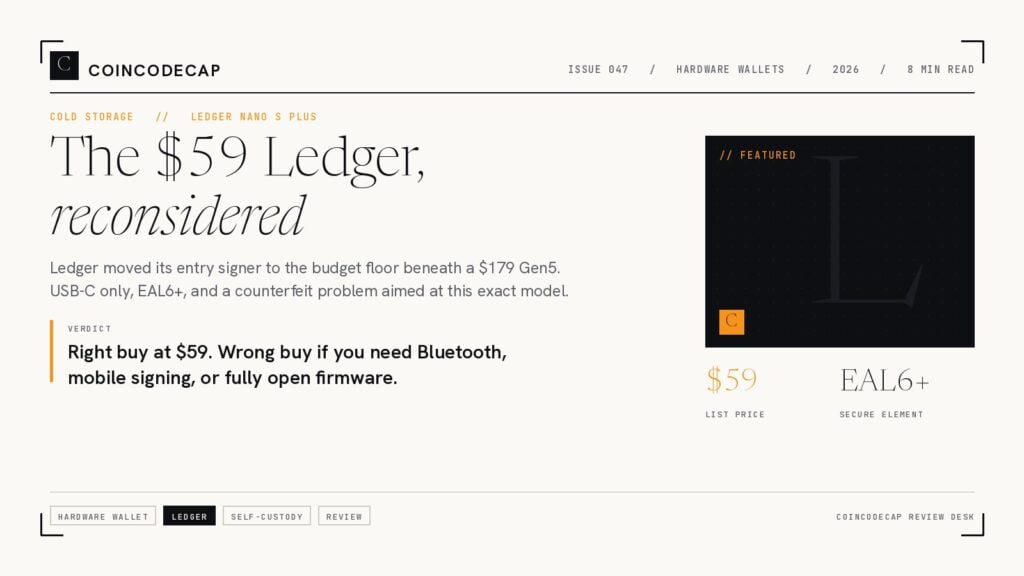
Ledger is the largest hardware wallet brand in the world and the most accessible option for Indian buyers. The 2026 lineup: Ledger Stax (curved E-ink touchscreen, premium ~₹35,000), Ledger Flex (smaller E-ink touchscreen ~₹22,000), Ledger Nano X (Bluetooth ~₹13,000), and Ledger Nano S Plus (entry-level USB ~₹7,500). All four use Ledger’s certified Secure Element chip. Available on Amazon India with proper authorization, plus direct shipping from Ledger.com (with customs duty).
- ✅ Most-supported hardware wallet — works with every major BTC and ETH wallet
- ✅ 4-tier lineup from ~₹7,500 (Nano S Plus) to ~₹35,000 (Stax)
- ✅ Available on Amazon India through authorized listings
- ✅ Ledger Live: companion app, manage assets, swap, stake
- ✅ CC EAL5+ Secure Element chip — the highest commercial certification tier
- ⚠️ Closed-source firmware (Trezor is open-source)
- ⚠️ 2020 customer database leak (not key material, but addresses leaked) — relevant context
- 📌 Best for: Long-term BTC holders, broad ecosystem support, mainstream users
8. Trezor (Safe 3 / Safe 5) — Open-Source Alternative
Trezor’s 2026 lineup is the Safe 3 (~₹7,500, button-based, secure element added in this generation) and Safe 5 (~₹16,000, color touchscreen). Both replaced the older Model One and Model T from the 2021 era. Trezor’s distinguishing pitch is open-source firmware — the entire codebase is publicly auditable, which appeals to security-conscious users who don’t want to trust closed-source binaries. Optional Shamir Backup splits your seed across multiple shares for distributed recovery. Available on Amazon India and direct from Trezor.io.
- ✅ Open-source firmware — fully auditable
- ✅ Safe 3 entry-level (~₹7,500) and Safe 5 premium (~₹16,000)
- ✅ Secure element chips added in Safe series (older Model One/T lacked this)
- ✅ Optional Shamir Backup — split seed across multiple shares
- ✅ Strong reputation in self-custody community
- ⚠️ Older Model One and Model T discontinued — buy current Safe series only
- ⚠️ Smaller in-app ecosystem than Ledger Live
- 📌 Best for: Open-source advocates, conservative crypto holders
9. NGRAVE Zero — Premium EAL7-Certified Hardware
NGRAVE Zero is the most secure hardware wallet on this list — and the most expensive (~₹35,000–40,000). It’s fully air-gapped: no USB cable, no Bluetooth, no internet connection ever. Communication with the companion mobile app is via QR codes only. EAL7 security certification — the highest tier for commercial security products, used by military and intelligence agencies. Tamper-evident hardware. True random number generation using biometric data and light technology. Overkill for most users; appropriate for users holding significant BTC long-term who want the highest available security.
- ✅ Highest security certification: EAL7 (military/intelligence-grade)
- ✅ Fully air-gapped — no USB, no Bluetooth, no internet ever
- ✅ Tamper-evident hardware, true random number generation
- ✅ QR code-only communication with companion app
- ⚠️ Most expensive option (~₹35,000+) — overkill for small holdings
- ⚠️ Less convenient daily UX than Ledger or Trezor
- 📌 Best for: Large BTC holdings, security-maximalist users, treasury setups
Self-Custody Software Wallets
10. MetaMask — Universal EVM Wallet
MetaMask isn’t a Bitcoin wallet by default — it’s the most-used Ethereum wallet — but in 2024, MetaMask Snaps added Bitcoin support via plugins, making it a viable single-wallet solution for users holding both BTC and ETH. For Indian users, MetaMask is universally accessible (no India-specific restrictions, no KYC), free, and pairs cleanly with Ledger or Trezor for cold storage. Browser extension + iOS + Android. For our deeper review of MetaMask alongside other ETH wallets, see our best Ethereum wallets guide.
- ✅ Universal — no India-specific KYC or restrictions
- ✅ Self-custody, free, open-source
- ✅ Bitcoin support via Snaps (added 2024)
- ✅ Pairs with Ledger / Trezor / Lattice / Keystone hardware wallets
- ✅ Most-supported wallet across DeFi dApps
- ⚠️ ETH-first design — Bitcoin support feels secondary
- 📌 Best for: Multi-chain Indian users holding ETH + BTC + other tokens
11. Trust Wallet — Multi-Chain Mobile
Trust Wallet is owned by Binance and is one of the most-downloaded crypto wallets globally. The pitch: 10M+ assets across 70+ blockchains in one mobile app. Native Bitcoin support, native Ethereum support, Solana, BNB, Polygon, more — all in one wallet. Self-custodial, no KYC, no India-specific restrictions. iOS + Android + browser extension. Built-in DEX aggregator and dApp browser.
- ✅ 70+ blockchains supported in one mobile app
- ✅ Native Bitcoin + Ethereum + Solana + BNB + many more
- ✅ Self-custodial, no KYC, no India restrictions
- ✅ Strong mobile UX, built-in DEX aggregator
- ⚠️ Owned by Binance — adds centralization perception
- ⚠️ Browser extension less mature than mobile
- 📌 Best for: Mobile-first Indian users, multi-chain holdings
12. Phantom — BTC + ETH + Solana in One Wallet
Phantom started as the dominant Solana wallet but in 2024 added native Bitcoin support alongside Ethereum and Polygon. For Indian users who want a single wallet covering BTC + ETH + SOL without juggling multiple apps, Phantom is the cleanest option. Polished mobile and browser extension UX, strong NFT support, built-in cross-chain swap aggregator. Self-custodial, free, no KYC. Pairs with Ledger for cold storage.
- ✅ Native Bitcoin + Ethereum + Solana + Polygon in one wallet
- ✅ Polished mobile + browser extension UX
- ✅ Built-in cross-chain swap aggregator
- ✅ Strong NFT support across chains
- ✅ Pairs with Ledger for cold storage
- ⚠️ ETH dApp support good but slightly behind dedicated ETH wallets
- 📌 Best for: Indian users holding BTC + SOL + ETH, multi-chain memecoin traders
Side-by-Side Comparison
| Wallet | Custody | INR Onramp | TDS Auto | FIU Reg | Best For |
|---|---|---|---|---|---|
| CoinDCX | Custodial | UPI/IMPS/NEFT | ✅ | ✅ | Active traders, deepest liquidity |
| ZebPay | Custodial | UPI/Bank | ✅ | ✅ | Long-time users, security-first |
| Mudrex | Custodial | UPI/IMPS | ✅ | ✅ | Beginners, Coin Sets, SIPs |
| CoinSwitch | Custodial | UPI/Bank | ✅ | ✅ | Absolute beginners |
| Bitbns | Custodial | Bank transfer | ✅ | ✅ | Pro traders, futures |
| Unocoin | Custodial | UPI/Bank | ✅ | ✅ | BTC-only HODLers |
| Ledger Stax/Flex/Nano | Self-custody | None (transfer from exchange) | — | — | Long-term BTC storage |
| Trezor Safe 3/5 | Self-custody | None | — | — | Open-source preference |
| NGRAVE Zero | Self-custody | None | — | — | Premium / large holdings |
| MetaMask | Self-custody | None (third-party onramps) | — | — | Multi-chain ETH+BTC users |
| Trust Wallet | Self-custody | None (third-party onramps) | — | — | Mobile multi-chain |
| Phantom | Self-custody | None (third-party onramps) | — | — | BTC + SOL + ETH in one app |
My Recommended 2026 Setup for Indian Users
For most Indian Bitcoin users in 2026, the right setup combines an Indian exchange for INR onramp + a self-custody hardware wallet for storage. The exchange handles tax compliance (automatic TDS) and INR liquidity; the hardware wallet handles security for the bulk of your holdings.
- “I’m a beginner with under ₹50,000 in crypto.” → CoinSwitch or Mudrex for INR onramp + buy. Skip the hardware wallet for now; the cost-benefit doesn’t justify it at this size.
- “I have ₹50,000 to ₹5 lakh in crypto and trade occasionally.” → CoinDCX or ZebPay for INR onramp + Ledger Nano S Plus (~₹7,500) for storage. Move 80%+ of holdings to the hardware wallet.
- “I have ₹5 lakh to ₹50 lakh in crypto.” → CoinDCX or Bitbns for active trading + Ledger Flex or Stax for cold storage. Move 90%+ to hardware wallet.
- “I have over ₹50 lakh in crypto.” → Multiple Indian exchanges for INR liquidity diversification + NGRAVE Zero or multisig setup with two hardware wallets. Consider engaging a CA who specializes in crypto for tax planning.
- “I want to trade futures.” → CoinDCX or Bitbns. Mudrex also offers futures with up to 100x leverage on its Alpha Program. Treat 50x+ as the casino product it is.
- “I want self-custody only and don’t care about INR onramp.” → Ledger or Trezor hardware + MetaMask (for ETH and L2s) or Trust Wallet (mobile multi-chain) as the software interface. Use third-party onramps like MoonPay or Banxa for INR-to-crypto if needed.
For the majority of Indian users, the right answer is: CoinDCX or ZebPay + Ledger Stax or Flex. Two products, two roles, no overlap. Use the exchange for INR onramp and small trading float (under 10–15% of holdings); use the hardware wallet for everything else. Don’t reverse this — keeping your bag on an exchange is the most common way Indian crypto users have lost meaningful money over the past two years.
Frequently Asked Questions
Is Bitcoin legal in India?
Yes. Buying, holding, and trading Bitcoin is legal in India as of May 2026. It is heavily regulated and heavily taxed (30% flat tax on gains, 1% TDS on transfers, 18% GST on platform fees), and platforms must register with the FIU-IND, but private ownership and use are not banned. Banking is supported through FIU-registered exchanges with UPI, IMPS, and NEFT integration restored.
Should I use WazirX in 2026?
I’d be cautious. WazirX suffered a $234.9M hack in July 2024 and remains under court-supervised restructuring with phased withdrawals as of late 2025. It still has the largest INR liquidity for some pairs, but I would not store significant Bitcoin there until the restructuring concludes and a clean post-hack security audit is published. If you have funds stuck in WazirX, follow the restructuring updates and submit your claims through the official process. Use ZebPay or CoinDCX as alternatives for new activity.
CoinDCX or ZebPay — which should I pick?
If you want the most features, deepest liquidity, and lowest fees: CoinDCX (16M+ users, 500+ coins, futures + margin, 0.04–0.50% fees). If you want the longest track record and most security-focused setup: ZebPay (operating since 2014, 98% cold storage, HSM-signed, Omnitrixx protocol, 0.5%+ fees). Both are FIU-registered with automatic TDS deduction. For active traders, CoinDCX. For conservative buy-and-hold users, ZebPay.
How does the 1% TDS rule actually work?
Section 194S of the Income Tax Act requires a 1% Tax Deducted at Source on every crypto transfer exceeding ₹50,000/year for individuals (or ₹10,000/year for those with business income). FIU-registered Indian exchanges deduct this automatically and report it to the Income Tax Department on your PAN. The TDS is creditable against your final tax liability when you file ITR. If you transact on foreign exchanges or self-custody peer-to-peer, you remain personally responsible for calculating, deducting, and remitting the 1% TDS yourself. Consult a CA for compliance.
Can I import a Ledger or Trezor to India?
Yes, hardware wallets are legal to import into India. Three buying paths: (1) Amazon India — both Ledger and Trezor have authorized listings, fastest delivery, no customs hassle. (2) Direct from Ledger.com or Trezor.io — you’ll pay customs duty on arrival (~38% blended rate including IGST). (3) Authorized resellers in India for some models. Always buy new from authorized sources — never used hardware wallets, never cheap suspicious listings. A tampered device with a pre-leaked seed phrase is the standard scam vector, and India has had cases of this.
What’s the safest Bitcoin wallet for an Indian user?
For long-term Bitcoin holdings: a hardware wallet. Ledger Stax, Ledger Flex, Trezor Safe 3 or Safe 5, or NGRAVE Zero — paired with a software wallet (or Ledger Live / Trezor Suite) for the user interface. The keys never leave the hardware device, the device signs transactions offline, and the rest is just UX. For the trading float you keep on an Indian exchange, ZebPay’s 98% cold storage architecture is the strongest pick. The “safest wallet” overall is whichever one you’ll actually use correctly — an unused hardware wallet sitting in a drawer with a forgotten PIN isn’t safer than a used CoinDCX account with 2FA enabled.
Can I use Binance in India in 2026?
Yes, with caveats. Binance was banned in India in January 2024 over compliance issues but re-registered with FIU-IND and resumed full operations in December 2024. As of May 2026, Binance is available in India through both the app stores. However, INR direct deposits aren’t fully integrated yet, and TDS is not automatically deducted by Binance — you remain personally responsible for the 1% TDS calculation and remittance. For convenience, Indian-native exchanges (CoinDCX, ZebPay, Mudrex) handle this automatically. Use Binance for global liquidity and pairs not available on Indian exchanges.
What’s the difference between custodial and non-custodial wallets?
A custodial wallet (every Indian exchange wallet) holds your private keys on your behalf. Convenient, but you’re trusting the exchange to remain solvent and not get hacked. WazirX and CoinDCX hacks demonstrate the platform risk. A non-custodial wallet (Ledger, Trezor, MetaMask, Trust Wallet, Phantom) gives you control of your own private keys via a 12 or 24-word seed phrase. The exchange can’t freeze your funds, but you’re 100% responsible for protecting that seed phrase. For more on the distinction, see our different types of crypto wallets guide.
The Indian Bitcoin wallet landscape in 2026 is more mature than it was in 2021 — but also more cautious, after WazirX, CoinDCX, and Atomic Wallet have all reminded users that no exchange wallet is fully safe. The right setup pairs an FIU-registered Indian exchange (for INR onramp and automatic TDS handling) with a self-custody hardware wallet (for the long-term bag). CoinDCX or ZebPay + Ledger Stax or Flex covers the majority of users.
The 30% flat tax on gains and 1% TDS on transfers aren’t going away. Plan around them. Hold long-term in cold storage where you control the timing of taxable events. Use Indian exchanges for active trading where TDS deduction is automatic. Avoid the wallets that have lost user funds in recent years (WazirX until restructuring concludes, Atomic Wallet altogether). And never share your seed phrase with anyone — not “support,” not “verification staff,” not anyone. India is one of the most-targeted countries for crypto phishing in 2026, and the seed phrase remains the absolute single point of failure.
Reviewed by Gaurav Agarwal, founder of CoinCodeCap. Gaurav has covered Indian crypto exchanges, taxation, and self-custody wallets since 2018. Wallet feature claims, fees, security incidents, and Indian regulatory framework in this guide reflect direct testing and research through May 2026. Tax guidance is general and not a substitute for advice from a Chartered Accountant.
⚡ Bottom Line: Best Bitcoin wallets in India 2026 split into two categories: FIU-registered Indian exchange wallets (CoinDCX, ZebPay, Mudrex, CoinSwitch, Bitbns, Unocoin) for INR onramp + automatic TDS handling, and self-custody options (Ledger Stax/Flex/Nano S Plus, Trezor Safe 3/5, NGRAVE Zero, MetaMask, Trust Wallet, Phantom) for long-term storage. For most Indian users: CoinDCX or ZebPay for INR onramp + Ledger Stax or Flex for cold storage. Avoid WazirX (post-2024 $234M hack, still in restructuring) and Atomic Wallet (post-2023 $100M hack). India taxes crypto at 30% flat + 1% TDS on transfers + 18% GST on fees. Always self-custody anything beyond your trading float.
Related Reading
📋 Wallet Reviews & Comparisons: Best Hardware Wallets | Best Ethereum Wallets | Best Crypto Wallets App | Different Types of Crypto Wallets
🔧 India-Specific Guides: How to Buy Bitcoin in India | How to Buy Ethereum in India | Coinbase vs CoinDCX
💰 Multi-Chain & Self-Custody: Braavos Wallet Review | Best Telegram Wallets | Best Solana Wallets for Memecoins | Best Smart Contract Wallets