Affiliate Disclosure: This post contains affiliate links. If you sign up through them, CoinCodeCap may earn a commission at no extra cost to you. Read the full disclosure.
What Is Hyperliquid?
If you’ve spent any time in crypto over the past two years, you’ve heard the name. Hyperliquid isn’t just another decentralized exchange — it’s the platform that forced the entire DeFi industry to rethink what’s possible on-chain.
At its core, Hyperliquid is a decentralized perpetual futures exchange built on its own custom Layer 1 blockchain. Unlike most DEXs that rely on Automated Market Makers (AMMs) and off-chain order matching, Hyperliquid runs a fully on-chain Central Limit Order Book (CLOB) — the same mechanism used by professional centralized exchanges like Binance and Bybit, but without you ever giving up custody of your funds.
The result? Millisecond execution speeds, deep liquidity, transparent on-chain settlement, and a trading experience that genuinely rivals centralized platforms. That combination is exactly why Hyperliquid grew from 300,000 users at the start of 2025 to over 1.4 million users by year-end — a nearly 5x increase — while generating $844 million in annual revenue without a single dollar of venture capital funding.
That last point deserves emphasis. No VC allocations. No external investors. Every dollar of growth was organic, community-driven, and funded by trading activity. In an industry full of token launches backed by institutional money, Hyperliquid is a genuine outlier.

Hyperliquid’s Origin: Who Built It and Why
Hyperliquid Labs was founded by Jeff Yan, a former high-frequency trader who cut his teeth at Hudson River Trading — one of the world’s most sophisticated quantitative trading firms. After leaving institutional finance, Yan ran a crypto market-making operation, giving him direct experience with both the speed of centralized venues and the trust risks they carry.

Then FTX collapsed in November 2022.
The implosion of Sam Bankman-Fried’s exchange wiped out billions in user funds and shattered confidence in centralized custody. For Yan, it was confirmation that the industry needed an exchange with centralized performance and decentralized security. Hyperliquid launched that same year, though it gained serious traction through 2023 and into 2024.
The development team has backgrounds from Harvard, Caltech, and MIT, and deep experience at major tech and finance firms. Notably, despite processing over $2.95 trillion in cumulative volume as of end-2025, the company reportedly operates with just 11 employees — a lean model made possible by heavy automation and smart contract infrastructure.
How Does Hyperliquid Work? The Technical Foundation
HyperCore: The Trading Engine
HyperCore is the heart of Hyperliquid. It’s a purpose-built execution layer that runs the exchange’s on-chain order book, processes trades, executes liquidations, and handles funding payments — all on-chain and in real-time.
The system supports 100,000 orders per second with sub-second finality (block latency under 1 second). For context, most Ethereum-based DEXs struggle with transactions that take anywhere from 12 seconds to several minutes. Hyperliquid’s speed puts it firmly in centralized exchange territory, without the custodial risk.
HyperBFT: The Consensus Mechanism
Hyperliquid’s custom consensus algorithm, HyperBFT, is inspired by HotStuff and its successors — the same family of Byzantine Fault Tolerant (BFT) consensus protocols used in high-performance blockchain systems. Both the algorithm and networking stack are optimized from the ground up specifically to support the L1’s performance demands.
The result is deterministic transaction finality in under one second, even under heavy trading traffic.

HyperEVM: The Developer Layer
Launched in early 2025, HyperEVM is Ethereum Virtual Machine-compatible, allowing developers to build Ethereum-compatible smart contracts directly on Hyperliquid’s chain. By mid-2025, over 175 teams were actively building on HyperEVM — DeFi protocols, yield products, analytics tools, and more. This positions Hyperliquid not just as a trading venue, but as the infrastructure layer for an entire on-chain financial ecosystem.
Hyperliquid Fee Structure: Maker, Taker & Withdrawal Fees Explained
Let’s talk about what it actually costs to trade on Hyperliquid, because the fee structure is one of the platform’s strongest selling points — and it’s more nuanced than most reviews cover.
Perpetuals Trading Fees (Base Tier)
| Fee Type | Rate |
|---|---|
| Taker Fee (Perps) | 0.045% |
| Maker Fee (Perps) | 0.015% |
| Taker Fee (Spot) | 0.070% |
| Maker Fee (Spot) | 0.040% |
These are the Tier 0 (base) rates. For comparison, Binance Futures charges 0.018% maker and 0.045% taker at its base VIP level, and GMX v2 charges 0.04–0.06% to open and close positions. Hyperliquid’s maker rates are among the lowest in the industry.
The Tiered Fee System
Fees are adjusted daily based on your 14-day rolling weighted trading volume, combining both perps and spot activity (with spot counting double toward tier calculations). High-volume traders benefit significantly — maker fees can actually go negative (i.e., you receive rebates for providing liquidity) if your market-making activity represents a meaningful share of the platform’s volume.
Tier thresholds reward active traders: the more you trade, the lower your effective cost. Sub-accounts share the same fee tier as their master account, making this system practical for sophisticated traders running multiple strategies.

HYPE Staking Fee Discounts
One underappreciated feature: staking HYPE tokens reduces your trading fees by up to 40%. Fee discount tiers range from 5% for holding as few as 10 HYPE tokens to 40% for staking 500,000+. This creates a genuine flywheel — trading on Hyperliquid incentivizes holding HYPE, and holding HYPE makes trading cheaper.
HIP-3 Growth Mode Fees
For newly launched permissionless perpetual markets under Hyperliquid’s HIP-3 protocol, a special “growth mode” can reduce protocol fees by up to 90% — effectively making taker fees as low as a few basis points for eligible markets. This has been a key driver in the explosive expansion of Hyperliquid’s market listings.
Withdrawal Fees
Here’s something many new users miss: withdrawing USDC back to Arbitrum costs a flat 1 USDC fee. That’s it. No gas auction, no variable network fee. This is a fixed overhead, so it’s worth planning larger, less frequent withdrawals rather than moving small amounts repeatedly.
Deposits require a small amount of ETH on Arbitrum for gas, but the trading itself is entirely gas-free — trades are executed via cryptographic signatures rather than on-chain transactions.
Who Gets the Fees?
Unlike most protocols where fees flow to founders or insiders, Hyperliquid directs 97% of all protocol fees to the Assistance Fund, which automatically buys back HYPE tokens on the open market every single day. The remaining 3% covers operational costs. Spot and HIP-3 deployers can opt to retain up to 50% of fees generated by their deployed assets.
Hyperliquid Deposit, Bridge & Wallet Guide
How to Connect MetaMask to Hyperliquid
Connecting a wallet is straightforward, but there’s one important detail: Hyperliquid currently only supports deposits from the Arbitrum network.
- Go to app.hyperliquid.xyz (always verify the domain before connecting)
- Click “Connect” in the top right corner
- Select your wallet (MetaMask, Phantom, Coinbase Wallet, or any EVM-compatible wallet)
- Ensure your wallet is switched to the Arbitrum network
- Approve the connection request
If you’re using MetaMask and Arbitrum isn’t already listed, you can add it manually through the network settings. Coinbase Wallet also supports Arbitrum.
Hyperliquid Supported Wallets
Hyperliquid supports any EVM-compatible wallet. This includes MetaMask, Phantom (which has grown significantly on the platform), Coinbase Wallet, Trust Wallet, and WalletConnect-compatible mobile wallets. Hardware wallets like Ledger can also be connected through MetaMask.
How to Bridge to Hyperliquid
Since Hyperliquid only supports Arbitrum for deposits, the bridging process depends on where your funds currently are:
- Funds on Ethereum mainnet? Use the official Arbitrum Bridge (bridge.arbitrum.io) to move ETH or USDC to Arbitrum first, then deposit to Hyperliquid.
- Funds on Solana? Use a cross-chain bridge like Stargate or Debridge to move USDC to Arbitrum.
- Funds on Binance or another CEX? Withdraw directly to your Arbitrum wallet address (many exchanges now support Arbitrum withdrawals natively).
Once your funds are on Arbitrum, depositing to Hyperliquid is instant. You’ll need a small amount of ETH on Arbitrum (typically less than $1 worth) to cover the deposit transaction gas fee. After that, all trading is gas-free.
Hyperliquid Block Explorer
Every trade, liquidation, and funding payment on Hyperliquid is publicly visible on-chain. The platform has a native block explorer accessible through the app, where you can track transaction history, positions, and vault performance. Third-party analytics platforms like Hyperscreener and ASXN Data also provide detailed dashboards built on top of Hyperliquid’s public data.
How to Trade on Hyperliquid: Step-by-Step Guide
Step 1: Setting Up Your Account
Navigate to app.hyperliquid.xyz and connect your EVM-compatible wallet. There is no KYC requirement — no email, no ID verification, no personal information. You remain entirely pseudonymous. The only requirement is a crypto wallet and funds on Arbitrum.
Step 2: Depositing Funds
Click “Deposit” and follow the on-screen prompts. You’ll be approving a transaction on Arbitrum to bridge USDC into your Hyperliquid trading account. Remember to have a small ETH balance on Arbitrum for this gas fee.
Step 3: Navigating the Trading Dashboard
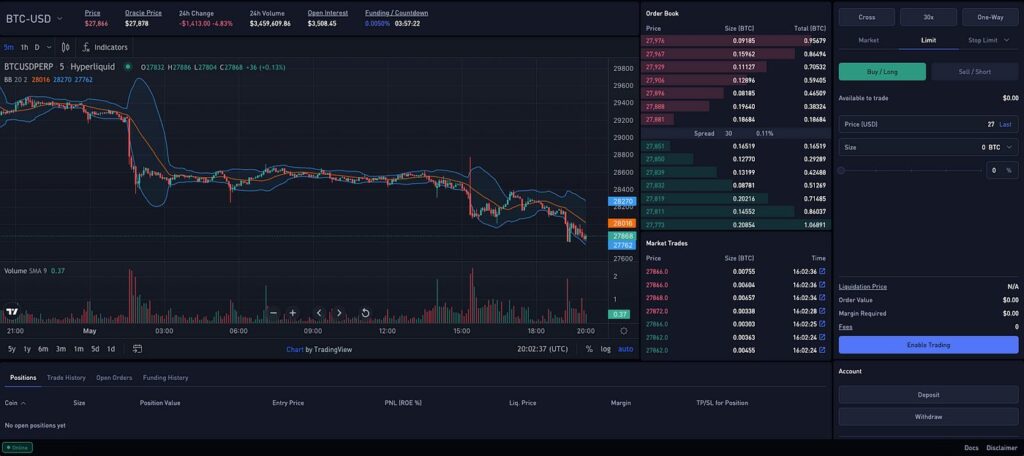
The trading interface will feel immediately familiar to anyone who’s used Binance or Bybit. You’ll see a central order book, price chart, order entry panel, and your open positions. Switch between the “Trade” tab for perpetuals and the “Spot” tab for spot markets.
Step 4: Placing Orders
Select your trading pair, choose your order type, set leverage (if applicable), and enter your position size. Review all details carefully before confirming — particularly your liquidation price on leveraged positions.
Step 5: Withdrawing Funds
Go to your Portfolio page, click “Withdraw,” and enter the amount of USDC you want to move back to Arbitrum. The flat $1 withdrawal fee is deducted automatically. Funds typically arrive on Arbitrum within minutes.
Order Types: A Complete Overview
Hyperliquid supports one of the most comprehensive sets of order types available on any DEX:
Market Orders execute immediately at the current best available price — ideal for entering or exiting positions quickly when speed matters more than price precision.
Limit Orders let you specify the exact price at which you want to buy or sell. Your order rests on the order book until the market reaches your price, making you a “maker” and earning you the lower maker fee rate.
Stop-Loss Orders automatically close your position if price moves against you to a specified level. Essential for risk management.
Take-Profit Orders lock in gains by automatically closing at a target price without requiring you to monitor the market continuously.
Scale Orders place a series of limit orders spread across a defined price range — useful for building positions gradually or executing large orders with minimal market impact.
TWAP (Time-Weighted Average Price) Orders split a large order into smaller sub-orders executed every 30 seconds with a maximum slippage of 3%. This is a feature typically found only on institutional-grade platforms and is invaluable for executing large positions without moving the market.
Hyperliquid Leverage: Maximum Limits and How They Work
Hyperliquid supports leverage from 3x up to 50x on perpetual futures, depending on the specific asset. The maximum leverage varies by market — major assets like BTC and ETH support higher leverage limits, while smaller-cap or newer listings may have lower caps.
It’s worth noting that leverage on Hyperliquid does not require holding the underlying asset. Perpetual contracts let you take both long and short positions with leverage using only USDC as collateral.
Auto-Deleveraging (ADL)
In extreme market conditions where an insolvent position cannot be fully liquidated on the open market, Hyperliquid uses an auto-deleveraging system. Profitable traders on the opposite side of a losing position are selected based on unrealized PnL and leverage used, and their positions are partially closed to cover the insurance fund gap. This is standard practice across professional derivatives venues.
Hyperliquid Strategies: How Traders Actually Use the Platform
The platform’s combination of speed, fee structure, and order types makes it well-suited for a variety of strategies:
Market Making / Passive Maker Ladders: Because Hyperliquid is gas-free, market makers can place, modify, and cancel thousands of orders without paying per-transaction fees. Combined with maker rebates at high volume tiers, this is one of the few DEXs where professional market-making strategies are economically viable.
Cash-and-Carry / Funding Rate Arbitrage: Going long spot while shorting the equivalent perpetual captures the funding rate — a positive carry strategy when perpetual funding is positive. The ability to adjust hedges hourly without gas costs makes this practical.
TWAP Execution: Institutional-sized entries can be executed with minimal price impact using the native TWAP order type, which automatically slices large orders over time.
Hyperliquid Vaults: Instead of trading directly, you can deposit USDC into Vaults — smart contract-managed liquidity pools that allocate funds to bid-ask quoting. Vault returns depend on spread profits, trading commissions, liquidation earnings, and funding payments.
DCA (Dollar-Cost Averaging): Third-party trading bots integrate with Hyperliquid’s API to automate regular interval purchases — useful for systematic accumulation strategies without manual execution.
Hyperliquid API: Everything Developers and Bot Traders Need to Know
Hyperliquid has one of the most developer-friendly APIs in the DEX space — a significant differentiator that has attracted a growing ecosystem of trading bots, analytics platforms, and third-party applications.
REST API
The primary REST endpoint is https://api.hyperliquid.xyz. It uses JSON for requests and responses, with HTTP POST for most trading actions. The API is well-documented and supports all order types, position management, and account queries.
Hyperliquid WebSocket API
The WebSocket endpoint (wss://api.hyperliquid.xyz/ws) provides real-time data streaming for trades, order book updates, funding rates, and liquidations. This is essential for automated trading strategies that require low-latency data. The WebSocket supports up to 1,000 subscriptions per IP address.
Hyperliquid Testnet API
For development and testing, an identical environment is available at https://api.hyperliquid-testnet.xyz. Always develop against testnet before deploying live strategies — mistakes with leverage on mainnet are expensive.
Authentication: API Wallets
Instead of traditional API keys, Hyperliquid uses API Agent Wallets — separate wallets authorized to trade on behalf of your main account without withdrawal permissions. This is an important security feature: even if your API wallet’s private key is compromised, an attacker cannot withdraw your funds. Generate API wallets through the app at app.hyperliquid.xyz/API.
SDKs
Official and community-maintained SDKs are available for Python and TypeScript/JavaScript. The CCXT library also maintains a Hyperliquid integration for those already familiar with that standard framework.
Hyperliquid Trading Bots
The platform integrates with popular automation tools including Hummingbot (for market-making strategies), WunderTrading, and various custom bot frameworks. The combination of WebSocket APIs, gas-free trading, and a predictable fee structure makes Hyperliquid one of the most practical venues for algorithmic trading in DeFi.
The $HYPE Token: Tokenomics Deep Dive
The HYPE token launched on November 29, 2024 in one of the largest and most community-oriented airdrops in crypto history. For other perpetual DEXs still distributing rewards, see our roundup of the best perp DEX airdrops worth farming. 31% of the total 1 billion HYPE supply — 310 million tokens — was distributed to early users of the platform, with the average recipient receiving tokens worth over $28,000 at launch prices.
Supply Distribution
| Allocation | % | Notes |
|---|---|---|
| Genesis Airdrop / Community | 31% | Distributed to early users |
| Future Rewards & Emissions | 38.8% | For ongoing community incentives |
| Core Contributors | 23.8% | Locked 1 year, vesting through 2027–2028 |
| Hyper Foundation | 6% | Treasury budget |
| Community Grants | 0.3% | Builder incentives |
Crucially, there are zero allocations to private investors, VCs, exchanges, or market makers. This is one of the cleanest token distributions in the industry.
Circulating supply as of March 2026 is approximately 333 million HYPE (around 33% of total supply). Full vesting schedules extend through 2027–2028, with no major VC unlock pressure until 2027.
The HYPE Buyback Flywheel
Here’s where the tokenomics get genuinely interesting. Every day, 97% of all protocol fees flow to the Assistance Fund, which autonomously buys HYPE on the open market. No governance vote needed. No quarterly schedule. Every. Single. Day.
With daily trading volumes regularly exceeding $8 billion, the buyback rate is approximately 7% of HYPE’s market cap annually — compared to around 1.5% for Ethereum’s EIP-1559 burns and 1.2% for BNB. Since its launch, the Assistance Fund has bought back over $715 million worth of HYPE tokens, creating consistent deflationary pressure.
HYPE reached an all-time high of $59.39 in September 2025, representing over a 1,700% increase from initial prices. As of March 2026, HYPE trades around $37–38, ranking #15 by market cap on CoinGecko.
HYPE Token Use Cases
- Gas fees on HyperEVM transactions
- Staking to secure the network (earning 0.83%–2.26% APY, with validators offering varying commissions)
- Governance voting on protocol decisions
- Fee discounts of 5%–40% based on staking tier
- Collateral in BLP Earn Vaults (launched December 2025)
HIP-3: Permissionless Perpetual Markets
One of Hyperliquid’s most ambitious features is the HIP-3 protocol, which allows anyone to deploy a permissionless perpetual futures market on the platform. This is analogous to Uniswap’s permissionless token listing, but for derivatives.
Through HIP-3, Hyperliquid expanded beyond crypto to list global equities as perpetual contracts — including Apple, Nvidia, Amazon, Google, and Tesla. Nvidia alone generated $1.73 billion in trading volume through HIP-3 listings, with Tesla and Google following at $1.15 billion and $1.04 billion respectively.
Deployers using HIP-3 can retain up to 50% of trading fees generated by their markets. A “growth mode” option reduces protocol-level fees by 90% for new markets, dramatically lowering the cost of early liquidity bootstrapping.
This framework is why Hyperliquid describes itself as building a “House of All Finance” — not just crypto derivatives, but a venue for trading virtually any financial asset on-chain.
USDH Stablecoin: What You Need to Know
In September 2025, Hyperliquid announced $USDH, a native Hyperliquid-first stablecoin designed to integrate across the entire ecosystem — perpetuals, spot markets, staking, and partner protocols like Kinetiq, HypurrFi, and Hyperlend.
The stablecoin emitter was selected through an on-chain validator governance vote, with Native Markets winning the competition. USDH is positioned as a “compliant” stablecoin, designed with an eye toward regulatory expectations while maintaining decentralized governance.
The introduction of USDH, combined with an 80% reduction in fees for spot pairs between stablecoin quote assets, signals Hyperliquid’s ambition to become the settlement layer for on-chain finance — not just a derivatives venue.
Hyperliquid Leaderboard and Traders
One distinctive cultural element of Hyperliquid is its public Leaderboard, which displays the top traders ranked by absolute PnL and return on invested capital. This transparency has created a genuine community around tracking notable positions.
The platform went viral multiple times in 2025 through high-profile traders — most notably James Wynn and Qwatio — who executed enormous leveraged positions publicly visible on-chain. These events brought significant new user attention and showcased the platform’s ability to handle whale-scale liquidity without slippage or outages (though the platform did experience brief API disruptions during peak load in mid-2025).
Hyperliquid KYC Requirements: No Verification Needed
Hyperliquid does not require any KYC (Know Your Customer) verification. There is no email registration, no identity document upload, no selfie verification. You connect your wallet and start trading — the entirety of your interaction with the platform is pseudonymous.
This is standard for decentralized exchanges but worth noting explicitly for traders coming from centralized venues. The tradeoff: no fiat on-ramp. You must arrive with crypto (USDC on Arbitrum) to get started.
Some geographic regions may encounter access restrictions (IP blocking). A VPN resolves this in most cases, though users should understand the legal implications in their jurisdiction.
Hyperliquid vs. Competitors: Aster, dYdX, and GMX
The decentralized perpetuals market in 2026 evolved into what analysts called the “perp DEX wars” — a genuine competitive battle with billions in daily volume at stake.
Hyperliquid vs. Aster
Aster launched in September 2025 with strong backing linked to Changpeng Zhao, former Binance CEO, and rapidly scaled to become the second-largest perp DEX. By end-2025, Aster commanded around 70% of market share in some periods, with Hyperliquid’s share narrowing to approximately 10% during peak Aster incentives — though Hyperliquid maintained deeper liquidity and open interest.
Key differences: Aster offers leverage up to 1,001x and operates across multiple chains (BNB Chain, Ethereum, Solana, Arbitrum) eliminating bridging friction. Hyperliquid’s advantage is its superior infrastructure quality, deeper liquidity on major pairs, and sustainable revenue model versus Aster’s incentive-heavy growth. The consensus view: Aster’s volume surge was largely driven by trading rewards — inorganic by nature — while Hyperliquid’s volumes are based on genuine user demand.
Hyperliquid vs. dYdX
dYdX is the original institutional-grade decentralized perp platform. It offers up to 100x leverage (vs. Hyperliquid’s 50x), supports 200+ perpetual markets, and operates on a Cosmos-based chain. Its fees start at 0.05% taker / 0.01% maker at the base tier — slightly higher than Hyperliquid. By early 2026, Hyperliquid had captured over 64% of the perpetual market while dYdX volumes stagnated. Hyperliquid’s faster execution and stronger community momentum are the key differentiators.
Hyperliquid vs. GMX
GMX operates on Arbitrum and Avalanche using a liquidity pool model (GLP) rather than an order book. Its fees are higher (0.04–0.06% to open and close), and execution relies on oracle pricing rather than a live order book. GMX is simpler to use for casual traders but lacks the depth and order types of Hyperliquid.
Analytics by the Numbers: Hyperliquid’s 2025 Performance
The following data, drawn from ASXN Data, Hyperscreener, and DefiLlama, tells the story of Hyperliquid’s 2025:
| Metric | Figure |
|---|---|
| Total 2025 Volume | $2.95 trillion |
| Annual Revenue | $844 million |
| Net Inflows | $3.87 billion |
| Total Value Locked (end-2025) | $4.15 billion |
| New Users Added | ~609,700 |
| Total Users (end-2025) | 1.4 million |
| Daily Transaction Average | 561.7 million |
| Peak Daily Volume | ~$32 billion |
| Peak Open Interest | $16 billion |
| Daily Revenue Peak | ~$20 million |
| HYPE Bought Back (all-time) | $715 million+ |
Perpetual contracts dominated activity — generating $848 million in fees and $808 million in revenue. Spot trading added $40.6 million in fees. Bitcoin led volume at $1.16 trillion, followed by Ethereum at $824 billion and Solana at $269 billion.
The builder ecosystem peaked at 289,800 users across 187 active builders, generating $46.27 million in revenue — a sign of genuine third-party development activity rather than just native platform usage.
HyperLiquid Pros and Cons: An Honest Assessment
HyperLiquid Pros
Unmatched Speed for a DEX. Sub-second finality and 100,000 orders per second. Trading feels like Bybit — not like DeFi.
No Gas Fees on Trades. Every order, cancel, and modification is gas-free. Only deposits (Arbitrum) and withdrawals (flat $1 USDC) carry any cost.
Genuinely Low Trading Fees. 0.015% maker / 0.045% taker at base rates — competitive with CEX VIP tiers. Negative maker fees are achievable for high-volume market makers.
No KYC. Connect wallet, start trading. Fully pseudonymous.
Community-First Tokenomics. Zero VC allocation, 97% of fees to HYPE buybacks, and the largest fair airdrop in recent crypto history.
Deep Liquidity. Order book model with real market makers creates genuine depth, not synthetic pool liquidity.
Comprehensive Order Types. TWAP, scale orders, stop-loss, take-profit — rivaling professional trading platforms.
API and Bot Support. One of the best APIs in DeFi, with official Python SDK, WebSocket support, and testnet environment.
HIP-3 Innovation. Permissionless perpetual markets for stocks, commodities, and any asset — an unprecedented capability.
HyperLiquid Cons
Arbitrum Only for Deposits. Cross-chain support is limited. Users on Solana, BNB Chain, or other networks must bridge to Arbitrum first.
No Fiat On-Ramp. You can’t fund your account with a credit card or bank transfer. Crypto-first only.
Steep Learning Curve for Beginners. The platform is built for experienced traders. Leverage, perpetuals, funding rates, and order book mechanics can overwhelm newcomers.
No Mobile App (Official). As of early 2026, there is no dedicated official Hyperliquid mobile app. The web app is mobile-browser accessible but not optimized for mobile trading. Third-party apps fill the gap: Dexari runs on iOS and Android and sends every order to Hyperliquid’s book, though its entry-tier builder fee of 0.10% sits on top of Hyperliquid’s own.
Token Unlock Risk. Approximately 23.8% of HYPE supply is allocated to core contributors with vesting through 2027–2028. Upcoming unlocks represent potential dilution pressure.
Geographic Restrictions. Some regions face IP-based access restrictions requiring a VPN.
HyperLiquid Security Architecture
Hyperliquid’s security model rests on several complementary pillars:
HyperBFT Consensus requires a two-thirds validator supermajority to process withdrawals via the Arbitrum bridge — making the bridge resistant to single-point failures or partial validator compromise.
Decentralized Oracles aggregate price data from multiple independent sources, preventing the price manipulation attacks that have plagued AMM-based DEXs.
Non-Custodial Design means Hyperliquid never holds your private keys. Your funds remain in your wallet or in the protocol’s smart contracts — never on a company-controlled server.
API Agent Wallets let traders run automated strategies without exposing their main wallet’s private key. The agent wallet can trade but cannot withdraw, containing the blast radius of a potential compromise.
Transparency is inherent: every trade, liquidation, and fund movement is publicly verifiable on-chain. There are no hidden books, no opaque risk departments, no hidden leverage like FTX had.
Who Should Use Hyperliquid?
Experienced Derivatives Traders who want the execution quality of a CEX without counterparty risk will find Hyperliquid difficult to beat. The order book, leverage options, and order types match or exceed most centralized platforms.
High-Frequency and Algorithmic Traders benefit enormously from the gas-free model, WebSocket API, sub-second finality, and competitive maker rebates. Running dense limit order ladders — impractical on most DEXs — works here.
DeFi Power Users looking for a non-custodial platform that actually performs at institutional standards. No compromise between speed and self-custody.
HYPE Token Investors who want exposure to a protocol with real revenue, aggressive buyback mechanics, and no VC overhang until 2027.
Beginners should start with spot trading and small positions before exploring leverage. The platform’s learning curve is real, but the fee structure is forgiving — low enough that mistakes don’t cost a fortune in transaction costs.
Frequently Asked Questions
Is Hyperliquid safe? Hyperliquid uses non-custodial smart contracts, on-chain settlements, and the HyperBFT consensus mechanism. It’s among the most auditable and transparent exchanges in the industry. That said, smart contract risk always exists in DeFi, and leverage always carries liquidation risk.
What is the Hyperliquid withdrawal fee? A flat 1 USDC fee for withdrawing to Arbitrum. No variable gas component — it’s a fixed cost.
Does Hyperliquid have a savings plan or savings account? Hyperliquid doesn’t offer a formal savings account. However, depositing USDC into Vaults provides yield from trading fees, liquidation revenues, and funding payments. BLP Earn Vaults (launched December 2025) also allow yield generation using HYPE as collateral. HYPE staking yields 0.83%–2.26% APY depending on the validator selected.
Is there a Hyperliquid mobile app? There is no official dedicated mobile app as of early 2026. The web interface at app.hyperliquid.xyz is accessible via mobile browser.
How do I buy HYPE? HYPE is available natively on Hyperliquid’s own spot market, as well as on centralized exchanges including OKX and Gate.io. You can also acquire it through various DEX aggregators once bridged to the appropriate chain.
What is HIP-3? HIP-3 is Hyperliquid’s permissionless perpetual market creation protocol. It allows anyone to deploy a new perpetual futures market using any underlying asset — from crypto tokens to global equities — with customizable fee structures and market parameters.
Final Verdict: Is Hyperliquid Worth Using?
In a space full of platforms that promise institutional-grade performance and deliver amateur-hour execution, Hyperliquid actually delivers. The numbers are real — $2.95 trillion in volume, $844 million in annual revenue, 1.4 million users — and they were built without venture capital, without trading incentives, without the synthetic volume manipulation that inflates competitor metrics.
The platform isn’t perfect. The Arbitrum-only deposit path creates friction. The lack of fiat on-ramps keeps it crypto-native by necessity. And the competitive pressure from Aster, Lighter, and others means Hyperliquid’s dominant market share is no longer guaranteed.
But the fundamental thesis holds: Hyperliquid built a DEX that doesn’t ask you to compromise. You get centralized-exchange speed and depth, with the security and transparency of a fully on-chain system. For experienced traders, that combination is genuinely rare.
For those new to DeFi derivatives: start slow, learn the mechanics, and begin with spot trading. The power is there when you’re ready for it.
This article is for informational purposes only and does not constitute financial or investment advice. Cryptocurrency trading, especially with leverage, carries significant risk of loss. Always conduct your own research before trading.