Disclosure: CoinCodeCap may earn a commission if you sign up through links on this page. Pricing, FSA licensing, and regulatory facts below were verified directly with the Japanese Financial Services Agency, official exchange websites, and authoritative 2026 sources between January and May 2026. Affiliate relationships don’t decide our rankings — Hodlnaut and CEX.io were removed from the previous version of this guide because Hodlnaut became insolvent in 2022 and CEX.io is no longer a Japan-focused option, regardless of any prior relationship.
How I Ranked These: The 2026 Japanese crypto market is fundamentally different from 2023-2024. Japan implemented a flat 20% capital gains tax on crypto in 2026 (replacing the prior progressive rate that could reach 55%) and reclassified digital assets as formal financial products under FSA oversight. That changes the calculus for which wallets and exchanges Japanese investors should use. I evaluated each option on FSA registration status, JPY deposit/withdrawal infrastructure, fee structure, supported assets, security history, and fit for the new regulatory regime. Hardware wallets and DeFi options are included for users who need long-term storage or EVM access beyond the FSA-licensed exchange ecosystem.
Japan’s 2026 crypto landscape is the cleanest it’s been in over a decade. The flat 20% tax rate (down from a top marginal of 55%) and the reclassification of crypto assets as formal financial products under FSA oversight mean Japanese investors finally have a regulatory framework that treats Bitcoin and Ethereum the same way it treats stocks. The Mt. Gox era and Coincheck hack era are firmly in the rear-view; today’s licensed exchanges run cold-wallet storage, publish proof-of-reserves, and operate under capital requirements that protect users from the kind of failures that wrecked unregulated platforms in other markets.
This guide ranks the wallets and exchanges that best match the new regime. The top six are all FSA-registered, JPY-native exchanges — pick based on what you actually need (beginner-friendly, low fees, advanced trading, points integration, etc.). Below those, we cover hardware wallets for long-term storage and DeFi-capable wallets for users who want to move beyond CEX-only access. The honest goal: get you to a setup where your JPY-to-crypto on-ramp is FSA-licensed, your long-term holdings are in cold storage, and your DeFi activity (if any) is on a smart wallet you can actually trust.
⚡ TL;DR — Best Crypto Wallets in Japan, 2026
| # | Wallet / Exchange | Best For | Type |
|---|---|---|---|
| 1 | bitFlyer | Beginners + deep BTC/JPY liquidity | FSA-licensed exchange |
| 2 | Coincheck | NFT marketplace + ¥500 minimum | FSA-licensed exchange |
| 3 | GMO Coin | Lowest fees + instant JPY deposits | FSA-licensed exchange |
| 4 | SBI VC Trade | Long-term holders + savings products | FSA-licensed exchange |
| 5 | Rakuten Wallet | Rakuten Points + Rakuten Bank users | FSA-licensed exchange |
| 6 | Binance Japan | Active traders + advanced features | FSA-licensed exchange |
| 7 | Ledger (Nano X / Stax) | Long-term BTC/ETH cold storage | Hardware wallet |
| 8 | MetaMask + Ambire | DeFi access on EVM chains | Self-custody software wallet |
| ⚡ Use FSA-licensed exchanges for JPY on-ramp + Ledger hardware for long-term storage. Top pick for beginners: bitFlyer. | |||
What Changed in 2026: Japan’s Regulatory Reset
Three regulatory shifts in 2026 reshaped what “best wallet in Japan” actually means:

- Flat 20% capital gains tax — the prior progressive system taxed crypto profits as miscellaneous income at marginal rates up to 55% (45% national + 10% local). The new flat 20% rate aligns crypto with the tax treatment of stocks and brings Japan in line with most developed markets. For active traders and long-term holders, the savings are substantial.
- Crypto reclassified as financial products — under the new framework, digital assets fall under the same FSA oversight regime as securities. This means stricter KYC/AML, mandatory cold-wallet storage, proof-of-reserves disclosure, and capital adequacy requirements for licensed exchanges. The Mt. Gox era is structurally over.
- Stricter exchange licensing — only FSA-registered exchanges can offer JPY pairs to Japanese residents. This filters out unregulated venues but also means cross-border platforms (like Bybit, KuCoin, OKX) can’t legally service Japanese users without local registration.
Practical implication: stick with FSA-licensed exchanges for JPY-to-crypto on-ramps, then move long-term holdings off-exchange to a hardware wallet, and use a self-custody EVM wallet (MetaMask, Ambire, Rabby) for any DeFi activity. The “everything in one place” approach was always risky; the 2026 regulatory framework just makes the right setup more obvious.
2026 Japan Crypto Wallet Comparison
| Platform | FSA License | JPY Deposit | Spot Fee | Min Order | Review |
|---|---|---|---|---|---|
| bitFlyer | ✅ Yes | Bank transfer + convenience | 0.01-0.15% (Lightning) | ~¥500 | Read |
| Coincheck | ✅ Yes | Bank transfer + convenience | 0% on many pairs | ¥500 | Read |
| GMO Coin | ✅ Yes | Instant + free withdrawals | -0.01% maker / 0.05% taker | ~¥500 | Coming |
| SBI VC Trade | ✅ Yes | SBI Group banking | -0.01% maker / 0.05% taker | ~¥500 | Coming |
| Rakuten Wallet | ✅ Yes | Instant via Rakuten Bank | Spread-based | Low | Coming |
| Binance Japan | ✅ FSA No.00031 | GMO Bank integration | Up to 0.10% | Low | Read |
| Ledger Nano X | N/A (hardware) | N/A | N/A | $149 device | Stax Review |
| MetaMask + Ambire | N/A (self-custody) | N/A | Network gas only | Free | Ambire Review |
1. bitFlyer — Best Overall for Japanese Beginners
bitFlyer is Japan’s most established licensed exchange and the right starting point for most Japanese crypto investors in 2026. It combines deep BTC/JPY liquidity (typically the highest in the country), a clean beginner-friendly main interface, and the more advanced Lightning Spot platform for users who outgrow the basics. With multi-signature wallets, cold storage of customer assets, SSL encryption, and 2FA, the security stack meets the post-2026 FSA standards comfortably.
- ✅ Deep BTC/JPY liquidity — best execution on large Bitcoin orders
- ✅ Lightning Spot tiered fees: ~0.15% taker, dropping to ~0.10% at higher volume
- ✅ Free market orders on the main board (simpler interface)
- ✅ 39+ supported cryptocurrencies covering BTC/ETH/XRP and major altcoins
- ⚠️ Smaller asset selection than global exchanges
- 📌 Best for: First-time Japanese crypto buyers, BTC-focused investors
| Spec | Detail |
|---|---|
| FSA License | ✅ Yes (long-standing) |
| JPY deposit methods | Bank transfer, convenience store, Pay-easy |
| Spot fee (Lightning) | ~0.10-0.15% taker |
| Mobile app | iOS + Android |
| Cold storage | Multi-sig BTC, cold wallet majority custody |
2. Coincheck — Best for NFTs and Small JPY Positions
Coincheck has a complicated history — the 2018 NEM hack remains the largest crypto exchange theft in Japanese history — but the rebuild under Monex Group ownership has been thorough, and the 2021 acquisition restructuring brought significantly improved security infrastructure. In 2026, Coincheck is one of the cleanest beginner-focused options on the FSA-licensed list, with one of the lowest minimum order sizes (~¥500) and a built-in NFT marketplace that’s the largest in Japan.
- ✅ ~¥500 minimum order — easiest entry point for first-time buyers
- ✅ Zero or low maker/taker fees on a broad set of pairs
- ✅ Native NFT marketplace (largest in Japan) — buy/sell NFTs with JPY directly
- ✅ Convenience store deposit support (7-Eleven, Lawson, FamilyMart)
- ⚠️ No native derivatives suite
- 📌 Best for: Small-position beginners, NFT collectors, convenience-store deposit users
3. GMO Coin — Lowest Fees and Best JPY Infrastructure
GMO Coin is the cost leader among FSA-licensed Japanese exchanges, and the fee structure makes a real difference for active traders. Negative maker fees (-0.01% to -0.03%) actually pay you to provide liquidity. Free JPY deposits and withdrawals — most other exchanges charge for one or both. Instant JPY deposit support means your funds are tradeable immediately rather than waiting overnight for a bank transfer.
- ✅ Negative maker fees (-0.01% to -0.03%) — paid to add liquidity
- ✅ Free JPY deposits + free withdrawals (rare in this market)
- ✅ Instant deposits via Japanese bank transfer
- ✅ 21+ cryptocurrencies plus 14 crypto-FX leverage pairs
- ✅ Spot, leverage, staking, and lending products in one platform
- ⚠️ Smaller catalog than global exchanges
- 📌 Best for: Active traders, high-frequency users, anyone optimizing for total cost
4. SBI VC Trade — Best for Long-Term Holders
SBI VC Trade is the crypto arm of SBI Group, one of Japan’s largest financial conglomerates. The institutional pedigree shows up in two ways: rock-solid security and compliance infrastructure (SBI VC has never had a security incident), and a savings-focused product mix that suits long-term holders better than pure trading platforms. Zero deposit, withdrawal, and account maintenance fees combined with built-in staking and lending make it easy to hold positions over multi-year horizons.
- ✅ Backed by SBI Group — institutional-grade compliance and security
- ✅ Zero fees: deposits, withdrawals, account maintenance all free
- ✅ 36+ supported cryptocurrencies including BTC, ETH, XRP, and major altcoins
- ✅ Spot, savings, staking, and NFT trading in one platform
- ✅ Maker fee -0.01% / taker 0.05% on spot
- ⚠️ UI feels more conservative — fewer advanced features than global exchanges
- 📌 Best for: Long-term BTC/ETH holders, savings-focused investors, SBI Bank users
5. Rakuten Wallet — Best for Rakuten Ecosystem Users
Rakuten Wallet is a niche pick that wins decisively for one specific user: anyone deeply embedded in the Rakuten ecosystem. The Rakuten Points integration lets you convert points to crypto (or charge Rakuten Cash from crypto holdings for shopping), and instant JPY deposits/withdrawals through Rakuten Bank are seamless if you already have an account. The asset list is small — only 10 cryptocurrencies and 5 trading pairs — but for the target user, the ecosystem integration matters more than catalog depth.
- ✅ Convert Rakuten Points ↔ crypto natively
- ✅ Instant JPY deposits/withdrawals via Rakuten Bank
- ✅ 2FA on logins, withdrawals, and payments
- ✅ Strong FSA compliance and security
- ⚠️ Only 10 cryptocurrencies, 5 trading pairs — narrower than competitors
- 📌 Best for: Rakuten Bank account holders, Rakuten Points collectors
6. Binance Japan — Best for Active Traders
Binance Japan is the FSA-registered local entity (Director of Kanto Finance Bureau No.00031), operating separately from global Binance with a curated “White List” of approved tokens. The trade-off vs. global Binance is a smaller asset catalog (Japan’s regulatory token-listing process is conservative), but you get the same advanced trading infrastructure: deep liquidity, low fees (up to 0.10% spot), Binance Earn integration, and the broader Binance product ecosystem (loans, trading bots, Launchpad).
- ✅ FSA-registered with Director of Kanto Finance Bureau (No.00031)
- ✅ Spot trading fees up to 0.10% — competitive with GMO Coin’s taker fee
- ✅ JPY deposits/withdrawals via GMO Bank integration
- ✅ Japanese UI + 24/7 local customer support
- ✅ Binance Earn staking, crypto loans, futures (where regulated)
- ✅ SAFU fund + regular proof-of-reserve audits
- ⚠️ Smaller token catalog than global Binance — White List restrictions
- ⚠️ Dense interface can intimidate beginners
- 📌 Best for: Active traders, futures users, Binance ecosystem users
7. Ledger (Nano X / Stax) — Best Hardware Wallet for Long-Term Storage
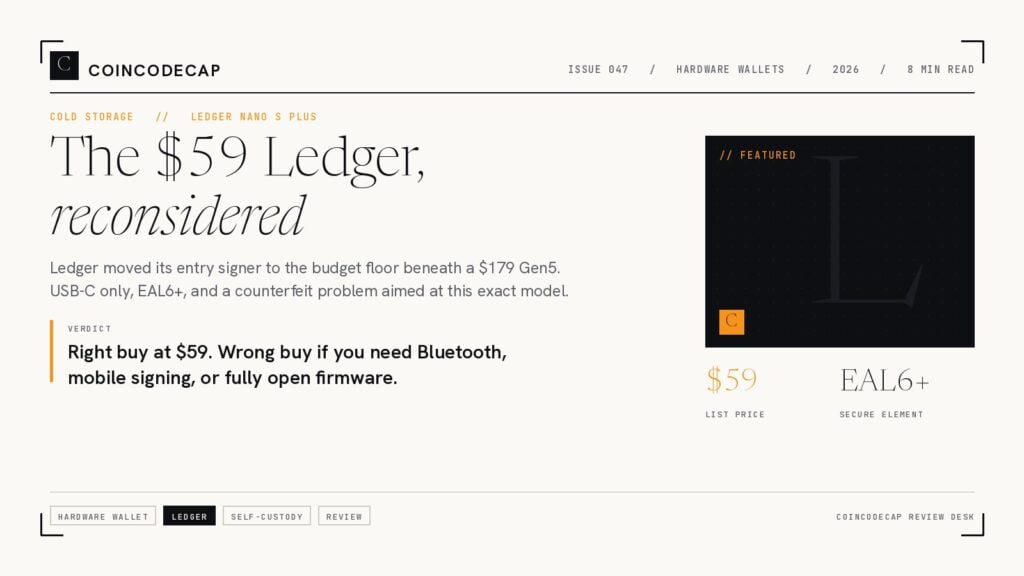
Once you’ve accumulated meaningful crypto holdings on an FSA-licensed exchange, the standard practice is to move long-term positions to a hardware wallet for cold storage. Ledger is the most widely-used option globally and works seamlessly for Japanese users — devices ship internationally, the Ledger Live software supports Japanese language, and the EAL 5+ secure element protects against the kind of remote and physical attacks that exchange custody can’t fully prevent.
- ✅ Ledger Nano X ($149) — Bluetooth + USB-C, 100+ apps, supports 5,500+ tokens
- ✅ Ledger Stax ($399) — premium E-Ink touchscreen, EAL 6+ certified
- ✅ Native support for BTC, ETH, XRP, ADA, SOL, DOT — full multi-chain coverage
- ✅ Japanese language support in Ledger Live
- ✅ Pair with MetaMask or Ambire for DeFi access while keeping keys offline
- 📌 Best for: Anyone with $5K+ in crypto holdings to secure long-term
For deeper hardware wallet comparisons, see our best hardware wallets for Bitcoin guide and the Ledger Stax review.
8. MetaMask + Ambire — Best for DeFi and EVM Self-Custody
For users who want to access DeFi protocols, NFT marketplaces, or any non-Japanese smart contract activity, you’ll need a self-custody EVM wallet. MetaMask is the default — broad chain support, every dApp integrates with it, and the user base is large enough that fake-MetaMask phishing is well-documented and easier to spot. Ambire is the underrated alternative for active DeFi users: the Gas Tank lets you pay transaction fees in stablecoins across all chains (no more “I need to bridge ETH for gas”), and EIP-7702 support means you can upgrade your existing MetaMask wallet to a Smart EOA with one transaction.
- ✅ Free, self-custody, your keys
- ✅ Pair with Ledger or Trezor for hardware-signed transactions
- ✅ Access to Uniswap, Aave, Curve, Compound, all major DeFi
- ✅ Ambire’s Gas Tank pays gas in stablecoins cross-chain
- ⚠️ EVM-only (no native BTC or SOL on Ambire; MetaMask supports both via Snaps)
- ⚠️ Self-custody = full responsibility for seed phrase security
- 📌 Best for: DeFi users, EVM-chain power users, hardware wallet pairings
How to Choose: A Simple Decision Framework
- If you’re new to crypto in Japan: Start with bitFlyer or Coincheck. Buy small amounts in JPY, learn the workflow, then expand.
- If you trade actively: GMO Coin for low fees, or Binance Japan for advanced features and futures.
- If you’re a long-term holder ($5K+): Buy on bitFlyer/SBI VC/GMO, then move to Ledger Nano X for cold storage.
- If you’re in the Rakuten ecosystem: Use Rakuten Wallet for the points/banking integration.
- If you want DeFi access: Add MetaMask or Ambire for self-custody EVM activity. Consider pairing with a hardware wallet.
- If you’re tax-conscious post-2026: The flat 20% rate makes long-term holding more attractive vs. day trading. Plan accordingly.
Frequently Asked Questions
Is crypto legal in Japan in 2026?
Yes. Japan was the first country to formally recognize Bitcoin as legal tender for payments under the Payment Services Act (2017), and the 2026 reforms reclassified crypto as formal financial products under FSA oversight. Trading, holding, and using crypto are all legal. Only FSA-licensed exchanges can offer JPY pairs to Japanese residents — using offshore unlicensed venues is technically a regulatory grey area.
What is the crypto tax rate in Japan in 2026?
The 2026 reforms moved crypto capital gains to a flat 20% tax rate — the same treatment as stocks. This is a major change from the prior progressive system, which taxed crypto profits as miscellaneous income at marginal rates that could exceed 50% for high earners. The new flat rate applies to realized gains; unrealized holdings aren’t taxed (corporate holders also benefit from a 2024 reform exempting unrealized gains).
Can foreigners use Japanese crypto exchanges?
Yes, but you’ll need a Japanese residential address, a Japanese bank account, and a Zairyū residence card (or My Number for citizens). FSA-licensed exchanges require this for KYC. If you’re a tourist or short-term visitor, you cannot legally open an account at a Japanese exchange — you’d need to use a global exchange that operates in your home country.
Why isn’t Hodlnaut listed anymore?
Hodlnaut filed for judicial management in Singapore in August 2022 after halting customer withdrawals during the broader 2022 lending platform collapse (alongside Nexo, Voyager, and BlockFi). It is no longer a viable platform for storing or earning on crypto. Any guide that still recommends Hodlnaut in 2026 is outdated and should not be trusted.
Should I keep my crypto on the exchange or move to a hardware wallet?
For active trading positions, exchange custody is fine — FSA-licensed exchanges meet strict cold-storage and proof-of-reserve requirements. For long-term holdings (anything you don’t plan to trade in the next 6-12 months), move it off-exchange to a hardware wallet. The principle “not your keys, not your coins” still applies even with regulated exchanges, and a $149 Ledger Nano X is cheap insurance against any custody risk.
What’s the safest exchange for storing Bitcoin in Japan?
For exchange custody, bitFlyer and SBI VC Trade have the cleanest security records — neither has had a major incident. Coincheck had the 2018 NEM hack but has since restructured under Monex Group. For genuinely safe storage, however, the answer is “no exchange” — move long-term holdings to a hardware wallet. Even the best-run exchange is a centralized point of failure.
Can I use MetaMask in Japan?
Yes. MetaMask is a self-custody software wallet — it’s not a regulated entity, and using it isn’t restricted by Japanese FSA rules. You can install MetaMask, hold ETH and ERC-20 tokens, and access DeFi protocols freely. The standard pattern for Japanese DeFi users: buy ETH on bitFlyer or GMO Coin, withdraw to MetaMask, use for DeFi or NFT activity. For active DeFi users, also consider Ambire for the Gas Tank feature (pay gas in stablecoins).
What’s the difference between bitFlyer and Coincheck?
bitFlyer has deeper BTC/JPY liquidity and a more advanced trading interface (Lightning Spot), making it better for users who want to grow into more sophisticated trading. Coincheck has the lowest minimum order size (~¥500), zero fees on many pairs, and a built-in NFT marketplace, making it better for first-time buyers and small-position users. Most Japanese investors end up using both at some point — bitFlyer for the BTC liquidity, Coincheck for NFTs and small positions.
Verdict
Japan’s 2026 regulatory reset is genuinely good news for crypto investors. The flat 20% tax rate, the reclassification of digital assets as formal financial products, and the strict FSA licensing regime mean Japanese investors finally have a clean framework — much cleaner than the U.S. patchwork or the EU’s MiCA implementation. Use FSA-licensed exchanges for JPY on-ramp (bitFlyer for beginners, GMO Coin for low fees, Binance Japan for active trading). Move long-term holdings to a Ledger Nano X. Add MetaMask or Ambire if you want DeFi access. That stack covers 95% of what any Japanese crypto investor actually needs in 2026.
⚡ Bottom Line: The cleanest 2026 setup for Japanese crypto investors is a three-tier stack — FSA-licensed exchange for JPY on-ramp (start with bitFlyer or Coincheck for beginners, GMO Coin if you optimize for fees, SBI VC for long-term savings, Binance Japan for advanced trading), Ledger Nano X for cold storage of holdings you’re not actively trading, and MetaMask or Ambire for any DeFi or NFT activity beyond what the FSA-licensed exchanges offer. The flat 20% tax rate makes long-term holding more attractive than day trading. Hodlnaut and CEX.io are not recommended — Hodlnaut is insolvent, CEX.io has no specific Japan focus. Stick to FSA-registered platforms; they meet the highest security and compliance standards in the world right now.
Reviewed by Gaurav Agarwal, founder of CoinCodeCap. Pricing, FSA license status, and feature claims reflect direct verification with the Japanese Financial Services Agency, official exchange websites (bitFlyer, Coincheck, GMO Coin, SBI VC Trade, Rakuten Wallet, Binance Japan), and authoritative 2026 sources between January and May 2026. The 2026 flat 20% crypto tax rate and the reclassification of crypto as formal financial products are confirmed by Japan’s FSA and Ministry of Finance. Hodlnaut and CEX.io were intentionally removed from the previous version of this guide for the reasons stated above.
Related Reading
📋 Japanese Exchange Reviews
📋 Sister Regional Wallet Guides
📋 Hardware Wallets (Pair with Japanese Exchanges)
📋 DeFi Wallets
📘 Crypto Education