📢 Disclosure: CoinCodeCap may earn affiliate commission when you sign up via links in this article. Our reviews remain editorially independent — we test products, validate claims, and report honestly. Trading derivatives involves substantial risk of loss; capital is at risk. This article is for educational purposes only and is not financial advice. Consult a SEBI-registered advisor for personalised guidance.
CoinDCX US Futures and Vested Finance are not competitors — they’re completely different products targeting different types of US stock traders. Vested gives you real ownership of US stocks and ETFs via the LRS route: dividends, SIPC protection, 5,000+ assets, long-only, INR-to-USD conversion, 2–3 day settlement.
CoinDCX US Futures gives you leveraged INR-settled derivative exposure: 24/7 trading, shorting, up to 20x leverage, instant IMPS deposit, but no ownership, no dividends, funding costs, and only 20+ stocks. Choose Vested if you’re building long-term wealth in US equities. Choose CoinDCX US Futures if you’re an active trader who wants leverage, shorting, or 24/7 access without foreign remittance. (Start with our How to Trade US Stock Futures from India pillar guide; for the platform itself, see our CoinDCX US Futures Review.)
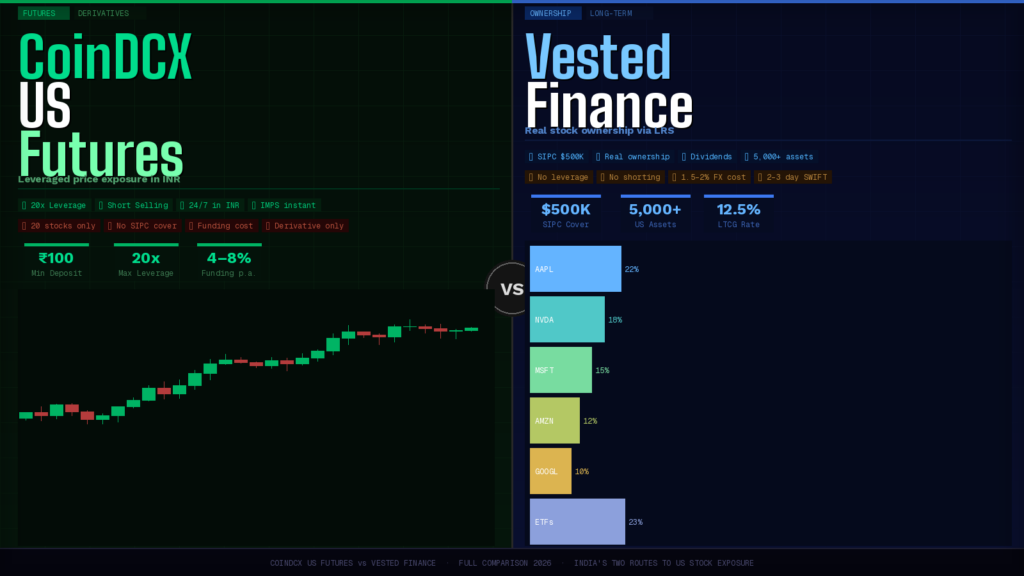
⚡ TL;DR — CoinDCX US Futures vs Vested Finance
Vested is for building. CoinDCX US Futures is for trading. They’re different financial instruments — derivatives vs real ownership — that happen to give Indian users exposure to US stock prices. Use the right tool for your goal.

- Asset universe: CoinDCX 20+ stocks · Vested 5,000+ stocks & ETFs (S&P 500, QQQ, sector ETFs, REITs)
- Leverage: CoinDCX up to 20x · Vested 1x only
- Short selling: CoinDCX yes · Vested never (long-only)
- Deposit speed: CoinDCX ~2 min (IMPS) · Vested 2–3 business days (SWIFT)
- FX cost: CoinDCX zero · Vested 1.5%–2% markup each way
- Dividends: CoinDCX no · Vested yes
- SIPC protection: CoinDCX none · Vested up to $500K via DriveWealth (FINRA)
- Tax on long holds (24m+): CoinDCX 30% slab · Vested 12.5% LTCG
- Cost crossover: CoinDCX cheaper for trades under ~6 weeks · Vested cheaper for anything longer
CoinDCX US Futures vs Vested Finance — Full Feature Comparison
| Feature | CoinDCX US Futures | Vested Finance |
|---|---|---|
| Product type | Perpetual futures (derivative) | Direct stock/ETF ownership |
| Underlying asset | Futures contract (no ownership) | Actual shares in your name |
| Asset count | 20+ US stocks + NASDAQ 100 | 5,000+ US stocks and ETFs |
| Minimum investment | ₹100 | $1 (~₹84) |
| Leverage | Up to 20x | None (1x only) |
| Short selling | Yes | No (long only) |
| Trading hours | 24/7 incl. weekends | US market hours only (+ extended) |
| Deposit method | IMPS/NEFT (INR) — instant | SWIFT/LRS — 2–3 business days |
| Currency | INR settlement, no USD needed | INR to USD conversion required |
| FX conversion cost | None | 1.5%–2% FX markup each way |
| Trading fee | 0.05% taker / 0.007% maker | Commission-free on stocks/ETFs |
| Funding/carry cost | 4%–8% p.a. (explained here) | None — no carry cost |
| Dividends | No | Yes — credited in USD |
| Fractional shares | N/A (futures contracts) | Yes — from $1 |
| Withdrawal fee | Nil (INR) | $11 per USD withdrawal |
| Account opening fee | None | ₹399 one-time (Basic plan) |
| Premium plan | N/A | ₹4,500/year (advanced features) |
| LRS required | No | Yes — counts against $250K limit |
| TCS applicability | No | Yes — 20% above ₹10L remittance |
| SIPC protection | No | Yes — up to $500K via DriveWealth |
| FINRA regulation | No | Yes — VF Securities, Inc. |
| FIU-IN registered | Yes (see Is CoinDCX Safe?) | N/A (not a crypto exchange) |
| Hack history | $44M July 2025 (user funds safe) | No reported breaches |
| Tax treatment (gains) | Business income / speculative | Capital gains (STCG/LTCG) |
| ITR Schedule FA required | No (INR product) | Yes — Schedule FA mandatory |
| Curated portfolios | No | Yes — themed ‘Vests’ |
| Tax loss harvesting | No | Yes (Premium feature) |
| Mobile app rating | 3.8/5 (mixed UI reviews) | 4.3/5 (generally positive) |
| Best for | Active traders, leveraged plays, shorting | Long-term investors, passive wealth building |
They’re Not Competing Products — Start Here
Most comparison articles frame this as a choice between two ways to access the same thing. That framing is wrong. CoinDCX US Futures and Vested Finance are fundamentally different financial instruments that happen to both give Indian traders exposure to US stock prices. Understanding that difference first prevents every bad decision that follows from it.
When you buy Apple stock on Vested, you own Apple stock. It’s in your name at DriveWealth (a FINRA-registered US broker-dealer). You receive dividends. If Apple does a stock split, your holdings split. If Apple gets acquired, you receive the acquisition price. You are a shareholder. The USD value of your position grows or falls with Apple’s actual price.
When you go long Apple futures on CoinDCX, you own a contract whose value tracks Apple’s price. You don’t own Apple stock. You don’t receive dividends. You don’t vote in Apple shareholder meetings. You’re holding a derivative. Your P&L is calculated based on the price difference between entry and exit, multiplied by your leverage. If you hold for 7 days, you pay funding costs. If the price moves 5% against your 10x leveraged position, you lose 50% of your margin.
💡 The simplest frame: Vested is for building. CoinDCX US Futures is for trading. If your verb is “accumulate,” “hold,” or “compound” — go Vested. If your verb is “react,” “leverage,” or “short” — go CoinDCX. The two also pair well: Vested for the long-term core, CoinDCX for tactical overlays.
Fee Comparison — The Real All-In Cost
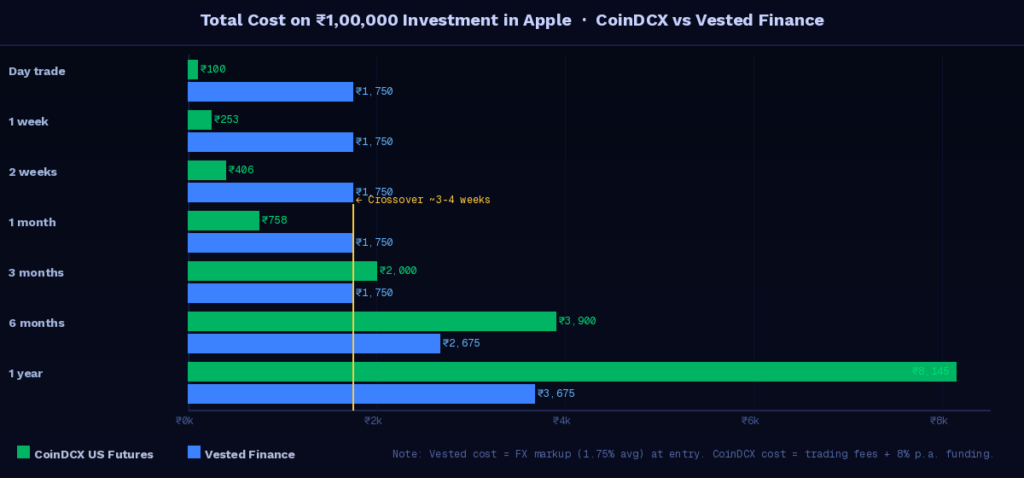
CoinDCX charges for time (funding rate on holds). Vested charges for currency conversion (FX markup at entry and exit). The one that’s cheaper depends entirely on what you’re doing.
CoinDCX US Futures — What You Actually Pay
- Trading fee: 0.05% taker, 0.007% maker, charged on notional position value at entry and exit
- Funding rate: 4%–8% p.a. on notional, charged every 8 hours you hold. Zero if you close before a timestamp
- No deposit fee. No withdrawal fee for INR. No account opening fee. No annual fee.
Vested Finance — What You Actually Pay
- Trading fee: Zero commission on stocks and ETFs (revenue comes from FX markup and subscriptions)
- FX markup: 1.5%–2% on each INR-to-USD conversion (at deposit). Applied again on USD-to-INR withdrawal
- Withdrawal fee: $11 per USD withdrawal back to India
- Account opening: ₹399 one-time (Basic plan)
- Premium plan: ₹4,500/year — includes advanced screeners, Vest portfolio access, tax loss harvesting tools
- No carry cost. No funding. No time-based charges.
Real-World Cost Comparison: ₹1,00,000 Invested in Apple
| Scenario | CoinDCX US Futures | Vested Finance |
|---|---|---|
| Entry: ₹1,00,000 → Apple | ₹50 trading fee (0.05% taker) | ₹1,500–₹2,000 FX markup (1.5%–2%) |
| Hold 7 days (8% p.a. funding) | ₹153.42 funding cost | ₹0 (no carry charge) |
| Hold 30 days (8% p.a. funding) | ₹657.53 funding cost | ₹0 |
| Exit: close position / sell stock | ₹50 trading fee | $11 withdrawal (~₹925) when repatriating |
| Dividend received | ₹0 (futures = no dividends) | Yes (depends on Apple’s dividend) |
| Total cost: Day trade | ₹100 fees, ₹0 funding | ₹1,500–₹2,000 FX (if same day) |
| Total cost: 7-day hold | ₹100 fees + ₹153 funding = ₹253 | ₹1,500–₹2,000 FX + ₹0 carry |
| Total cost: 30-day hold | ₹100 fees + ₹658 funding = ₹758 | ₹1,500–₹2,000 FX + ₹0 carry |
| Total cost: 1-year hold | ₹100 fees + ₹7,945 funding = ₹8,045 | ₹1,500–₹2,000 FX in + ₹925 out = ~₹3,000 |
▶ Winner: CoinDCX short-term trades (< 2 weeks)
▶ Winner: Vested Finance long-term holding (> 1 month)
Asset Selection — 20 Stocks vs 5,000+
CoinDCX: The 20+ Stock Universe
At launch, CoinDCX US Futures offers futures contracts on 20+ major US stocks plus the NASDAQ 100 index. The coverage is solid for mega-cap tech: Apple (AAPL), NVIDIA (NVDA), Tesla (TSLA), Microsoft (MSFT), Amazon (AMZN), Alphabet (GOOGL), Meta (META), Netflix (NFLX), Palantir (PLTR), AMD, Raytheon (RTX), and a handful more.
What’s missing: small caps, sector ETFs (no QQQ, SPY, or ARKK), second-tier AI plays (C3.ai, SoundHound, Recursion Pharmaceuticals), energy stocks, healthcare names, REITs, bond ETFs, and any stock outside the 20-something CoinDCX has listed. CoinDCX has indicated more assets will be added, but there’s no published expansion timeline. For thematic AI exposure beyond the top names, see our how to buy AI stocks guide; for defence names, see our US defence stocks guide.
Vested Finance: 5,000+ Assets
Vested gives access to over 5,000 US stocks and ETFs listed on NYSE, NASDAQ, and AMEX. This includes the full S&P 500, sector ETFs, bond ETFs, REITs, thematic ETFs, ADRs, and fractional shares from $1. You can build a genuinely diversified US portfolio — a combination of VOO for broad S&P 500 exposure, QQQ for NASDAQ tech tilt, sector-specific ETFs for overweights, and individual names for conviction plays.
Vested also has curated ‘Vests’ — pre-built thematic portfolios covering areas like Electric Vehicles, AI, Healthcare Innovation, Dividend Aristocrats, and ESG. These are particularly useful for investors who want US exposure without the cognitive load of individual stock selection. (Investors looking for even more breadth — 11,000+ assets — should compare with our CoinDCX vs Winvesta piece.)
▶ Winner: Vested Finance not even close — 5,000+ vs 20 is a fundamental difference
Leverage and Short Selling — CoinDCX’s Decisive Advantage
Leverage: 20x on CoinDCX, None on Vested
Vested is a direct stock ownership platform. You can only invest what you deposit — no borrowing, no leverage, no margin. If you put in ₹10,000, you get ₹10,000 of Apple exposure. This is intentional: Vested is designed for investors, not traders.
CoinDCX US Futures allows up to 20x leverage on individual stocks. ₹10,000 in margin can control ₹2,00,000 of NVIDIA exposure. The return on a 5% NVIDIA move is 100% on your capital. So is a 5% loss. (For a head-to-head with other leverage platforms, see our CoinDCX vs Pi42 vs Delta Exchange comparison.)
Short Selling: CoinDCX Only
This is the most clear-cut capability gap between the two platforms. Vested Finance is long-only. If you believe Tesla is overvalued and headed for a correction, Vested has nothing for you. You can’t short. You can’t hedge. You can only not own Tesla.
CoinDCX US Futures allows short positions on any of its 20+ listed stocks. Go short Tesla, set your stop above the recent high, and your risk is clearly defined and bounded. This makes CoinDCX unique in the Indian retail market for US stocks — it’s the only consumer-facing platform that enables Indian retail traders to express bearish views on US stocks directly. Similar walkthroughs exist for shorting Meta and shorting the NASDAQ 100.
Shorting use cases that CoinDCX handles and Vested doesn’t: hedging an existing US portfolio against market corrections, speculating on overvalued stocks before earnings, capturing downside during macro shocks (Fed surprise, geopolitical events), and funding rate arbitrage (going short on high-funding-rate stocks to collect the funding payment).
▶ Winner: CoinDCX complete advantage on leverage and shorting — Vested has neither
Deposit Speed and Access — When You Need to Trade Now
CoinDCX: IMPS in Under 10 Minutes
Funding your CoinDCX US Futures wallet requires an IMPS or NEFT transfer from your Indian bank account to your CoinDCX INR wallet. IMPS settles in real time — typically under 2 minutes during banking hours. Your funds are available for trading almost immediately. CoinDCX does not support UPI as of March 2026 (see our UPI for US stocks guide for alternatives), which is a gap given how dominant UPI has become in Indian consumer fintech, but IMPS remains fast and reliable.
This speed matters most when trading around US market events: earnings releases at 9–11 PM IST, Fed announcements, unexpected macro news.
Vested: SWIFT Transfer, 2–3 Business Days
Funding a Vested account requires an international SWIFT remittance from your Indian bank. The process involves submitting the transaction through your bank’s net banking or mobile app with the correct LRS purpose code, completing Form A2 declarations where required, and waiting for the SWIFT to settle internationally. CoinDCX’s own documentation confirms 2–3 business days is the typical timeline for SWIFT settlement from banks like SBI and ICICI.
Vested has tried to reduce this friction with ‘Vested Direct’ — a partnership with SBM Bank India designed to speed up fund transfers. For investors with pre-funded Vested accounts, this doesn’t matter on a day-to-day basis. But for someone making their first transfer, or someone who’s reacting to a market development and needs to get money in quickly, the 2–3 day timeline is a real constraint. (Compared to INDmoney’s UPI-via-Federal-Bank route, which lands in 12–24 hours, Vested’s funding speed is now the slowest of the three major LRS platforms.)
Additionally, Vested requires TCS collection above ₹10 lakh in LRS remittances per financial year — 20% TCS from Budget 2025-26. This doesn’t reduce your actual investment (it’s reclaimable against your income tax liability), but it creates a temporary cash flow impact of 20% on amounts above the threshold. For someone investing ₹50,000–₹1,00,000 periodically, it’s not a concern. For anyone deploying larger amounts, the TCS timing matters.
▶ Winner: CoinDCX clear winner for speed — IMPS vs 2–3 day SWIFT is not even comparable
Safety and Regulatory Protection — The Critical Difference
Vested’s SIPC Coverage: Up to $500,000
Vested operates through DriveWealth, a FINRA-registered US broker-dealer. This means every Vested user’s account at DriveWealth is protected by SIPC — the Securities Investor Protection Corporation — for up to $500,000 in securities (including $250,000 in cash). SIPC protection kicks in if the broker-dealer fails: if DriveWealth went bankrupt tomorrow, SIPC would work to return your assets to you up to the $500,000 limit. Your Apple shares don’t disappear.
This is the strongest investor protection available to Indian retail traders investing in US stocks. It’s backed by a US government-sponsored entity, and it’s the same protection that American retail investors get when they open an account at Fidelity or Schwab.
CoinDCX: No SIPC Equivalent
CoinDCX US Futures positions are derivative contracts held at an exchange, not securities held at a FINRA-registered custodian. There is no SIPC equivalent. CoinDCX is FIU-IN registered, ISO 27001 certified, and uses 100% cold storage for user funds — it passed the test in July 2025 when a $44 million hack touched company funds but left user balances intact. But in a platform insolvency scenario, your futures positions are unsecured claims against CoinDCX’s assets, not protected by an external guarantee scheme. (For the full safety analysis, see our Is CoinDCX Safe in 2026 deep-dive.)
For context, CoinDCX’s $100M+ corporate treasury and profitable India business make near-term insolvency unlikely. But structurally, the protection gap between SIPC coverage and no SIPC coverage is meaningful for any trader thinking beyond six months.
Hacks and Platform Risk
CoinDCX was hacked in July 2025 ($44M, zero user impact). Vested has no reported security breaches. Both platforms use strong encryption and secure account practices. For Vested, the key safety feature is that your assets are held at DriveWealth — not at Vested itself. Even if Vested the company faced problems, your assets would remain at the custodian. This structural segregation is more robust than what CoinDCX can offer for its futures positions.
▶ Winner: Vested Finance SIPC coverage and FINRA-regulated custody is materially stronger investor protection
Tax Treatment — How Each Platform Is Taxed in India
Vested Finance: Capital Gains Tax (STCG/LTCG)
Gains from US stocks held on Vested are taxed as capital gains in India. The applicable rate depends on holding period. Shares held for 24 months or more qualify for Long-Term Capital Gains (LTCG) at 12.5% (Budget 2025-26 update). Shares held for under 24 months are Short-Term Capital Gains (STCG), taxed at your income slab rate. Dividends received are taxable as ‘income from other sources’ at your slab rate.
Critically, you must declare all foreign assets in Schedule FA of your ITR, regardless of whether you made a profit or loss. Failure to disclose foreign assets — even small amounts — attracts penalties under the Black Money Act. Vested provides a dedicated tax module with one-click download of all required ITR documents, which simplifies this considerably.
TCS collected at remittance (20% on LRS remittances above ₹10L) is fully reclaimable against your income tax liability via Form 12BAA at ITR filing time. It’s not an additional tax — it’s a prepayment of tax you’d owe anyway. The practical friction is the temporary cash lockup.
CoinDCX US Futures: Business Income / Speculative Business
Gains from CoinDCX US Stock Futures are likely classified as either speculative business income or non-speculative business income in India, depending on the nature of your trading activity. This is more favourable in some ways — business losses can be carried forward for 8 years (for non-speculative) — but more complex to file. It also means your gains are taxed at your income slab rate, not at the concessional LTCG rate that applies to long-held Vested shares.
Since CoinDCX US Futures are INR-settled, there’s no foreign asset disclosure requirement, no Schedule FA, and no LRS/TCS implication. Your P&L from CoinDCX appears as INR trading income — structurally similar to NSE F&O trading for tax purposes. This makes filing conceptually simpler for traders already familiar with F&O taxation.
| Tax Factor | CoinDCX US Futures | Vested Finance |
|---|---|---|
| Gain classification | Business income / speculative | Capital gains (STCG/LTCG) |
| LTCG rate (24m+) | Not applicable | 12.5% (Budget 2025-26) |
| STCG / short hold | Slab rate (30% for high earners) | Slab rate |
| Loss carryforward | Up to 8 years (non-spec) | 3 years (STCG losses) |
| Schedule FA required | No (INR product) | Yes — mandatory foreign asset disclosure |
| TCS applicability | No | 20% on LRS above ₹10L (reclaimable) |
| Dividends | N/A — no dividends | Slab rate as other income |
| Tax document generation | Manual export from app | One-click ITR docs in Vested tax module |
| Tax clarity/guidance | Low — product is new, no CBDT guidance | Moderate — established LRS framework |
Trading Experience — App, Speed, and Day-to-Day Use
CoinDCX Pro App — Powerful but Inconsistent
CoinDCX’s futures interface is built for derivatives traders familiar with perpetual contracts. The trade ticket shows leverage selector, margin calculator, estimated funding cost, and mark price — everything an active futures trader needs. The problem is the redesigned app that rolled out in late 2025: users have documented difficulty sorting positions, finding specific stocks quickly, and managing multiple open positions during fast-moving sessions. Google Play rating sits at 3.8/5 with recurring UX complaints. For new users learning futures trading, the interface is harder to navigate than it should be. For experienced derivatives traders migrating from BTC perpetuals, the learning curve is near zero.
Vested Finance App — Clean, Investor-Focused
Vested’s app is well-rated at 4.3/5 on Google Play with generally positive user reviews. The interface is designed for investors rather than traders: clean portfolio view, stock research pages with valuation charts, Vest portfolio browsing, and a dedicated tax section. The experience is closer to Zerodha’s Coin for mutual funds than to a derivative trading platform. Limit orders and stop-limit orders are available for more precise execution. The extended hours feature (9.5 additional hours of trading before and after regular US market hours) adds practical flexibility for Indian users in the IST time zone.
24/7 Access — Weekend Trading
CoinDCX US Futures trade 24/7. You can open a TSLA short at 3 AM on a Sunday. You can react to breaking news — a Fed official’s speech at an unusual time, a weekend geopolitical development, a CEO resignation announced on a Saturday — in real time. This is structurally impossible on Vested, which is limited to US market hours plus extended hours. For traders who follow US macro closely, the 24/7 access is genuinely valuable.
▶ Winner: Vested Finance better app experience for investors — CoinDCX wins on trading features but loses on UX polish
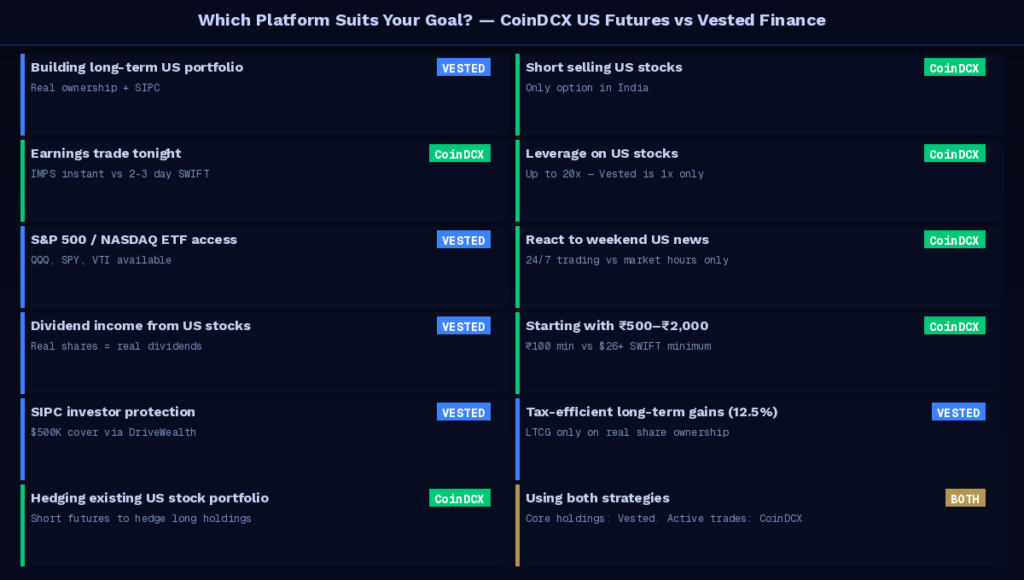
Who Should Use Which — Decision Framework
| If you are… | Use this | Why |
|---|---|---|
| Building a long-term US stock portfolio | Vested Finance | Real ownership, SIPC protection, dividends, no leverage risk, 5,000+ assets |
| Wanting to short Tesla, Meta, or NASDAQ | CoinDCX US Futures | Only platform offering retail short-selling on US stocks in India |
| An active trader reacting to US earnings | CoinDCX US Futures | 24/7 IMPS deposit, immediate execution, no SWIFT delay |
| Starting with under ₹5,000 | CoinDCX US Futures (1x) | ₹100 minimum vs $26 minimum + FX markup on Vested |
| Investing ₹50,000+ per month systematically | Vested Finance | FX cost amortised over time, tax efficiency, dividend income |
| Already a crypto futures trader on CoinDCX | CoinDCX US Futures | Same interface, zero onboarding friction |
| Wanting S&P 500 or NASDAQ ETF exposure | Vested Finance | QQQ, SPY, VTI — CoinDCX only has NSDQ100 futures |
| Wanting leverage on US stocks | CoinDCX US Futures | Only option — Vested is long only, 1x |
| Worried about platform solvency | Vested Finance | DriveWealth custody + SIPC — assets safe even if Vested closes |
| Wanting dividends and stock split benefits | Vested Finance | Real ownership required — futures holders get neither |
| Trading around US Fed decisions (fast) | CoinDCX US Futures | React in minutes with IMPS, not days with SWIFT |
| Already a Zerodha user awaiting GIFT City launch | Both options apply | See our CoinDCX vs Zerodha GIFT City comparison |
| Using both strategies | Use both platforms | CoinDCX for active trades, Vested for long-term core holdings |
Real-World Scenarios — Which Platform Wins Each
Scenario 1: NVIDIA Earnings Play (Night Trade)
NVIDIA reports Q4 2025 earnings after US market close on a Thursday evening. Results drop at 9:45 PM IST. You’ve been following the trade and believe the stock will gap up on strong datacenter revenue. You want to be long going into the print.
CoinDCX: Deposit ₹8,000 via IMPS at 9:30 PM, open 5x long NVDA futures at 9:50 PM, NVIDIA gaps up 7.2%. Your 5x position gains 36%. You close at 11 PM for ₹2,880 profit. Zero funding crossed (between 17:30 and 01:30 timestamp window). Total cost: ₹80 in trading fees.
Vested: If you haven’t pre-funded, you can’t participate. If you have $100 pre-loaded from a previous SWIFT transfer, you can buy NVDA shares and capture the 7.2% gain — ₹612 profit on ₹8,500 equivalent. No leverage, no funding, but significantly lower absolute return on the same capital.
▶ Winner: CoinDCX leverage and instant deposit give a decisive edge for reactive earnings trades
Scenario 2: Long-Term MSFT Accumulation
You want to invest ₹5,000 per month in Microsoft over the next 3 years. Your thesis: Microsoft’s AI integration through Azure and Copilot will drive sustained earnings growth. You’re not interested in leverage. You just want to own Microsoft.
CoinDCX: You’d be paying 4%–8% annual funding rate on ₹5,000 monthly — approximately ₹3,600–₹7,200 per year in funding on a ₹60,000/year investment pace by year end. No dividends. After 3 years, your ‘investment’ is a derivatives position that still requires active management. This is the wrong product for this goal.
Vested: Pay 1.5%–2% FX markup at each deposit (₹75–₹100 on ₹5,000). Receive MSFT’s quarterly dividend (~0.75% annual yield). Three years later, you own real MSFT shares. LTCG tax rate of 12.5% applies after 24 months. Tax module generates your ITR documents. This is exactly what Vested is built for.
▶ Winner: Vested Finance correct product entirely — CoinDCX Futures is structurally wrong for this goal
Scenario 3: Shorting Tesla Before Earnings
Tesla is trading at $890 ahead of its Q1 2026 earnings. You believe the automotive margin story is deteriorating and consensus estimates are too optimistic. You want to short Tesla before results.
CoinDCX: Open a short position on TSLA futures. 3x leverage, ₹10,000 margin, ₹30,000 notional. Tesla misses estimates and drops 9.1%. Your 3x short position gains 27.3%, returning ₹2,730 profit. Cost: ₹30 in trading fees plus one funding timestamp ≈ ₹1.97. Net profit: ₹2,698. (Full setup walkthrough in our how to short Tesla guide.)
Vested: Cannot short. Zero options. The trade simply doesn’t exist on this platform.
▶ Winner: CoinDCX sole option — Vested cannot execute this trade at all
Frequently Asked Questions
Which is better — CoinDCX US Futures or Vested Finance?
Neither is universally better — they serve different strategies. For active trading, leverage, short-selling, 24/7 access, and earning plays, CoinDCX US Futures is the better choice. For long-term wealth building, SIPC protection, dividends, access to 5,000+ stocks and ETFs, and tax efficiency via capital gains treatment, Vested Finance is the right platform. Many Indian traders use both simultaneously for different purposes.
Can I short US stocks on Vested Finance?
No. Vested Finance is a long-only platform — you can only buy and hold US stocks and ETFs. Short selling is not available. For short exposure to US stocks from India, CoinDCX US Futures is currently the only accessible retail option.
Is Vested Finance safer than CoinDCX?
For long-term asset protection, yes. Your shares on Vested are held at DriveWealth, a FINRA-registered US broker-dealer, covered by SIPC for up to $500,000. CoinDCX US Futures positions are exchange-held derivatives with no equivalent investor protection scheme. CoinDCX is technically secure — it survived a $44M hack in July 2025 with zero user impact — but the structural regulatory protection on Vested is stronger.
What happens to my Vested account if Vested Finance shuts down?
Your assets would remain at DriveWealth, the underlying US custodian. Vested is the interface; DriveWealth holds your actual shares. If Vested the company closed, you could transfer your assets out through DriveWealth directly. This is one of the most important structural features of the LRS route — your shares are yours, held at a regulated custodian, independent of the interface provider.
Can I use both CoinDCX US Futures and Vested Finance at the same time?
Yes, and many sophisticated Indian investors do exactly this. A common approach: hold a core long-term US portfolio on Vested (index ETFs, quality individual names), and use CoinDCX US Futures for tactical trades — earnings plays, short positions, hedging the portfolio during corrections, or expressing a high-conviction directional view with leverage. The two platforms are genuinely complementary.
What is the minimum amount to start on each platform?
CoinDCX US Futures: ₹100 minimum deposit. You can open a position for as little as ₹100, though at any meaningful leverage, ₹1,000–₹5,000 is a more practical starting point to avoid immediate liquidation risk. Vested Finance: the minimum is $1 for fractional shares, but you need to send at least $26 via SWIFT (SBI’s minimum) to fund your account, plus the 1.5%–2% FX markup.
How is the tax different between CoinDCX and Vested?
Vested gains are capital gains — STCG at slab rate for under 24 months, LTCG at 12.5% for over 24 months. You must file Schedule FA for foreign assets. CoinDCX gains are likely business income (speculative or non-speculative), taxed at slab rate with no LTCG benefit, but no foreign asset declaration required since it’s INR-settled. For high earners in the 30% slab who plan to hold for more than 2 years, Vested’s 12.5% LTCG rate is significantly more tax-efficient.
Does CoinDCX charge conversion fees like Vested’s FX markup?
No. CoinDCX US Futures are fully INR-settled — there’s no currency conversion at any point. You deposit INR, trade in INR, receive P&L in INR, and withdraw INR. The FX markup that Vested charges (1.5%–2%) doesn’t apply. CoinDCX’s primary cost for active trades is the 0.05% taker fee plus the 4%–8% annual funding rate for held positions.
💡 Bottom Line
This isn’t a winner-takes-all comparison — these are different tools for different jobs. CoinDCX US Futures and Vested Finance solve fundamentally different problems for the same Indian investor.
Use Vested for long-term US wealth building: real share ownership, dividends, SIPC-backed custody at DriveWealth, 5,000+ stocks and ETFs, and 12.5% LTCG treatment after 24 months. Use CoinDCX for tactical trades: leveraged earnings plays, shorts on overextended names, hedging existing US longs during macro shocks, and any move where 2–3 day SWIFT timing would mean missing the trade.
If you can only pick one based on your primary use case: active trader → CoinDCX. Long-term investor → Vested. Many serious investors run both — that’s the right answer too. New to either? Start with the How to Trade US Stock Futures from India pillar guide and the CoinDCX US Futures Review for the trader path.
Continue Reading
- Foundation: How to Trade US Stock Futures from India · CoinDCX US Futures Review · Is CoinDCX Safe in 2026? · Funding Rate Explained
- Other comparisons: vs INDmoney · vs Winvesta · vs Angel One · vs Zerodha GIFT City · vs Interactive Brokers · vs Pi42 & Delta
- How-to buy: AI Stocks (NVDA, PLTR, AMD) · NASDAQ 100 · S&P 500 · US Defence Stocks · UPI for US Stocks
- Strategies: NVIDIA Earnings · Short Tesla · Short Meta · Short NASDAQ 100
For on-demand analysis of any cryptocurrency, join our Telegram channel.