📢 Disclosure: CoinCodeCap may earn affiliate commission when you sign up via links in this article. Our reviews remain editorially independent — we test products, validate claims, and report honestly. Trading derivatives involves substantial risk of loss; capital is at risk. This article is for educational purposes only and is not financial advice. Consult a SEBI-registered advisor for personalised guidance.
Indian residents can legally trade US stock futures through platforms like CoinDCX, starting with just ₹100, with up to 25x leverage, settled entirely in INR — no US brokerage account, no dollar conversion, and no LRS remittance required.
Alternatively, platforms like Vested Finance, INDmoney, and Winvesta offer actual stock ownership via the LRS route, requiring dollar transfers and a US custodian. This guide covers both routes in full, with step-by-step setup, costs, taxes, and honest pros and cons. For a hands-on walkthrough of the platform itself, see our CoinDCX US Futures Review.

Most Indian traders first hear about US stock futures the same way — a friend mentions he shorted Tesla during a Musk controversy and made ₹18,000 in two hours. Then you Google it. Then you fall into a maze of contradictory information about FEMA, LRS, brokerage accounts, and SEBI regulations. Some articles say it’s illegal. Others list five apps without explaining the difference between owning a stock and trading a futures contract on it. This guide cuts through all of that.
There are two completely different ways to access US stocks from India, and they are not interchangeable. One gives you actual share ownership — useful for long-term investors. The other gives you price exposure through futures contracts — designed for active traders who want leverage, 24/7 access, and INR settlement without the overhead of foreign remittances. CoinDCX’s US Stock Futures product, launched in February 2026, is the most accessible version of the second route available to Indian retail traders today.

This guide explains both routes honestly. By the end, you’ll know exactly how each works, what it costs, how the tax treatment differs, and which one fits your situation.
⚡ TL;DR — US Stock Futures from India
If you’re an active trader who wants leverage, short-selling, and 24/7 access without the LRS paperwork — CoinDCX US Stock Futures is the route. If you want long-term share ownership with dividends and SIPC protection — Vested, INDmoney, or Winvesta via the LRS route is the right call.
- Minimum to start: ₹100 on CoinDCX (futures) vs ~₹5,000 on LRS platforms
- Leverage: Up to 25x on CoinDCX; none (1x only) via LRS
- Short selling: Yes on CoinDCX; not available on any LRS platform
- Trading hours: 24/7 on CoinDCX; US market hours only via LRS
- Currency: INR-settled on CoinDCX; USD via LRS (with TCS above ₹10L)
- Available stocks: 20+ on CoinDCX; 11,000+ on Winvesta, thousands on Vested/INDmoney
- Tax: Slab rate (up to 30%) on CoinDCX futures; LTCG 12.5% after 24 months on direct holdings
The Two Routes to US Stocks from India — and Why They’re Fundamentally Different
Before touching any platform or app, you need to understand that ‘investing in US stocks from India‘ can mean two very different things. Conflating them is the single most common mistake first-time traders make.
| Feature | Direct Ownership (LRS Route) | US Stock Futures (CoinDCX) |
|---|---|---|
| What you own | Actual shares held at a US custodian | Derivative contract tracking the stock price |
| Minimum investment | From $1 (fractional shares) | ₹100 |
| Currency | USD — requires forex conversion | INR — fully settled in rupees |
| LRS remittance needed? | Yes — must send money abroad | No — funds stay in India |
| Leverage | None (long-only) | Up to 25x |
| Short selling | Not available | Yes — go short easily |
| Trading hours | US market hours (7:30 PM–2:00 AM IST) | 24/7 |
| Dividends | Yes, subject to 25% US withholding | No — futures contracts don’t pay dividends |
| SIPC protection | Yes (up to $500,000) | No — crypto-style exchange structure |
| Tax treatment in India | Capital gains / foreign assets | Business income or capital gains (case-specific) |
| Regulatory status | FEMA/LRS compliant, SEBI-registered apps | Operates under CoinDCX’s FIU-IN registration |
| Best for | Long-term wealth building | Active trading, leverage plays, short-selling |
Both routes are legal for Indian residents. The LRS route is governed by FEMA and RBI’s Liberalised Remittance Scheme. The futures route through CoinDCX operates under the platform’s crypto exchange registration (you can read more about CoinDCX’s regulatory standing in our Is CoinDCX Safe in 2026 deep-dive). Neither requires a US bank account. The key question is what you’re trying to do — hold or trade.
What Exactly Are US Stock Futures — and How Do They Work?
A futures contract is a derivative — it tracks the price of an underlying asset without you actually owning that asset. When you buy an Apple futures contract on CoinDCX, you don’t own any Apple shares. You hold a position whose value moves in sync with Apple’s market price. If Apple rises 5%, your long position gains roughly 5% of your exposure. If you’re on leverage, your returns — and your losses — are amplified accordingly.
CoinDCX’s US Stock Futures are perpetual contracts, which means they have no expiry date. You hold them as long as you want, paying a funding rate for the privilege. This is structurally identical to how crypto perpetual futures work on the same platform — which is why the product feels instantly familiar to anyone who already trades BTC or ETH futures on CoinDCX, or uses competing leverage platforms like those covered in our CoinDCX vs Pi42 vs Delta Exchange comparison.
The Funding Rate — the Cost You Often Miss
Every perpetual futures contract has a funding rate — a periodic payment between long and short holders that keeps the futures price anchored to the underlying stock price.
On CoinDCX’s US Stock Futures, this rate runs between 4% and 8% per annum. For a ₹10,000 position held for 30 days, that’s roughly ₹33 to ₹67 in funding costs. It sounds small, but on leveraged positions held for weeks, it compounds.
Compare this to crypto futures, where BTC perpetual funding often runs at 12–15% annually and altcoin contracts can reach 60%+. For US stocks, the funding rate is significantly lower — another structural advantage for medium-term traders. (We break down the funding-rate math in much more depth in our dedicated funding-rate guide.)
💡 Why Perpetual Futures Have No Expiry: Traditional futures expire on a fixed date — monthly or quarterly. When they expire, you must either close the position or roll it into the next contract, incurring costs. Perpetual futures solve this by replacing expiry-based settlement with a continuous funding mechanism. You pay (or receive) a small periodic fee that keeps the contract price tracking the spot price. Result: you can hold your position as long as you want without forced rollovers.
Long and Short — the Most Powerful Feature for Indian Traders
This is the capability that no direct stock ownership platform in India offers. On CoinDCX US Futures, you can go short — meaning you profit when a stock’s price falls.
If you believed Tesla was overvalued during a specific news cycle, you could open a short position, and every 1% decline in Tesla’s price would add to your P&L. We have walkthroughs for the most popular short trades — shorting Tesla, shorting Meta, and shorting the NASDAQ 100 — all from India.
Winvesta, Vested, INDmoney — none of them support short positions. If you want to profit from a US stock falling, US stock futures on CoinDCX are currently the most accessible route for Indian retail traders.
How CoinDCX US Stock Futures Works — Full Platform Overview
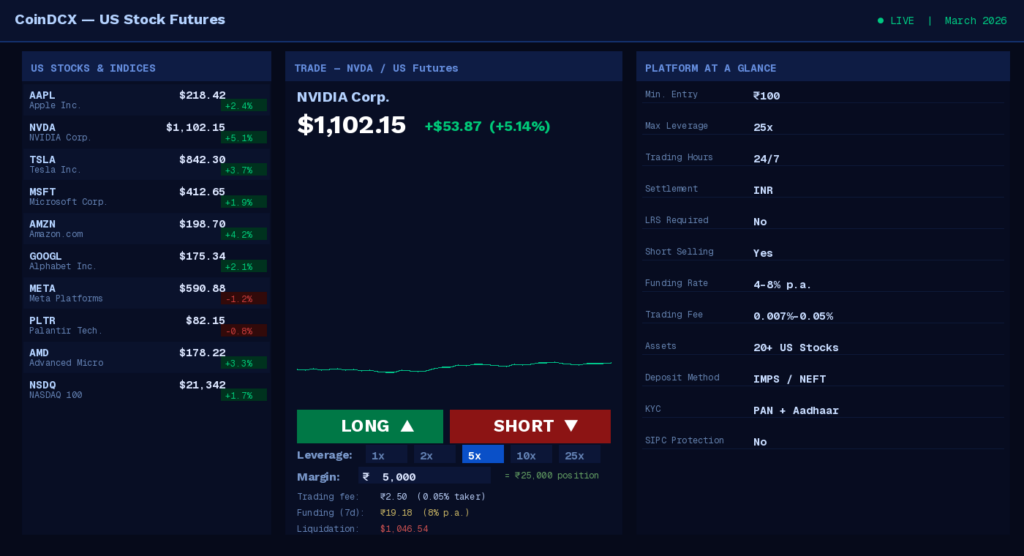
CoinDCX launched its US Stock Futures product in February 2026. It is built on the same perpetual futures infrastructure that powers the platform’s crypto derivatives offering, adapted for US equities. Here’s what you’re actually getting. For a hands-on user perspective with screenshots and real-trade examples, see our complete CoinDCX US Futures Review.
Available Assets (as of March 2026)
At launch, CoinDCX offers futures contracts linked to 20+ major US stocks and indices. The list includes:
- Individual stocks: Apple (AAPL), Tesla (TSLA), Microsoft (MSFT), NVIDIA (NVDA), Amazon (AMZN), Meta (META), Alphabet/Google (GOOGL), Netflix (NFLX), Palantir (PLTR), AMD, and others. For AI-themed plays, see our guide to buying AI stocks from India; for defence names like Palantir and RTX, see our US defence stocks guide.
- Indices: NASDAQ 100 (NSDQ100), with S&P 500 access expected to follow.
Coverage will expand over time. CoinDCX has confirmed that additional markets will be added based on user demand. For traders focused on the major names — the AI stocks, the mega-cap tech, the high-volatility earnings plays — current coverage is sufficient.
Leverage Tiers
CoinDCX offers up to 25x leverage on US stock futures. In practice, this means a ₹4,000 margin deposit can control a ₹1,00,000 position in Apple or NVIDIA. The leverage works identically to crypto futures on the same platform — your margin is the collateral, and if the position moves against you to a point where your margin is insufficient, liquidation kicks in.
⚠ Risk warning: Leverage amplifies both gains and losses in equal measure. A 4% adverse move on a 25x leveraged position can wipe out your entire margin. Most experienced traders use 2x–5x leverage even when higher limits are available. Using 25x on a US stock position is extremely high risk and should only be considered by traders with robust stop-loss discipline.
Wallet Structure and INR Settlement
CoinDCX maintains a dedicated US Futures wallet, separate from your crypto trading balance. You deposit INR into this wallet via IMPS or NEFT — no international wire transfer, no SWIFT, no forex conversion required from your end. All P&L is displayed and settled in INR, calculated against a live INR-USD conversion rate applied by the platform. When you close a position, the profit or loss lands in your INR wallet.
This structure is what makes CoinDCX fundamentally different from direct stock platforms. With Vested or INDmoney, your money physically leaves India via LRS — it gets converted to USD, held at a US custodian, and comes back to you when you sell and repatriate. With CoinDCX, the money never crosses a border. You’re trading claims on price movements, not moving capital internationally.
Minimum Entry — ₹100
The advertised ₹100 minimum is real. You can open a futures position on Apple or NVIDIA with ₹100 as your margin. Whether trading with ₹100 is a good idea is a separate question — the point is that the accessibility barrier is exceptionally low compared to direct US stock platforms, which typically require a minimum LRS remittance of ₹5,000 to ₹10,000 to make the forex conversion worthwhile.
Trading Hours — 24/7
CoinDCX US Stock Futures trade around the clock, seven days a week. This includes weekends and Indian public holidays.
During US market hours (7:30 PM to 2:00 AM IST in standard time, 6:30 PM to 1:00 AM IST during US daylight saving from March to November), the futures contracts track the live stock price with tight spreads. This 24/7 access is what lets you trade NVIDIA around earnings without waiting for the next Indian session.
Outside those hours, trading continues but with reduced liquidity and wider bid-ask spreads. Futures prices during off-hours are anchored within a price discovery range around the last closing price.
How to Start Trading US Stock Futures on CoinDCX — Step by Step

Step 1: Create and Verify Your CoinDCX Account
- Download the CoinDCX app (iOS or Android) or visit coindcx.com
- Register with your email and mobile number
- Complete full KYC: upload PAN card, Aadhaar card, and a selfie for liveness check
- KYC approval typically takes a few minutes for Aadhaar-linked verification, up to 24 hours in edge cases
If you already have a CoinDCX account for crypto trading, your existing KYC covers US Futures — no separate verification required.
Step 2: Navigate to US Stock Futures
- In the app, go to the Futures or F&O tab
- Look for ‘US Stock Futures’ or ‘US Stocks’
- You’ll see the list of available stocks and indices with live prices and 24H change
Step 3: Fund Your US Futures Wallet
- Tap ‘Add Funds’ within the US Stock Futures section
- Transfer INR via IMPS or NEFT from your linked bank account
- Minimum deposit: ₹100. There’s no maximum single deposit limit within RBI-allowed structures
- IMPS transfers typically reflect within minutes. NEFT can take up to 2 hours during banking hours
⚠ As of March 2026, UPI is not available for deposits into the US Futures wallet. Deposits use IMPS or NEFT only. If UPI deposit support is critical to you, see our guide on how to use UPI to buy US stocks from India via alternative platforms. Always verify current payment methods on the platform before attempting a transfer, as this may change.
Step 4: Choose Your Stock and Position
- Select the stock you want to trade — for example, NVDA (NVIDIA)
- Review the current price, 24H change, funding rate, and available leverage tiers
- Choose Long (you expect the price to rise) or Short (you expect the price to fall)
- Set your margin amount — the capital you’re putting in — and adjust leverage
- The platform shows your position size, liquidation price, and estimated funding cost before you confirm
- Confirm the trade. Your position is live immediately
Step 5: Managing and Closing Your Position
Your open positions appear in the Futures portfolio section. You can set a take-profit and stop-loss order at the same time you open the trade. To close, simply tap the position and select ‘Close’ — either fully or partially. The P&L settles to your INR wallet in real time.
What It Actually Costs — Fees, Funding Rates, and Hidden Charges
The total cost of trading US stock futures on CoinDCX has three components. Most traders focus only on the trading fee and miss the funding rate entirely, which is the larger cost for anyone holding positions beyond a day.
| Cost Component | Rate | Example on ₹10,000 Position, 7-day Hold |
|---|---|---|
| Trading fee (maker) | 0.007% per trade | ₹0.70 to open + ₹0.70 to close = ₹1.40 |
| Trading fee (taker) | 0.05% per trade | ₹5.00 to open + ₹5.00 to close = ₹10.00 |
| Funding rate | 4%–8% p.a. (paid every 8 hours) | ₹7.67–₹15.34 for 7-day hold |
| INR conversion spread | Built into live rate (not separately charged) | Implicit, not itemised |
| Deposit fee | ₹0 (IMPS/NEFT) | ₹0 |
| Withdrawal fee | ₹0 (INR withdrawal) | ₹0 |
For a day trader opening and closing within the same session, the cost is dominated by the trading fee — typically ₹1.40 to ₹10 per ₹10,000 traded depending on order type. For a swing trader holding for a week or two, the funding rate becomes the dominant cost. At 8% per annum, a ₹1,00,000 position costs roughly ₹153 in funding over a 7-day hold — workable, but something to model before entering a trade.
Contrast this with the cost of the LRS route. On Vested Finance, the forex markup runs 1.5%–2% each way — meaning ₹1,000 in transaction overhead on a ₹25,000 investment before you’ve made a single trade. INDmoney charges a 0.75% platform fee on deposits (capped at ₹1,000) plus 0.15% brokerage. Winvesta‘s forex markup is a more competitive 1%. For active traders making multiple moves per week, the CoinDCX cost structure is meaningfully lower once you account for forex friction on the direct route.
The LRS Route — Direct US Stock Ownership from India
If you want to actually own shares — to hold Apple stock in your name, receive dividends, and build a long-term portfolio — the LRS route is the right one. This section covers how it works, what it costs, and who it’s best suited for.
What the Liberalised Remittance Scheme (LRS) Allows
The RBI’s Liberalised Remittance Scheme permits Indian resident individuals to remit up to USD 250,000 per financial year (April to March) for approved purposes, including buying foreign equity and ETFs. The limit applies per person — a family of four can collectively remit up to $1 million annually. The LRS is for individuals only; companies, HUFs, and partnership firms are not eligible.
To use LRS, you need a PAN, an Aadhaar-linked bank account, and full KYC with your bank. Transfers go via SWIFT from your Indian bank to the platform’s partner US custodian. Your bank will ask you to declare the purpose — use code S0001 for equity investment. Getting the purpose code wrong can invite RBI compliance queries.
TCS on LRS Remittances — Updated Budget 2025-26
Tax Collected at Source (TCS) applies to LRS remittances above a threshold. Budget 2025-26 raised the TCS-free threshold from ₹7 lakh to ₹10 lakh per financial year — a meaningful improvement for retail investors. Above ₹10 lakh, TCS at 20% applies.
The critical point: TCS is not a final tax. It’s collected upfront by your bank and fully adjustable against your income tax liability when you file your ITR. If your total income tax exceeds the TCS amount, you get full credit. For most salaried investors remitting under ₹10 lakh annually, TCS is no longer a concern at all.
💡 LRS Summary: What You Need
- PAN card
- Aadhaar-linked savings account
- KYC with your bank completed
- Purpose code S0001 for equity investment
- Annual limit: USD 250,000 per individual
- TCS-free up to ₹10 lakh per year (Budget 2025-26)
Platforms for the LRS Route — Quick Comparison
| Platform | Forex Markup | Min. Investment | US Broker | Leverage | Short Selling | Best For |
|---|---|---|---|---|---|---|
| Vested Finance | 1.5%–2% | $1 (fractional) | VF Securities (FINRA) | None | No | Thematic/curated portfolios |
| INDmoney | 1%–1.5% | $1 (fractional) | DriveWealth/Alpaca | None | No | Super-app, all-in-one finance |
| Winvesta | 1% | $1 (fractional) | Saxo Bank | None | No | Widest ETF selection (11,000+) |
| Angel One | Via Vested | $1 | Via Vested/VF Securities | None | No | Existing Angel One users |
| Zerodha GIFT City | Low (0.5%) | Larger minimum | Direct, IFSC regulated | Limited | Limited | F&O traders, HNIs |
| Interactive Brokers | 0.5% | $0 | IBKR (US) | Up to 4x | Yes | Advanced/HNI traders |
All LRS platforms require 1–3 business days for account setup and the first fund transfer. After that, execution is typically same-day. SIPC protection (up to $500,000 including $250,000 cash) applies to all platforms that route through US FINRA member broker-dealers — Vested, INDmoney, and Winvesta all qualify.
Honest Pros and Cons — CoinDCX US Futures vs Direct Ownership

CoinDCX US Stock Futures — Pros
- No LRS remittance required — your money stays in India, no international wire, no SWIFT fees, no forex conversion.
- ₹100 minimum entry — the lowest barrier to US market exposure available to Indian retail traders currently.
- Up to 25x leverage — allows traders to take meaningful positions with limited capital. A ₹4,000 margin can control a ₹1,00,000 position.
- Short selling — the only easy way for Indian retail traders to profit from falling US stock prices without complex setups.
- 24/7 trading — react to US earnings, Fed announcements, geopolitical events, and earnings calls at any hour.
- Familiar interface — traders already using CoinDCX for crypto futures face zero learning curve.
- Lower funding rate than crypto — 4%–8% p.a. versus 12%–60%+ for crypto perpetuals on the same platform.
- Fast settlement — INR P&L settles immediately when you close a position.
CoinDCX US Stock Futures — Cons
- No actual ownership — you hold a contract, not shares. No dividends, no shareholder rights, no portfolio portability to another broker.
- No SIPC protection — unlike LRS platforms where your shares sit with a FINRA member broker, CoinDCX’s futures are exchange-held. If CoinDCX has a platform-level issue, recourse is limited (read our CoinDCX safety analysis for the full risk picture).
- Liquidation risk — leveraged positions can be fully wiped out. A 4% adverse move on 25x leverage triggers liquidation of your entire margin.
- Limited asset range — 20+ stocks at launch versus 11,000+ US stocks and ETFs on Winvesta or thousands on Vested/INDmoney.
- Funding cost on long holds — at 8% p.a., a ₹1,00,000 position held for 60 days costs ₹1,315 in funding. The longer you hold, the more the cost erodes returns.
- Regulatory grey area — operates under crypto exchange registration (FIU-IN), not as a SEBI-registered stock broker. The regulatory framework for this product is still evolving.
- No UPI for deposits — funding via IMPS/NEFT only as of March 2026, which adds a 2–4 step process versus the instant UPI flow many traders prefer.
Direct Ownership (LRS) — Pros
- Actual share ownership — you hold real Apple or NVIDIA shares in your name at a US custodian. Dividends, bonuses, and splits apply.
- SIPC protection up to $500,000 — strong regulatory backstop for long-term investors.
- Access to 11,000+ stocks and ETFs — virtually every US-listed company, including small-caps, REITs, and international ETFs.
- No funding rate — holding shares long-term has no ongoing cost beyond any platform or custody fee.
- USD appreciation hedge — as the rupee historically depreciates against the dollar, USD-denominated holdings grow in INR value over time even if the stock price stays flat.
Direct Ownership (LRS) — Cons
- LRS remittance overhead — requires international wire transfer, forex conversion (0.75%–2% markup), and 1–3 business day fund transfer delays.
- TCS on large remittances — 20% TCS on remittances above ₹10 lakh, recoverable but creates a cash flow burden.
- No leverage — long-only, no ability to short individual stocks.
- US market hours only — trading restricted to 7:30 PM–2:00 AM IST (or 6:30 PM–1:00 AM during US daylight saving). No weekend access.
- Estate tax exposure — US-domiciled stocks held by non-US residents face potential 40% US estate tax on amounts above $60,000. This is a real risk that most Indian investors are unaware of.
Tax Treatment in India — What You Need to Report
Tax is the area where most traders either under-report or overthink. The following applies to Indian resident individuals as of the financial year 2025-26. Tax law changes frequently — always cross-check with a CA before filing.
Tax on CoinDCX US Stock Futures Profits
Income from US stock futures on CoinDCX is likely to be classified as income from speculative business activity or non-speculative business income, depending on the frequency of trades and CoinDCX’s characterisation of the contracts. For most active traders, this means: profits are added to total income and taxed at your applicable income tax slab rate (up to 30% plus surcharge and cess). Losses from this activity may be set off against other business income in the same year and carried forward for 4 years (speculative) or 8 years (non-speculative).
⚠ Tax classification note: The tax classification of crypto-exchange-hosted US stock futures is still evolving in India. Some CAs classify them under Section 43(5) as speculative transactions; others treat them as non-speculative derivatives. The characterisation has meaningful implications for loss carry-forward rules. Get a specific opinion from a CA before your first filing year.
Tax on Direct US Stock Ownership (LRS Route)
Gains from selling US stocks held for more than 24 months qualify as long-term capital gains (LTCG) at 12.5% without indexation — the rate updated in Budget 2025-26. Gains from holdings under 24 months are short-term capital gains (STCG), taxed at your income slab rate. Dividends received from US stocks are taxed in India as income at your slab rate, after claiming credit for the 25% US withholding tax deducted at source under the India-US DTAA.
You must also disclose foreign assets (Schedule FA) in your annual ITR if you hold US stocks at any point during the financial year. Non-disclosure of foreign assets attracts penalties under the Black Money Act, which can be severe.
Most LRS platforms now provide Form 1099-DIV equivalent reports and basic ITR assistance, but the disclosure obligation is yours.
| Tax Item | CoinDCX US Futures | Direct Ownership (LRS) |
|---|---|---|
| Tax on profits | Income slab rate (up to 30%) | LTCG 12.5% (24m+) / STCG at slab |
| Tax on dividends | N/A | Taxed at slab, DTAA credit for 25% withheld |
| Loss set-off | Against business income | Against capital gains |
| Foreign asset disclosure (ITR) | Platform-level, check with CA | Yes — Schedule FA mandatory |
| TCS on deposits | None (INR-only) | 20% on LRS >₹10 lakh (recoverable) |
Risk Management — What Most Guides Skip
Leverage is the part of US stock futures trading that fills the screenshots people post in WhatsApp groups. It also fills the screenshots nobody posts — the liquidation notices. This section covers practical risk management for the CoinDCX futures product specifically.
Liquidation — How It Works and How to Avoid It
When a leveraged position moves against you to the point where your remaining margin falls below the maintenance margin threshold, CoinDCX automatically closes (liquidates) the position. You lose the margin you posted. Liquidation on a 25x leveraged position can occur with a 4% adverse price move. On individual stocks — which routinely gap 5%–15% on earnings, analyst downgrades, or macro shocks — this can happen very fast. Always know your liquidation price before entering any trade. CoinDCX displays it on the order ticket before you confirm.
The Stop-Loss Rule
Every open position should have a stop-loss order set at entry. No exceptions. The two most common mistakes: placing the stop too tight (gets triggered by normal intraday noise) or not placing it at all (waiting to see how it plays out). A practical framework for stock futures: place your stop at the level where your thesis is demonstrably wrong — not where the loss becomes uncomfortable.
Position Sizing — the Rule Most Traders Ignore
With a ₹100 minimum entry, it’s tempting to open many positions. The actual discipline is different. No single position should risk more than 1%–2% of your total trading capital. If you have ₹50,000 in your futures wallet, your maximum loss on any single trade should be ₹500–₹1,000. If your stop is 8% below entry and you want to risk ₹500, your position size is ₹6,250. On 5x leverage, that’s a ₹31,250 notional position. Work backwards from risk, not from ‘how much can I make.’
Who Should Use Which Route — Decision Framework
| If you are… | Recommended Route | Why |
|---|---|---|
| A salaried investor building long-term wealth | Direct ownership via Vested, INDmoney, or Winvesta | Share ownership, dividends, SIPC protection, USD hedge |
| An active trader who already uses CoinDCX for crypto | CoinDCX US Stock Futures | Same interface, lower friction, leverage, 24/7 access |
| A trader who wants to short US stocks from India | CoinDCX US Stock Futures | Only accessible route for retail short-selling in India |
| Someone with <₹5,000 to start | CoinDCX US Stock Futures | ₹100 minimum vs high LRS transfer costs on small amounts |
| An investor who wants exposure to 100+ US ETFs | Winvesta or Vested Finance | 11,000+ instruments, ETF diversity impossible on CoinDCX |
| A trader reacting to US earnings in real time | CoinDCX US Stock Futures | 24/7 trading means you can act at 2 AM when results drop |
| Someone building a portfolio for >3 years | Direct ownership (LRS) | LTCG tax rate, dividends, share ownership, estate planning |
| A SEBI-registered F&O trader seeking US exposure | Zerodha GIFT City route | Regulatory alignment, actual market access, familiar structure |
Frequently Asked Questions
Is it legal to trade US stock futures from India?
Yes, for Indian resident individuals. CoinDCX’s US Stock Futures product operates under the platform’s FIU-IN registration as a crypto/derivatives exchange. Separately, buying actual US shares via LRS is explicitly permitted by RBI under the Liberalised Remittance Scheme. Neither route requires a specific SEBI license for the user. Always verify that the platform you’re using is compliant before depositing funds.
Do I need a US bank account or brokerage account to trade US futures on CoinDCX?
No. CoinDCX US Stock Futures are funded in INR, settled in INR, and operated entirely within India’s financial system from your end. There is no requirement for a US bank account, a US brokerage account, or any international money transfer. This is the fundamental difference between futures trading and direct stock ownership.
How much money do I need to start?
The minimum deposit is ₹100. That said, ₹100 on a meaningful leveraged position leaves almost no margin for error — liquidation can occur on a 1%–2% adverse move. A more practical starting point is ₹5,000–₹10,000, which gives you enough margin to maintain positions through normal intraday volatility while keeping individual trade risk within reasonable bounds.
What is the funding rate and how much does it cost?
The funding rate is a periodic fee paid between long and short traders to keep the futures price aligned with the underlying stock price. On CoinDCX US Stock Futures, it ranges from 4% to 8% per annum. On a ₹1,00,000 position held for 30 days, that’s ₹329–₹658 in funding costs. For positions held under 48 hours, the funding impact is minimal. For medium-term swing trades, it needs to be factored into your P&L calculations.
Are profits from US stock futures on CoinDCX taxable in India?
Yes. Profits from US stock futures are taxable in India as business income (either speculative or non-speculative, depending on classification). They are added to your total income and taxed at your applicable income tax slab rate. There is no reduced LTCG rate available for futures income. Consult a CA for your specific situation, particularly around loss carry-forward rules.
What happens if CoinDCX has technical issues or shuts down?
This is the most important risk question. Unlike direct stock platforms where your shares sit with a US FINRA member custodian under SIPC protection, CoinDCX’s futures are exchange-held instruments. If CoinDCX experiences a platform outage during a volatile period, you may not be able to close positions at your intended prices. For platform solvency risk, CoinDCX uses cold storage and proof-of-reserves auditing — but there is no equivalent of SIPC insurance. Keep this in mind when sizing positions.
Can I trade US stock futures during Indian holidays?
Yes. CoinDCX US Stock Futures trade 24/7 including Indian public holidays. During US market hours (7:30 PM–2:00 AM IST standard, 6:30 PM–1:00 AM IST daylight saving), the contracts reflect live market prices. Outside US hours, trading continues with wider spreads and lower liquidity.
How does CoinDCX compare to Vested Finance for someone starting out?
The two products serve fundamentally different needs. Vested Finance gives you actual stock ownership with fractional shares from $1, suited for long-term investors building a portfolio in USD. CoinDCX US Futures gives you leveraged price exposure in INR, suited for active traders who want to go long or short without LRS overhead. If you’re a long-term investor, Vested. If you’re an active trader who already uses CoinDCX, the futures product is the natural extension. For a detailed side-by-side breakdown, see our full CoinDCX vs Vested Finance comparison.
💡 Bottom Line
If you’re an active trader, already comfortable with leverage, and want to react to US market events in real time without LRS overhead — CoinDCX US Stock Futures is the right tool. Start with ₹5,000–₹10,000, use 2x–5x leverage maximum, set stop-losses on every position, and treat the ₹100 minimum as a practice account, not a real capital deployment. New to the platform? Start with our CoinDCX US Futures Review for a hands-on tour.
If you’re building a long-term portfolio and want actual share ownership with dividends and SIPC protection — go the LRS route via Vested, INDmoney, or Winvesta. The two products are not competitors. They solve different problems.
Explore More in This Series
- Platform deep-dives: CoinDCX US Futures Review · Is CoinDCX Safe in 2026? · Funding Rate Explained
- Comparisons: vs Vested · vs INDmoney · vs Winvesta · vs Angel One · vs Zerodha GIFT City · vs Interactive Brokers · vs Pi42 & Delta
- How-to buy guides: AI Stocks (NVIDIA, Palantir, AMD) · NASDAQ 100 · S&P 500 · NVIDIA without US Brokerage · US Defence Stocks · Use UPI to Buy US Stocks
- Trading strategies: NVIDIA Earnings Plays · Short Tesla · Short Meta · Short NASDAQ 100
For on-demand analysis of any cryptocurrency, join our Telegram channel.