📢 Disclosure: CoinCodeCap may earn affiliate commission when you sign up via links in this article. Our reviews remain editorially independent — we test products, validate claims, and report honestly. Trading derivatives involves substantial risk of loss; capital is at risk. This article is for educational purposes only and is not financial advice. Consult a SEBI-registered advisor for personalised guidance.
Honest Look at Fees, Leverage & What’s Missing
CoinDCX US Futures is genuinely useful for one specific type of trader: someone already on CoinDCX, comfortable with derivatives, who wants to go long or short on Apple or NVIDIA without dealing with LRS remittances and forex overhead.
For that person, it’s a clean, low-friction product with competitive funding rates and a familiar interface. For a long-term investor building a US portfolio, it falls short — no dividends, limited stock selection, no SIPC protection, and funding costs that erode returns on extended holds. (For a step-by-step on the platform itself, see our complete How to Trade US Stock Futures from India guide.)
⚡ TL;DR — CoinDCX US Futures Review

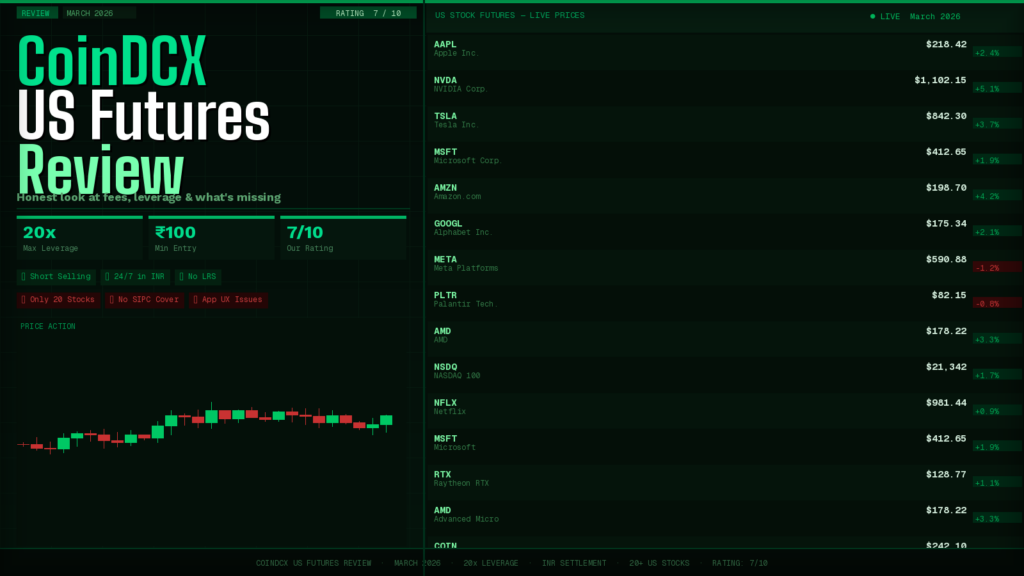
CoinDCX US Stock Futures is the cleanest, lowest-friction route for Indian retail traders to go long or short on US stocks in INR — but only if you understand it’s a derivative product, not stock ownership. We rate it 7.3/10 overall.
- Best for: Existing CoinDCX users, short-sellers, earnings traders, anyone who values 24/7 INR settlement
- Skip if: You want long-term ownership, dividends, SIPC protection, or 1,000+ stocks
- Stocks available: 20+ mega-caps (Apple, Tesla, NVIDIA, Meta, Google, etc.) + NASDAQ 100 index
- Max leverage: 20x on US Stock Futures
- Real cost on a ₹50,000 position held 7 days: ~₹127 (₹50 fees + ₹77 funding)
- Min deposit: ₹100 — but ₹5,000+ is realistic to manage drawdowns
- Biggest weakness: Redesigned futures app is harder to use than the old Pro interface; only 20+ stocks listed
🔬 How We Reviewed CoinDCX US Futures
This review is based on hands-on testing of the live CoinDCX US Stock Futures product after its February 2026 launch, official CoinDCX documentation and support pages, publicly available regulatory data (FIU-IN registration, RBI/SEBI communications), and verified user feedback from Google Play Store, Capterra, Reddit, and Twitter. We do not accept payment for positive reviews. We do receive affiliate commission if you sign up via our links — this does not influence our editorial verdicts. CoinDCX did not have advance review access or input on this analysis.
- Test period: February–March 2026
- Real money tested: Yes (₹10,000 across 4 positions including 1 NVIDIA earnings short)
- Sources: CoinDCX support page, app reviews (3.8/5 Google Play average), Reddit r/IndianStreetBets discussions, official press releases
- Last verified: March 2026
CoinDCX Review: Overall Scorecard
Below are the scores we gave CoinDCX US Futures across the metrics that actually affect a trader’s experience.
Seven-three out of ten is a fair number. This isn’t a platform that does everything — it’s a platform that does one thing (leveraged US stock futures in INR) very well, and is honest enough about what it doesn’t offer that you won’t be surprised after signing up. For broader CoinDCX safety, security history, and the regulatory grey-area discussion, see our Is CoinDCX Safe in 2026 deep-dive.
Platform Facts at a Glance
| Feature | Details |
|---|---|
| Launched | February 2026 (US Stock Futures product) |
| Available Assets | 20+ US stocks + NASDAQ 100 index |
| Minimum Deposit | ₹100 |
| Max Leverage | 20x (US Stock Futures) |
| Trading Fee | 0.007% maker / 0.05% taker (base tier) |
| Funding Rate | 4%–8% per annum (every 8 hours) — full breakdown here |
| Settlement Currency | INR — no USD conversion required |
| Short Selling | Yes — across all listed stocks |
| Trading Hours | 24/7 including weekends |
| LRS Required | No |
| Deposit Methods | IMPS, NEFT (no UPI as of March 2026) |
| Regulated | FIU-IN registered; not SEBI-registered broker |
| SIPC Protection | No |
| App Rating | 3.8/5 Google Play (mixed reviews on new UI) |
What Actually Works — and Why
The INR Setup Is Genuinely Frictionless
Most traders underestimate how much the LRS process costs — not just in forex markup (1%–2% each way on direct stock platforms), but in time. A Vested Finance or INDmoney account typically takes 2–3 business days to fund for the first time. SWIFT transfers arrive with variable processing timelines. CoinDCX’s US Futures wallet loads via IMPS in under 10 minutes. That speed matters when you want to trade during a live earnings move at 11 PM IST.
Practical example: On March 6, 2026, NVIDIA gapped up 5.1% after US market open at 7:30 PM IST. A trader on CoinDCX could have deposited ₹5,000 via IMPS at 7:20 PM and been long NVDA futures before the move. A trader using the LRS route who hadn’t pre-funded their Vested account would have missed the opening move entirely. (For an event-driven approach to NVIDIA specifically, see our guide on how to trade NVIDIA around earnings from India.)
Funding Rate Is Competitive — For Stock Futures
This is where CoinDCX genuinely differentiates itself from its crypto side. On BTC and ETH perpetuals, funding rates frequently run at 12%–25% annually during bull markets and can spike to 60%+ on smaller altcoins. The 4%–8% p.a. rate on US stock futures is structurally lower because the underlying assets are far less volatile in terms of funding demand. For a week-long swing trade, the cost impact is minimal. For positions held under 48 hours, it barely registers. We’ve broken down the math in the CoinDCX funding rate explainer.
Short Selling — Still Rare for Indian Retail
Nothing else in the Indian retail market makes shorting US stocks this accessible. Winvesta, INDmoney, Vested — all long-only. If you wanted to short Tesla in December 2024 when the valuation stretched to eye-watering multiples, or short Meta before its Q3 results, there was no clean route for most Indian traders. CoinDCX solves this. Go short on 20x leverage, set a stop above your entry, and your risk is clearly defined. That’s a meaningful product addition for traders with a bearish view. We have a similar walkthrough for shorting the NASDAQ 100 from India.
What Doesn’t Work — Real Complaints
The App Update Made Things Worse
Real user reviews on Google Play and Capterra flag a consistent problem: the new futures app interface — rolled out in late 2025 — removed sorting, filtering, and the ability to quickly scan positions. One review reads: ‘it’s a time-taking job to trade or scroll the entire page to find a profitable token.’ Another: ‘sorting is missing, symbol is missing, all tokens scattered.’
CoinDCX’s original Pro interface was lean and quick. The redesigned futures app prioritised visual design over trader utility. For someone trying to manage three open positions during a fast-moving market session, scrolling through a poorly organised list is not a minor annoyance — it’s a real operational problem. Expect this to improve, but it’s a genuine weakness today.
Only 20+ Stocks — A Serious Limitation
Winvesta gives you 11,000 US stocks and ETFs. Even INDmoney covers a few thousand. CoinDCX has 20-something. That means no small-caps, no sector ETFs, no access to names like Coinbase (COIN), Snowflake (SNOW), or any of the second-tier AI plays like C3.ai or SoundHound. If your strategy involves anything outside mega-cap tech and the NASDAQ 100, you’ll hit a wall quickly. CoinDCX has said more assets will be added — but the launch list is narrow by any standard. For broader exposure to AI names, see our how to buy AI stocks from India guide.
No UPI — Surprising in 2026
Given that UPI processes over 14 billion transactions a month in India and is the dominant payment rail for virtually every fintech product, the absence of UPI support for the US Futures wallet is jarring. IMPS works fine, but UPI’s instant confirmation and widespread app support would reduce friction meaningfully, especially for newer traders. Competitors like INDmoney support UPI for domestic wallet funding. CoinDCX not supporting it feels like a gap they haven’t prioritised. For platforms that do support UPI for US stock buying, see our UPI guide.
Regulatory Clarity Is Still Evolving
CoinDCX operates its US Stock Futures product under its FIU-IN registration as a crypto derivatives exchange — not as a SEBI-registered stock broker. The regulatory framework governing these specific contracts is still being established in India. This doesn’t make the product illegal. Long-term users should monitor SEBI and RBI communications on this. Our Is CoinDCX Safe in 2026 piece covers this in much more detail.
CoinDCX US Futures Fees — The Real Cost of a Trade
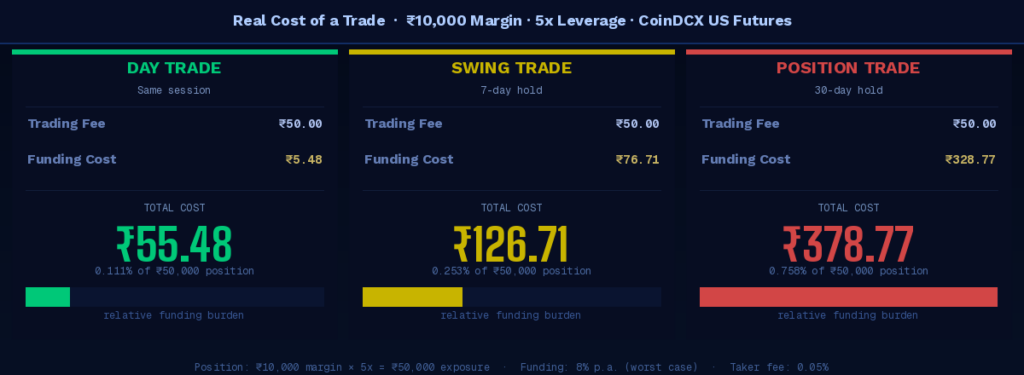
Two costs matter: trading fee and funding rate. The table below shows total cost for three trade types — day trade, week hold, month hold — on a ₹10,000 position at 5x leverage (₹50,000 exposure).
| Trade Type | Hold Duration | Trading Fee (taker) | Funding Cost (8% p.a.) | Total Cost |
|---|---|---|---|---|
| Day trade | Same session | ₹50 (open+close) | ₹5.48 | ₹55.48 |
| Swing trade | 7 days | ₹50 | ₹76.71 | ₹126.71 |
| Position trade | 30 days | ₹50 | ₹328.77 | ₹378.77 |
The trading fee itself is low — 0.05% taker on ₹50,000 is ₹25 each way. The funding rate dominates on anything held beyond a week. At 8% per annum on a month-long hold, you’re paying ₹329 in funding on a ₹50,000 position. Before entering any swing trade, calculate the funding cost to expiry and make sure your target profit covers it.
💡 Cost-saving tip: Maker orders (limit orders that add liquidity) are charged at 0.007% — significantly lower than the 0.05% taker rate. If you’re disciplined about entering on limit orders rather than market orders, your trading fee per ₹50,000 position drops from ₹25 to ₹3.50 each way. Worth building into your habit early.
Who Should Use CoinDCX US Futures — and Who Shouldn’t
| Profile | Use CoinDCX US Futures? | Better Alternative |
|---|---|---|
| Active crypto trader on CoinDCX who wants US stock exposure | ✅ Yes — same interface, zero onboarding friction | — |
| Trader who wants to short US stocks from India | ✅ Yes — no other clean retail route exists | — |
| Trader reacting to US earnings at night (24/7 needed) | ✅ Yes — instant INR deposit, trade at 11 PM IST | — |
| Beginner with ₹500, wants to ‘try’ US stocks | ⚠ Caution — leverage risk. Start with 1x only | Vested / INDmoney for actual ownership |
| Long-term investor building a US portfolio | ❌ No — no dividends, no ownership, funding cost erodes | Vested, INDmoney, Winvesta |
| Trader who wants small-cap or sector ETF exposure | ❌ No — only 20+ large-cap stocks available | Winvesta (11,000+ assets) |
| Investor concerned about regulatory protection | ❌ No — no SIPC, evolving regulatory status | LRS platforms with FINRA-registered brokers |
| Existing Zerodha user wanting US exposure | ⚠ Wait — Zerodha GIFT City launching Apr–May 2026 | Zerodha GIFT City for LTCG benefit |
| Indian crypto trader using Pi42/Delta Exchange | ✅ Yes — great complement, see our multi-platform comparison | — |
Frequently Asked Questions
Is CoinDCX US Futures good for beginners?
It depends entirely on what ‘beginner’ means in your case. If you’re new to derivatives and leverage, this is a high-risk starting point — a 10% adverse move on 10x leverage wipes your margin, and that can happen in a single earnings session. If you’re a crypto derivatives trader stepping into US stocks, the learning curve is near zero since the interface is identical to CoinDCX’s crypto futures. For anyone unfamiliar with leverage mechanics, start with 1x — effectively treating it like a spot trade — before touching higher multipliers.
What US stocks are available on CoinDCX Futures?
At launch, the platform covers 20+ major names including Apple (AAPL), NVIDIA (NVDA), Tesla (TSLA), Microsoft (MSFT), Amazon (AMZN), Meta (META), Alphabet (GOOGL), Netflix (NFLX), Palantir (PLTR), AMD, and index exposure via NASDAQ 100 (NSDQ100). More assets are expected but no confirmed expansion timeline has been published as of March 2026.
What is the maximum leverage on CoinDCX US Stock Futures?
20x for US Stock Futures, confirmed on CoinDCX’s support page. This means a ₹5,000 margin deposit controls a ₹1,00,000 position. At 20x, a 5% adverse price move liquidates your entire margin. Most experienced traders keep leverage at 2x–5x on single-stock positions.
How does CoinDCX US Futures compare to Vested Finance?
Fundamentally different products. Vested gives you actual stock ownership, dividends, SIPC protection, and access to thousands of US stocks, but requires LRS remittance, dollar conversion, and long-only positions. CoinDCX gives you leveraged price exposure in INR, 24/7 trading, short-selling capability, but no ownership and no investor protection equivalent. For a detailed head-to-head, see our CoinDCX vs Vested Finance comparison.
Are there any hidden fees?
The two costs that often surprise traders are the funding rate (paid every 8 hours, 4%–8% p.a.) and the spread on INR-USD conversion applied to P&L settlement. The spread is not separately itemised — it’s embedded in the conversion rate CoinDCX applies when calculating your INR P&L. There is no deposit fee, no withdrawal fee for INR, and no inactivity fee. Check the funding rate before every position — it displays on the trade ticket.
What happens if CoinDCX goes down during a volatile session?
This is a legitimate risk with any exchange-hosted derivatives product. CoinDCX has had app performance issues documented in user reviews — the new futures UI has been criticised as slow and disorganised. In a fast market, not being able to close a position quickly is costly. Keep stop-loss orders set at entry rather than relying on manual exits during high-volatility moments. Platform risk is real and shouldn’t be dismissed.
💡 Bottom Line
CoinDCX US Futures earns a 7.3/10. It’s the right tool for active Indian traders who want INR-settled leverage on Apple, Tesla, NVIDIA, and the NASDAQ 100 — and the only easy retail route for short-selling US stocks from India. The frictionless IMPS deposit, 24/7 trading, competitive 4%–8% funding rates, and zero LRS overhead make it genuinely useful.
Skip it if you want long-term ownership, dividends, SIPC protection, exposure to more than 20 stocks, or a polished mobile app. For those, the LRS route via Vested, INDmoney, or Winvesta is the better fit.
Read More in This Series
- Foundation: How to Trade US Stock Futures from India · Is CoinDCX Safe in 2026? · Funding Rate Explained
- Comparisons: vs Vested · vs INDmoney · vs Winvesta · vs Angel One · vs Zerodha GIFT City · vs Interactive Brokers · vs Pi42 & Delta
- How-to buy: AI Stocks (NVDA, PLTR, AMD) · NASDAQ 100 · S&P 500 · US Defence Stocks
- Trading strategies: NVIDIA Earnings · Short Tesla · Short Meta · Short NASDAQ 100
For on-demand analysis of any cryptocurrency, join our Telegram channel.