📢 Disclosure: CoinCodeCap may earn affiliate commission when you sign up via links in this article. Our reviews remain editorially independent — we test products, validate claims, and report honestly. Trading derivatives involves substantial risk of loss; capital is at risk. This article is for educational purposes only and is not financial advice. Consult a SEBI-registered advisor for personalised guidance.
CoinDCX US Futures and INDmoney are structurally different in the same way CoinDCX and Vested are — but INDmoney has one meaningful differentiator over Vested: UPI deposits via Federal Bank that can settle in 12–24 hours, significantly faster than SWIFT.
INDmoney also offers a super-app experience covering Indian stocks, mutual funds, EPF, insurance, and US stocks in one place — and a GIFT City ‘Direct Access’ route via NSEIX alongside its standard LRS ‘Global Access’ route.
CoinDCX wins on leverage (20x), short-selling, 24/7 trading, and same-session INR execution. INDmoney wins on real stock ownership, SIPC protection, UPI deposit speed, the super-app ecosystem, and access to 1,000+ stocks including ETFs unavailable on CoinDCX.
For active traders who want to express leveraged or bearish views on US stocks: CoinDCX. For investors wanting to build a US portfolio within a unified Indian financial dashboard: INDmoney. (For the platform foundation, start with our How to Trade US Stock Futures from India guide; for hands-on platform impressions, see the CoinDCX US Futures Review.)

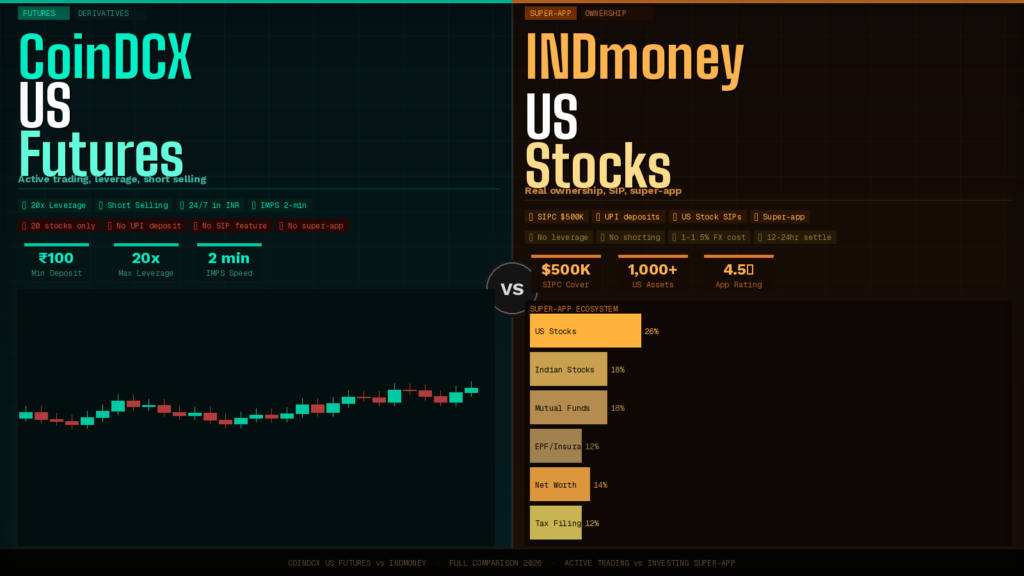
⚡ TL;DR — CoinDCX US Futures vs INDmoney
Use CoinDCX for active trading, leverage, shorts, earnings plays, and 24/7 access. Use INDmoney for long-term wealth-building, US Stock SIPs, ETFs, dividends, and SIPC-protected ownership inside a finance super-app. They solve different problems — many serious investors run both.
- Leverage: CoinDCX 20x · INDmoney 1x only
- Short selling: CoinDCX yes · INDmoney never
- Asset universe: CoinDCX ~20 stocks · INDmoney 1,000+ stocks & ETFs (VOO, QQQ, SCHD, etc.)
- Deposit speed: CoinDCX ~2 min (IMPS) · INDmoney 12–24 hrs (UPI via Federal Bank)
- SIP feature: CoinDCX no · INDmoney yes (auto-invest in US stocks/ETFs)
- Tax on long holds (24m+): CoinDCX 30% slab · INDmoney 12.5% LTCG → ₹87,500 saving on every ₹5L gain
- Investor protection: CoinDCX cold-storage only · INDmoney SIPC up to $500K + SEBI + IFSCA + FINRA
Full Feature Comparison — Every Data Point
| Feature | CoinDCX US Futures | INDmoney (Global + Direct Access) |
|---|---|---|
| Product type | Perpetual futures (derivative) | Real stock/ETF ownership (LRS or GIFT City) |
| Underlying asset | Futures contract — no ownership | Actual shares in your name at custodian |
| Asset count | 20+ US stocks + NASDAQ 100 index | 1,000+ US stocks and ETFs (NYSE, NASDAQ) |
| Minimum investment | ₹100 | $1 (~₹84) fractional shares |
| Leverage | Up to 20x | None (1x only) |
| Short selling | Yes | No (long only) |
| Trading hours | 24/7 incl. weekends | US market hours + extended hours |
| UPI deposit | No — IMPS/NEFT only (see UPI guide) | Yes — via Federal Bank / HDFC Bank (Global Access) |
| Deposit timeline | IMPS: real-time, ~2 min | 12–24 hours (via INDmoney Federal Bank route) |
| Currency | INR settlement — no USD needed | INR to USD conversion required |
| FX conversion cost | None | 1%–1.5% markup via partner bank |
| Trading fee | 0.05% taker / 0.007% maker | Zero brokerage on US stocks |
| Funding/carry cost | 4%–8% p.a. on notional per 8 hrs (explained here) | None — no carry cost on real shares |
| Withdrawal fee | Nil (INR withdrawal) | Zero — included in FX spread |
| Account opening fee | None | None (zero AMC, zero account fee) |
| Dividends | No | Yes — credited to USD wallet |
| Fractional shares | N/A (futures contracts) | Yes — from $1 |
| US Stock SIPs | No | Yes — weekly/monthly auto-invest in US stocks |
| LRS required | No | Yes (Global Access) / No (Direct Access via GIFT City) |
| TCS applicability | No | Yes for Global Access (LRS route above ₹10L) |
| SIPC protection | No | Yes — up to $500K via DriveWealth + Alpaca |
| Regulated by | FIU-IN (India) — see Is CoinDCX Safe? | IFSCA GIFT City (Direct) + SEC/FINRA (US custodians) |
| SEBI registered | No | Yes — SEBI-registered investment advisor |
| GIFT City route | No (see Zerodha GIFT City comparison) | Yes — INDmoney Global IFSC (Private) Limited |
| Hack history | $44M July 2025 (user funds safe) | No reported breaches |
| Super-app features | No — futures only | Yes — MF, EPF, insurance, loans, tax filing, Indian stocks |
| Net worth tracker | No | Yes — aggregates all Indian financial accounts |
| Tax filing tool | Manual export | Integrated — auto-computes US stock tax liability |
| Order types | Market, limit, stop | Market, limit, stop-limit |
| Mobile app rating | 3.8/5 | 4.5+/5 (10M+ downloads) |
| Customer support | Below average | Inconsistent — large user base creates delays |
| Best for | Active traders, leverage, short selling | Long-term investors, SIP investors, super-app users |
The Structural Difference — Futures vs Ownership (Again, but Different)
If you’ve read the CoinDCX vs Vested comparison, you already understand the core divide between derivative exposure and real ownership. INDmoney is also a real ownership platform, so that same divide applies here. But INDmoney has some structural features that Vested doesn’t, which changes the comparison in important ways.
INDmoney’s Two Routes: Global Access vs Direct Access
Most Indian investors using INDmoney are on the Global Access route — the standard LRS path where INR is converted to USD via a partner bank (Federal Bank or HDFC Bank) and invested through DriveWealth or Alpaca Securities, regulated US broker-dealers under SEC and FINRA. This is functionally similar to Vested’s route and carries the same SIPC protection, the same Schedule FA disclosure requirement, and the same TCS implications on LRS remittances above ₹10 lakh.
The Direct Access route is newer and meaningfully different. INDmoney operates INDmoney Global IFSC (Private) Limited, an NSE International Exchange (NSEIX) member regulated by IFSCA — the International Financial Services Centres Authority in GIFT City, Gujarat. Under the Direct Access route, trades are executed on NSEIX rather than a US exchange, with settlement handled through the IFSCA framework rather than US broker-dealer infrastructure. The practical implication: different regulatory treatment, potentially different tax classification, and a route that sidesteps the LRS mechanism entirely for users who prefer to keep their $250,000 LRS headroom available for other purposes.
ℹ️ INDmoney’s GIFT City Route — What It Means Practically
Direct Access via NSEIX: Regulated by IFSCA (not SEBI). No LRS/TCS implication. US stocks trade in USD-denominated contracts on an Indian exchange. Still real stock exposure, not derivatives. Regulatory framework is newer and evolving. Tax treatment may differ from standard LRS capital gains — confirm with a CA before using this route for tax planning. (For a detailed look at how the GIFT City framework compares with Zerodha’s planned launch, see our CoinDCX vs Zerodha GIFT City comparison.)
The Key Gap CoinDCX Has Over Both INDmoney and Vested
Regardless of which INDmoney route you use, both are long-only real stock ownership platforms. There is no leverage available on either INDmoney route. There is no short selling on either. You cannot go short Tesla on INDmoney even if you’re convinced it’s overvalued. You cannot amplify a bullish NVDA thesis with 5x leverage. INDmoney, like Vested, is built for investors — not for traders who want to express directional views with amplification.
CoinDCX US Futures is the only consumer-facing platform in India that currently lets retail traders go leveraged long, leveraged short, or both simultaneously on US individual stocks. This is not a minor feature distinction — it’s a completely different trading capability that doesn’t exist on INDmoney at all. (For a deeper view on leverage trading specifically, see our CoinDCX vs Pi42 vs Delta Exchange piece.)
Deposit Speed — INDmoney’s UPI Advantage vs CoinDCX’s IMPS
This is where the CoinDCX vs INDmoney comparison diverges most sharply from CoinDCX vs Vested — and where INDmoney has built a genuine structural advantage over other LRS-route platforms.
INDmoney: UPI via Federal Bank — 12 to 24 Hours
INDmoney has partnered with Federal Bank (and optionally HDFC Bank) to enable UPI-based deposits for US stock investing. This works by creating a Federal Bank savings account within the INDmoney app itself — the full account opening, Aadhaar eKYC, and video KYC are completed digitally in the app. Once the account is set up, you can use UPI to fund it, the bank converts INR to USD, and the amount reaches your US stocks wallet within 12 to 24 hours.
This is a significant advantage over standard SWIFT-based LRS funding. Traditional SWIFT from banks like SBI or ICICI takes 2–3 business days. INDmoney’s UPI-to-Federal Bank pipeline cuts that to same-day or next-day in most cases. For an Indian investor who wants to deploy capital into US stocks reactively — responding to an earnings move, a macro event, or a sharp sector correction — 12–24 hours is genuinely better than 2–3 days.
CoinDCX: IMPS in Under 2 Minutes
CoinDCX US Futures doesn’t require currency conversion, LRS paperwork, or a partner bank account. You open the CoinDCX app, tap ‘Add Funds,’ send an IMPS transfer from your regular Indian bank account, and your INR is available for trading within 2 minutes. No documentation. No regulatory forms. No currency conversion. No GIFT City infrastructure.
This is still faster than INDmoney’s 12–24 hours for reactive trading scenarios. If NVIDIA’s earnings drop at 9:45 PM IST and you haven’t pre-funded either platform, CoinDCX lets you be in the market by 9:48 PM. INDmoney lets you be in the market the next morning. For a stock that moves 8% in 20 minutes post-earnings, that timing difference is the difference between participating in the trade and watching it happen.
Where INDmoney’s UPI advantage matters more: systematic monthly investing. If you’re deploying ₹10,000–₹20,000 per month into US stocks via SIP, 24-hour settlement is entirely acceptable. INDmoney’s US Stock SIP feature automates this — you set an amount, a schedule, and a stock or ETF allocation, and the platform handles the recurring deposits and purchases. CoinDCX has no equivalent systematic investment feature.
| Deposit Scenario | CoinDCX US Futures | INDmoney |
|---|---|---|
| Method | IMPS / NEFT | UPI (via Federal Bank) or SWIFT |
| UPI accepted | No | Yes — via Federal Bank account in app |
| Typical timeline | 2 minutes (IMPS) | 12–24 hours (UPI-Federal Bank route) |
| First-time setup | Instant after KYC | Requires Federal Bank A/C + video KYC (one-time) |
| Works for reactive trading? | Yes — best in class | Partial — same-day if morning deposit |
| Works for monthly SIP? | No SIP feature available | Yes — automated US Stock SIP built-in |
| Minimum deposit | ₹100 | $1 equivalent (~₹84) |
| LRS documentation | None required | Mandatory (Form A2, bank statement / ITR) |
| TCS impact | None | 20% on LRS above ₹10L (reclaimable) |
▶ Winner: CoinDCX for reactive same-session trades (IMPS = 2 min vs 12–24 hrs)
▶ Winner: INDmoney for systematic investing — UPI SIP deposits are seamless and automated
Fees — Who’s Cheaper and When
INDmoney’s Fee Structure — Mostly Hidden in the FX Spread
INDmoney advertises zero brokerage, zero account opening fee, zero AMC, and zero withdrawal fee for US stocks. This is accurate on a literal read. The actual cost is embedded in the FX markup — approximately 1%–1.5% applied at the point of INR-to-USD conversion. This rate is competitive: lower than Vested’s 1.5%–2% markup and similar to Winvesta’s approximately 1% markup. The absence of a separate withdrawal fee (unlike Vested’s $11 per withdrawal) means INDmoney’s all-in round-trip cost is often lower than Vested’s for smaller investment amounts.
The complication is transparency. Because the FX markup is embedded in the conversion rate rather than charged as a line item, it’s harder to see exactly what you’re paying. When you send ₹10,000 and see $118.32 appear in your wallet instead of $119.05, the difference is the markup — but you have to calculate it yourself. INDmoney’s pricing page discloses the mechanism, but not the precise rate in real time.
CoinDCX’s Fee Structure — Transparent, Time-Based
CoinDCX charges 0.05% per trade on taker orders (market orders) and 0.007% on maker orders (limit orders that add liquidity). There is no annual fee, no FX markup, and no withdrawal fee for INR. The funding rate of 4%–8% per annum on notional position value is charged at every 8-hour timestamp you hold through — and it’s displayed explicitly on the trade ticket before you confirm the position. For a deeper breakdown of how funding accumulates across hold durations, see our CoinDCX funding rate explainer.
For very short trades — intraday or single overnight — CoinDCX’s all-in cost is dramatically lower than any LRS-route platform simply because there’s no FX conversion.
Real Cost Model: ₹1,00,000 in Apple Across Time
| Hold Duration | CoinDCX All-In Cost | INDmoney All-In Cost | Cheaper Platform |
|---|---|---|---|
| Day trade | ₹111 | ₹1,000–₹1,500 (FX only) | CoinDCX |
| 1 week | ₹253 | ₹1,000–₹1,500 (FX only) | CoinDCX |
| 1 month | ₹758 | ₹1,000–₹1,500 (FX + no withdrawal fee) | CoinDCX |
| 3 months | ₹2,000 | ₹1,000–₹1,500 | INDmoney |
| 6 months | ₹3,900 | ₹1,500–₹2,000 | INDmoney |
| 1 year | ₹8,145 | ₹1,500–₹2,000 | INDmoney |
| 2+ years | ₹16,000+ | ₹1,500–₹2,000 (+ LTCG tax benefit) | INDmoney strongly |
The crossover: At roughly 6–8 weeks holding, CoinDCX’s accumulated funding cost surpasses INDmoney’s one-time FX markup. For any position you plan to hold beyond 2 months, INDmoney is materially cheaper. For anything shorter — reactive trades, earnings plays, 1–4 week swings — CoinDCX wins on cost.
Asset Selection — 20 Stocks vs 1,000+
CoinDCX: 20+ Mega-Cap Stocks and NASDAQ 100
CoinDCX US Futures covers approximately 20 major US stocks — Apple, NVIDIA, Tesla, Microsoft, Amazon, Alphabet, Meta, Netflix, Palantir, AMD, Raytheon, and a handful more — plus the NASDAQ 100 index. For traders whose focus is the top 15–20 most-traded US names, this is sufficient. For anyone wanting breadth — ETFs, small-caps, second-tier AI names, energy, healthcare, or sector-specific plays — it runs out fast. (For thematic AI exposure beyond the top names, see our how to buy AI stocks guide; for defence names, see US defence stocks.)
INDmoney: 1,000+ Stocks and ETFs — and the ETF Ecosystem
INDmoney offers access to over 1,000 US stocks and ETFs on NYSE and NASDAQ. This is smaller than Vested (5,000+) and Winvesta (11,000+), but still dramatically wider than CoinDCX. The ETF coverage is INDmoney’s particular strength for Indian investors — you can build a complete passive US portfolio without picking individual stocks: VOO for S&P 500 broad exposure, QQQ for NASDAQ tech tilt, SCHD for dividend growth, VEA for developed international exposure, VWO for emerging markets, TLT for US Treasury bonds, GLD for gold.
INDmoney’s US Stock SIP feature works particularly well with ETFs. A ₹5,000/month SIP into VOO (S&P 500) runs automatically every month — no manual execution, no price monitoring, just systematic dollar-cost averaging into the broadest US index. For Indian investors who want to replicate the SIP habit they already have with Indian mutual funds, but applied to US equities, this is genuinely valuable functionality that no other platform in this comparison offers.
What INDmoney Covers That CoinDCX Doesn’t
- All major US ETFs: QQQ, SPY, VOO, VTI, SCHD, ARKK, GLD, TLT, SLV, XLK, XLF
- Sector ETFs: healthcare (XLV), energy (XLE), consumer discretionary (XLY)
- Dividend ETFs: SCHD, VYM, DGRO — unavailable on CoinDCX futures
- Bond ETFs: TLT, BND, AGG — interest rate plays, duration trades
- Second-tier tech: Snowflake, CrowdStrike, Cloudflare, Datadog, SentinelOne
- Healthcare: UnitedHealth, Johnson & Johnson, Eli Lilly, Pfizer
- Energy: ExxonMobil, Chevron, ConocoPhillips
- Any stock outside CoinDCX’s ~20-stock universe
▶ Winner: INDmoney 1,000+ vs 20 — not close; especially for ETF-based investing
INDmoney’s Super-App Advantage — and Why It Matters
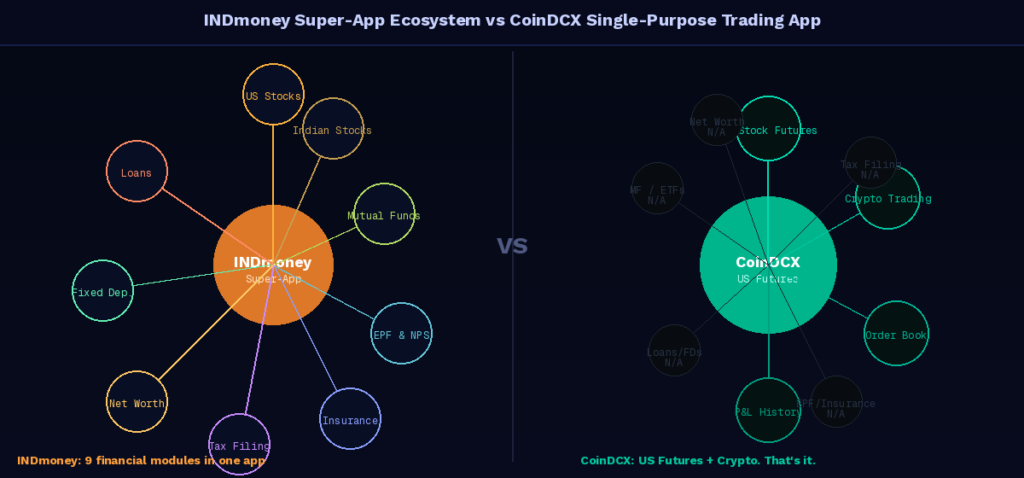
INDmoney isn’t primarily a US stock platform. It’s a personal finance super-app — currently with over 10 million downloads and a 4.5+ rating on Google Play — that includes US stock investing as one of several modules. This context matters for how you should think about choosing it.
What the Super-App Ecosystem Includes
- Indian stocks: Full equity trading via SEBI-registered broker-dealer, NSE/BSE access
- Mutual funds: 1,600+ direct plan funds, zero commission, SIP setup
- US stocks: Global Access (LRS/DriveWealth) and Direct Access (NSEIX/GIFT City)
- Fixed deposits: Multi-bank FD comparison and booking from one app
- EPF tracking: Links to EPFO and shows Provident Fund balance in real time
- Insurance: Term, health, and vehicle insurance comparison and purchase
- Loans: Home loan, personal loan comparison across lenders
- Tax filing: Integrated ITR-related computations including US stock tax liability
- Net worth tracker: Account Aggregator integration — aggregates all Indian financial accounts
Why This Matters in Practice
The net worth tracker is INDmoney’s most distinctive feature relative to both CoinDCX and Vested. Using India’s Account Aggregator framework, INDmoney can pull in balances from your bank accounts, mutual fund holdings, Indian stock portfolio, EPF balance, and US stock portfolio into a single dashboard view of your total wealth. No other US stocks platform in this comparison does this.
For an Indian investor managing a multi-asset portfolio — Indian equity mutual funds, some Indian stocks, a PPF or EPF corpus, and US stocks — having a unified view across all of these is genuinely useful. Decisions like asset allocation, rebalancing, tax harvesting, and goal planning become much easier when you can see the full picture in one place rather than logging into five different apps.
CoinDCX’s Super-App? Not One
CoinDCX’s product focus is crypto and US Stock Futures. It does not offer mutual funds, Indian stock trading, insurance, loans, EPF tracking, or a net worth aggregator. Its app is single-purpose: derivatives trading. This is the right product for what it does. But for an investor who wants to manage their entire financial life from one platform, CoinDCX is structurally incomplete in a way that INDmoney is not.
▶ Winner: INDmoney not comparable on this dimension — CoinDCX is a trading app, INDmoney is a finance super-app
Leverage and Short Selling — CoinDCX’s Decisive Advantages
No Leverage on INDmoney — By Design and By Regulation
INDmoney explicitly states that Indian residents are not permitted to trade derivatives in global markets under its platform terms and the LRS/GIFT City framework it operates within. This isn’t a business choice that might change — it reflects the regulatory environment for Indian LRS investors. You cannot use margin lending, leverage, or derivative products through INDmoney’s US stock routes. Every rupee of US stock exposure you hold on INDmoney is backed 1:1 by actual capital.
This is the right design for INDmoney’s target user — a long-term investor accumulating US equity exposure systematically. It’s entirely wrong for the trader who wants to take a leveraged position ahead of NVIDIA’s earnings, or hedge an existing portfolio with a short position, or capture the downside of an overextended tech stock.
Short Selling Remains CoinDCX-Only in India
As of March 2026, CoinDCX US Futures is still the only consumer-accessible Indian platform where retail traders can short individual US stocks. The bearish trade — whether for speculation or portfolio hedging — simply cannot be expressed through INDmoney. A trader who held TSLA longs through Vested or INDmoney and wanted to hedge them with a short position during the February 2026 correction had no tool available on either platform. Through CoinDCX, that hedge was available in 2 minutes. Similar walkthroughs exist for shorting Meta and shorting NASDAQ 100.
The Leverage Math at Different Risk Levels
| Scenario | CoinDCX (5x leverage) | INDmoney (1x) | Difference |
|---|---|---|---|
| ₹10,000 capital in NVDA | ₹50,000 notional exposure | ₹10,000 exposure | 5x more capital at work |
| NVDA +10% move | ₹5,000 profit (50% return) | ₹1,000 profit (10% return) | 5x profit differential |
| NVDA -10% move | ₹5,000 loss (50% of margin) | ₹1,000 loss (10% of capital) | 5x loss differential |
| NVDA -20% move | Liquidation (margin wiped) | ₹2,000 loss (20% of capital) | CoinDCX = full loss; INDmoney = partial loss |
| 7-day hold cost (8% funding) | ₹153.42 | ₹0 | INDmoney cheaper for held positions |
⚠ Leverage warning: Leverage amplifies losses with the same symmetry as gains. At 5x leverage, a 20% adverse move means total loss of margin. Individual US stocks — particularly TSLA, NVDA, and PLTR — have moved 15%–25% in a single session multiple times in 2024–2025. Leverage without a stop-loss on these names is not a trading strategy, it’s a lottery ticket.
▶ Winner: CoinDCX complete and exclusive advantage — INDmoney has neither leverage nor shorting
Safety, Regulation, and Investor Protection
INDmoney: Multiple Regulatory Layers
INDmoney operates under several regulatory frameworks simultaneously, which makes it one of the more comprehensively regulated platforms available to Indian investors for US stock access. At the Indian level: INDmoney Private Limited is SEBI-registered as an investment advisor. At the GIFT City level: INDmoney Global IFSC (Private) Limited is an NSEIX member regulated by IFSCA. At the US level: your assets through Global Access are held at DriveWealth and Alpaca Securities, both SEC and FINRA regulated, with SIPC protection up to $500,000.
This multi-layer regulatory structure is the strongest investor protection framework available on any Indian platform offering US stock access. Even if INDmoney Private Limited faced difficulties, your US assets would remain at the regulated US custodian. The SIPC backstop covers securities up to $500,000 per account. IFSCA oversight provides an Indian regulatory touchpoint for the GIFT City route.
CoinDCX: Strong Platform Security, No SIPC Equivalent
CoinDCX’s regulatory and security position is covered in detail in our Is CoinDCX Safe in 2026 deep-dive. In brief: ISO 27001:2022 certified, FIU-IN registered, 100% cold wallet user storage, passed the July 2025 $44M hack test with zero user impact. The gap vs INDmoney is structural — no SIPC equivalent for futures positions, not a SEBI-registered entity, not under FINRA oversight. For a derivatives trading platform, this is normal and expected. But the safety comparison is tilted clearly toward INDmoney for asset protection.
What Happens to Your Assets if the Platform Closes
| Scenario | CoinDCX US Futures | INDmoney |
|---|---|---|
| Platform insolvency | Futures positions are unsecured creditor claims | Assets remain at DriveWealth/Alpaca (SIPC protected) |
| Platform hacked (user funds) | Cold wallet segregation — July 2025 proved this | Assets held at US custodian — not on INDmoney servers |
| Regulator shuts platform | FIU-IN can suspend — user funds in cold wallet | SEBI/IFSCA can act — assets remain at US custodian |
| Maximum asset protection | No external guarantee scheme | $500,000 SIPC per account |
| Your recourse if dispute | CoinDCX support, then FIU-IN | INDmoney → SEBI → IFSCA → DriveWealth → SIPC |
▶ Winner: INDmoney SIPC + SEBI + IFSCA + FINRA-regulated custodian = materially stronger investor protection
Tax Treatment — Capital Gains vs Business Income
INDmoney: Standard Capital Gains with Built-In Tax Tools
Gains from US stocks on INDmoney’s Global Access route (LRS) are taxed as capital gains in India: LTCG at 12.5% for holdings over 24 months (Budget 2025-26), STCG at slab rate for under 24 months. Dividends are taxable as other income at slab rates, after claiming the 25% US withholding tax as a foreign tax credit under the India-US DTAA. You must declare all foreign assets in Schedule FA of your ITR — failure to do so can attract Black Money Act penalties, regardless of whether you made a profit.
INDmoney makes this significantly easier than competitors through its integrated tax computation module. The platform auto-calculates your US stock capital gains, prepares the Schedule FA data, and generates the relevant ITR worksheets. For the Direct Access (GIFT City) route, the tax treatment may differ from the standard LRS framework — this is an area where specific CA advice is essential given the regulatory novelty.
CoinDCX: Business Income — Simpler Filing, Higher Rate
CoinDCX US Futures P&L is classified as business income — either speculative or non-speculative depending on your total trading activity. There is no Schedule FA requirement since the product is INR-settled with no foreign asset exposure. The main tax disadvantage vs INDmoney: no LTCG benefit. A Microsoft position held through CoinDCX for 3 years is still taxed at your income slab rate (up to 30%) because it’s a derivative position, not a capital asset. The same position held through INDmoney for 2 years qualifies for the 12.5% LTCG rate — a meaningful 17.5% difference for high-income earners.
The LTCG Advantage Quantified
For a high-income earner in the 30% tax bracket who holds ₹5,00,000 of NVIDIA exposure for 3 years and the stock doubles: gross gain is ₹5,00,000. On CoinDCX (business income at 30%): tax payable ₹1,50,000. On INDmoney (LTCG at 12.5% after 24 months): tax payable ₹62,500. The difference — ₹87,500 on a ₹5,00,000 gain — is the tax cost of choosing the wrong product for a long-term position. Add to this the funding cost on CoinDCX (approximately ₹32,877 over 3 years at 8% p.a. on ₹5,00,000 notional) and the all-in cost differential between the two platforms for this scenario is over ₹1,20,000 in favour of INDmoney.
App Experience and Trading Interface
INDmoney: Best-in-Class App, Multiple Financial Modules
INDmoney has one of the most highly rated finance apps in India — 4.5+ on Google Play with over 10 million downloads as of early 2026. The user experience is clean, well-designed, and genuinely user-friendly for someone who doesn’t have a financial trading background. The home screen shows your net worth aggregated across all connected accounts. The US stocks section gives you stock charts, valuation metrics, news feed, analyst ratings, and SIP setup in a single stock detail view.
Extended hours trading is available — you can place orders during US pre-market (4:00 AM to 9:30 AM EST) and post-market (4:00 PM to 8:00 PM EST). For Indian investors, US post-market hours correspond roughly to 1:30 AM to 5:30 AM IST — accessible if you’re awake, but not the typical trading window. The SIP feature for US stocks is particularly well-implemented: it mirrors the SIP setup flow Indian investors are already familiar with from mutual fund investing, making recurring US stock investment frictionless.
CoinDCX Pro: Built for Derivatives Traders
CoinDCX’s interface is optimised for futures trading, not passive investing. The trade ticket is the core of the experience — leverage selector, position size calculator, estimated funding cost, mark price display, stop-loss and take-profit fields on the same screen. For an experienced derivatives trader, everything they need is surfaced immediately. The app’s 3.8/5 Google Play rating reflects legitimate UX issues with the 2025 redesign: users have reported difficulty navigating multiple open positions, the removal of sorting functionality, and slower performance during high-volatility sessions. These are real problems that affect professional use, and CoinDCX has acknowledged them without yet fully resolving them.
Which App is Right for You
If you’re a buy-and-hold investor, INDmoney’s app is better by a wide margin — cleaner, more informative on fundamental data, better SIP tooling, and the net worth aggregator alone is worth the download. If you’re an active derivatives trader who wants leverage, short positions, and fast execution, CoinDCX’s interface gives you the tools you need even if the UX has rough edges. The two apps are built for fundamentally different users and the rating difference reflects that audience match, not one being objectively superior.
Real-World Scenarios — Which Platform Wins Each
Scenario 1: Monthly ₹5,000 US Stock SIP
You want to invest ₹5,000 per month into a combination of AAPL (40%), MSFT (30%), and QQQ (30%) over the next 5 years via systematic investment. You don’t want to think about it — just set and forget.
INDmoney: Set up three SIPs in the app. Monthly auto-debit from your bank account via UPI. Federal Bank converts INR to USD. Holdings accumulate at DriveWealth with SIPC protection. After 5 years, LTCG treatment on holdings over 24 months. Tax module prepares your Schedule FA data automatically. Total FX cost over 5 years: approximately ₹3,750 on ₹3,00,000 invested (1.25% average markup). This is exactly the product this scenario requires.
CoinDCX: No SIP feature. No QQQ access. You’d have to manually open positions each month, pay 4%–8% annual funding on held futures, and receive no dividends. The cost over 5 years would be far higher than INDmoney’s FX markup, the tax treatment is less efficient, and the product isn’t designed for this use case at all.
▶ Winner: INDmoney precisely what INDmoney is built for — CoinDCX is the wrong product
Scenario 2: Leveraged NVIDIA Play Before Earnings
NVIDIA reports Q1 2026 earnings in 3 hours. You expect a beat driven by Blackwell GPU demand. You want 5x leveraged long exposure to capture the move.
CoinDCX: Open IMPS transfer from your bank (2 minutes). Enter 5x long NVDA futures at market. NVIDIA beats and gaps up 8.4%. Your 5x position returns 42%. Close position within 2 hours of the release. Zero funding timestamps crossed. Net return: ₹4,200 on ₹10,000 margin. Total cost: ₹100 in trading fees. (Full setup walkthrough in our NVIDIA earnings playbook.)
INDmoney: No leverage available. If you’ve pre-funded your account, you can buy NVDA shares at 1x. The same 8.4% move returns ₹840 on ₹10,000. The trade is available but the return profile is completely different. CoinDCX’s leverage makes this specific trade 5x more capital-efficient.
▶ Winner: CoinDCX leverage and IMPS speed make this a decisive win for the active earnings trade
Scenario 3: Hedging an Existing INDmoney US Portfolio
You hold ₹2,00,000 in US tech stocks through INDmoney (AAPL, MSFT, NVDA). The Fed is meeting next week and you expect a hawkish surprise. You want to hedge your longs.
CoinDCX: Open short positions in AAPL, MSFT, and NVDA futures equal to your INDmoney notional exposure. Cost: ₹200 in trading fees plus funding credits (you receive funding on shorts during positive-rate periods). If the hawkish surprise drops your stocks 6%, your CoinDCX shorts offset the INDmoney losses almost entirely. The two platforms complement each other.
INDmoney alone: No hedging option. You can sell your positions (and pay FX conversion costs + trigger a taxable event) or hold through the volatility. The ability to hedge without selling is exclusive to CoinDCX in this comparison.
▶ Winner: CoinDCX sole option for hedging existing US stock positions — INDmoney cannot do this
Who Should Use Which — Full Decision Framework
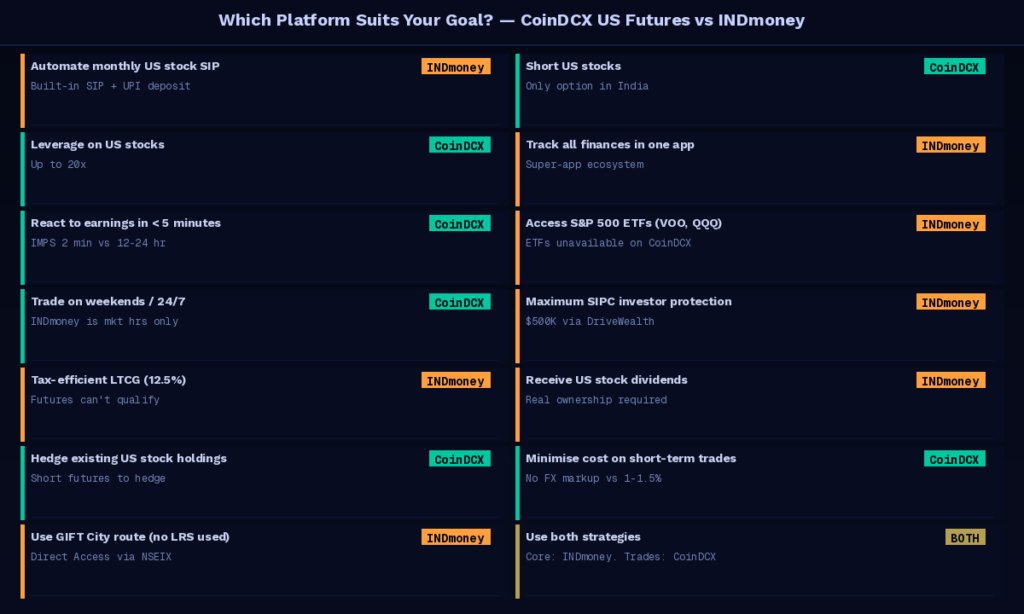
| If you want to… | Use this | Why |
|---|---|---|
| Automate monthly US stock SIPs | INDmoney | Only platform with built-in US Stock SIP + UPI deposit |
| Short US stocks (Tesla, Meta, NASDAQ) | CoinDCX | Only option — INDmoney is long-only |
| Use leverage on US stocks | CoinDCX | Up to 20x — INDmoney doesn’t offer leverage |
| Track all your finances in one app | INDmoney | Super-app with MF, EPF, Indian stocks, US stocks, insurance |
| React to earnings in under 5 minutes | CoinDCX | IMPS instant vs 12–24 hr for INDmoney |
| Access S&P 500 ETFs (VOO, SPY) | INDmoney | CoinDCX doesn’t offer ETF access |
| Trade on weekends / 24/7 | CoinDCX | INDmoney is US market hours only |
| Maximum investor protection (SIPC) | INDmoney | $500K via DriveWealth + FINRA regulation |
| Tax-efficient long-term gains (LTCG 12.5%) | INDmoney | Futures gains can’t qualify for LTCG |
| Receive US stock dividends | INDmoney | Real ownership = real dividends; futures = none |
| Hedge existing US stock holdings | CoinDCX | Short futures to offset long stock positions |
| Minimise costs for short-term trades | CoinDCX | No FX markup vs INDmoney’s 1–1.5% |
| Use GIFT City route (no LRS headroom used) | INDmoney Direct Access | CoinDCX doesn’t have a GIFT City route |
| Build long-term AI stock positions | INDmoney | LTCG benefit + ETF access (e.g., ARKK, QQQ) |
| Combined active trading + long-term hold | Use both | CoinDCX for trades; INDmoney for core holdings |
Frequently Asked Questions
Which is better — CoinDCX US Futures or INDmoney for US stocks?
Depends entirely on your goal. For active trading with leverage, short selling, or same-session reactivity, CoinDCX US Futures is the only option that delivers these capabilities. For long-term US equity investing, systematic SIP, a unified financial dashboard, dividends, SIPC protection, and ETF access, INDmoney is the better platform. The two serve genuinely different trader and investor profiles — many Indian investors use both simultaneously.
Can I short US stocks on INDmoney?
No. INDmoney explicitly states that Indian residents cannot trade derivatives or use margin in global markets through its platform. The LRS and GIFT City regulatory frameworks that INDmoney operates within are designed for direct equity ownership, not leveraged or short derivative trading. For short selling on US stocks from India, CoinDCX US Futures is currently the only accessible option.
Does INDmoney accept UPI for US stock investments?
Yes — this is one of INDmoney’s most important differentiators over other LRS-route platforms. INDmoney partners with Federal Bank (and optionally HDFC Bank) to enable UPI-based deposits for US stock investing. You open a Federal Bank savings account within the INDmoney app itself (Aadhaar eKYC + video KYC, one-time setup), then fund it via UPI. The bank converts INR to USD and sends funds to your US stocks wallet within 12–24 hours. This is significantly faster than SWIFT-based LRS transfers from most other banks, which typically take 2–3 business days.
What is INDmoney’s Direct Access route vs Global Access?
Global Access is INDmoney’s standard LRS route: INR is remitted via SWIFT/UPI to a partner bank, converted to USD, and invested through DriveWealth or Alpaca Securities (FINRA-regulated US broker-dealers) with SIPC protection up to $500,000. Direct Access uses INDmoney Global IFSC (Private) Limited, an IFSCA-regulated NSEIX member in GIFT City. Under Direct Access, trades are executed on NSE International Exchange, not a US exchange, which means the LRS mechanism is bypassed — useful if you want to preserve your $250,000 LRS headroom. Tax treatment and regulatory implications may differ; consult a CA before choosing between routes.
Is INDmoney safer than CoinDCX?
For long-term asset protection, yes. INDmoney’s US stock assets are held at DriveWealth and Alpaca Securities under SIPC protection (up to $500,000), and the platform itself is SEBI-registered and IFSCA-regulated. CoinDCX is technically secure — it survived a $44M server breach in July 2025 with zero user impact thanks to cold wallet segregation — but has no SIPC equivalent for futures positions and is not under SEBI or FINRA oversight. For a long-term investor’s assets, INDmoney provides structurally stronger protection.
What is the minimum to start on each platform?
CoinDCX US Futures: ₹100 minimum deposit, and you can open a position from ₹100, though practical trading requires ₹1,000–₹5,000 to avoid immediate liquidation risk at any meaningful leverage. INDmoney: $1 minimum for fractional shares, but you need to fund your account first via Federal Bank — the account setup requires completing Aadhaar eKYC and video KYC, which takes 10–20 minutes. First deposit after setup can be as low as $1 equivalent (approximately ₹84) via UPI.
How are gains taxed differently on CoinDCX vs INDmoney?
INDmoney Global Access (LRS route) gains are capital gains: STCG at slab rate for under 24 months, LTCG at 12.5% for over 24 months. Foreign asset Schedule FA disclosure is mandatory. CoinDCX futures gains are business income, taxed at your income slab rate (no LTCG benefit available), with no Schedule FA requirement since the product is INR-settled. For high-income earners planning to hold US stocks for 2+ years, INDmoney’s 12.5% LTCG vs CoinDCX’s 30% business income rate creates a significant long-term tax advantage on the same underlying stock exposure.
Can I use CoinDCX and INDmoney at the same time?
Yes, and many sophisticated Indian investors do exactly this. A common strategy: hold core long-term US equity exposure through INDmoney (SIPs in VOO, QQQ, individual quality stocks with LTCG horizon), and use CoinDCX US Futures for tactical expressions — leveraged earnings plays, short positions during corrections, or hedging the INDmoney portfolio against a market downturn. The two platforms are genuinely complementary and serve different purposes in the same investor’s toolkit.
What happens if INDmoney shuts down?
Your Global Access assets (held at DriveWealth or Alpaca via the LRS route) would remain at the FINRA-regulated US custodian and are protected by SIPC. Even if INDmoney the company ceased operations, you could work with DriveWealth or Alpaca directly to transfer or liquidate your holdings. Your Direct Access assets (NSEIX/GIFT City route) would be subject to IFSCA’s resolution framework. This structural custody segregation is the most important safety feature of the LRS model — your assets don’t live on INDmoney’s servers.
💡 Bottom Line
This isn’t a winner-takes-all comparison — it’s a different-tools-for-different-jobs situation. CoinDCX US Futures and INDmoney solve fundamentally different problems for the same Indian investor.
Use INDmoney for the core of your US stock journey: monthly SIPs into VOO and QQQ, individual stock buys with 24m+ horizon for the LTCG benefit, the super-app dashboard that pulls together your entire financial life, and the SIPC-backed custody that genuinely protects assets. Use CoinDCX for tactical expressions: leveraged earnings plays on NVIDIA, shorts on overextended names, hedges against your INDmoney longs during a Fed-driven correction, and any trade where 12–24 hour deposit timing would mean missing the move.
If you can only pick one based on your primary use case: active trader → CoinDCX. Long-term investor → INDmoney. New to either? Start with our How to Trade US Stock Futures from India pillar guide and the CoinDCX US Futures Review for the trader path; for INDmoney, the official onboarding flow inside their app handles setup end-to-end.
Continue Reading
- Foundation: How to Trade US Stock Futures from India · CoinDCX US Futures Review · Is CoinDCX Safe in 2026? · Funding Rate Explained
- Other comparisons: vs Vested · vs Winvesta · vs Angel One · vs Zerodha GIFT City · vs Interactive Brokers · vs Pi42 & Delta
- How-to buy: AI Stocks (NVDA, PLTR, AMD) · NASDAQ 100 · S&P 500 · US Defence Stocks · UPI for US Stocks
- Strategies: NVIDIA Earnings · Short Tesla · Short Meta · Short NASDAQ 100
For on-demand analysis of any cryptocurrency, join our Telegram channel.