Affiliate Disclosure: This post contains affiliate links. If you sign up through them, CoinCodeCap may earn a commission at no extra cost to you. Read the full disclosure.
LuxAlgo, Zeiierman Trading, AlgoAlpha, and Indicator Vault all promise an edge, but they are not really competing on the same terms. It is which one fits a specific trading style, workflow, and budget. This comparison breaks down LuxAlgo vs. Zeiierman vs. AlgoAlpha vs. Indicator Vault.
LuxAlgo vs. Zeiierman vs. AlgoAlpha vs. Indicator Vault: Overview
LuxAlgo
LuxAlgo is the most widely recognized premium indicator platform on TradingView, positioned as a full research and execution ecosystem rather than a single toolkit. Its offering revolves around three flagship systems — Price Action Concepts, Signals & Overlays, and the Oscillator Matrix — supported by screeners, synced alerts, AI-powered backtesting, and an AI tool called Quant that generates and validates Pine Script indicators. LuxAlgo also maintains a large free indicator library, and its Signals & Overlays has historically been one of the highest-rated paid scripts on TradingView. With more than 150,000 community members on Discord, LuxAlgo leans heavily on scale, ecosystem, and convenience.

Zeiierman Trading
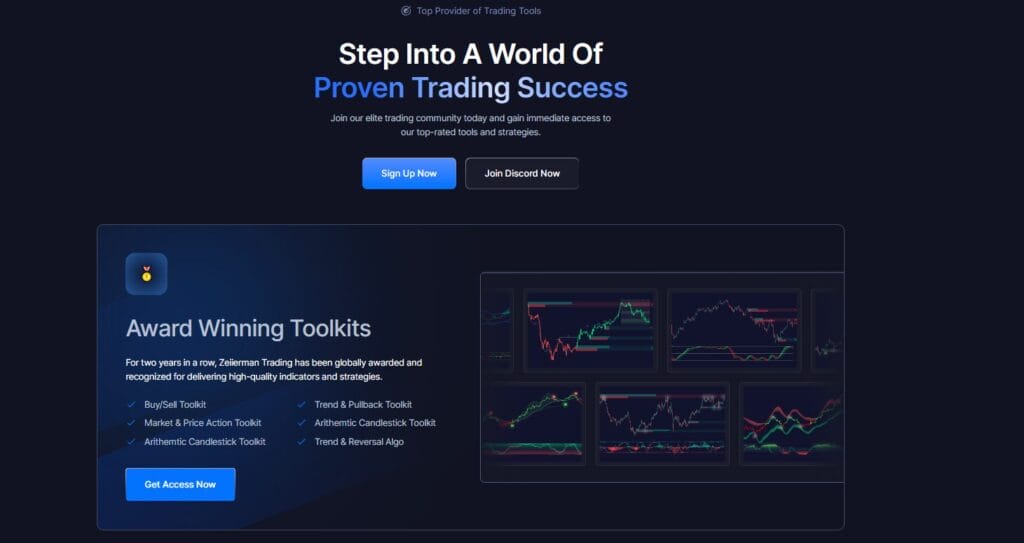
Zeiierman Trading is a premium indicator provider founded in 2018 and positioned as a professional-grade toolkit for Smart Money Concept traders and price action specialists. Its catalog includes over 80 invite-only indicators across categories such as Buy & Sell toolkits, Smart Money Concept frameworks, reversal bands, oscillators, and institutional-flow tools. The brand has picked up a reputation for depth and innovation — the founder has a hedge fund and risk advisory background — and its community spans more than 100,000 followers on TradingView alongside an active Discord of around 30,000 members. Zeiierman’s pitch is less about the breadth of the ecosystem and more about the quality and uniqueness of individual indicators.
AlgoAlpha
AlgoAlpha is a newer entrant that has moved aggressively into the premium indicator space with a machine-learning flavor. Its Unfair Advantage Pack bundles three core tools — Smart Signals Assistant (SSA), Momentum Concepts, and Institutional Liquidity and Price Action Concepts (ILPAC) — alongside a backtester, screeners tracking up to 18 symbols per chart, and a community layer. AlgoAlpha emphasizes adaptive ML-based trend detection, volatility-aware signal filtering, and institutional-style liquidity mapping. The brand also publishes a substantial library of free open-source indicators on TradingView, making it similar to LuxAlgo in how it uses free tools as a funnel into paid subscriptions.

Indicator Vault
Indicator Vault is the oldest of the four and takes the most traditional approach. It sells proprietary premium indicators as individual products with one-time payments, originally built for MetaTrader and NinjaTrader and now extended to TradingView. Its team positions itself as specialist indicator developers with over a decade of experience, and its catalog is organized around specific trade problems — supply and demand, reversals, pullbacks, breakouts, momentum, and smart money concepts. Indicator Vault also offers a TV Champ membership for bulk access. It is less of a platform and more of a premium indicator shop, which suits traders who know exactly what they want to buy.
LuxAlgo vs. Zeiierman vs. AlgoAlpha vs. Indicator Vault: Key Features
LuxAlgo
• Full platform ecosystem: LuxAlgo bundles indicators, screeners, alerts, backtesting, and an AI code generator into a single subscription, making it the most complete workflow of the four.
• Three flagship toolkits: Price Action Concepts, Signals & Overlays, and the Oscillator Matrix cover market structure, directional signals, and momentum without needing separate purchases.
• AI-assisted backtesting: The Ultimate plan unlocks an AI backtester that explores large volumes of strategy combinations to surface configurations worth testing further.
• Large free library: LuxAlgo publishes hundreds of free open-source indicators on TradingView, which also serve as an on-ramp to its paid tiers.
• Active community and support: A Discord community of more than 150,000 members plus nearly 24/7 live chat support makes it the most beginner-friendly of the four.
• Best for convenience-focused traders: LuxAlgo suits traders who want an all-in-one premium experience with minimal setup friction rather than deep customization or individual tool purchases.

Zeiierman Trading
• Smart Money Concept specialization: Zeiierman is especially strong for SMC traders, with dedicated tools for market structure, order blocks, liquidity sweeps, and institutional flow reading.
• Over 80 premium indicators: Its catalog is broader at the individual indicator level than LuxAlgo or AlgoAlpha, spanning Buy & Sell toolkits, reversal bands, divergence tools, and take-profit systems.
• Non-repainting signal engineering: Zeiierman markets many of its buy and sell indicators as non-repainting, a meaningful claim in a space where repainting is a frequent complaint about premium tools.
• VIP content and education: Paid plans include trading setups, strategy callouts, indicator settings guides, and educational material through a VIP dashboard.
• Learning curve is real: Reviews consistently note that it takes several weeks to figure out which indicator combinations fit a particular trading style, despite the plug-and-play framing.
• Best for SMC and price action traders: Zeiierman fits traders who want deep specialization in institutional-style analysis rather than a generic all-in-one signal suite.
AlgoAlpha
• Machine-learning signal engine: Smart Signals Assistant uses a hybrid model with Swing and Scalping modes, classifying markets as trending or ranging in real time to filter signals based on current conditions.
• Institutional liquidity mapping: ILPAC covers market structure, liquidity heatmaps, trend lines, and FOMO bubbles, giving traders a visual map of where orders are likely resting.
• Multi-symbol screeners: Dedicated screeners for SSA, ILPAC, and Momentum Concepts track up to 18 symbols per chart, which helps swing traders monitor correlated markets without chart hopping.
• Large free indicator catalog: AlgoAlpha has published more than 100 open-source scripts on TradingView, many of which are legitimate standalone tools.
• Strategy builder and backtester: Paid users can build rule-based strategies and test them against historical data without writing Pine Script manually.
• Best for systematic and swing traders: AlgoAlpha fits traders who want ML-assisted signal generation, multi-symbol scanning, and a quantitative framing of price action rather than a pure visual toolkit.
Indicator Vault
• One-time purchase model: Indicator Vault sells individual indicators as lifetime products, eliminating the recurring cost that defines the other three.
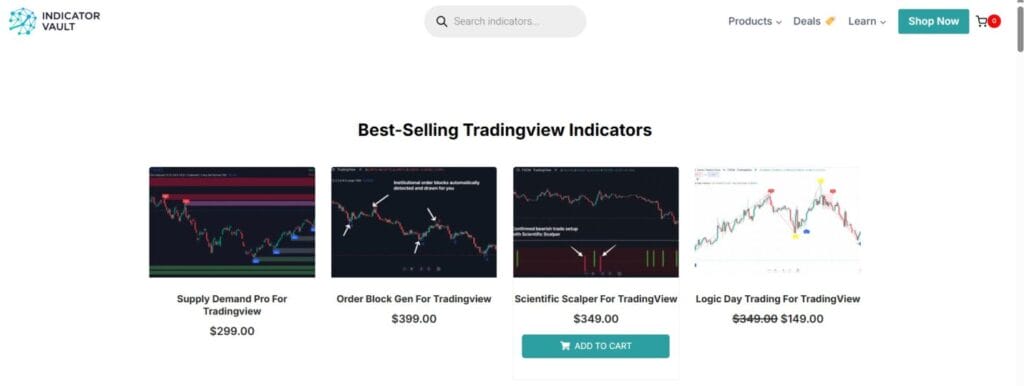
• Specialist tools by problem type: The catalog is organized around specific setups — Supply Demand Pro, Pullback Factor, Scientific Scalper, Order Block Gen — so traders can buy exactly the tool that solves their problem.
• Multi-platform heritage: Many tools originated on MetaTrader 4 and NinjaTrader before being ported to TradingView, giving them longer real-world track records than most newer premium suites.
• Scanner-style indicators: Several tools include multi-timeframe, multi-symbol scanning built into the indicator itself, which saves time for traders tracking many pairs.
• No community platform: Unlike LuxAlgo, Zeiierman, or AlgoAlpha, Indicator Vault does not run a large Discord or VIP community, which means fewer shared strategies and tuned settings to borrow from.
• Best for budget-conscious, specific-problem traders: Indicator Vault fits traders who already know their edge and want one or two purpose-built tools rather than an entire subscription ecosystem.
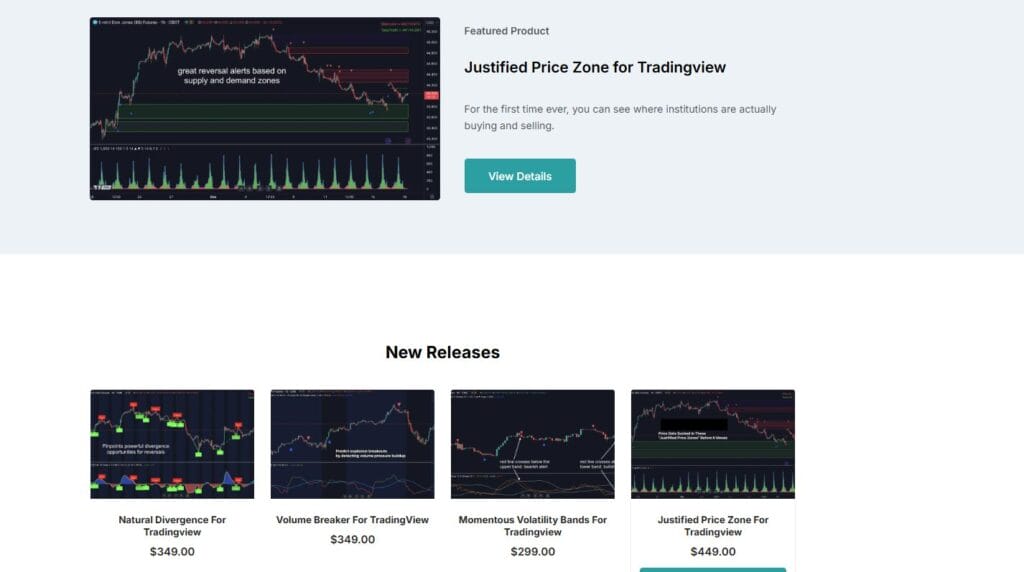
LuxAlgo vs. Zeiierman vs. AlgoAlpha vs. Indicator Vault: Pricing
| Platform | Pricing Model | Current Pricing | What You’re Paying For |
| LuxAlgo | Subscription platform | Free plan at $0, Premium at $39.99/month (or $27.99/month billed annually for year one, renewing at $479.88/year), and Ultimate at $59.99/month (or $32.99/month billed annually). A 30-day money-back guarantee applies to first-time subscribers. | A full premium ecosystem including three flagship toolkits, AI backtesting (Ultimate only), screeners, alert routing, and nearly 24/7 support. |
| Zeiierman Trading | Subscription with lifetime option | Monthly around $95, quarterly around $179.96 (often discounted to around $99), and yearly around $455.82 (roughly $38/month effective). A lifetime plan is available, commonly referenced around $1,699, with upgrade and downgrade flexibility. Refunds are not standard practice. | Access to 80+ invite-only indicators, VIP Discord, strategy callouts, educational content, and ongoing new-indicator releases. |
| AlgoAlpha | Subscription platform with free tier | Entry pricing starts around $42.60/month for the Unfair Advantage Pack. AlgoAlpha runs frequent promotions, often 50% off across plans, and typically offers monthly, quarterly, and annual billing options with discounts for longer terms. A free open-source library is available on TradingView with no account required. | Full access to SSA, Momentum Concepts, and ILPAC, plus the strategy builder, screeners, community, and ongoing market analysis updates. |
| Indicator Vault | Product-by-product purchases or membership | Individual TradingView indicators commonly priced between $79 and $399, with examples such as Natural Momentum at $79, Supply Demand Pro at $299, Scientific Scalper at $349, and Order Block Gen at $399. A TV Champ membership is offered at around $2,697/year or $5,997 lifetime. All sales are final and non-refundable. | Lifetime access to individual proprietary indicators, or bulk access to the full TradingView catalog through the membership, with no recurring subscription on single-tool purchases. |
LuxAlgo vs. Zeiierman vs. AlgoAlpha vs. Indicator Vault: Comparative Analysis
| Comparison Factor | LuxAlgo | Zeiierman | AlgoAlpha | Indicator Vault |
| Core model | Full premium ecosystem with three flagship toolkits, AI backtesting, screeners, and community. | Smart Money Concept and price action specialist with 80+ invite-only indicators and a VIP layer. | ML-flavored signal engine bundled with liquidity mapping, momentum tools, and a strategy builder. | Proprietary indicator shop selling individual tools as one-time purchases, with an optional bulk membership. |
| Customization level | Medium. Toolkits are configurable but closed-source, which limits deep modification. | Medium. Zeiierman encourages default settings and explicitly warns against curve-fitting, so customization is possible but discouraged. | Medium to high. AlgoAlpha exposes many inputs and also publishes open-source free scripts that can be modified in Pine Editor. | Low. Indicators are prebuilt with settings menus, but the logic itself is closed and not meant to be combined or forked. |
| Backtesting and strategy development | Strong on the Ultimate plan, which unlocks AI-driven strategy exploration. | Limited as a built-in feature. Zeiierman provides predefined strategies and callouts rather than a formal backtester. | Strong. A dedicated strategy builder lets users define entries, exits, and risk rules without writing Pine Script. | Minimal. Indicator Vault is an indicator shop, not a research platform; strategy building is up to the trader. |
| Free indicators | Hundreds in the LuxAlgo library, available with a free account. | Few. Zeiierman is mostly pay-walled, with limited free educational material. | 100+ open-source scripts on TradingView, many of which are legitimate standalone tools. | Essentially none. Indicator Vault is a paid-only catalog. |
| Cost efficiency | Mid-range recurring cost; Premium at $39.99/month is the most common entry point. | Higher monthly cost than LuxAlgo and AlgoAlpha, but a lifetime plan can neutralize that for long-term users. | Competitive entry price, often further reduced by promotional 50% discounts. | Cheapest single purchase, but total cost rises fast if buying several tools. Membership pricing is the most expensive option of the four. |
| Who it suits most | Traders who want one subscription to cover signals, screeners, alerts, and backtesting with minimal setup. | SMC and price action traders who value depth, indicator variety, and community-driven setups. | Systematic, quant-leaning traders who want ML signals, multi-symbol scanning, and rule-based strategy testing. | Focused traders who want one purpose-built tool, a lifetime license, and no recurring bill. |
Which Is the Best Premium TradingView Indicator Suite?
- LuxAlgo positions itself as an all-in-one trading toolkit that integrates signals, screeners, alerts, and AI-assisted backtesting into a single ecosystem, making it easier for traders to operate without juggling multiple tools.
- Its strength lies in accessibility, with a short learning curve and strong community support that helps traders fine-tune indicators across crypto exchanges and traditional markets.
- Zeiierman Trading is designed specifically for Smart Money Concepts and price action traders, offering non-repainting tools and structured VIP content for those seeking depth over general-purpose signals.
- AlgoAlpha focuses on systematic and quantitative trading, providing ML-driven signal generation, multi-symbol screening, and a rule-based strategy builder for traders who prefer data-driven decision-making.
- Indicator Vault targets experienced traders with a defined edge, offering one-time purchase tools instead of subscriptions, making it cost-effective long term but risky for those still exploring their strategy.
LuxAlgo vs. Zeiierman vs. AlgoAlpha vs. Indicator Vault: Conclusion
The best premium TradingView indicator suite in 2026 depends entirely on what a trader is trying to solve. LuxAlgo wins on ecosystem breadth and usability. Zeiierman wins on SMC depth and indicator variety. AlgoAlpha wins on quantitative framing and systematic research. Indicator Vault wins on focus and zero recurring cost.
None of the four guarantees better trading performance. All four deliver packaged logic that is derived from the same price and volume data available to every TradingView user, so the edge comes from how the tools are used, not from the tools themselves. Premium suites justify their price when they save time, reduce noise, and fit a specific workflow better than free alternatives would. For most active traders, LuxAlgo is the safest first subscription, Zeiierman is the deepest upgrade for SMC specialists, AlgoAlpha is the sharpest fit for systematic thinkers, and Indicator Vault is the best way to avoid recurring charges while still buying something premium. The smartest approach is to start with free tools, identify the gap in the workflow, and then pay only for the one suite that plugs that specific gap.
Is Zeiierman Trading better than LuxAlgo?
Zeiierman is better for traders who focus on Smart Money Concepts and price action, thanks to its deeper SMC catalog and non-repainting emphasis. LuxAlgo is better for traders who want a broader, easier, and more beginner-friendly ecosystem with built-in backtesting and larger community support.
How does AlgoAlpha compare to LuxAlgo?
AlgoAlpha leans quantitative with ML-based signal classification, multi-symbol screeners, and a strategy builder, while LuxAlgo leans visual and ecosystem-driven. AlgoAlpha suits systematic traders who want rule-based testing; LuxAlgo suits traders who want a polished signal and workflow experience.
Is Indicator Vault worth it compared to subscription-based platforms?
Indicator Vault is worth it for traders who already know exactly which tool they need and prefer a one-time purchase over recurring fees. It becomes expensive if multiple tools are needed, and it lacks the ecosystem, community, and backtesting features offered by LuxAlgo, Zeiierman, or AlgoAlpha.