Affiliate Disclosure: This post contains affiliate links. If you sign up through them, CoinCodeCap may earn a commission at no extra cost to you. Read the full disclosure.
Hey there, crypto adventurers! Altie here, your trusty guide through the ever-evolving jungle of decentralized trading platforms.
You’ve probably heard of Jupiter, the exchange aggregator that’s been making waves by combining liquidity from multiple DEXs and helping traders get the best rates in the business.
But let’s be real: no one platform is perfect, and every trader’s needs can differ. That’s why some traders are on the lookout for alternatives to Jupiter. Maybe it’s the fee structure, maybe it’s the quest for more liquidity, or maybe you’re chasing that elusive speed boost to keep your trades sharp and efficient.
This article dives into some of the top alternatives to Jupiter, each bringing something unique to the table, whether that’s advanced trading tools, better liquidity aggregation, or cross-chain compatibility. If you’re looking for something different, or just curious to see what’s out there, keep reading. Your next go-to platform might be just a few scrolls away.

Jupiter is a decentralized exchange (DEX) aggregator that has earned its place as a popular platform within the crypto ecosystem.
Its main function is to help users maximize liquidity by aggregating pools from different decentralized exchanges.
By doing so, it offers the best rates for token swaps, essentially acting as a bridge to ensure users get the most favorable prices across a wide range of DEXs.
Whether you’re trading ERC-20 tokens or tapping into other multi-chain assets, Jupiter makes the process seamless with its sophisticated order routing algorithms.
But even with all its strengths, Jupiter is not the only player in the game. As the decentralized finance (DeFi) ecosystem evolves, traders are increasingly seeking platforms that offer specific features beyond what Jupiter provides.
From custody concerns and decentralization to liquidity issues and cross-chain compatibility, there are numerous reasons why some traders are exploring alternatives to Jupiter.
Whether it’s for low fees, better liquidity solutions, or faster execution times, this article reviews the best alternatives to Jupiter in 2025.
Each platform is unique, offering traders specific advantages that might align better with their individual needs and trading styles.
What Makes a Strong Jupiter Alternative?
To truly compete with Jupiter, an alternative platform must fulfill a set of well-defined criteria. Here’s what makes a strong competitor in the decentralized exchange aggregator space:
Non-Custodial / On-chain Execution
A strong alternative to Jupiter needs to prioritize decentralization, ensuring that users maintain full control over their funds.
Non-custodial trading allows for secure, on-chain transactions that don’t require third-party intervention. This is a must-have for traders looking for greater security and privacy in their trades.
Low Fees & Competitive Pricing
Fees can be a game-changer for traders, particularly high-frequency ones. An alternative should offer low fees without compromising the efficiency of order routing.
Competitive pricing and low spreads are key for maximizing profits.
Strong Liquidity
Jupiter is known for tapping into multiple DEXs to offer ample liquidity.
An effective alternative must aggregate liquidity in a similar fashion, ideally from multiple sources, to ensure that trades can be executed without excessive slippage.
Cross-Chain Capabilities
One of the biggest advantages Jupiter offers is its cross-chain support, which allows traders to access assets across multiple blockchains.
Strong alternatives need to offer seamless cross-chain functionality to stay relevant in an increasingly multi-chain world.
Execution Performance & Speed
Execution speed is vital for traders.
Platforms must provide fast, reliable trade execution to prevent slippage and delay, especially during volatile market conditions. This is a critical point for those who rely on swift, responsive markets.
Advanced Trading Tools and Features
Advanced features like limit orders, stop-losses, and access to complex financial instruments can set alternatives apart from Jupiter.
Traders looking for more control and customization of their trades should seek platforms that offer these capabilities.
Ecosystem Adoption and Integration
Ecosystem adoption is another important factor. A platform that integrates with a variety of decentralized applications (dApps), liquidity pools, or other DeFi services adds more value to traders.
This can lead to improved user experience, enhanced market access, and better liquidity options.
User Experience and Interface
Ease of use is just as important as functionality.
A clean, intuitive user interface can significantly enhance a trader’s experience, especially for those new to the crypto space. Platforms should focus on offering a streamlined experience that doesn’t sacrifice advanced features for simplicity.
Platform Deep Dives
dYdX
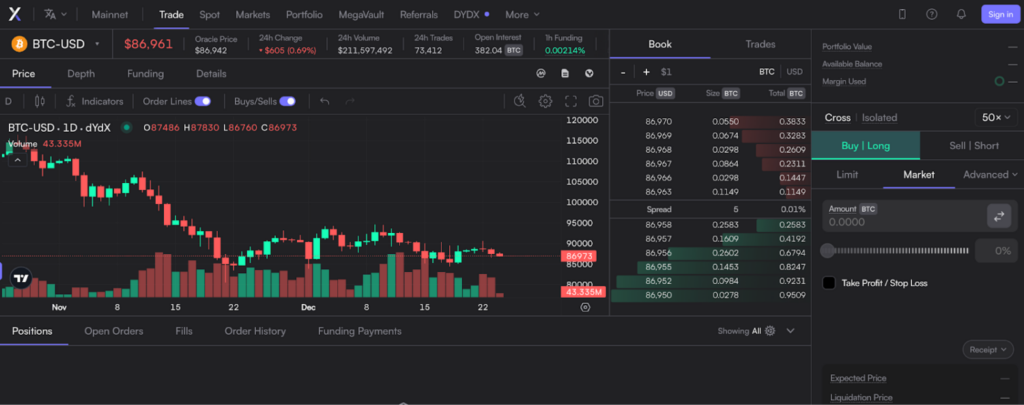
dYdX is one of the most well-known decentralized perpetual trading platforms. Operating on Ethereum and its Layer 2 network, dYdX offers a robust trading experience by combining decentralized finance principles with the power of high-frequency trading. The platform primarily focuses on offering derivatives trading with leverage and various advanced order types like market, limit, and stop orders.
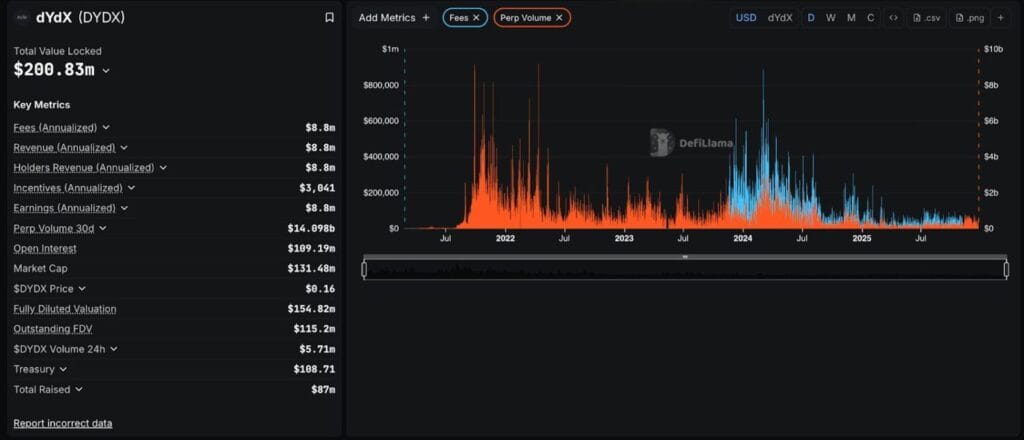
As of now, dYdX has an impressive total value locked (TVL) of $200.83M with substantial 30-day perpetual volume of $14.09B, making it one of the largest players in this space. The platform leverages a highly efficient order book model, ensuring that trades are executed with low slippage. Its perpetual contracts include various popular cryptocurrencies, such as BTC and ETH, enabling traders to take positions on both assets.
USP (Unique Selling Proposition) dYdX’s main selling point is its high-performance order book model, combined with decentralized features, offering advanced trading tools that are typically seen in centralized platforms. It provides professional-grade trading for perpetual contracts with a decentralized, non-custodial framework.
Key Features
- Liquidity model: Orderbook-based with high liquidity, ensuring efficient trade execution.
- Execution speed: Low latency and high-speed order matching, similar to centralized exchanges.
- Fee structure: Fees are relatively competitive, but higher than some DEXs due to its orderbook-based system.
- Supported assets: Offers popular cryptocurrencies like BTC, ETH, and others for perpetual contracts.
- Order types: Advanced order types including market, limit, and stop orders, providing enhanced control over trades.
- Leverage: Allows up to 20x leverage on selected pairs.
Why It’s a Good Alternative to Jupiter
dYdX stands out from Jupiter by offering advanced derivatives trading capabilities that Jupiter doesn’t. Traders looking for leverage or more complex orders will find dYdX more aligned with their needs.
The platform’s order book model allows for precise price execution, which Jupiter’s aggregator doesn’t necessarily offer. However, unlike Jupiter, dYdX is primarily focused on a select few trading pairs and derivatives.
While Jupiter excels in liquidity aggregation and broad token access, dYdX is ideal for professional traders looking for leverage and advanced risk management features.
Additionally, dYdX’s orderbook system may offer better price discovery and more control over trades, especially for larger volume orders. However, for users looking for cross-chain integration and wider asset coverage, Jupiter could be a more versatile choice.
Hyperliquid
Hyperliquid is an innovative decentralized perpetual exchange that aims to deliver a seamless and high-performance trading experience. Unlike traditional AMMs, Hyperliquid employs an advanced liquidity protocol with low slippage, focusing on efficient price discovery for perpetual contracts.
With a total value locked (TVL) of $4.12B and a 30-day perpetual volume of $181.42B, Hyperliquid has quickly gained traction as a formidable alternative for those seeking advanced perpetual trading on-chain.

Operating on Ethereum and Layer 2 networks, it integrates liquidity across multiple protocols to offer a robust trading experience.
Hyperliquid provides access to various perpetual pairs, including high-demand cryptocurrencies like BTC and ETH, and guarantees deep liquidity across these markets. It uses a smart order routing system to ensure the best execution price by aggregating liquidity from multiple sources.
USP (Unique Selling Proposition) Hyperliquid’s standout advantage lies in its next-gen liquidity solution.

The platform boasts an innovative hybrid liquidity model, combining AMM and orderbook elements, which allows for both deep liquidity and competitive pricing across perpetual contracts. This hybrid approach offers low slippage and high execution speed, making it an excellent choice for traders seeking efficiency and seamless trading.
Key Features
- Liquidity model: A hybrid AMM-orderbook model that aggregates liquidity from various sources.
- Execution speed: Ultra-low latency with high-frequency execution, ensuring efficient trade processing.
- Fee structure: Competitive fees, with options for reduced fees based on trading volume or token staking.
- Supported assets: Includes popular assets such as BTC, ETH, and other major tokens for perpetual contracts.
- Advanced features: Allows limit orders, market orders, and stop-loss features, with plans to expand to more advanced derivatives.
- Cross-chain support: Operates seamlessly on Ethereum and Layer 2, with potential expansion to other chains.
Why It’s a Good Alternative to Jupiter
While Jupiter is great for token swaps and cross-chain liquidity aggregation, Hyperliquid excels in advanced perpetual contract trading.
If you’re a trader focused on using leverage and more sophisticated trading tools, Hyperliquid provides a better fit, particularly due to its hybrid liquidity model that offers both liquidity depth and competitive pricing. Its low slippage and advanced order types make it a strong contender in the perpetual trading space.
For Jupiter users, particularly those seeking more advanced trading features and higher liquidity for leveraged positions, Hyperliquid presents a strong alternative.
However, Hyperliquid’s primary focus on perpetual contracts means it may not be the best choice for users simply looking for token swaps across multiple DEXs. While Jupiter offers a wider range of assets, Hyperliquid shines in its execution performance and the professional-grade tools it offers for derivative trading.
edgeX
edgeX is a high-performance, orderbook-based decentralized exchange (DEX) designed specifically for perpetual trading.
The platform aims to combine the best features of centralized exchanges with the decentralized ethos of blockchain, offering traders a low-latency, high-throughput trading experience. As of now, edgeX has a total value locked (TVL) of $367.48M, with an impressive 30-day perpetual volume of $121.68B.

edgeX operates primarily on Ethereum and Layer 2 solutions, ensuring that it can provide fast execution times and low fees.
By employing an orderbook model, it guarantees deeper liquidity, enabling efficient execution even with larger trades. Its emphasis on offering a professional-grade trading platform has attracted users from both the crypto and traditional finance sectors.
USP (Unique Selling Proposition)
edgeX’s primary strength lies in its ability to provide a centralized-like trading experience with the decentralized benefits of a non-custodial platform. It offers sophisticated risk management tools, low fees, and high liquidity, positioning it as an ideal choice for both professional traders and DeFi enthusiasts.

Key Features
- Liquidity model: Orderbook-based, allowing for deeper liquidity and efficient trade execution.
- Execution speed: High-frequency order matching with minimal latency, similar to centralized exchanges.
- Fee structure: Offers competitive trading fees, with potential reductions for higher-volume traders.
- Supported assets: Focuses on major cryptocurrency pairs for perpetual contracts such as BTC, ETH, and other key assets.
- Advanced features: Provides advanced order types including limit, market, and stop orders, with sophisticated risk management options like margin trading and liquidation protection.
- Cross-chain integrations: Initially focused on Ethereum and Layer 2, but potential future support for other chains is being explored.
Why It’s a Good Alternative to Jupiter
While Jupiter excels in aggregating liquidity for token swaps across different DEXs, edgeX is a superior alternative for traders seeking a high-performance environment for perpetual contracts. Its orderbook model ensures precise price execution, which is ideal for large trades and high-frequency trading.
Users who are accustomed to the orderbook-based structure of centralized exchanges will find edgeX a seamless transition into decentralized perpetual trading.
edgeX’s focus on professional-grade tools, including leverage and risk management features, makes it particularly appealing for experienced traders who want control over their positions and are less concerned with broader token swaps.
For those looking for deep liquidity, fast execution, and robust order types in the perpetual trading space, edgeX outshines Jupiter.
However, for traders who seek cross-chain liquidity aggregation and more diversified asset support for general token swaps, Jupiter remains the preferred choice. edgeX’s more niche focus on professional perpetual trading means it might not offer the same level of variety in assets or liquidity as Jupiter.
Paradex
Paradex is a high-performance decentralized exchange (DEX) focused on providing liquidity for perpetual contracts.
The platform is designed for traders seeking a fast, efficient trading experience with access to leverage and sophisticated order types. With a total value locked (TVL) of $158.21M and a 30-day perpetual volume of $26.14B, Paradex positions itself as an emerging leader in the decentralized perpetual trading space.

Paradex primarily operates on Ethereum, utilizing Layer 2 solutions for scalability and low-cost transactions.
By combining decentralized principles with a robust liquidity model, Paradex ensures deep liquidity for its users. The platform offers perpetual contracts for major cryptocurrencies, including Bitcoin and Ethereum, catering to both retail and institutional traders.
USP (Unique Selling Proposition) Paradex stands out with its deep liquidity pools and focus on capital efficiency. Its fee structure is competitive, and the platform’s low-cost transaction model offers a powerful alternative to high-fee centralized exchanges. Moreover, the platform’s liquidity pools are designed to optimize slippage, making it an ideal choice for traders who prioritize execution efficiency.

Key Features
- Liquidity model: Paradex leverages deep liquidity pools to ensure efficient price discovery and low slippage, making it ideal for high-volume traders.
- Execution speed: Designed for high-frequency trading, Paradex ensures minimal latency and fast order execution, even during periods of high market volatility.
- Fee structure: Competitive fees with the potential for fee reductions based on trading volume or token staking.
- Supported assets: Offers perpetual contracts on top assets like BTC, ETH, and other cryptocurrencies.
- Advanced features: Provides advanced trading tools like margin trading, limit orders, and stop-loss features for better risk management.
- Cross-chain support: Primarily operates on Ethereum and Layer 2, with potential future expansions to support additional blockchains.
Why It’s a Good Alternative to Jupiter
Paradex is a strong alternative to Jupiter, especially for traders looking for a platform that specializes in perpetual contracts and high-frequency trading. Unlike Jupiter, which focuses on token swaps across various DEXs, Paradex delivers a tailored experience for leveraged trading.
The liquidity model and execution speed make it an ideal choice for those who need efficiency and minimal slippage when executing large trades.
For traders familiar with traditional exchanges and looking to replicate that experience in the decentralized world, Paradex’s focus on leverage and risk management tools makes it a perfect fit.
However, Jupiter’s broad cross-chain capabilities and its focus on general token swaps still make it the better choice for users looking for a wider variety of assets and decentralized liquidity aggregation.
Reya
Reya is a decentralized exchange (DEX) that brings an innovative approach to perpetual trading by focusing on efficiency and scalability.
Operating on Ethereum and Layer 2 solutions, Reya offers a high-speed, low-latency trading experience. With a TVL of $212.48M and a 30-day perpetual volume of $48.56B, Reya has positioned itself as a strong contender in the decentralized perpetual trading space.

Reya’s key feature is its focus on providing a streamlined experience for perpetual contracts with minimal slippage. The platform ensures efficient order execution, leveraging decentralized liquidity sources and Layer 2 scaling solutions to offer faster, more affordable trades. Reya supports a range of perpetual trading pairs, including BTC, ETH, and other major tokens, making it an attractive option for traders who require both speed and reliability.
USP (Unique Selling Proposition) Reya’s unique advantage is its emphasis on high execution speed, combined with a decentralized order matching system that ensures deep liquidity with low slippage. Its use of Layer 2 scaling solutions helps reduce fees and transaction times, making it a solid option for active traders who prioritize speed and low cost.

Key Features
- Liquidity model: Combines decentralized liquidity sources to ensure deep liquidity and efficient price discovery, with minimal slippage.
- Execution speed: Built for speed, Reya offers fast order matching and low-latency execution, even in volatile markets.
- Fee structure: Competitive fees with low transaction costs, thanks to Layer 2 integration.
- Supported assets: Perpetual contracts for top cryptocurrencies like BTC and ETH, with expansion plans to add more assets in the future.
- Advanced features: Supports leverage, margin trading, limit orders, and stop-loss features to help manage risk.
- Cross-chain integration: Initially focused on Ethereum and Layer 2, with plans for future cross-chain support.
Why It’s a Good Alternative to Jupiter
Reya offers a compelling alternative to Jupiter for traders who prioritize execution speed and reduced fees.
While Jupiter aggregates liquidity for token swaps across various DEXs, Reya focuses on perpetual contracts, offering better price discovery and slippage reduction for these types of trades.
Its use of Layer 2 solutions enhances the overall trading experience by lowering fees and speeding up transaction times, which is something Jupiter, primarily focused on token swaps, does not emphasize.
Traders who are used to Jupiter’s cross-chain liquidity aggregation might find Reya’s more focused approach a bit limiting in terms of asset variety. However, for those looking for an optimized, high-speed trading experience with minimal slippage in the perpetual contract space, Reya provides a solid alternative.
Comparison Table
| Platform | Chain Support | Liquidity Model | Fee Structure | Supported Markets | Cross-Chain Compatibility | Ideal Trader Type |
| dYdX | Ethereum, Layer 2 | Orderbook | Competitive | BTC, ETH, others | Limited | Advanced traders, professionals |
| Hyperliquid | Ethereum, Layer 2 | Hybrid AMM-Orderbook | Competitive | BTC, ETH, others | Potential future support | High-frequency traders, professionals |
| edgeX | Ethereum, Layer 2 | Orderbook | Competitive | BTC, ETH, others | Potential future support | High-volume traders, professionals |
| Paradex | Ethereum, Layer 2 | Liquidity Pools | Competitive | BTC, ETH, others | Limited | Leverage traders, professionals |
| Reya | Ethereum, Layer 2 | Decentralized Pools | Low fees | BTC, ETH, others | Potential future support | Speed-focused traders, active traders |
Risks & Trade-Offs
When exploring alternatives to Jupiter, traders must consider several risks and trade-offs:
- Smart Contract Risk: As with any decentralized platform, smart contract vulnerabilities are a potential risk, especially for cross-chain or Layer 2 solutions.
- Chain Reliability Risks: The performance of decentralized exchanges and aggregators is heavily dependent on the underlying blockchain or Layer 2 network. Any issues or downtime can disrupt trading activities.
- Liquidity Depth Differences: While some platforms may offer deeper liquidity for specific pairs, others might face liquidity fragmentation, leading to potential slippage or suboptimal prices during periods of high market volatility.
- Regulatory Uncertainty: As decentralized finance (DeFi) evolves, so too does the regulatory landscape. Some platforms may face scrutiny from regulators, potentially impacting their availability or functionality in certain regions.
How to Choose the Right Alternative for Your Trading Style
Depending on your trading preferences, here’s how to pick the right alternative:
- For Best Liquidity Aggregation → Consider 1inch or Matcha, which are optimized for aggregating liquidity across multiple DEXs.
- For Cross-Chain Trading → Platforms like Paraswap or KyberSwap are great for cross-chain trading with wide asset support.
- For Advanced Trading Tools → dYdX gives professional traders advanced order types and granular control over their positions.
- For Low Fees and Speed → Matcha and Reya excel in offering quick execution and low transaction fees.
- For Specific Asset Coverage → KyberSwap offers specific support for niche assets, making it ideal for traders looking for less common tokens.
Conclusion
Jupiter remains a dominant force in the decentralized exchange aggregator space, known for its liquidity aggregation and cross-chain capabilities. However, as the DeFi landscape evolves, multiple alternatives have emerged, each offering unique features that cater to different trading styles.
By exploring these alternatives, traders can find platforms that better suit their needs, whether it’s low fees, speed, advanced trading tools, or specialized liquidity.
When selecting an alternative, consider your trading priorities and experiment with smaller positions to minimize risk. As always, be mindful of the potential trade-offs and the unique risks associated with decentralized trading.
Alright, fellow traders, it’s been quite the journey through the jungle of DEX aggregators and platforms! While Jupiter certainly has its place in the crypto landscape, the alternatives we’ve explored here each have their own set of perks. Whether it’s deep liquidity, low fees, or cross-chain capabilities, there’s something for every type of trader.
Of course, it’s always a good idea to tread carefully, especially when diving into new platforms. Test things out with small trades, keep an eye on your risk, and don’t forget, every platform comes with its own set of pros and cons.
In the end, these platforms are making decentralized trading more accessible and competitive than ever. The choice is yours, so go ahead and find the one that fits your style. Stay smart, stay safe, and keep those trades sharp. Altie out!
One newer name isn’t in the list above. Fermi Trade put an order book perp exchange on Solana mainnet on 28 September 2026, with SOL, ETH and BTC contracts. It’s still close to empty, so read our Fermi Trade review before you send it any collateral.