Affiliate Disclosure: This post contains affiliate links. If you sign up through them, CoinCodeCap may earn a commission at no extra cost to you. Read the full disclosure.
HyperLend Finance is a decentralized finance protocol focused on on-chain crypto lending and borrowing. It is built on the Hyperliquid EVM blockchain, a high-performance Layer-1 optimized for financial applications. The platform’s mission is to serve as the primary money-market infrastructure in the Hyperliquid ecosystem, offering permissionless, secure, transparent lending services without intermediaries, making it a strong contender in this HyperLend Finance Review.
What is HyperLend Finance?

HyperLend is a decentralized lending protocol built to make crypto lending and borrowing more efficient. Deployed on Hyperliquid’s EVM chain, it offers secure, transparent, and deep-liquidity financial services. Their goal is to evolve into the on-chain equivalent of modern banking rails, built on stronger foundations with far greater transparency.
How HyperLend Finance Works?
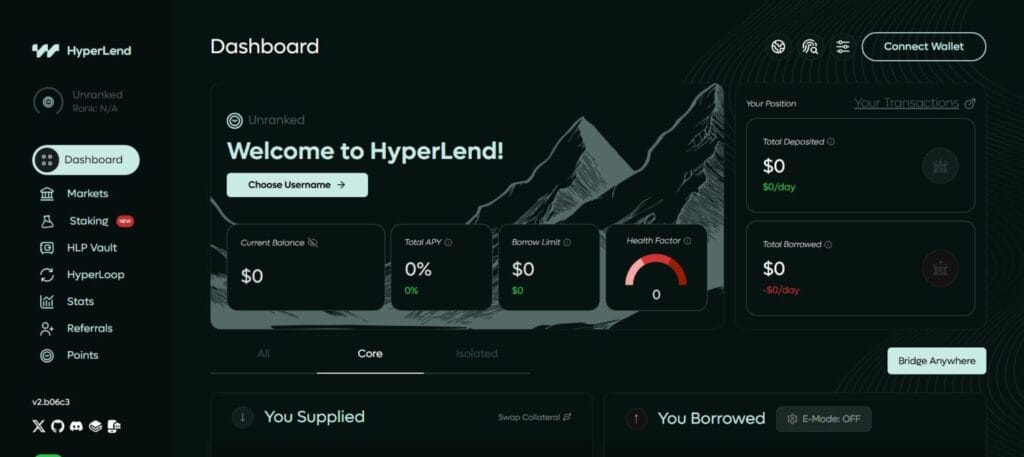
HyperLend is a decentralized money-market protocol that enables users to lend, borrow, and use crypto assets as collateral in a trustless, smart-contract-driven environment on the Hyperliquid EVM blockchain.
- Lending (Supply Side)
- Users supply supported crypto assets to HyperLend’s liquidity pools.
- These supplied assets become part of the pool that borrowers can draw from.
- Lenders earn interest paid by borrowers, with rates determined by market utilization.
- Borrowing (Demand Side)
- To borrow, users must first deposit collateral in supported assets.
- The amount they can borrow is based on their collateral value and risk ratios (e.g., Loan-to-Value).
- Borrowed funds accumulate interest, and positions are monitored using a health factor to gauge safety.
- If the health factor drops too low, positions may be liquidated to protect the protocol.
- Interest Rates
- Interest rates for both lending and borrowing are algorithmically adjusted based on how much of the pool is in use.
- Higher utilization → higher interest rates earned by suppliers and higher cost for borrowing, lower utilization → the opposite.
- Flash Loans
- HyperLend supports flash loans, a tool that lets users borrow assets without upfront collateral, provided the loan is repaid in the same transaction.
- Risk & Security
- Users must maintain a healthy collateral ratio if market prices change and collateral value falls too far, automatic liquidations can occur.
- The entire protocol runs on audited smart contracts for a trustless experience.
- User Dashboard & Interaction
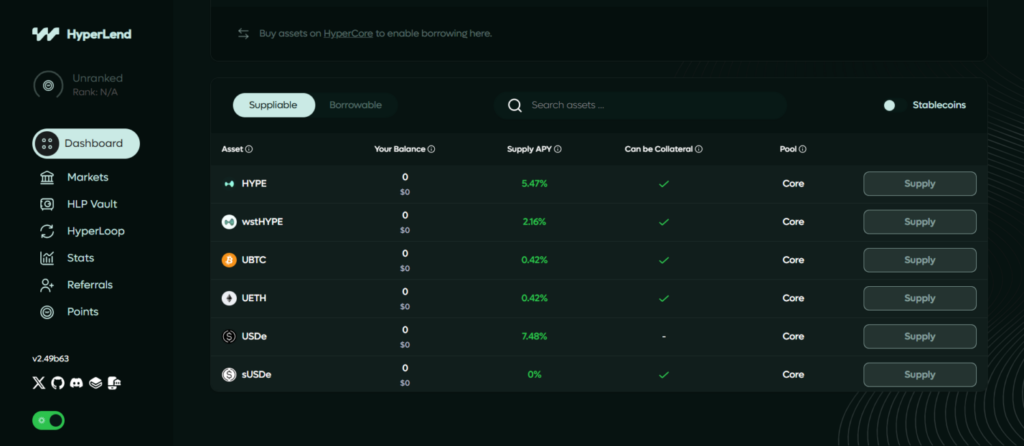
- The interface shows health factor, total supplied & borrowed, interest rates, and available liquidity for each supported asset.
- Users can toggle whether supplied assets are used as collateral or withdrawn.
Also, you may read Hyperliquid Review – Top Perpetual DEX?
Hyperliquid EVM: Performance and Design
- Performance: Hyperliquid’s Layer-1 blockchain is optimized for high performance, with block latency under 1 second and support for up to 200,000 orders per second, enabling fast, efficient DeFi operations.
- Transparency: All transactions, including orders, trades, cancellations, and liquidations, occur fully on-chain, promoting trust and visibility for users and protocols.
- Custom Consensus Algorithm: The chain uses HyperBFT, a custom consensus algorithm inspired by Hotstuff, designed for speed, reliability, and high throughput.
- Native Components: Hyperliquid EVM supports a fully on-chain order book perpetual futures exchange, native token standards, spot trading, and permissionless liquidity, all as integrated, on-chain building blocks.
- Ecosystem Support: It enables a fully on-chain open financial system where user-built applications can interface with native components without compromising the end-user experience.
Also, you may read HyperLiquid vs Drift vs AsterDex
HyperLend Finance Review: Key Features and Benefits
Key Features
- Decentralized Protocol: Runs openly on secure, audited, open-source smart contracts for full transparency.
- Flexible Lending and Borrowing: Users can earn yield by supplying assets or borrow against posted collateral.
- Flash Loans: Provides instant, trust-minimized liquidity for executing advanced financial strategies.
- Strong Security Model: Uses audited, battle-tested contracts to prioritize the safety of user funds.
- Referral Rewards: Encourages community growth by rewarding users for bringing in new participants.
- Incentive Programs: Delivers multiple engagement and rewards initiatives to boost activity and improve returns.
User Benefits
- Passive Yield: Deposit assets into liquidity pools and earn attractive interest over time.
- Flexible Strategy: Choose specific assets and pools that match your goals and risk appetite.
- Full Transparency: Open-source, regularly audited, and designed for end-to-end visibility into how the protocol operates.
Also, you may read 8 Best Crypto Lending Platforms
HyperLend Finance Review: Security Features

- Audited Smart Contracts: HyperLend uses secure, audited, and open-source smart contracts, which reputable auditors review to detect and fix vulnerabilities before deployment.
- Transparent On-Chain Protocol: All actions, including deposits, borrows, interest calculation, and liquidations, occur on-chain, offering full transparency and verifiability of protocol behavior.
- Collateral Risk Monitoring: Borrow positions are continuously checked against collateral value. The protocol tracks a health factor for each position to ensure it stays safely over minimum thresholds. If it falls too low, positions are automatically liquidated to protect lenders.
- Liquidation Mechanisms: Built-in liquidation rules help prevent bad debt by letting the protocol repurchase under-collateralized positions when volatile markets threaten solvency.
- Bug Bounty Program: HyperLend offers a program that allows external security researchers to find and report vulnerabilities, increasing security through community testing.
- Rigorous Testing and Battle-Testing: The team subjects contracts to extended testing, including testnet and mainnet interactions, to expose real-world scenarios before widespread usage.
- Risk Disclosure & Management: The documentation openly discusses smart contract risk and market volatility risk, ensuring users understand that residual risks can still exist despite audits and mitigations.
Also, you may read Top 10 Polymarket Trading Terminals
HyperLend Finance Review: Fee Structure
- Flash Loan Fee
- A 0.04% fee is charged on the amount utilized for flash loans.
- This fee applies when borrowers take a flash loan and is calculated on the principal.
- Flash loan fees may be split between liquidity providers and the protocol treasury based on governance settings.
- Reserve / Treasury Fee
- Part of the interest paid by borrowers goes into the reserve factor.
- A portion of this interest is collected by the protocol treasury to support insurance funds, development, and ecosystem sustainability.
- Liquidation Fee
- When a borrow position is liquidated due to insufficient collateral, a portion of the liquidation bonus is directed to the treasury as a liquidation fee.
- This fee arises when liquidators repay undercollateralized debts and receive discounted collateral.
- Deposit & Withdrawal Fees
- HyperLend does not charge any fees for depositing or withdrawing assets.
- Users can supply assets to liquidity pools or redeem supplied funds without direct on-chain fees from the protocol, though they will still pay standard blockchain gas costs.
Also, you may read DeFi vs TradFi Lending, Benefits and Risks
Conclusion
HyperLend Finance positions itself as the core lending layer of the Hyperliquid ecosystem, combining familiar DeFi money-market mechanics with a high-performance, low-latency chain. Its focus on capital efficiency, risk-segmented markets, and ecosystem-native integration makes it well-suited for active DeFi users looking for fast, on-chain lending and borrowing. While still early in its lifecycle, HyperLend’s model shows strong potential as Hyperliquid adoption grows, with its long-term success closely tied to ecosystem expansion, liquidity depth, and execution on governance and incentives.

Frequently Asked Questions (FAQs)
Which blockchain does HyperLend operate on?
HyperLend is deployed on the Hyperliquid EVM environment, designed for high-speed, low-cost financial applications.
Is HyperLend custodial?
No. HyperLend is fully non-custodial, meaning users retain control of their assets through smart contracts.
What are the main risks of using HyperLend?
Key risks include smart contract vulnerabilities, market volatility, and liquidation risk if collateral value falls below required thresholds.
Does HyperLend have a native token?
HyperLend has plans for a native token intended for governance and incentives, though its full utility and distribution are still evolving.