⚠️ Disclosure: CoinCodeCap is reader-supported. Some links on this page are affiliate links. If you click and sign up, we may earn a commission at no extra cost to you. Learn more.
How We Rank These Bots
Our team evaluated each bot on GitHub community size (stars, forks, contributors), release cadence, exchange support, backtesting accuracy, and ease of setup. We only include actively maintained projects — no abandoned repos, no last-commit-in-2022 bots. Pricing and features verified in April 2026.
Open-source trading bots let you audit the code, customize every strategy, and pay zero subscription fees. The catch? Not every GitHub repo with “crypto bot” in the title is worth your time. Some haven’t been updated in years. Others have great ideas but communities too small to help you debug anything.
We went through the most-starred crypto trading repos on GitHub, checked real commit activity, and verified what each bot actually does in live trading. The six here are the ones that hold up.
⚡ TL;DR — Open-Source Crypto Trading Bots on GitHub
- Freqtrade — #1 pick. Python, 53,000+ GitHub stars, v2026.7, FreqAI ML optimization, 30+ exchanges.
- Hummingbot — Best for market making. 6,000+ stars, v2.13 (March 2026), 50+ exchange connectors, DEX + CEX.
- OctoBot — Best for beginners. 5,400+ stars, v2.1.1 (March 2026), managed cloud from $9.99/mo.
- Jesse — Best for backtesting. 5,000+ stars, zero look-ahead bias, JesseGPT assistant, ML pipeline.
- Superalgos — Best no-code option. Visual node canvas, no Python required, Apache-2.0 license.
- OpenTrader — Best modern UI. DCA + Grid, 100+ exchanges via CCXT, TypeScript stack.
| Bot | GitHub Stars | Language | Best For | Cloud Option |
|---|---|---|---|---|
| Freqtrade | 53,000+ | Python | ML strategy development | Self-hosted only |
| Hummingbot | 6,000+ | Python | Market making / HFT | Self-hosted only |
| OctoBot | 5,400+ | Python | Beginners + AI strategies | Yes ($9.99–$29.99/mo) |
| Jesse | 5,000+ | Python | Backtesting + research | Pro tier available |
| Superalgos | 4,000+ | JavaScript | Visual / no-code | Self-hosted only |
| OpenTrader | Growing | TypeScript | DCA + Grid with UI | Self-hosted only |
| ⭐ Editor’s Pick: Freqtrade — largest community, best ML support, most exchange connections. OctoBot if you want managed cloud hosting. | ||||
What to Look For in an Open-Source Trading Bot on GitHub
- GitHub stars + last commit date: 5,000+ stars with a commit in the last 30 days means the project is alive. Anything with the last commit 12+ months ago is probably abandoned — skip it.
- Community size: A Discord or Telegram with thousands of active members means you’ll get answers when something breaks at 2 AM. Smaller communities mean slower help and less documentation.
- Exchange support method: CCXT-based bots (Freqtrade, OpenTrader) support 100+ exchanges automatically when new venues launch. Direct API integrations (Jesse) are more stable but cover fewer venues.
- Backtesting quality: Most bots claim to backtest. Many have look-ahead bias baked in — which means your backtest results look great but live performance disappoints. Jesse’s zero look-ahead bias is the most honest backtest engine in open source.
- Coding requirement: Freqtrade, Hummingbot, and Jesse need Python strategy code. OctoBot and Superalgos have click-and-configure options that work without writing code.
- License type: GPL-3.0 (Freqtrade, OctoBot) restricts commercial use. Apache-2.0 (Hummingbot, Superalgos) and MIT (Jesse, OpenTrader) are more permissive if you plan to build on top of them.
Don’t optimize for: the total number of features listed in the README. Every bot claims to support everything. What matters is whether the specific strategy type you want — DCA, Grid, market-making, ML — is actually battle-tested in that codebase with real user results.

How to Choose the Right Open-Source Bot
- Need ML strategy optimization? → Freqtrade (FreqAI is the best ML integration in any open-source bot).
- Running market-making or cross-exchange arbitrage? → Hummingbot (purpose-built for HFT and multi-venue market making).
- Want cloud-hosted with no server to maintain? → OctoBot (from $9.99/mo, no Python required for pre-built strategies).
- Backtest accuracy above all else? → Jesse (zero look-ahead bias + Monte Carlo stress testing).
Skip if: You’re expecting a set-and-forget bot that profits automatically with no ongoing work. Every open-source bot here requires strategy maintenance, periodic reoptimization, and monitoring. For fully managed automation, see the best crypto trading bots (including paid options) or the 4 best free open source bots for a direct side-by-side.
Freqtrade — Best Overall Open-Source Crypto Trading Bot on GitHub
Freqtrade is the most-starred crypto trading bot on GitHub, and it earns that position. With more than 53,000 stars and a release cycle that now tracks the year (v2026.7 landed on 31 July 2026), it’s the most actively developed and community-backed open-source trading bot available.
- FreqAI — integrates machine learning directly into strategy code. Train adaptive prediction models on historical data; the bot retrains automatically as market conditions shift. v2026.3 added an opt-in MaxDrawdown Protection mode for accounts using FreqAI.
- HyperOpt — brute-forces thousands of parameter combinations to find the configuration with the best expected performance. Takes hours to run, but the results make strategies meaningfully more robust.
- Dry-run mode — paper trades any strategy live against a real exchange feed before touching real capital. Non-negotiable step before going live.
- 30+ exchange support via CCXT — Binance, Kraken, Bybit, OKX, and dozens more. Switching exchanges doesn’t require rewriting strategy code.
- Telegram + WebUI control — monitor open trades, adjust stop losses, and receive P&L alerts from your phone while the bot runs on a server.
- 53,000+ GitHub stars, 10,000+ community Discord members — the largest open-source bot community. Whatever problem you hit, someone’s almost certainly solved it already.
⚠️ Real trade-off: Setup takes 30–90 minutes even for experienced Python users. The config.json has dozens of options, and getting FreqAI working correctly requires additional ML dependencies. There’s a real learning curve before your first live trade.
📌 Best for: Python-comfortable traders who want to build, test, and ML-optimize their own strategies across 30+ exchanges.
| Feature | Detail |
|---|---|
| Language | Python 3.11+ |
| Exchange support | 30+ (via CCXT) |
| Latest version | v2026.7 |
| GitHub stars | 53,000+ |
| License | GPL-3.0 |
| Cost | Free (self-hosted) |
| The most active open-source crypto bot on GitHub — best community, best ML support, most battle-tested strategies. | |
Hummingbot — Best Open-Source Bot for Market Making and HFT
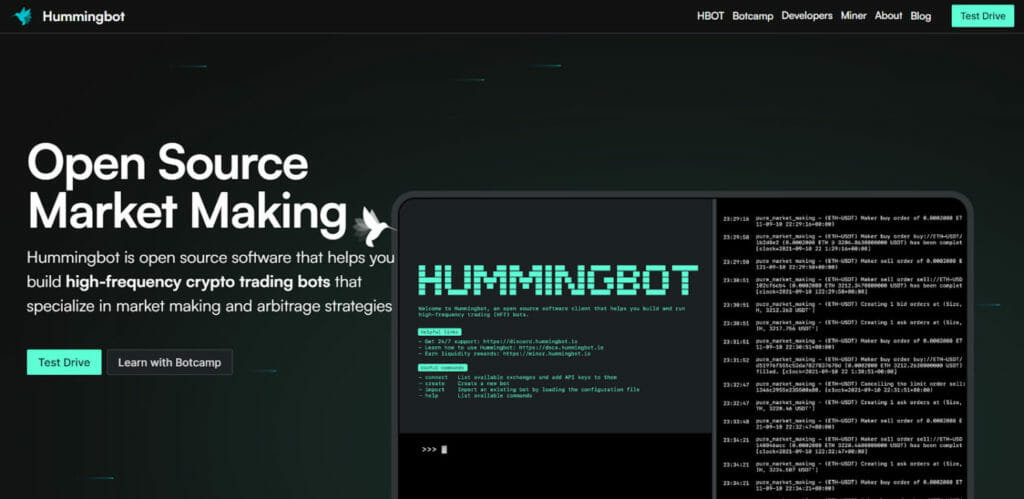
Hummingbot isn’t a general-purpose trading bot — it’s purpose-built for market making and high-frequency strategies. Version 2.13 (February/March 2026) added three new exchange connectors, expanded DEX capabilities, and introduced AI agent integration that no other open-source bot currently matches.
- 50+ exchange connectors — CEX and DEX, with v2.13 adding Backpack (Solana native wallet integration), Aevo, and Pacifica. Total trading volume from the community: $34+ billion across 140+ venues.
- Market making, cross-exchange arbitrage, and TWAP/VWAP — all built-in and production-tested across real trading activity, not prototype code.
- MCP server integration — AI agents running in Claude Code, Gemini CLI, and other MCP-compatible tools can interface directly with Hummingbot to execute trades programmatically.
- Condor interface (2026) — a specialized harness for AI-controlled trading agents with mobile and desktop Telegram control and professional-grade execution.
- Binance TRADIFI_PERPETUAL support (v2.13) — trade tokenized equities and real-world assets (RWAs) on Binance perpetuals. No other open-source bot currently has this.
- Crypto.com Onchain Wallet strategic partnership — new decentralized intelligent trading infrastructure for the US market, announced 2026.
⚠️ Real trade-off: Market-making strategies need significant capital to work well. Under $5,000, the spread profits get eaten by fees and slippage. Hummingbot is built for serious traders — not for experimenting with $100.
📌 Best for: Quant traders and developers running market-making or HFT strategies across multiple DEX and CEX venues simultaneously.
| Feature | Detail |
|---|---|
| Language | Python |
| Exchange support | 50+ CEX and DEX |
| Latest version | v2.13 (March 2026) |
| GitHub stars | 6,000+ |
| License | Apache-2.0 |
| Cost | Free (self-hosted) |
| Top open-source bot for market making and HFT — battle-tested across $34B+ in real trading volume. | |
OctoBot — Best Open-Source Bot for Beginners (Cloud Option Available)
OctoBot is the most beginner-friendly bot on this list — and the only one with a managed cloud option if you don’t want to run your own server. Version 2.1.1 (March 28, 2026) brought AI agent mode, Hyperliquid DEX support, and a new DSL trading mode that lets you define strategies in plain text rather than Python.
- Cloud option from $9.99/mo (Investor Plus) or $29.99/mo (Pro) — run strategies without a server. Free tier available for self-hosted users who want full control.
- 40+ pre-built strategies including Grid, DCA, and Technical Analysis modes — activate and configure in a few clicks. No Python writing required to get live.
- Hyperliquid DEX support — run strategies on decentralized perps, not just centralized exchanges. One of the first open-source bots with production-ready DEX perp integration.
- AI agent mode (beta, 2026) — OctoBot adapts strategy parameters using AI signals in real time, reducing the manual reoptimization cycle.
- Polymarket prediction market trading (beta) — trade crypto prediction markets directly from OctoBot. No other bot on this list supports this.
- iOS + Android mobile app — monitor and control your bot from anywhere. Trustpilot 4.2/5 and SourceForge 4.4/5 from verified users.
⚠️ Real trade-off: The free self-hosted version is functional but limited. Most compelling strategies require the $9.99–$29.99/mo cloud plan. It stops being free quickly once you want a real automated setup.
📌 Best for: Beginners who want pre-built strategies and a cloud-hosted option, and traders interested in DEX perps or AI-powered automation without writing Python.
| Feature | Detail |
|---|---|
| Language | Python |
| Exchange support | 15+ (Binance, Bybit, Hyperliquid, etc.) |
| Latest version | v2.1.1 (March 2026) |
| GitHub stars | 5,400+ |
| License | GPL-3.0 |
| Cloud plan | $9.99–$29.99/mo |
| Only open-source bot with managed cloud hosting — ideal for beginners or traders who don’t want to maintain a server. | |
Jesse — Best Open-Source Bot for Backtesting and Strategy Research
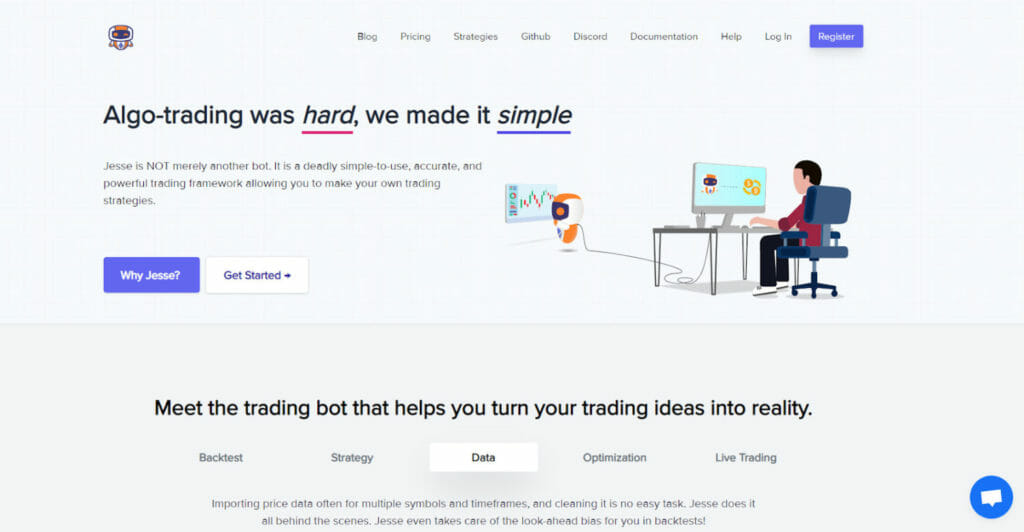
Jesse is built by and for traders who care about backtest accuracy above everything else. Its defining feature is zero look-ahead bias — strategy parameters genuinely cannot see future candles during optimization. That makes Jesse backtest results the closest thing to honest live performance prediction that open source offers.
- Zero look-ahead bias — strategies are evaluated on out-of-sample data only. This eliminates the most common cause of strategies that look great in backtests and fail immediately in live trading.
- 300+ technical indicators built in with clean Python syntax — RSI, MACD, Bollinger Bands, Ichimoku, and hundreds more, all usable without importing extra libraries.
- JesseGPT (2025–2026) — a specialized AI assistant that writes strategies from plain-language descriptions, debugs logic errors, and suggests optimizations based on backtest results.
- ML pipeline — gather labeled training data from backtests, train a scikit-learn model, and use its predictions as live trading signals without switching to a different framework.
- Monte Carlo Analysis — stress-tests strategies by shuffling trade order and simulating candle variations. Filters out strategies that only work on one specific market sequence.
- Multi-symbol / multi-timeframe — one strategy can manage BTC, ETH, and altcoin positions across different timeframes simultaneously.
⚠️ Real trade-off: Jesse supports a limited set of exchanges in live trading (Binance, Bybit, Bitget). If your preferred exchange isn’t on the list, you’re limited to backtesting until someone contributes a new connector.
📌 Best for: Python developers serious about strategy research who want the most rigorous backtesting framework in open source, with an AI assistant to accelerate strategy development.
| Feature | Detail |
|---|---|
| Language | Python |
| Live exchanges | Binance, Bybit, Bitget |
| GitHub stars | 5,000+ |
| License | MIT |
| JesseGPT | Yes (AI strategy assistant) |
| Look-ahead bias | Zero |
| Best backtest accuracy of any open-source bot — zero look-ahead bias, Monte Carlo stress testing, and JesseGPT for AI-assisted strategy writing. | |
Superalgos — Best No-Code Visual Strategy Builder
Superalgos takes a completely different approach from every other bot on this list. Instead of writing Python, you build trading strategies by connecting nodes in a visual canvas — data mining feeds into indicator nodes, which feed into condition nodes, which trigger execution. No code required to build a working strategy.
- Visual node-based strategy designer — connect data, indicators, conditions, and execution blocks graphically. Strategy logic is visually auditable, which makes it easier to spot errors than reading a Python file.
- Integrated charting system — see your strategy logic overlaid directly on historical price data in the same interface where you build it. No switching between tools.
- Built-in data mining — collects and stores its own market data locally rather than relying entirely on real-time exchange API calls during backtesting.
- Multi-server deployment — spread strategies across multiple machines or cloud instances from a single control panel. Useful for running different strategies on different exchanges simultaneously.
- Apache-2.0 license — more permissive than GPL-3.0. You can use Superalgos code in commercial projects without restrictions that apply to Freqtrade or OctoBot.
- 4,000+ GitHub stars with active development — this is a maintained community project, not an abandoned visual experiment.
⚠️ Real trade-off: The visual canvas has its own steep learning curve. The node interface becomes complex fast, and setup takes longer than any other bot here. Documentation quality is inconsistent — some sections are excellent, others are out of date.
📌 Best for: Traders who think visually and want to build complex multi-indicator strategies without writing Python code.
| Feature | Detail |
|---|---|
| Language | JavaScript (Node.js) |
| Coding required | No |
| Exchange support | 10+ major exchanges |
| GitHub stars | 4,000+ |
| License | Apache-2.0 |
| Cost | Free (self-hosted) |
| Only major open-source bot with a visual no-code strategy builder — ideal for traders who prefer diagrams over code. | |
OpenTrader — Best Modern Interface for DCA and Grid Strategies
OpenTrader is the newest bot on this list, and it shows — in a good way. It’s built TypeScript-first with a proper React web UI rather than a Python script with a bolted-on interface. If your priority is DCA and Grid strategies with the widest possible exchange coverage and a clean user experience, it’s worth evaluating.
- 100+ exchange support via CCXT — the widest exchange compatibility of any bot on this list. If an exchange has a public API and CCXT supports it, OpenTrader works with it.
- Built-in DCA and Grid strategy templates with visual setup wizards — configure strategies through the web interface rather than editing config files manually.
- TypeScript/React stack — the web interface is fast and genuinely responsive. A real improvement over Python bots with slow, after-thought UIs.
- Docker deployment — runs on any server or home computer with a single docker-compose command. No complex dependency setup.
- Active GitHub development with regular commits — maintained and improving, not an abandoned side project.
⚠️ Real trade-off: OpenTrader is newer, so it lacks the years of community-tested edge cases that Freqtrade and Hummingbot have accumulated. The strategy library is smaller. Run smaller positions while you evaluate live behavior.
📌 Best for: Traders who want DCA and Grid automation with a modern interface and 100+ exchange support — and prefer TypeScript to Python.
| Feature | Detail |
|---|---|
| Language | TypeScript |
| Exchange support | 100+ (via CCXT) |
| GitHub | github.com/Open-Trader/opentrader |
| License | MIT |
| UI | Built-in web interface |
| Cost | Free (self-hosted) |
| Best modern UI experience of any open-source bot — ideal for DCA/Grid strategies with the widest exchange support via CCXT. | |
AI and Machine-Learning Trading Bots on GitHub
Search GitHub for an AI crypto trading bot and the star counts look staggering. The leading repo has passed 96,000. Then you check what those projects actually do, and a pattern shows up fast: the most-starred AI trading repos do not place orders. They simulate and backtest. The projects that genuinely trade live have smaller followings and much quieter claims.
That gap matters if you are about to hand one an API key. Below is what each project actually does, verified against its own repository and documentation on 7 August 2026, with star counts read from the GitHub API the same day.
| Project | Stars (Aug 2026) | What it actually does | Live crypto trading? | License |
|---|---|---|---|---|
| FreqAI (in Freqtrade) | 53,000+ | ML models as live trade signals, with background retraining | Yes | GPL-3.0 |
| TradingAgents | 96,000+ | Multi-agent LLM debate between analyst, trader and risk-manager roles | No, simulated only | Apache-2.0 |
| ai-hedge-fund | 62,000+ | LLM personas modelled on famous investors; equities, not crypto | No, paper only | MIT |
| Qlib (Microsoft) | 47,000+ | Quant research platform; LLM agents mine factors automatically | No, equities only | MIT |
| NautilusTrader | 25,000+ | Rust execution engine; same strategy code backtests and trades live | Yes | LGPL-3.0 |
| FinRL | 15,900+ | Deep reinforcement learning framework for teaching and benchmarking | Paper trading | MIT |
| ⚠️ Only two of these execute live crypto trades. Star count measures interest, not capability. | ||||
FreqAI — the machine-learning layer inside Freqtrade
If you want machine learning that actually trades, this is the shortest path, and you may already have it installed. FreqAI ships inside Freqtrade, so the execution, exchange connections and risk controls are the ones described earlier on this page. You supply the model. It handles LightGBM, XGBoost, CatBoost and any Python ML library, plus a reinforcement-learning module built on stable-baselines3, and it retrains in the background as the market moves.
Freqtrade reached v2026.7 on 31 July 2026 and now carries more than 53,000 GitHub stars, which makes it both the most-starred and the most actively released bot covered here.
⚠️ Read this before you run the RL module: Freqtrade’s own documentation says the shipped default reward function is a showcase of functionality rather than something built for live production, and warns that a badly trained agent can find “cheats and tricks to maximize reward without actually winning any trades.” Treat the example config as a starting point, not a strategy.
TradingAgents — the most-starred AI trading repo, and it never places a trade
TradingAgents runs a simulated trading desk. Separate LLM agents argue as analyst, trader and risk manager until they settle on a position. It is a genuinely interesting piece of research, it handles BTC and ETH alongside equities, and it is actively developed. It also routes no orders to any exchange, and the authors state plainly that it is not financial or investment advice.
One documented 30-day live-money run returned roughly 7% against the S&P 500’s 4.5% over the same window, while taking 22% drawdowns to get there. The project’s own team recommends against running it with real capital. Two more practical limits: the agents produce different answers on repeated runs against the same ticker and date, and they depend on paid, rate-limited third-party APIs.
NautilusTrader — the execution engine AI researchers build on
NautilusTrader is not an AI bot and does not pretend to be. Its documentation puts built-in AI and ML tooling out of scope. What it offers is a Rust core with a Python control plane, fast enough to train reinforcement-learning agents against, and live crypto execution on Binance, Coinbase, Kraken, Bybit, OKX, BitMEX, dYdX and Hyperliquid. Strategy code runs unchanged between backtest and live, which removes a whole category of deployment bugs.
📌 Best for: anyone who already has a working model and needs somewhere serious to run it.
FinRL, Qlib and ai-hedge-fund — useful, but not crypto bots
These three collect a lot of the AI trading search traffic and none of them is a drop-in crypto bot. FinRL is a deep reinforcement learning framework its own maintainers position for education and benchmarking, with basic paper trading; the team has since started FinRL-X as a production-oriented successor, still too new to judge. Qlib is Microsoft-backed and technically strong, and its RD-Agent brings LLM agents to automated factor mining, but it covers US and China equities only. ai-hedge-fund is well maintained and popular, and is likewise equities-focused and labelled by its author as educational.
Worth knowing if you use OctoBot: its AI agent mode is in beta and can connect ChatGPT or a local Ollama model to a trading mode. The separate OctoBot-AI companion repository is a different matter: 10 stars, one fork, last pushed in March 2026. That is an early scaffold rather than a product, and it should not be mistaken for the main bot.
Before you point an AI bot at real money
- Backtests flatter AI strategies more than most. Perfect-fill assumptions ignore slippage, spread and price impact. A strategy backtesting near 50% annual return can land closer to 10–15% once those frictions are priced in.
- Reinforcement learning overfits, and in crypto it is a documented problem. Peer-reviewed work on deep RL for cryptocurrency trading exists specifically because naive backtests report inflated profits from overfitting; the authors propose hypothesis testing to reject overfit agents before deployment.
- Public information is already priced in. These agents mostly read news and indicators every other participant can also read, which is a hard place to find durable edge.
- Non-determinism is an operational risk, not a quirk. An LLM agent that answers differently on identical inputs cannot be audited the way a rules-based strategy can.
AI tooling in open-source trading has improved a lot, and the part that is production-ready is mostly the unglamorous part: FreqAI’s retraining pipeline and NautilusTrader’s execution layer. The LLM agent frameworks collecting the headlines are research projects. Treat them as reading material rather than trading infrastructure.
Which Open-Source Bot Is Right for You?
| Your Goal | Best Pick |
|---|---|
| Biggest community + most help | Freqtrade |
| Market making or arbitrage | Hummingbot |
| No coding, managed cloud | OctoBot ($9.99/mo) |
| No coding, visual builder | Superalgos |
| Best backtest accuracy | Jesse |
| Modern UI + 100+ exchanges | OpenTrader |
| ML-powered strategy optimization | Freqtrade (FreqAI) |
| DEX perps + AI mode | OctoBot |
| Start with Freqtrade for the widest community support. OctoBot if you want cloud hosting. Jesse if backtest accuracy is your priority. | |
⚠️ Risk Disclaimer
Crypto trading bots do not guarantee profits. Automated strategies can and do lose money, especially in volatile or sideways markets. Always backtest thoroughly on out-of-sample data, start with small amounts, and never invest more than you can afford to lose. Past backtest performance does not guarantee future live results.
Bottom Line
If you’re picking one open-source bot on GitHub, start with Freqtrade. It has the largest community (53,000+ stars), the best ML integration via FreqAI, and more battle-tested strategy examples than any other project. Setup takes real effort — but the documentation and Discord community mean you’ll never be stuck for long.
Need market making or HFT across DEX and CEX? Hummingbot is the specialist with $34B+ in community trading volume to back it up. Want managed cloud hosting with no server? OctoBot is the only open-source bot that gives you that from $9.99/mo. And if backtest accuracy is your top priority, Jesse‘s zero look-ahead bias design is the most honest backtesting in the open-source space.
All six bots on this list are free and actively maintained. Use the routing table above to match your strategy type — the right bot for you depends on what you’re actually trying to trade, not which one has more stars.
Written by the CoinCodeCap Editorial Team. Our researchers and trading experts test and verify every platform featured in our guides. All pricing and features are verified against official sources and community reports.
Frequently Asked Questions
What is the most popular open-source crypto trading bot on GitHub?
Freqtrade is the most popular open-source crypto trading bot on GitHub by star count — over 53,000 stars as of August 2026. It’s written in Python, supports 30+ exchanges via CCXT, and includes FreqAI for machine learning strategy optimization. The project has been actively maintained since 2017 with a regular release schedule.
Do open-source trading bots actually work?
Yes, but results depend entirely on strategy quality — not the bot. The bot is execution infrastructure. A weak strategy deployed on Freqtrade performs as badly as it would on any paid platform. Strategies need rigorous backtesting (ideally with Jesse’s zero look-ahead bias engine), optimization, and regular retuning as market conditions change.
Is Freqtrade better than Hummingbot?
They’re built for different things. Freqtrade is better for general strategy development, ML optimization (FreqAI), and running trend-following or DCA strategies across 30+ exchanges. Hummingbot is better for market-making and HFT strategies across multiple DEX and CEX venues. Pick based on your strategy type, not star count.
Can I use open-source trading bots without knowing Python?
Yes. OctoBot has 40+ pre-built strategies you can activate in a browser, with a cloud option from $9.99/mo requiring zero server setup. Superalgos uses a visual node canvas with no Python required. Both are open source and on GitHub. Freqtrade, Hummingbot, and Jesse require writing Python strategy code.
Related Articles
📋 Individual Reviews: OctoBot Cloud Review | WunderTrading Review | 3Commas Review
📊 Related Comparisons: 4 Best Free Open Source Trading Bots | Best Crypto Trading Bots
⬆️ Full Guide: Best Crypto Trading Bots: Complete Ranked Guide