Disclosure: CoinCodeCap has no commercial relationship with Fermi Trade and earns nothing from this page. Fermi runs a referral program, but it’s open only to whitelisted wallets and we haven’t joined it, so none of the links below pay us.
Can an exchange keep its whole order book on Solana and still feel quick? That’s the bet behind Fermi Trade, a perpetual futures exchange whose program reached Solana mainnet on 28 September 2026. We looked at it three days later.
The short version: it’s live, the code on chain matches the code its team published, and it’s almost empty. Its three markets traded about $13,500 between them in 24 hours. One wallet sat on a side of every recent SOL trade we could see.
How we reviewed this: fees, markets, margin rules and risk notes come from Fermi’s own documentation at docs.fermi.trade, read on 1 October 2026. Prices, volume, open interest and the order book were read from app.fermi.trade the same day. We queried Solana mainnet ourselves to check the program’s deployment date, its build hash and the addresses the docs list. We did not connect a wallet or place a trade, so nothing below describes live fill quality. The review was researched and drafted with AI assistance, and every figure was re-checked against the linked sources before publication.
TL;DR: Fermi Trade is a non-custodial order book exchange for SOL, ETH and BTC perps on Solana, with cross margin and up to 40x leverage in the app. Its docs list a 0.06% taker fee and a 0.03% maker rebate. It’s a beta that went live on 28 September 2026: no published audit, a single sequencer, daily volume near $13,500 and docs that still point to a retired program address. It’s worth watching, and worth a small test if you’re curious, but it isn’t ready for large orders.

What Fermi Trade is
Fermi Trade is a perpetual futures exchange built by Fermi Labs. You keep your collateral in an account you control, sign each order with your wallet, and a Solana program does the matching, the margin checks and the liquidations. There’s no company ledger in the middle.
Most Solana perp venues price trades against a liquidity pool. Fermi uses a central limit order book instead, the same model as Binance or Hyperliquid: buyers and sellers post prices, and the earliest order at the best price fills first.
The code has a history. Fermi’s public repository says the program is a fork of Mango v4, the engine behind Mango Markets. Mango wound down in January 2025 after an SEC settlement, a little over two years after an earlier version of the exchange lost about $110 million in a price-manipulation attack that ended up in court. Fermi adds its own ordering layer on top of that engine, which we cover below.
Fermi Labs doesn’t name its founders on its site. DropsTab lists a pre-seed round in May 2025 led by Big Brain Holdings, with Equilibrium among the backers, and a Solana Foundation grant. No amount is shown for either.
One naming note. Fermi Trade has nothing to do with Fermilab, the US physics laboratory, or with the listed company that trades under the ticker FRMI. Searches for “Fermi” return all three.
What we checked on Solana ourselves
A new exchange asks you to trust its claims. Solana lets you test some of them, so we did. Every row below comes from our own queries to a public Solana RPC node on 1 October 2026.
| What we checked | What we found |
|---|---|
| Is the program live on mainnet? | Yes. Program FRMiX94P...Vdd4 was deployed in slot 451,279,020, which Solana timestamps at 09:29 UTC on 28 September 2026. |
| Does the code on chain match the published source? | Yes. We downloaded the program from mainnet and hashed its 3,777,264 bytes. The SHA-256 came out as 29c6167e...358aa9, the same value Fermi’s repository gives for a build from source. |
| Can the program be changed? | Yes. It’s upgradeable, and one address (2DdpNWCr...jjg3) holds the upgrade authority. We couldn’t tell whether that’s a single key or a multisig, and the docs don’t say. |
| Do the docs point to the live program? | No. The getting-started page lists a different program ID (FRMiKrj2...hUvA) and a group account. That program was last used on 11 September and its code has been removed from the chain. The group account doesn’t exist. |
| Is anything happening? | The program handled 1,000 transactions in 43 minutes, about 23 a minute. The eight we opened were all sent by one address running the exchange’s own queue and settlement steps. |
The hash match counts for a lot. Fermi published source that anyone can rebuild, and the rebuild agrees with what’s on chain. The stale address is carelessness. A developer who copies the program ID from the docs today will be talking to a program that no longer runs.
Markets, leverage and order types
Fermi lists three contracts: SOL-PERP, ETH-PERP and BTC-PERP. That’s the whole menu for now.
Margin is cross only. Your deposits back every position in the account, and the docs say USDC, SOL, ETH and BTC all count as collateral, with USDC recommended. Collateral other than USDC is discounted when the system works out how much you can open. The docs use SOL at 85% of its market price as their example.
Leverage is where the docs and the app disagree. The FAQ works through an example that tops out near 20x. The order ticket in the app reads “Cross, 40x max” on all three markets. The docs do say live settings come from the program and the trading screen, so 40x is probably current. At 40x, a 2.5% move against you is your whole margin.
The app offers market and limit orders, a reduce-only switch, take profit and a slippage setting that defaults to 0.25%. Traders using the SDK get more:
- Post-only orders, which are thrown out if they’d fill straight away
- A sliding post-only type that moves one tick back instead of being rejected
- Immediate-or-cancel orders
- Orders pegged to the oracle price
- A time limit in seconds, after which an order expires without a cancel
Fermi Trade fees
The fee page is short. Takers pay 0.06%. Makers get paid 0.03% for every fill. The protocol keeps the 0.03% in between. There are no volume tiers and no VIP levels, and the same rates apply to all three markets.
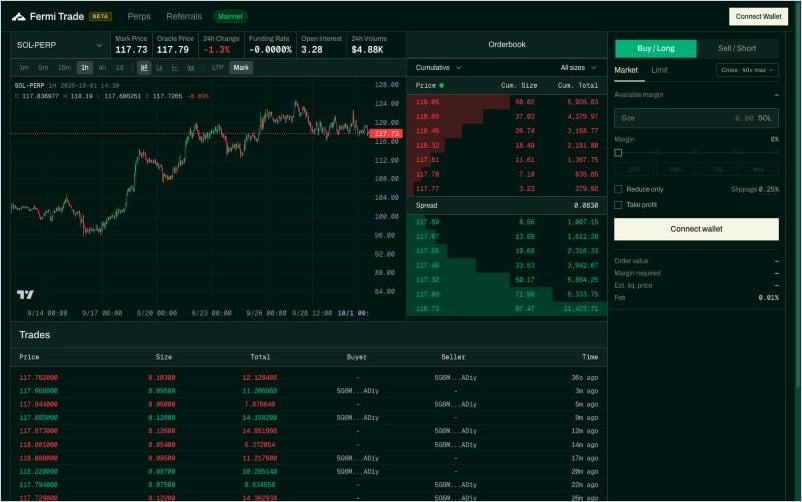
The app shows something else. With no wallet connected, the order ticket on each market displayed “Fee 0.01%”. We don’t know which number a real order pays, and we’d treat the docs’ 0.06% as the planning figure until Fermi explains the gap.
| On a $10,000 order | Taker pays | Maker pays |
|---|---|---|
| Fermi Trade, per its docs (0.06% / -0.03%) | $6.00 | Receives $3.00 |
| Fermi Trade, per the app ticket (0.01%) | $1.00 | Not shown |
| Hyperliquid base tier (0.045% / 0.015%) | $4.50 | $1.50 |
So on paper Fermi costs takers a third more than Hyperliquid’s base rate, and it pays makers where Hyperliquid charges them. That’s a deliberate pull for market makers, which a new book needs.
Three smaller costs are easy to miss:
- Market and immediate-or-cancel orders carry a flat penalty, charged even if nothing fills. The docs don’t publish the amount.
- Funding is the gap between the book price and the oracle price, held inside daily limits. It showed 0.0000% on all three markets when we looked.
- Liquidations include a fee to the liquidator and a platform cut. The docs name both and give no percentages.
Fermi doesn’t charge for deposits or withdrawals. You pay Solana’s network fee, and the docs suggest keeping at least 0.05 SOL in the wallet for account rent and transactions.
Liquidity three days after launch
This is the weakest part of Fermi today, and the numbers are the app’s own.
| Market | 24h volume | Open interest | Open interest in dollars |
|---|---|---|---|
| SOL-PERP | $4,880 | 3.28 SOL | About $386 |
| ETH-PERP | $4,680 | 0.029 ETH | About $78 |
| BTC-PERP | $3,970 | 0.028 BTC | About $2,345 |
| All three | $13,530 | About $2,810 |
The trade list tells the same story. The 20 most recent SOL trades covered 53 minutes. Each was worth between $5 and $15. The same wallet, shown as 5G6M…ADiy, was the buyer or the seller in all 20.
The order books look like one market maker’s work too. On ETH, the buy side and the sell side were near mirror images: $544.89 bid against $544.90 offered at the first level, and $8,500.62 against $8,500.44 by the seventh.
What does that mean for an order? On SOL, the offers within about 1.1% of the best price added up to $5,927. A $5,000 market buy would have eaten most of that and moved the price by around 1%. A $200 order would have filled at the top of the book without trouble.
None of this is strange for day three. It does mean the “fast order book” pitch can’t be tested at any real size yet.
How Fermi orders its trades
The part of Fermi that’s new is the queue in front of the matching engine. On most chains, whoever builds the block can see pending orders and decide where they go. That’s how traders get sandwiched.
Fermi’s answer has four steps:
- You sign an order and send it, encrypted, to a relayer.
- The relayer gives it a place in line and writes a hash of that place to Solana.
- Only then is the order revealed.
- The program checks the revealed order against the hash and runs it in queue order.
Because the position is fixed before anyone can read the order, reordering it later would leave a visible trail. An off-chain service shows you a likely result within milliseconds, and the final on-chain confirmation follows in seconds.
There’s a catch the docs state plainly. In this first version, one sequencer does the ordering. It can’t quietly shuffle orders it has accepted, but it can refuse to accept yours, or go offline. For that case Fermi has a fallback: you can push an order straight into the on-chain queue, where it waits out a short delay before it runs. A second version with rotating sequencers is planned.
Security and open questions
⚠️ Risk warning: this is a beta that had been on mainnet for three days when we reviewed it. We found no published security audit. Perpetual futures with leverage can wipe out your collateral in minutes, and the venue’s own risks sit on top of that. Don’t deposit money you can’t afford to lose.
Here’s what we could and couldn’t confirm:
- No audit report is linked from the site, the docs or the repository.
- The docs call every component open source. The on-chain program is public. The main repository that holds the relayer and the other off-chain services returned a 404 when we tried it.
- The docs send bug-bounty questions to a SECURITY.md file. The public repository doesn’t contain one.
- The program can be upgraded by whoever controls one address. Users are trusting that key.
- If a market’s price feed goes stale, the risk page says you can’t open, close or be liquidated on that market until it returns.
- If an account goes bankrupt, an insurance fund pays first. Any shortfall after that is spread across USDC depositors.
We have mixed feelings about the Mango heritage. The engine ran in public for years, so its margin logic has been tested by real markets. It’s also a large codebase with new queue code bolted on, and that new code is what hasn’t been reviewed in public.
Referral program, points and token
The app has a Referrals tab. It offers 0.02% of every trade your invited friends make, paid in USDC with no end date, plus a rebate on your own fees. You need to “connect a whitelisted wallet” to create a code, so the program isn’t open to everyone yet. The page doesn’t say how to get whitelisted.
We found no token and no points program. If you’re here for a perp DEX airdrop, nothing Fermi has published promises one.
How to start on Fermi Trade
The docs describe the same path for every user:
- Set up a Solana wallet. Phantom, Backpack and Solflare are named. Our guide to Solana wallets covers the main choices.
- Hold at least 0.05 SOL for fees, plus the collateral you want to trade with.
- Open app.fermi.trade, connect the wallet and create a Fermi account. It’s made once and used across all markets.
- Deposit collateral. USDC is the simplest because it isn’t discounted.
- Place a limit order. In a book this thin, a market order can move the price.
- Settle your profit or loss when you close. On Fermi, gains sit as unsettled until a settle step runs.
We haven’t tested whether any wallet can trade or whether trading is whitelisted like referrals are. The trading screen showed no invite prompt before the connect step.
Who should use Fermi Trade today
Developers and market makers get the most from it right now. The maker rebate is generous and the book is uncrowded. If you build trading systems on Solana, the ordering design is worth a read on its own.
Curious traders can try it with a small amount. Think tens of dollars, placed with limit orders.
Everyone else should wait. If you trade four or five figures at a time, there isn’t enough on the other side of the book. And if you want an audit before you deposit, there isn’t one to read.
Fermi Trade alternatives
If you want an order book for perps with real depth today, these are the places to look first:
- Hyperliquid is the largest on-chain perp exchange. It runs on its own chain, lists far more markets and has the deepest books.
- Pacifica is another perp exchange built on Solana, further along than Fermi.
- Lighter is an order book perp exchange on its own Ethereum rollup.
- Drift and Jupiter are the established Solana names. We compare them in Hyperliquid vs Drift vs AsterDex and in our list of Jupiter alternatives for perp traders.
For a wider view, see our roundup of the best Hyperliquid alternatives and, on the centralized side, the best crypto futures exchanges.
Pros and cons
| ✅ Pros | ❌ Cons |
|---|---|
| Non-custodial, with matching and margin checks on chain | No published security audit |
| On-chain program matches the published source | About $13,500 in daily volume across three markets |
| Makers are paid 0.03% per fill | Taker fee of 0.06% in the docs, above Hyperliquid’s base rate |
| Order queue fixed before orders are revealed | One sequencer in this version |
| On-chain fallback if the relayer is down | Docs and app disagree on fees, maximum leverage and program address |
Expert tip: before you deposit, paste the program ID from Fermi’s GitHub page into a Solana explorer and compare it with the program your wallet is asked to approve. The docs and the repository listed different addresses when we checked, and only one of them was running. Thirty seconds on an explorer beats trusting either page.
6 questions people ask about Fermi Trade
Is Fermi Trade safe?
The exchange is non-custodial, and the program on Solana matches the source code its team published, which we confirmed by hashing it ourselves. It’s also a beta that went live on 28 September 2026, with no published security audit, an upgradeable program and a single sequencer. Treat it as experimental and keep deposits small.
What are Fermi Trade’s fees?
Fermi’s documentation lists a 0.06% taker fee and a 0.03% rebate paid to makers, with no volume tiers. The app’s order ticket showed 0.01% when we checked on 1 October 2026, and Fermi hasn’t explained the difference. Market and immediate-or-cancel orders also carry a flat penalty whose size isn’t published.
Which markets does Fermi Trade offer?
Three perpetual contracts: SOL-PERP, ETH-PERP and BTC-PERP. All use cross margin, and the app shows a 40x maximum on each.
Does Fermi Trade have a token or an airdrop?
We found no token and no points program in Fermi’s site, docs or app as of 1 October 2026. There is a referral program that pays 0.02% of invited users’ trades in USDC, limited to whitelisted wallets.
Is Fermi Trade related to Fermilab?
No. Fermi Trade is a crypto derivatives exchange built by a company called Fermi Labs. It has no connection to Fermilab, the US particle physics laboratory, or to the listed company with the ticker FRMI.
How much liquidity does Fermi Trade have?
Very little so far. On 1 October 2026 the app showed about $13,500 of 24-hour volume across its three markets and roughly $2,800 of open interest. On SOL-PERP, offers within about 1.1% of the best price totalled under $6,000.
Bottom line: Fermi Trade is a serious attempt at a fair order book on Solana, and publishing code that matches what runs on chain earns its team some trust. But the exchange is three days old and has no audit, and almost nobody is trading on it yet. Try it with pocket money if the design interests you. We’ll look again when the volume has a second wallet in it.
Reviewed by the CoinCodeCap editorial team on 1 October 2026. Figures change quickly on a new exchange; confirm leverage and fees in the app before you trade. This article is information, not financial advice.
Related reading
Perp exchanges on Solana
- Pacifica review (a Solana perp exchange with more volume)
- Jupiter alternatives for perp traders (other Solana venues)
- Pacifica alternatives (low-fee perp trading)
- Best Solana DEX platforms (spot and perps)
Order book perp DEXs elsewhere
- Hyperliquid review (the largest on-chain perp exchange)
- Hyperliquid fees explained (the rates we compared Fermi against)
- Lighter review (an order book on an Ethereum rollup)
- StandX review (a newer perp DEX)
Comparisons
- Hyperliquid vs Drift vs AsterDex (three perp venues side by side)
- Hyperliquid vs Lighter vs Aster vs Hibachi vs Variational (head-to-head)
- Best Hyperliquid alternatives (other perp DEXs)
- Best crypto futures exchanges (centralized options)
New trading apps we’ve reviewed
- Liquid review (crypto, stock and pre-IPO perps in one app)
- Dexari review (a mobile Hyperliquid app)
- Tread.fi review (execution algorithms across venues)
- trade.xyz review (stock and index perps)
Tools and background
- Trading tools for on-chain perp traders (trackers, terminals and bots)
- Perp DEX airdrops worth farming (points programs on newer venues)
- Sandwiched.wtf review (check what front-running has cost you)
- Best Solana wallets (Phantom, Solflare and others)