Affiliate Disclosure: This post contains affiliate links. If you sign up through them, CoinCodeCap may earn a commission at no extra cost to you. Read the full disclosure.
If you are a beginner in crypto, the first problem is not lack of opportunity. It is lack of structure. The market moves fast, candles move faster, and beginners usually enter with a mix of excitement, half-understood advice, and a dangerous amount of confidence borrowed from someone else’s screenshot.
That is where crypto signals become useful.
Crypto signals can help beginners find structured trade opportunities without spending all day buried in charts.
They can show what coin to trade, where to enter, where to exit, and where to cut risk if the setup fails. In a market that runs nonstop, that kind of clarity matters. It is one reason products like CoinCodeCap Signals have become attractive to new traders trying to avoid pure randomness.

But let’s keep this clean and honest. Signals are not profit machines. They do not remove risk.
They do not save a trader who ignores stop losses, enters late, uses too much leverage, or treats every alert like a guaranteed win. Signals can support profit. They do not manufacture it.
For beginners, the real edge is not just finding signals. It is learning how to use them with discipline, small risk, and realistic expectations. That is the difference between using signals as a tool and turning them into another form of gambling with cleaner formatting.
This article breaks down how beginners can use crypto signals properly, what makes them useful, and how to turn them into a structured part of a profitable learning process instead of a fast-track route to avoidable losses.
- Crypto signals help beginners trade with more structure.
- They show what to trade and where.
- Signals save time and reduce market confusion.
- Beginners can profit, but only with discipline.
- Spot trading is usually better than futures at first.
- Risk management matters more than signal excitement.
- One good provider is better than five noisy ones.
- Long-term profit comes from consistency, not hype.
| Product Name | Key Features | Product Link |
| C3 Signals | Real-time crypto alerts, structured entries, stop-loss guidance, clear take-profit levels, beginner-friendly workflow | Click here! |
| AltSignals | Telegram-based delivery, broad signal coverage, fast market alerts, accessible format, multi-market appeal | Click here! |
| Learn 2 Trade | Beginner-friendly alerts, Telegram access, educational angle, structured trade setups, regular market updates | Click here! |
How Can You Use Crypto Signals for Profit as a Beginner?
Crypto is one of the few markets where a beginner can open an exchange account in the morning and feel like a macro trader by lunch. Then the market teaches its first lesson. Fast.
Most beginners do not lose because there were no opportunities. They lose because they had no system.
They buy late, sell early, average into bad positions, chase green candles, panic during red ones, and confuse motion with strategy. Crypto signals are useful because they bring structure into that mess.
A signal gives the beginner a clearer framework. It says: this is the coin, this is the trade direction, this is the entry area, this is the stop loss, and these are the targets. That reduces guesswork.
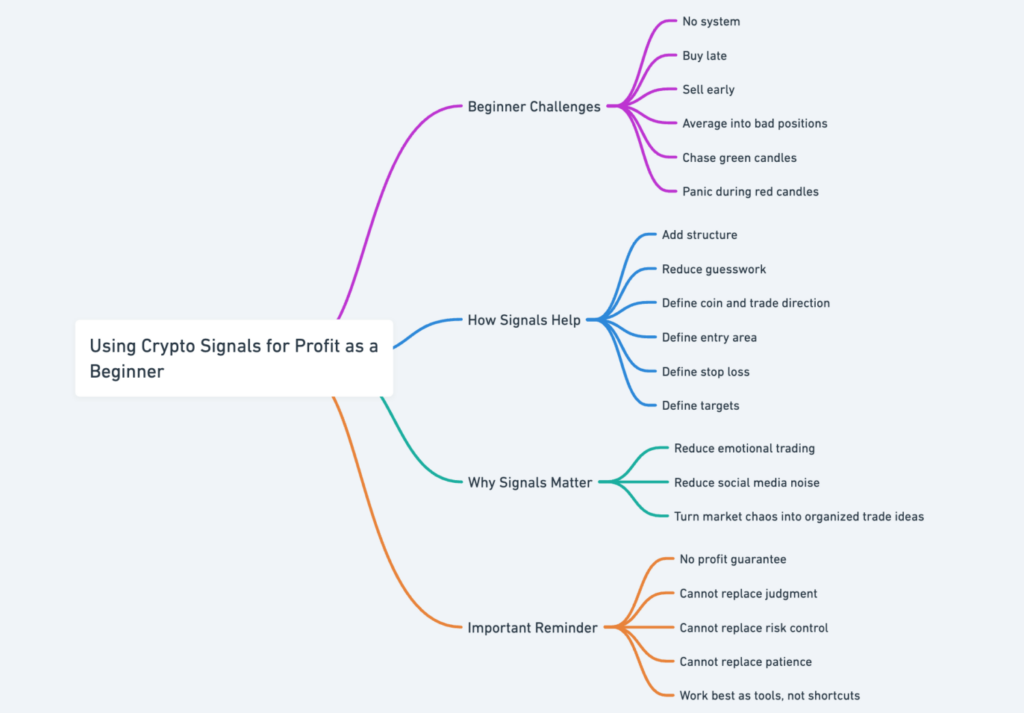
It also reduces the chance of entering random trades built on emotion, social media noise, or one influencer acting like every chart is about to change your life.
This is why services like CoinCodeCap Signals matter. They help transform raw market chaos into organized trade ideas.
That does not mean they guarantee profit. It means they give beginners a more disciplined starting point than staring at ten charts and hoping intuition shows up fully trained.
The key thing beginners need to understand is simple. Signals can help you find opportunity, but they cannot replace judgment, risk control, or patience. They are tools, not shortcuts. If you treat them like a framework, they can help. If you treat them like a magic shortcut, the market will invoice you immediately.
What Are Crypto Signals in Beginner Terms?
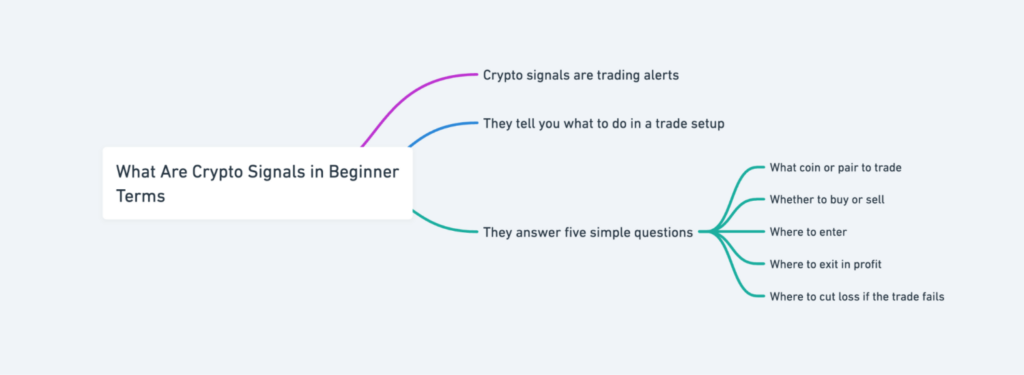
In beginner terms, crypto signals are trading alerts that tell you what to do in a trade setup.
They usually answer five simple questions:
- What coin or pair to trade
- Whether to buy or sell
- Where to enter
- Where to exit in profit
- Where to cut loss if the trade fails
That is the easiest way to understand them.
Think of a signal as a ready-made trade plan. Instead of opening a chart and trying to guess what matters, the signal gives you the main decisions in a more organized format. It takes market analysis and turns it into something actionable.
For example, a signal might say to buy ETH/USDT between two price levels, place a stop loss below support, and take profits at two higher targets. That gives a beginner a structured map instead of forcing them to improvise in a market that punishes random decisions.
This is why signals feel approachable to new traders. You do not need to master every indicator or become a full-time chart detective on day one. You are given a clearer framework. The coin is identified. The direction is identified. The risk is identified. The exit plan is identified.
Of course, that does not mean the work disappears. The beginner still needs to execute properly. But signals make the process easier to follow. They turn trading from vague opinions into defined actions.
A strong signal is not just someone shouting “buy now.” That is noise. A real signal gives the logic of a trade structure, even if it presents it in a short format. That structure is what makes signals useful for beginners.
Why Beginners Use Crypto Signals
Beginners use crypto signals because crypto is overwhelming at first.
There are too many coins, too many opinions, too many indicators, and too many people speaking with confidence they absolutely did not earn. Signals simplify that environment. They reduce the number of decisions a beginner has to make from scratch.
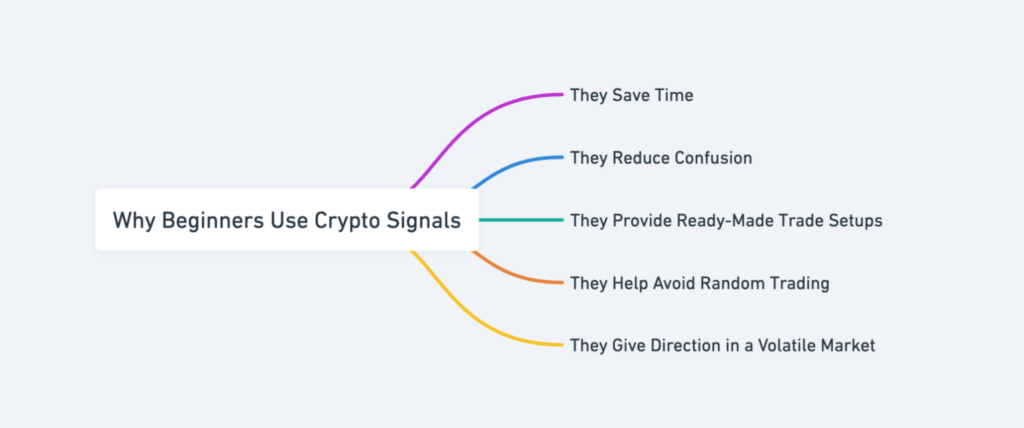
They save time
New traders often assume profitability comes from staring at charts all day. It does not. More screen time without a process usually just creates more bad decisions.
Signals save time by narrowing the market down to specific setups. Instead of scanning dozens of pairs, the beginner can focus on a smaller number of opportunities that have already been filtered.
They reduce confusion
The crypto market is full of mixed signals in the worst possible sense. One person says bullish breakout. Another says fake pump. Another says whale accumulation. Another says total collapse.
Signals reduce that noise by giving one structured trade idea with defined conditions. That clarity is useful when beginners are still learning how to filter market chatter.
They provide ready-made trade setups
A beginner usually struggles with one major issue: not knowing how to build a trade plan.
Signals solve that by presenting a prepared structure. Entry, stop loss, and targets are already laid out. The beginner does not have to invent every part of the trade in real time.
They help avoid random trading
This matters more than most people realize.
Random trading is one of the biggest beginner problems. It happens when someone buys because price is moving, sells because fear kicks in, then buys again because they saw a post claiming a breakout is coming. Signals can interrupt that cycle by replacing impulse with a framework.
They give direction in a volatile market
Crypto moves fast. For beginners, that speed often creates paralysis or reckless action.
Signals help by giving direction. They do not make the market less volatile, but they make the trader less directionless. That alone can improve early trading behavior significantly.
Can Beginners Really Make Profit With Crypto Signals?
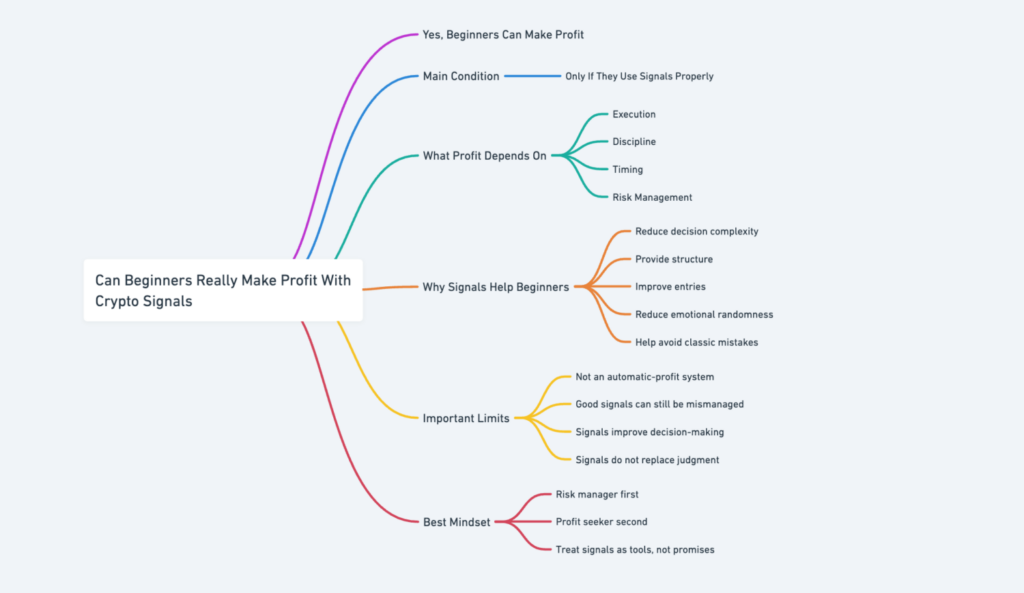
Yes, beginners can make profit with crypto signals.
Now for the more important sentence: only if they use them properly.
Profit from signals does not come from copying alerts like a robot with no survival instinct. It comes from execution, discipline, timing, and risk management. A signal can point to a strong opportunity, but the trader still decides whether to enter correctly, size the trade responsibly, and respect the stop loss when the market disagrees.
That is the critical difference.
A beginner can absolutely make money using signals because signals reduce decision complexity. They provide structure where beginners usually have none. That structure can improve entries, reduce emotional randomness, and help new traders avoid some classic mistakes.
But signals are not an automatic-profit system. A bad trader can lose money with good signals. That happens all the time. They enter late after price already moved. They ignore position sizing. They use leverage they do not understand. They skip stop losses because they are “sure” the trade will bounce. Then they blame the signal when the real issue was execution.
The market does not care how good the alert looked in Telegram. It cares how the trade was managed.
So yes, beginners can profit with crypto signals, but only when they understand one brutal truth: signals improve decision-making, they do not replace it. The beginner still needs to operate like a risk manager first and a profit seeker second.
That mindset shift changes everything. Once signals are treated as structured tools rather than instant-win promises, they become far more useful.
Best Way for Beginners to Start Using Crypto Signals
The best way to start is not complicated, but it does require restraint. That is usually the part beginners hate most.
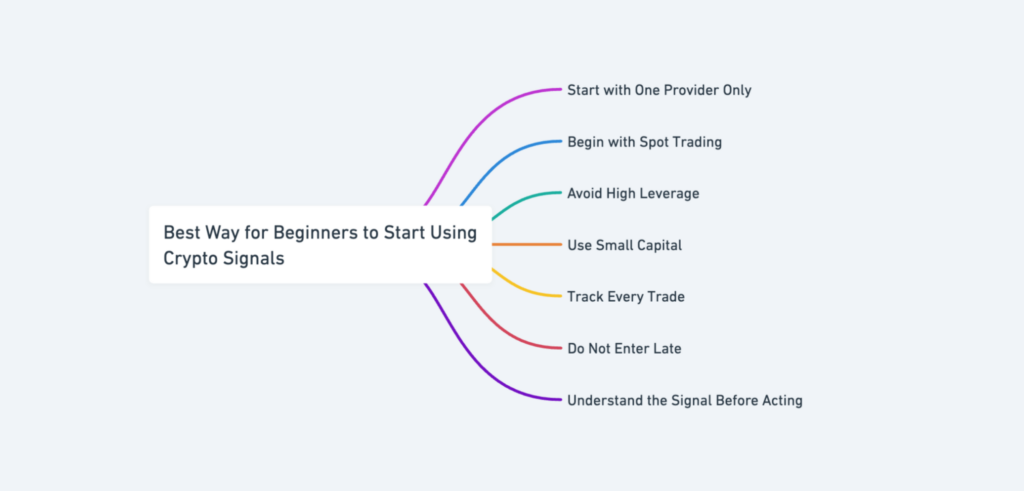
Start with one provider only
Do not join five groups and call it diversification. That is not diversification. That is cognitive overload wearing a trader costume.
One solid provider is enough. More signals do not automatically create more profit. They usually create conflicting setups, emotional confusion, and a higher chance of overtrading.
Begin with spot trading
This is the cleaner starting point for most beginners.
Spot trading is simpler, slower, and less destructive than futures when mistakes happen. You are buying the asset directly rather than trading a leveraged contract that can punish small errors aggressively. Beginners should learn trade structure in spot first before trying to survive the chaos of leveraged futures.
Avoid high leverage
This should not even be optional advice. High leverage is one of the fastest ways beginners erase accounts.
Leverage multiplies outcomes, but it also multiplies mistakes. A bad entry with no leverage hurts. A bad entry at 20x becomes a short case study in preventable damage. Beginners should focus on learning execution before touching aggressive leverage.
Use small capital
Your early trades should not be treated like your financial breakthrough arc.
Use small capital so you can learn without catastrophic pressure. Early trading is training. It should feel manageable enough that you can follow process instead of panicking over every candle. Small size creates room for learning and reduces emotional distortion.
Track every trade
If you are not tracking trades, you are not building a process. You are just collecting experiences and hoping memory does accounting.
Track the entry, exit, reason for trade, risk size, result, and whether you followed the signal correctly. Over time, this shows whether the provider is working for you and whether your own behavior is helping or hurting results.
Do not enter late
This is where many beginners sabotage perfectly decent signals.
A signal has an entry zone for a reason. If price has already moved too far, the trade structure changes. The risk-to-reward may no longer make sense. Chasing late entries is one of the fastest ways to turn a good setup into a bad trade.
Understand the signal before acting
Do not click because the alert looked confident.
Before entering, make sure you understand the asset, direction, entry zone, stop loss, and targets. If you do not understand the setup, you should not be in the trade. Beginner profit comes from structured participation, not blind obedience.
How to Use Crypto Signals Profitably as a Beginner
This is where the game gets real. Signals only become profitable when the beginner uses them with discipline. The alert itself is just the starting point.
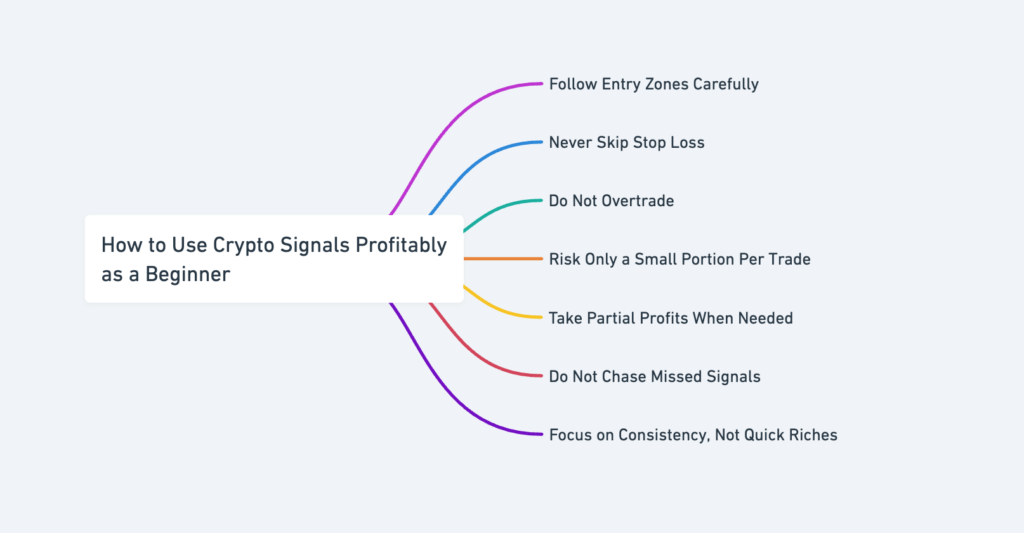
Follow entry zones carefully
A signal is built around a price area, not a fantasy version of the chart after it already ran away.
If the signal says enter within a certain range, respect that range. A late entry changes the risk profile. It may increase downside, reduce upside, and make the stop loss placement less logical. Beginners often lose not because the signal was wrong, but because they entered after the trade already started moving.
Never skip stop loss
This is the line between trading and hoping.
A stop loss exists because not every signal wins. That is normal. Losses are part of the process. What matters is keeping losses controlled so one bad trade does not erase multiple good ones. Beginners who refuse stop losses usually learn the hardest version of the same lesson.
Do not overtrade
You do not need to take every signal.
Profitability for beginners is usually harmed by volume, not by lack of opportunity. Too many trades create emotional exhaustion, inconsistent execution, and unnecessary exposure. Choose quality setups. Take the ones that fit your plan. Skip the rest.
Risk only a small portion per trade
This is where sustainability starts.
A beginner should risk only a small portion of capital on each trade. That way, one losing setup stays manageable and the trader remains in the game long enough to improve. Large risk creates pressure, distorted decision-making, and a higher chance of account damage.
Take partial profits when needed
Markets do not move in perfect straight lines, and beginners should not expect them to.
Taking partial profits at target levels can help lock in gains while still leaving room for further upside. This also reduces emotional stress because the trade starts paying you before the full move is complete. That is often a smarter approach than holding everything for the final target and watching the market reverse halfway there.
Do not chase missed signals
Missed trades are part of the business.
A beginner sees price move after the entry was missed and thinks the solution is to jump in anyway. Usually, that is how discipline gets replaced by regret-driven execution. If the entry is gone, let it go. Another setup will come. The market is never out of opportunities. It is only out of patience for undisciplined traders.
Focus on consistency, not quick riches
This is the biggest mindset shift beginners need.
Profit in trading does not come from one lucky signal. It comes from repeating solid behavior over time. Good entries. Controlled losses. Rational position sizing. Respect for stops. Patience with targets. Signals can support all of this, but only if the trader stops looking for instant wealth and starts building repeatable habits.
Common Mistakes Beginners Make With Crypto Signals
This is where most beginner profit plans get ambushed.
The problem is usually not that signals exist. The problem is how beginners behave around them. A decent signal can still end badly when the trader adds impatience, overconfidence, and zero process to the mix. Crypto is already volatile. Beginner mistakes turn that volatility into self-inflicted damage.
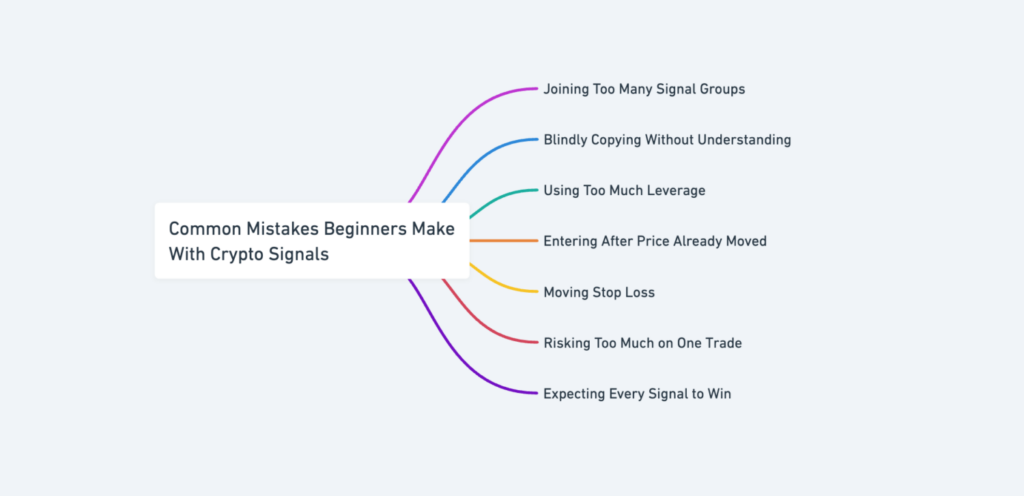
Joining too many signal groups
This feels smart at first. More groups, more opportunities, more market coverage. Sounds efficient. Usually it is chaos.
Different groups send different setups, different time horizons, different coins, and sometimes opposite market views. The beginner ends up overloaded, confused, and unable to distinguish signal quality from message frequency. Instead of getting clarity, they get a constant stream of alerts competing for attention.
One good provider is a system. Five noisy providers are a distraction engine.
Blindly copying without understanding
This is one of the most common mistakes and one of the most dangerous.
A beginner sees a signal, copies it instantly, and never asks what the trade actually means. They do not know whether it is spot or futures. They do not understand why the stop loss is placed there. They do not know whether the entry is still valid. They are trading the appearance of structure, not the structure itself.
That approach creates dependency and weak execution. Even basic understanding improves behavior. You do not need to become a technical analyst overnight, but you do need to know what you are entering and why.
Using too much leverage
This is the classic beginner trap dressed up as ambition.
Leverage looks attractive because it makes small moves feel meaningful. The problem is that it also makes small mistakes expensive. Beginners often underestimate how quickly leverage changes the margin for error. A price move that would be manageable in spot can become a serious hit in a leveraged position.
For most beginners, aggressive leverage is not a shortcut to better profits. It is a shortcut to learning liquidation vocabulary faster than necessary.
Entering after price already moved
A signal has an entry zone for a reason. That zone defines the logic of the setup.
When a beginner sees the trade moving and jumps in late because they are afraid of missing out, the structure changes. The stop loss may now be too far. The reward may now be too small. The original risk-to-reward balance may already be gone.
This is how traders turn good setups into weak ones. They chase movement instead of respecting structure.
Moving stop loss
This is where discipline quietly collapses.
A stop loss exists to protect capital when the setup is invalidated. Beginners often move it lower because they do not want to accept the loss. They tell themselves the trade just needs “a little more room.” Sometimes that room turns into a much bigger loss that never needed to happen.
Moving a stop loss out of fear is one of the fastest ways to turn controlled damage into unnecessary account stress.
Risking too much on one trade
No single signal deserves oversized exposure, especially for a beginner.
Beginners often believe that strong confidence in a setup justifies large position size. That belief becomes dangerous quickly. Even good signals lose sometimes. If too much capital is tied to one idea, one failed trade can undo weeks of progress or confidence.
Trading survives through repetition. Oversized risk destroys the ability to repeat the process calmly.
Expecting every signal to win
This expectation ruins behavior faster than people realize.
Once a beginner assumes signals should always work, every loss feels like betrayal instead of a normal part of trading. That mindset leads to revenge trading, provider switching, emotional exits, and unrealistic expectations about what signals are supposed to do.
Signals are probability tools. They are not certainty machines. A trader who understands that stays calmer, more disciplined, and more capable of long-term improvement.
How Much Money Should a Beginner Start With?
Most beginners ask this question as if there is one perfect number. There is not. The better question is this: how much can you trade with while still thinking clearly, learning properly, and surviving mistakes without financial damage?
That answer is usually smaller than beginners want.
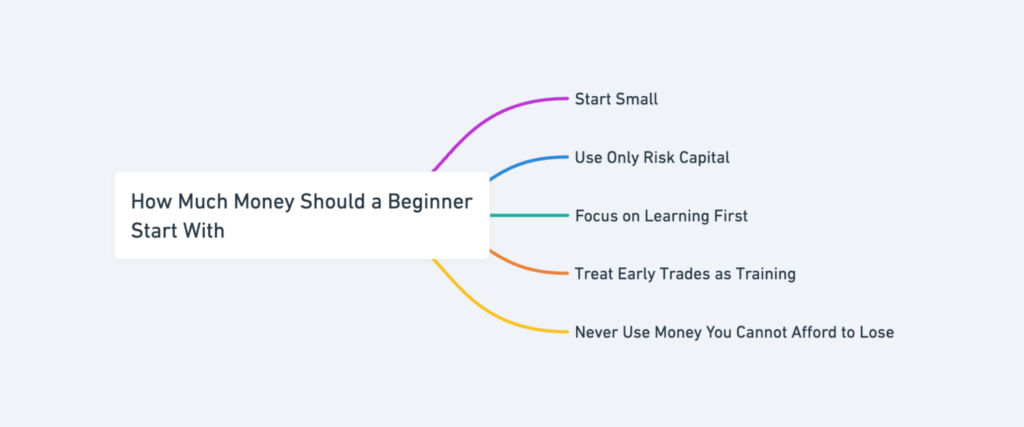
Start small
Your first capital amount should be sized for learning, not for changing your life.
Early trading should not feel like a high-stakes survival exercise. If every candle move is causing stress, the position is probably too large. Small capital gives room to make mistakes, observe behavior, and build process without emotional overload.
In beginner trading, staying rational matters more than looking ambitious.
Use only risk capital
This should be a hard rule.
Trade only with money you can afford to lose. Not rent money. Not emergency money. Not money needed for bills, debt, or daily stability. Crypto remains volatile no matter how clean the signal looks. If the capital is emotionally or financially essential, the decision-making around it will almost always get worse.
Risk capital protects both your account and your psychology.
Focus on learning first
At the beginning, profit is useful but education is more valuable.
A beginner should treat early trading as skill-building. The goal is to understand entries, exits, stop losses, risk size, emotional reactions, and how well signals fit personal behavior. If profit comes during that process, good. But learning the process is what makes future profit sustainable.
Skipping the learning phase is how beginners stay beginners longer.
Treat early trades as training
This mindset changes everything.
If your first trades are treated like practice under real conditions, you become more observant and less desperate. You stop forcing outcomes and start studying behavior. You learn how you react to volatility, how well you follow entry zones, and whether you respect stops when the trade moves against you.
That information is worth more than one lucky early win.
Never use money you cannot afford to lose
This point deserves repetition because the market repeats the lesson harshly.
If losing the money would damage your real life, you should not be trading it. Once essential money is at risk, fear takes control of execution. You exit too early, hold losers too long, ignore the plan, and turn every signal into a psychological test you were never supposed to take.
For beginners, the right starting amount is not based on excitement. It is based on safety, learning value, and emotional control.
Can You Rely Only on Crypto Signals?
In the beginning, signals can carry a lot of the workload. That is fine. For a beginner, having external structure is often better than trading on raw instinct and random internet noise.
But relying only on crypto signals forever is not a strong long-term plan.
Signals are useful because they simplify trading decisions. They help surface opportunities, define entries, and make risk more visible. For a beginner, that is a major advantage. It creates a safer starting point than trying to build a full trading system from zero with no experience.
The problem starts when signals become the only source of judgment.
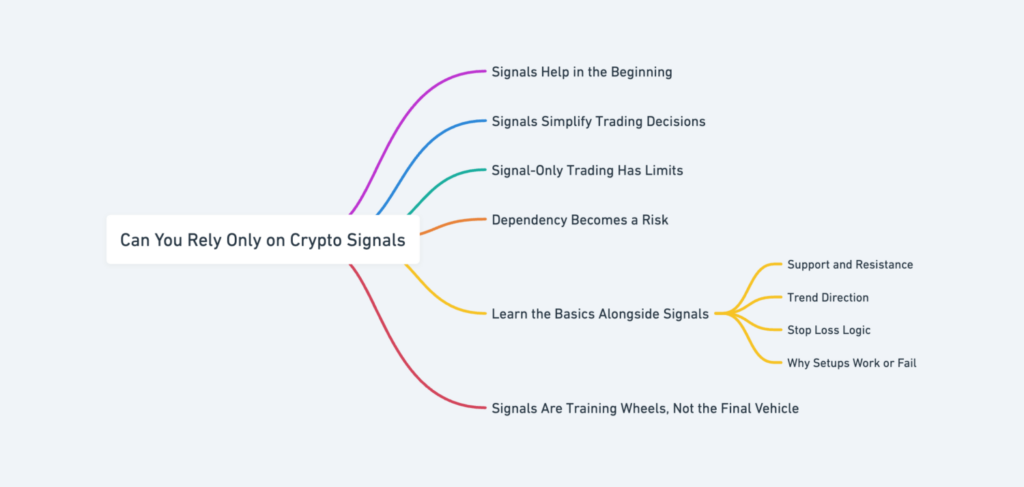
If a trader never learns basic chart reading, never understands why setups work, and never builds personal risk discipline, they remain dependent. They can only function when someone else provides the plan.
The moment that provider changes quality, misses a market shift, or simply no longer fits the trader’s style, the trader has no internal framework to fall back on.
That is the real limitation of signal-only trading. It can produce short-term structure while blocking long-term independence if used passively.
The healthier path is gradual development.
Use signals as a starting framework, but slowly learn the basics alongside them. Understand support and resistance. Learn what trend direction means. Notice how stop losses are placed.
Pay attention to why some setups work in strong conditions and fail in weak ones. You do not need to become fully independent immediately, but you should be moving in that direction.
Signals are excellent training wheels. The mistake is pretending training wheels are the final vehicle.
Crypto Signals vs Learning Trading Yourself
This comparison gets framed badly all the time.
People act like you must choose one side forever. Either follow signals or become a fully self-directed trader from day one. That is not how most traders actually improve. The smarter path usually combines both.
Signals give speed and structure
This is why signals are attractive, especially for beginners.
They reduce the need to scan everything manually. They provide ready-made trade setups. They define entries, stop losses, and targets in a way that makes action simpler. For a new trader, that structure is valuable because it avoids one of the biggest beginner problems: turning every market decision into a guess.
Signals are efficient. They help you move faster and with more direction.
Self-learning gives deeper understanding
Doing your own analysis builds something signals alone cannot fully provide: internal judgment.
When you study charts, market behavior, risk structure, and trade logic yourself, you start understanding why a setup makes sense or fails. That understanding makes you more adaptable. It also makes you less dependent on external alerts and more capable of filtering good opportunities from bad ones.
Self-learning is slower, but it builds stronger long-term independence.
The best beginner path is to use signals while learning the logic behind them
This is usually the strongest combination.
Use signals to get structure and reduce chaos. At the same time, study the logic behind each setup. Ask why the entry is there. Why the stop is below that level. Why those targets were chosen. Why one setup is spot and another is futures. Why some trades are worth skipping.
That approach gives beginners the operational advantage of signals and the educational value of self-development. It is more practical than blindly copying and more realistic than expecting a total beginner to become a full analyst immediately.
The goal is not to worship signals or reject them. The goal is to use them intelligently while building your own trading brain.
Conclusion
Beginners can use crypto signals for profit, but only when they stop treating them like shortcuts and start treating them like structured tools.
That is the real difference.
Signals can save time, reduce confusion, and provide a cleaner way to enter the market.
They can help beginners avoid random trades, improve discipline, and operate with more clarity in a market that is usually full chaos. But the signal itself is never the full answer. Profit comes from how the trader uses it.
That means protecting capital first. It means focusing on win-loss behavior and risk-reward rather than chasing constant action.
It means journaling trades so mistakes become visible instead of repeating in silence. It means staying patient when the market does not offer clean setups. It means avoiding emotional trading when fear or greed tries to rewrite the plan mid-trade.
And above all, it means choosing quality over quantity, both in signal providers and in the trades you take.
For most beginners, the smartest move is simple. Start with one strong provider, keep position sizes small, follow the structure carefully, and treat every trade as both an opportunity and a lesson.
Over time, that process creates something much more valuable than a lucky winning streak. It creates consistency.
That is what profitable beginners actually need. Not fantasy. Not shortcuts. Not twenty Telegram groups screaming “next 100x.” Just a clear process, controlled risk, and enough discipline to let good habits compound.