Affiliate Disclosure: This post contains affiliate links. If you sign up through them, CoinCodeCap may earn a commission at no extra cost to you. Read the full disclosure.
If you trade perps, you already know how crowded the field has become. Aster earned attention by blending fast execution with a clean interface, but traders like me are always scanning for stronger liquidity, deeper markets, and better decentralization. That’s why I put together this guide.
Aster has become one of the most recognized names in the perpetual trading landscape because it gives traders fast execution, deep liquidity, and a familiar centralized-exchange style interface while still retaining certain on-chain properties.
Its popularity comes from a blend of speed, asset coverage, execution reliability, and a user journey that mirrors what traders expect from professional derivatives venues.
As more volume shifts toward decentralized trading, Aster positioned itself as a hybrid solution that feels efficient without demanding the compromises of fully custodial platforms.

Even with its strengths, traders often search for alternatives. Some want strict self-custody with every position settled on-chain.
Others are motivated by fee structure differences, market availability, or the need to trade on their preferred ecosystem. Certain traders prioritize decentralized orderbooks, while others prefer AMM based liquidity for predictable pricing.
The choice often comes down to chain alignment, gas costs, performance expectations, and reliability during market volatility.
This article reviews five perpetual DEX platforms that stand out in 2025 as serious Aster alternatives.
These platforms combine non-custodial execution with competitive liquidity, advanced tooling, and a track record of active user adoption. Each provides a different angle on how decentralized trading can operate, giving both casual and professional traders more options across ecosystems and liquidity models.
Quick Comparison Table
| Platform | Chain | Liquidity Feel | Fee Structure | Supported Markets | Ideal Trader Type |
| GMX v2 | Arbitrum, Avalanche | AMM with isolated pools | Maker-taker, low fees | Majors and selected alts | Major-pair traders wanting stability |
| dYdX v4 | Cosmos appchain | Deep orderbook | Low taker fees, chain-level gas | BTC, ETH, majors | Professional orderbook users |
| Hyperliquid | Custom L1 | Very deep orderbook | Competitive taker and maker | Majors, extensive long-tail | High-volume and active derivatives traders |
| Drift | Solana | Hybrid AMM plus orderbook | Low fees, fast settlement | Majors and Solana assets | High-frequency and intraday traders |
| Level Finance | BNB Chain, Arbitrum | Tranche-based AMM | Fee-sharing with LPs | Ecosystem-focused markets | Traders seeking yield plus perps |
What Makes a Strong Aster Alternative?
A strong alternative should retain the core benefits traders expect from a platform like Aster while improving on areas such as decentralization, custody, cost structure, or cross-chain accessibility.
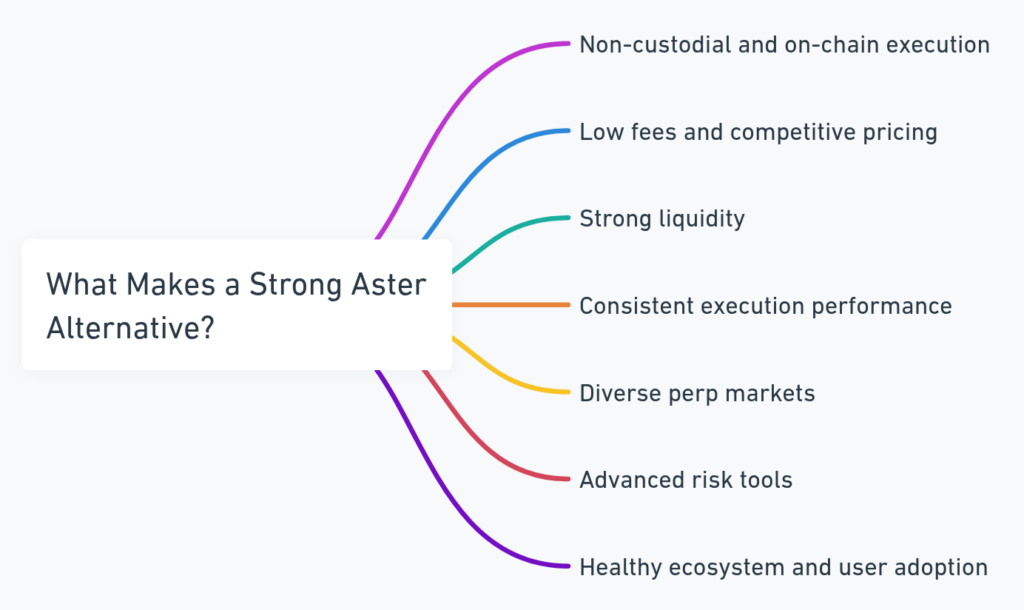
Non-custodial and on-chain execution: Traders should remain in control of their collateral, positions, and settlement. Custody should not depend on a centralized matching engine or opaque internal accounts.
Low fees and competitive pricing: Reduced taker and maker fees, minimized funding costs, and efficient liquidity models allow for tighter spreads and more durable strategies. Sustainable fee designs also underpin protocol longevity.
Strong liquidity: Depth and stability across key markets support high leverage and large position sizes. Liquidity should remain consistent across market conditions rather than collapsing during volatility.
Consistent execution performance: Order matching, liquidations, and oracle updates must remain predictable. The best DEX perps maintain reliable fill quality even during rapid price movement.
Diverse perp markets: A strong Aster alternative should offer more than just majors. Altcoins, long-tail assets, and ecosystem-specific markets allow both hedging and speculative flexibility.
Advanced risk tools: Order types, position management tools, cross margining, isolated margin, and accurate liquidation engines improve risk handling and overall trade control.
Healthy ecosystem and user adoption: Growing TVL, active traders, stable fee revenue, and visible integrations are signs of a protocol with real user traction rather than manufactured activity.
These criteria guide the selection of the five platforms explored in the next section, each representing the strongest choices for traders looking beyond Aster.
Top 5 Aster Alternatives – Platform Deep Dives
GMX v2 (Arbitrum and Avalanche)
GMX v2 is a decentralized perpetuals protocol deployed on Arbitrum and Avalanche. It replaces the original single-pool GLP model with a multi-asset liquidity architecture, allowing each perp market to use its own isolated pool.
This shift significantly improves pricing, reduces risk for liquidity providers, and enables more assets to be listed without exposing all LPs to correlated volatility.

GMX operates a hybrid oracle pricing model that combines Chainlink feeds with on-chain data sources to maintain robust and manipulation-resistant execution.
According to DefiLlama, the protocol holds approximately 394 million dollars in total value locked, with annualized revenue around 22.23 million dollars and annualized fees near 60 million dollars. Open interest sits above 121 million dollars, and its 30-day DEX volume is just over 193 million dollars. These metrics reflect a protocol with sustained user adoption, consistent trading demand, and meaningful liquidity.
USP: Market-isolated liquidity pools that provide efficient pricing and lower systemic risk for LPs while preserving deep liquidity for traders.

Key Features:
- Multi-asset isolated pools that limit LP exposure to specific markets
- Hybrid oracle pricing mechanism combining Chainlink data with on-chain sources for stability
- Support for major assets across Arbitrum and Avalanche yielding diverse trading markets
- Maker-taker fee structure designed to optimize execution while sustaining LP returns
- Advanced order types such as limit, trigger, and guaranteed execution during normal network conditions
- Robust LP yield structure driven by real trading fees rather than emissions-led incentives
Why It’s a Good Alternative to Aster: GMX v2 appeals to traders who prefer lower gas costs, straightforward UX, and deep liquidity in major asset markets. Like Aster, it aims for predictable execution and minimal slippage, but it offers a more transparent on-chain structure suited for traders who prioritize decentralization.
GMX’s isolated liquidity design provides a more risk controlled environment compared to broader pooled models, which makes it attractive for Aster users who want stronger LP safety and durable pricing.
dYdX v4 (Cosmos Appchain)
dYdX v4 runs on its own Cosmos appchain, giving it full control over execution, validation, and fee structure. The platform uses a decentralized off-chain orderbook with on-chain settlement.
This design preserves high-speed matching while ensuring that custody and liquidation logic stay transparent and verifiable.

DefiLlama shows roughly 203 million dollars in total value locked, with annualized revenue and fees both near 12.56 million dollars. Perp volume over 30 days sits around 15.58 billion dollars, supported by open interest of roughly 87.6 million dollars. These numbers illustrate its position as one of the most active decentralized perpetual exchanges.
USP: A professional-grade decentralized orderbook offering CEX-level execution speed with full on-chain settlement.
Key Features:
- Decentralized off-chain orderbook for low-latency order matching
- Cosmos appchain architecture enabling chain-level customization and performance tuning
- High-volume markets including BTC, ETH, majors, and selected altcoins
- Cross-margin trading with efficient liquidation mechanics
- Validator-driven infrastructure ensuring decentralization at the consensus layer
- Consistent deep liquidity backed by strong trader activity

Why It’s a Good Alternative to Aster: Aster users who value fast execution and tight spreads will find dYdX v4 familiar, but with stronger decentralization credentials. The dedicated chain enables highly consistent performance during volatility, making it attractive for professional traders.
It offers deeper orderbook dynamics than AMM-based systems and is better suited for users who want CEX-like responsiveness without sacrificing custody. It may lack the broad long-tail listings found on more experimental platforms, but for major markets and serious leverage strategies, it is a top-tier alternative.
Hyperliquid (Custom L1)
Hyperliquid runs on a fully custom layer-1 chain engineered specifically for high-performance derivatives. It operates a decentralized orderbook with sub-second transaction times and deterministic execution.

According to DefiLlama, Hyperliquid maintains over 4.336 billion dollars in total value locked, with annualized fees around 1.204 billion dollars and annualized revenue slightly above 1.081 billion dollars. Open interest exceeds 6.29 billion dollars. These figures reflect some of the strongest organic activity in the decentralized perps ecosystem.
USP: A custom-built high-speed chain delivering the fastest and most scalable decentralized orderbook environment in the market.
Key Features:
- Custom L1 optimized for lightning-fast settlement and consistent block times
- Deep liquidity across majors and long-tail altcoins
- Orderbook architecture designed for scalable throughput and accurate fills
- Large open interest capacity and tight spreads even during volatility
- Extensive market listings with new assets added rapidly
- Active ecosystem growth driven by trader volume rather than emissions

Why It’s a Good Alternative to Aster: Hyperliquid appeals to Aster users who want maximum execution quality and market coverage. It offers deeper liquidity and faster performance than most on-chain perps.
Traders who value speed, diverse listings, and professional orderbook structure will find Hyperliquid more capable than Aster in nearly every performance dimension. It may be less familiar for users who prefer EVM-based tooling, but for pure trading experience, it stands as one of the strongest alternatives.
Drift Protocol (Solana)
Drift Protocol operates on Solana and uses a hybrid liquidity model known as a Just-in-Time AMM combined with an orderbook. This allows takers to be matched against live LP quotes or resting orders. The platform is built for high-frequency execution, benefiting from Solana’s low fees and fast block times.

DefiLlama shows approximately 894 million dollars in total value locked, with around 19.24 million dollars in annualized revenue and nearly 38.54 million dollars in annualized fees. Open interest sits near 404 million dollars, making Drift one of Solana’s dominant perps venues.
USP: Hybrid liquidity combining AMM flexibility with orderbook precision, powered by Solana’s high-speed environment.
Key Features:
- JIT AMM providing real-time liquidity for takers
- Low gas fees and fast execution enabled by Solana
- Support for majors and multiple ecosystem assets
- Advanced order types and risk tools suitable for active traders
- Transparent funding and pricing supported by oracle integrations
- Strong open interest and consistent volume growth across Solana’s user base

Why It’s a Good Alternative to Aster: Traders who like Aster’s responsiveness but want cheaper fees and faster chain-level performance will find Drift appealing. Solana’s throughput provides stable fills even during high volatility, and the hybrid liquidity model offers predictable execution.
It performs especially well for users who trade frequently or deploy scalping and intraday strategies. While Solana users benefit heavily, cross-chain traders seeking long-tail markets may find Hyperliquid or Level Finance more flexible.
Level Finance (BNB Chain and Arbitrum)
Level Finance is a decentralized perpetual exchange on BNB Chain and Arbitrum using a tranching-based liquidity model. Liquidity providers choose exposure levels across multiple tranches that correspond to different risk and reward profiles.

DefiLlama lists approximately 407 thousand dollars in total value locked at present, with historical peaks far higher before declining due to ecosystem risk events. Market cap stands around 197 thousand dollars. Although smaller in scale compared to the others, it remains a notable platform due to its structured LP design.
USP: Tranche-based liquidity allowing LPs to choose distinct risk tiers and yield opportunities.
Key Features:
- Multiple LP tranches with varying risk allocation
- BNB Chain and Arbitrum deployment for accessible and low-cost usage
- Perp markets tied closely to ecosystem demand
- LP incentives structured around real trading fees
- Simple trading interface suitable for newcomers
- Lower gas burden compared to higher-performance chains

Why It’s a Good Alternative to Aster: Level Finance suits Aster users who want LP flexibility and yield exposure in addition to trading. Its tranche model allows risk segmentation that Aster does not provide.
It performs best for traders who favor BNB Chain or want a simpler fee and execution structure. However, it lacks the deep orderbook liquidity and throughput found in dYdX or Hyperliquid, making it more appropriate for smaller-position traders or ecosystem-focused strategies.
Risks and Trade-Offs

Smart contract risk; All platforms depend on smart contract logic that may contain vulnerabilities, especially in complex AMM or liquidation systems.
Chain reliability risk; Performance can vary based on the underlying chain. High-throughput networks may face congestion or downtime at peak loads.
Liquidity depth differences; While some platforms maintain deep orderbooks, others rely on AMMs that may show slippage during extreme volatility.
Leverage and liquidation parameters; Each platform uses distinct liquidation engines, funding models, and margin rules, creating differences in trade survivability.
Regulatory uncertainty; Perpetual futures remain under regulatory scrutiny in many regions, which could affect platform accessibility or user availability over time.
How to Choose the Right Alternative for Your Trading Style

Majors-only: GMX v2 provides strong stability and deep liquidity for BTC, ETH, and top assets. Ideal for traders focusing on core pairs.
Pro trader or orderbook-focused: dYdX v4 and Hyperliquid offer the most advanced orderbook environments with fast execution and predictable fills.
Speed and cheap gas: Drift on Solana fits traders running intraday strategies that require low costs and rapid confirmations.
Perps plus yield with structured LP exposure: Level Finance suits users who want exposure to perp trading while earning through risk-tiered liquidity pools.
Top Aster Alternatives – Conclusion
Aster is a strong perpetuals platform, but the decentralized trading landscape in 2025 offers a wide range of alternatives.
Platforms like dYdX v4 and Hyperliquid lead in execution quality and liquidity depth, while GMX v2 and Drift excel in chain accessibility and fee efficiency. Level Finance brings a specialized approach with its tranche-based liquidity model.
DEX perps continue to grow by offering custody, transparency, and ecosystem choice that centralized platforms cannot match.
Traders exploring alternatives should begin with small size, test execution quality, and confirm comfort with each protocol’s risk model. With thoughtful selection, these platforms provide robust and flexible environments for derivatives trading.
That’s the full rundown from someone who lives plugged into the charts. Aster is solid, but the decentralized perp market has outgrown any single platform.
Whether you want sharper execution, lower fees, or a chain that aligns with your strategy, there is a strong option waiting for you. Explore carefully, start small, and let the data speak for itself. I’ll be right here watching the markets move, ready to break down whatever comes next.