Affiliate Disclosure: This post contains affiliate links. If you sign up through them, CoinCodeCap may earn a commission at no extra cost to you. Read the full disclosure.
Genius Terminal is pitched as a pro-grade onchain trading OS that removes wallet friction, unifies spot, perps, and cross-chain workflows, and optimizes execution for speed, control, and discretion. In this article, we will explore TradeGenius Terminal Review.
What is Genius Terminal ?
Genius Terminal, also referred to as Genius Pro, is an onchain trading terminal designed to make DeFi feel like one professional execution environment instead of a fragmented set of apps. Its core thesis is chain-invisible trading with fewer approvals, fewer popups, and fewer “wallet-managed” steps. The platform bundles spot markets, perpetual markets, pre-launch token discovery, cross-chain swaps, and portfolio-native yield into one interface. The promise is a CEX-like workflow while trades and routing still settle onchain through composable back-end rails.
Features and products
- Genius is terminal-first, meaning it treats the UI as the main product and pushes protocols into the background as infrastructure, aiming to give traders one consistent surface for discovery, execution, and portfolio management.
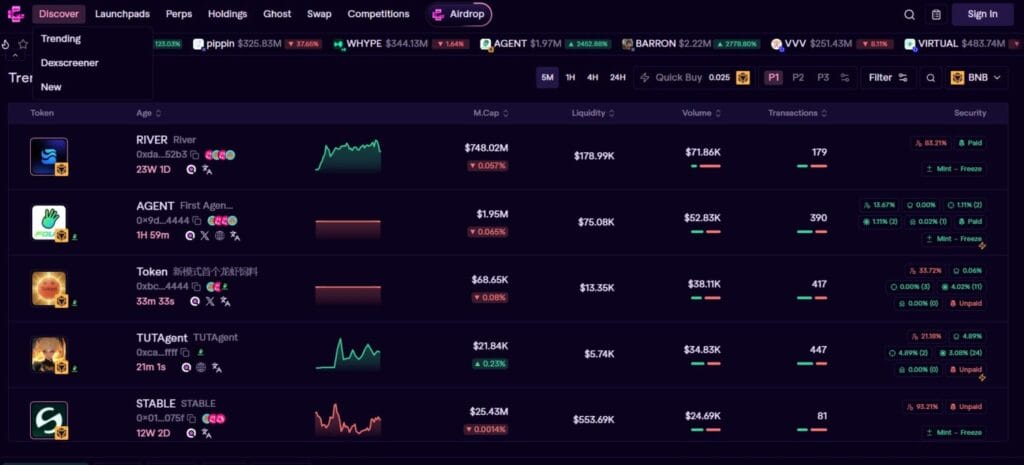
- Spot markets are grouped into views like Memes and Majors, so users can trade trending tokens and core assets across supported networks without navigating each chain as a separate ecosystem.
- Launchpads integrations surface active and upcoming pre-launch tokens from chain-specific sources, letting users browse, track, and trade new listings as soon as they become available, inside one workflow.
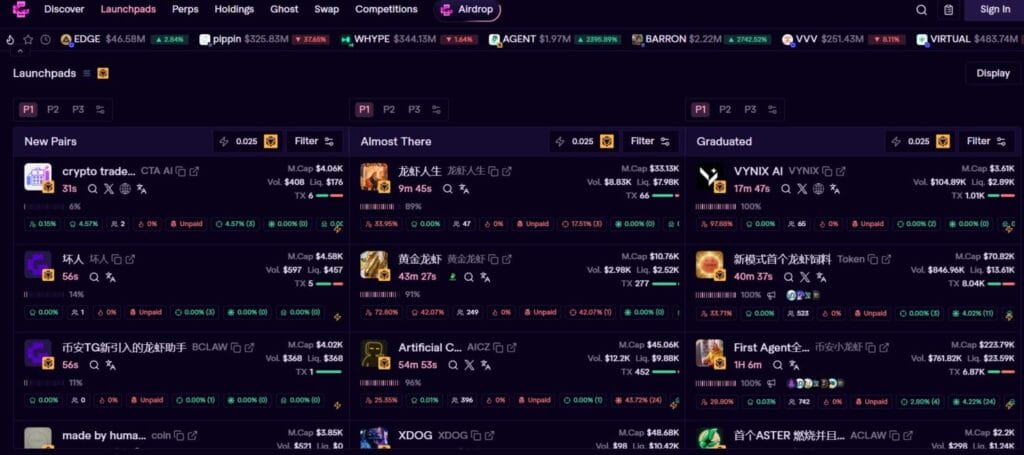
- Asset pages are data-heavy, showing live market metrics like price, volume, market cap, liquidity, and holder counts, plus verification indicators and interval controls to monitor changes without switching tools.
- The terminal includes a security panel that displays an audit-style score and flags checks like sellability, tax behavior, holder concentration, and contract details, with clear warnings that results are informational.
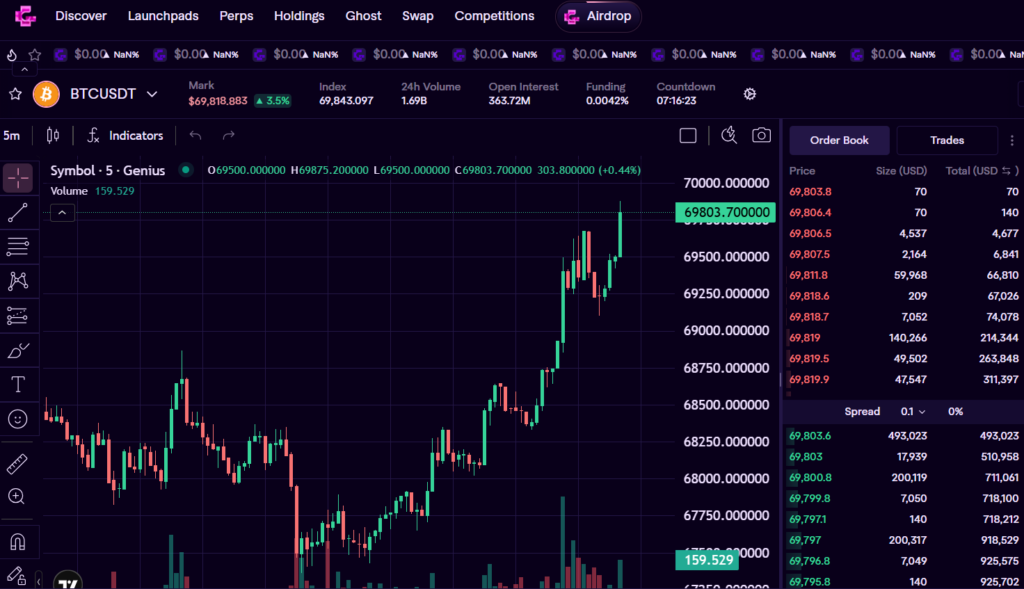
- TradingView charting is embedded directly, allowing advanced technical analysis using native indicators and drawing tools, so traders can analyze structure and execute immediately without leaving the terminal.
- Holder and trader intelligence panels support whale watching, showing top holders, concentration visuals, and trader activity with realized and unrealized PnL style views, helping users interpret behavior, not just price.
- Execution is designed for speed and control, offering market and limit orders with slippage and gas settings, plus built-in take profit and stop loss fields and presets for reusable configurations.
- Routing is explicitly exposed, letting users choose between Fast Direct swaps for latency and Aggregator swaps for better pricing, and enabling advanced control over which liquidity sources and venues are used.
- Cross-chain swaps and bridging are integrated into the same interface via a bridge protocol that abstracts multi-hop routing and settlement, aiming to make cross-chain movement feel like a single trade step.
- Perpetual markets are integrated through Hyperliquid, giving users access to deep order book liquidity inside the terminal, including live order book, trades feed, funding rates, open interest, and position management.
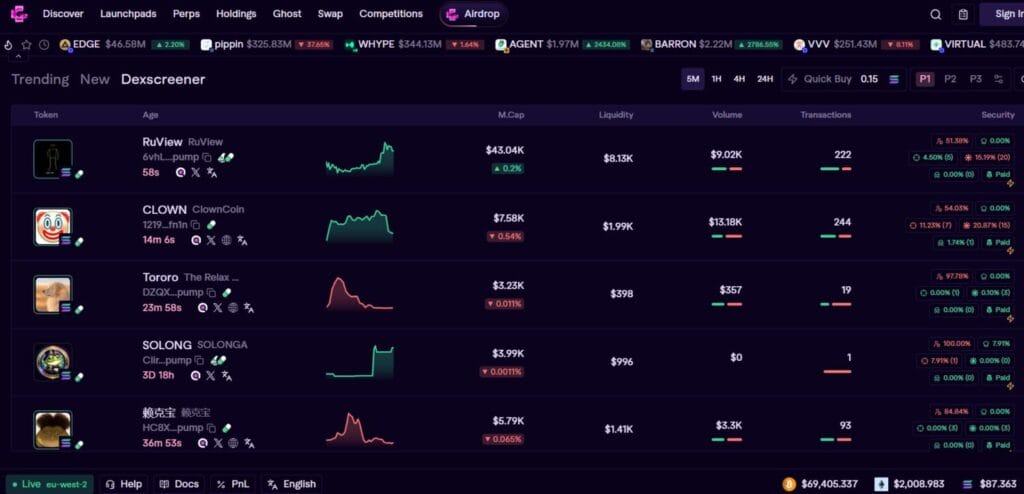
Table: Beginner-friendly product map
| What you want to do | Where in the terminal | What it feels like |
| Buy or sell tokens | Spot, Memes, Majors | One dashboard across chains, less context switching |
| Trade early listings | Launchpads | Discover and trade quickly as markets go live |
| Choose speed vs price | Fast vs Aggregator swaps | Pick speed-first or price-first execution intentionally |
| Move assets cross-chain | Cross-chain swap and bridge | Bridge without leaving the trading workflow |
| Trade perpetuals | Perps via Hyperliquid | Full perp workflow without changing platforms |
Genius Terminal Review: Fees
- Spot fees are volume-tiered, meaning higher trading volume can unlock higher cashback and reduce the net effective fee, rather than all users paying the same effective cost forever.
- Stable-to-stable swaps and stable-to-native swaps have a fixed 0.05% fee regardless of volume tier, and these categories do not receive fee kickbacks, even when other spot activity does.
- These stable-related transactions still earn points at a reduced multiplier, which matters if your usage is influenced by terminal rewards, rank systems, or engagement-driven perks.
- Perpetuals fees are determined by the underlying perp venue tiers, specifically your Hyperliquid and Aster tiers, so Genius acts as the execution terminal while core fee economics follow venue rules.
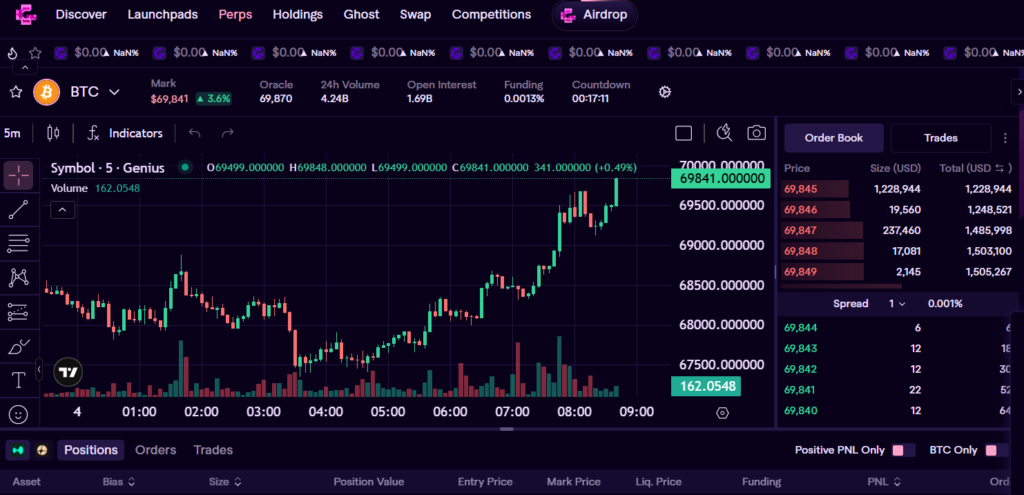
Table: Fast swaps vs Aggregator swaps
| Execution path | What it optimizes | Best for | Trade-off |
| Fast (Direct) swaps | Lowest latency, fastest submission | Snipes, volatile launches, thin markets, speed-first entries | Often worse pricing and higher price impact |
| Aggregator swaps | Better routing and output | Larger size, price-sensitive trades, calmer markets | Higher latency due to route computation |
Genius Terminal Review: Mobile app
- Genius is designed as a terminal-first product, so the best experience is typically on desktop where you can keep multiple panels visible, including charts, holders, routing controls, and order management.
- On mobile, it is more suited to monitoring positions, checking token pages, and managing basic actions, because the terminal’s edge comes from multi-surface visibility that is harder to use on small screens.
Genius Terminal Review: Security
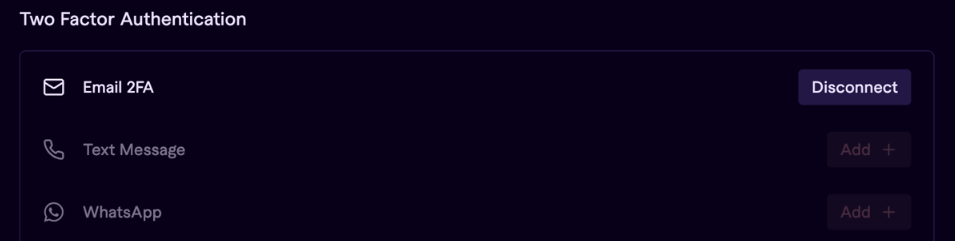
- Genius aims to reduce user-hostile DeFi behavior like repeated approvals, chain switching, and signature popups, but users still carry execution risk and must manage slippage, routing choices, and leverage responsibly.
- Token security scoring and checks can help flag obvious issues, but they are informational, so users should still validate contracts, liquidity conditions, and concentration risk before sizing into volatile assets.
- Cross-chain flows add a unique risk surface because routing depends on bridge and swap endpoints, so conservative sizing and careful review of expected output is important when moving value across networks.
Genius Terminal Review: UI and UX
- The UX thesis is chain-invisible execution, meaning the platform tries to feel like one trading environment where networks are abstracted and traders focus on markets, speed, and positioning.
- The UI is designed like an execution cockpit, with token header metrics, embedded TradingView tools, trader and holder intel panels, and one-click style order panels with TP and SL controls.
- A key pro feature is that routing is not treated as a black box, since users can choose speed-first or price-first behavior and control liquidity sources, which is rare in most terminals.
Genius Terminal Review: Conclusion
Genius Terminal is built for traders who want onchain access without onchain workflow friction. The strongest differentiator is execution control: fast direct swaps when speed matters, aggregator routing when pricing matters, and explicit visibility into how trades are routed instead of forcing a black-box decision. The product also blends discovery with execution through memes, majors, and pre-launch integrations, and adds trading intelligence using holder and trader panels that support behavior-based reads. The perps integration through Hyperliquid adds serious depth for derivatives traders, keeping positions, funding, and order books inside the same environment. The key caution is that abstraction does not remove risk, so slippage discipline, sizing, and bridge awareness remain mandatory.
Is Genius Terminal a DEX or an aggregator?
It is closer to a terminal layer. It connects to underlying liquidity sources, bridges, and perp venues, and presents them through one execution UI with routing controls and portfolio views.

What does “chain-invisible” mean here?
It means the terminal tries to hide chain complexity so users do not constantly switch networks, manage approvals repeatedly, or deal with chain-specific UI friction for basic trading actions.
What does “signatureless” actually mean for users?
It refers to reducing repeated wallet popups and approval steps in the workflow. You still take actions, but the experience is designed to feel closer to a single terminal flow.