Probable Markets is an on-chain prediction trading platform on BNB Chain where users buy and sell YES/NO outcome shares on real-world and crypto events. It uses an orderbook model, supports market and limit orders, and focuses on a low-friction trading experience with USDT-based funding and gas-sponsored trades. which is exactly what we examine in this Probable Markets Review.
Table of Contents
What is Probable Markets?
Probable is explicitly built around an orderbook model—it “matches traders with opposing views via orderbook liquidity,” positioning the platform closer to an exchange UX than an AMM swap experience.
That matters because prediction markets live or die on:
- price discovery (do prices move cleanly with information?)
- liquidity (can you enter/exit without huge slippage?)
- credible resolution (do users trust the settlement?)
How Probable Markets Work?
- Probable is an on-chain prediction market on BNB Chain where users trade on future event outcomes (crypto, sports, politics, etc.) using USDT.
- Each market is usually a YES/NO question (some can be multi-outcome), such as “Will X happen by Y date?”
- Outcomes are traded as shares priced between $0.01 and $0.99, and the price reflects the market’s implied probability (for example, $0.65 = ~65% chance).
- Winning shares settle at $1, losing shares settle at $0 once the event resolves. That is how profit/loss is determined.
- You can trade before settlement. You do not need to wait for the final result. You can buy early and sell later if prices move in your favor.
- Probable uses an orderbook model, so it matches traders with opposite views (instead of using only AMM-style pricing).
- It supports both Market and Limit orders:
- Market order: executes immediately at the best available price.
- Limit order: lets you set your preferred price and wait for a match.
- Funding is USDT-based, and users fund a proxy wallet. Probable also supports converting supported assets into USDT through its deposit flow.
- Trading is gas-less for users, but users still pay gas for deposits and withdrawals.
- Merge & Split feature helps with liquidity and position management:
- Split: USDT → YES + NO shares (1:1)
- Merge: YES + NO shares → USDT (1:1)
- Both occur outside the order book and are listed as no-fee actions.
- Market resolution is handled using the UMA oracle. After the outcome is confirmed, trading stops and the result is recorded on-chain.
- Users must manually claim winnings after resolution by clicking the Claim button, which triggers redemption into USDT.
- Fees follow a maker-taker model:
- Makers trade for free
- Only takers pay fees
- Taker fees vary by probability level and are highest around 50% probability.
Also, you may read Top 10 Prediction Trading Terminals
Probable Markets Review: Key Features
- Wide range of prediction markets: Probable offers markets across sports, politics, finance, crypto, and other future events, giving it broader appeal than a niche-only prediction platform.
- On-chain trading and settlement on BNB Chain: Probable is built on BNB Chain, and the platform positions itself around transparent, verifiable on-chain trades and outcomes. This improves trust and auditability compared with closed systems.
- Simple YES/NO share structure: Each outcome is represented by shares priced between $0 and $1, which makes the interface intuitive. Prices function like implied probabilities, and settlement is straightforward.
- Probability-based pricing model: As shares trade in the $0–$1 range, users can read market sentiment quickly. For example, a share trading near $0.70 implies the market is pricing roughly a 70% chance.
- USDT-based trading flow: Probable uses USDT as the trading collateral, which keeps the user experience more stable and familiar than using a volatile base token for every position.
- Orderbook-style trading experience: Probable is built as a decentralized prediction market with a trading-first feel (instead of a pure AMM flow), which is useful for users who prefer exchange-like execution and price discovery.
- Fast, low-cost chain environment: By using BNB Chain, Probable benefits from faster confirmations and lower transaction costs at the chain level, which is important for active trading.
- Market suggestion/community-driven expansion: The docs mention users can suggest new markets, which helps the platform expand into trending topics without being limited to a fixed catalog.
Probable Markets Review: Security Features
- On-chain settlement (BNB Chain): Trades and payouts are recorded on-chain for transparency.
- UMA oracle resolution: Market outcomes are resolved through UMA, with a dispute process for contested results.
- Smart contract payouts: Winning shares are redeemed through smart contracts, not manual payouts.
- Wallet-based login: Users connect a crypto wallet instead of using a username/password account.
- Proxy wallet setup: Probable uses a separate proxy wallet for trading activity.
- Temporary deposit addresses: Deposit addresses can change, so users must copy the latest one each time.
- Deposit recovery tool: Probable offers a recovery flow for some mistaken deposits (with limits).
- Restricted jurisdictions policy: Access is blocked in certain regions as part of compliance controls.
Also, you may read Top 10 Polymarket Trading Terminals
Probable Markets Review: Fee Structure
Fees
- Makers pay 0 fees. Only takers are charged.
- Taker fees range from 0.01% to 1.75%, depending on the market price.
- Fees are highest around 50% probability (maximum uncertainty/activity).
- Fees get lower near 0% or 100% probability.
Price Curve
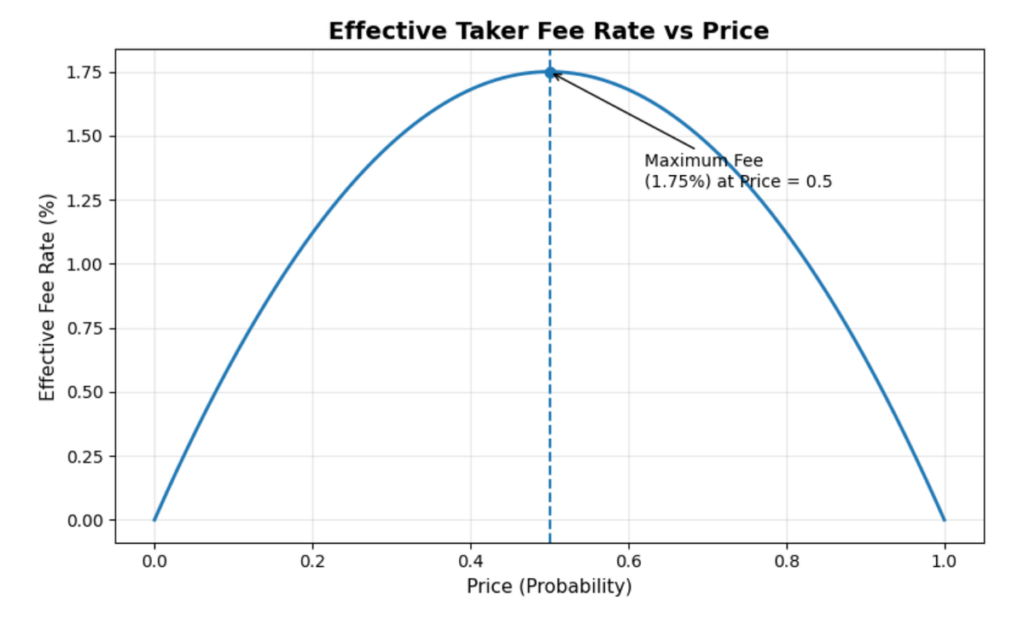
- Trades near the edges (close to 0% or 100%) have lower fees because those outcomes are priced with less uncertainty.
- Trades around the midpoint (about 50%) have higher fees since that is where uncertainty and trading activity are usually highest.
Settlement and gas
- Fees are charged in the settlement asset (like USDT) or the market’s CTF token.
- Probable says it covers gas costs for trade execution and settlement.
Conclusion
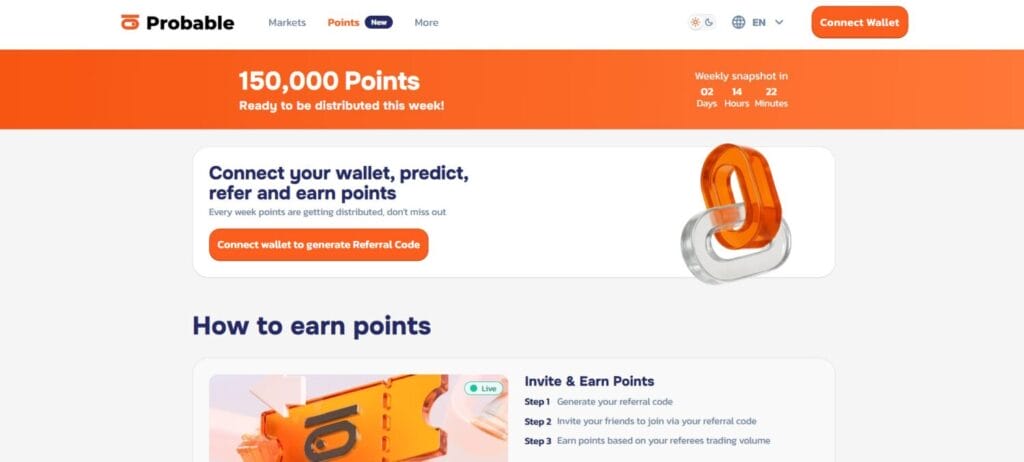
Probable Markets is a well-designed on-chain prediction trading platform that combines an orderbook experience, gas-sponsored trading, and liquidity-friendly tools like limit orders and Merge/Split. Its business model is centered on taker fees, while points and referrals are used to bootstrap liquidity and user growth. The biggest strengths are usability and trading-focused mechanics, while the main constraints are restricted jurisdictions and long-term fee sustainability.

Frequently Asked Questions (FAQs)
What happens when a market resolves?
Winning shares can be claimed for $1 each, and losing shares become worthless.
Does Probable support limit orders?
Yes. Probable supports both market orders and limit orders through an orderbook model.
What token is used for trading on Probable?
Probable uses USDT as the main collateral for trading.
What is Merge and Split on Probable?
It is a feature that lets users convert USDT into YES+NO shares (Split) and convert matched YES/NO shares back into USDT (Merge).