Published: March 6, 2026 · Coincodecap · 6 min read
Solana is sitting at roughly $87. Its all-time high was $294. The gap between those two numbers tells you most of what you need to know about where we are in this cycle — and why this asset has the attention of analysts, institutional buyers, and longer-term investors right now despite everything that’s gone sideways in the last three months.
This is not a straightforward story. SOL has dropped over 70% from its January 2025 peak. The memecoin economy that powered its late-2024 rise has cooled hard. Exchange inflows are spiking, DEX volumes are down, and the technical chart has a confirmed head-and-shoulders breakdown pointing toward $59 as a target. None of that is comfortable to write.
But the same asset added 11,500 developers in 2025, is processing more daily transactions than any chain except Ethereum, has two major spot ETFs above $1B AUM, and is shipping its most significant technical upgrade in years. Solana has been declared dead before. It tends to make that look foolish.
Here is what the data actually says about where SOL goes from here.

Table of Contents
Solana Live Price Metrics — March 6, 2026
| Metric | Value (Mar 6, 2026) |
| Live Price | $84–$90 USD |
| Market Cap | ~$49.3B (Rank #7) |
| 24H Trading Volume | $2.7B – $9.8B USD |
| Circulating Supply | 569.77M SOL (no hard cap) |
| All-Time High | $294.85 (January 19, 2025) |
| Current vs ATH | Down ~70.6% |
| Key Support | $80 / $59 (technical target) |
| Key Resistance | $96 → $116 (recovery gates) |
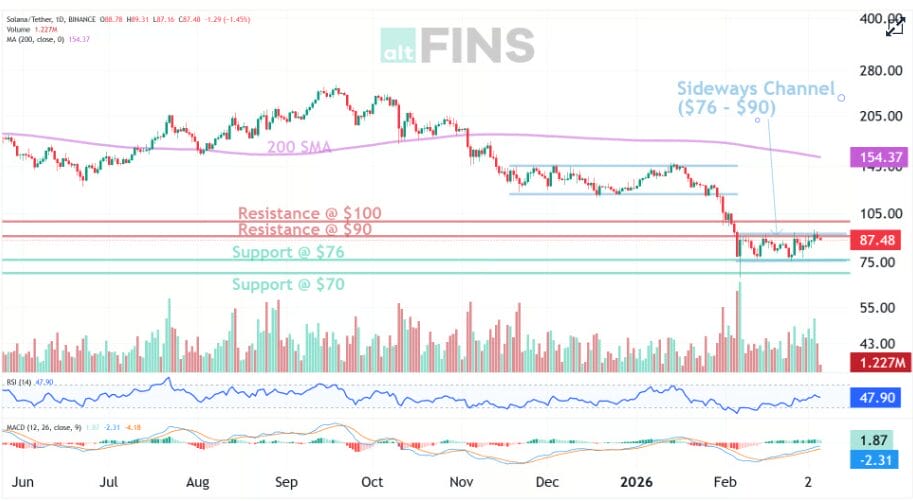
Price is in a Downtrend. It’s consolidating in a range ($76 – $90). If it breaks above $90 resistance, that could signal a bullish trend reversal. However, it is most likely to break in the existing direction of downtrend, below $76 support, and resume its Downtrend.
What’s Driving the Dip — The Honest Read
There is no mystery to SOL’s decline, and anyone framing it as purely macro-driven is missing the story. The memecoin machine broke. In late 2024 and early 2025, Pump.fun and its ecosystem were generating extraordinary fee revenue and token demand on Solana — real, measurable network activity. That cycle ended. DEX volumes on Solana peaked at $118.2 billion in early February 2026 and have since collapsed. When the speculative engine turns off, the native gas token reprices.
On top of that, the FTX estate holds tens of millions of SOL acquired at distressed prices. Each scheduled unlock creates a predictable wall of selling pressure. Markets know it’s coming, they price it in early, and the downside happens ahead of the event rather than after. This has triggered multiple double-digit corrections since 2024 and continues to be a structural overhang.
The technical picture makes this concrete. The 3-day chart confirmed a head-and-shoulders breakdown in late January after the $107 neckline gave way. The measured move from that pattern places the downside target at $59 — a number that analysts at BeinCrypto and Changelly have both called as the ‘full pattern fulfillment’ level. At the time of writing, SOL sits around $87. The pattern is only partially fulfilled.
The critical line to watch is $80. Above it, the bulls can argue the measured move failed. Below it, $59–64 becomes the base-case technical target — and that scenario deserves to be taken seriously.
Why the Long-Term Case Is Still Intact
The Alpenglow Upgrade
Solana’s most ambitious technical overhaul — SIMD-0326, called Alpenglow — is targeting sub-150-millisecond transaction finality, down from the current ~12 seconds. That is not a marginal improvement. That is a different class of performance. If Alpenglow ships to mainnet in Q1–Q2 2026 as planned, Solana stops being positioned as a ‘fast enough’ chain and starts being positioned as the infrastructure layer for real-time financial applications. The narrative shift that could follow would be significant — and fast.
ETF Adoption Is Structurally Real
Bitwise’s BSOL and Fidelity’s FSOL both crossed $1B AUM. On February 25 alone, Solana ETFs recorded their highest single-day inflows in two and a half months at $30.86M. Morgan Stanley has filed for a Solana Trust. This is not speculation — it is capital moving through regulated structures into SOL. When Bitcoin ETFs crossed the same milestones, the price spent the following six months higher. Correlation is not causation, but the institutional framework is now in place.
Developer Activity and On-Chain Reality
Solana added over 11,500 new developers in 2025 — second only to Ethereum. It is processing approximately 108.8 million daily transactions, leading all major blockchains by that metric. DePIN projects, tokenization of real-world assets, and enterprise-grade applications are building on Solana right now, not just memecoins. When the speculative layer reprices, the underlying infrastructure keeps compounding — and that compounds into future price action.
Institutional Treasury Buying
- Forward Industries (NASDAQ: FORD) holds 6.9 million SOL (~$600M at current prices) and operates its own validator node.
- Whale accumulation data shows large holders buying during dips, even as retail exits. This is the same pattern seen in Bitcoin’s 2022 bottom cycle before the 2023–2025 recovery.
Solana Price Predictions by Timeframe
Short-Term: March–June 2026
The most pressing question is whether $80 holds. If it does, the March–April window targets a gradual climb toward $95–$105, provided the broader crypto market stabilizes and Alpenglow delivers on its deployment timeline. CoinDCX forecasts SOL reaching $95–$100 by end of March under this scenario. CoinCodex puts the April target at $105–$110 if momentum holds. If $80 breaks before then, $59–$64 comes into play as the base case — and that level would represent one of the best risk-reward entries SOL has offered since 2023.
Mid-Term: H2 2026
InvestingHaven’s model calls for SOL to hit $300 by summer 2026 under a bullish scenario — a figure that requires the broader crypto market to turn, Alpenglow to ship, and ETF inflows to accelerate. Cryptopolitan’s more conservative model puts the H2 2026 high between $125 and $148. Bitpanda’s analysis sits in the middle at an average of $149–$169. The wide dispersion in these numbers is honest: it reflects genuine uncertainty. What most models agree on is that if the $80 floor holds, SOL does not stay in the $85–$95 range for long — one direction or the other comes quickly.
Long-Term: 2027–2030
The long-range models are where the numbers get interesting. By 2030, projections range from a conservative $342 (Cryptopolitan) to $1,200 (InvestingHaven) depending almost entirely on whether Solana captures a meaningful share of institutional financial infrastructure. The Alpenglow upgrade is the technical precondition. The ETF and regulatory pathway is the institutional one. If both materialize, $500–$700 by 2028–2030 is a credible range across the mid-case models. If Solana’s regulatory status gets clarity (the SEC has previously flagged SOL as a potential unregistered security, which has restricted institutional participation), the ceiling lifts considerably.
Risks That Could Break the Thesis
- FTX estate unlocks continue to create scheduled selling pressure. Predictable but persistent.
- $80 support fails. Below that, the head-and-shoulders pattern targets $59 — a ~30% further decline from current levels.
- Alpenglow delayed or underdelivers. A hyped upgrade that ships late or breaks things would reprice the narrative badly.
- Regulatory risk: SEC classification of SOL as a security would derail ETF approval pipelines and restrict institutional participation just as it’s scaling.
- Macro tightening. If rate hikes return or liquidity contracts further, high-beta assets like SOL feel it hardest and fastest.
Bottom Line
Solana at $87 is not the same as Solana at $294. But it is also not Solana at $9 — the price it hit after the FTX collapse before recovering 3,000%. The current dip is real, the structural risks are real, and the $59 technical target is real.
What is also real: the developer base, the ETF infrastructure, the institutional treasury buying, and an upgrade that could redefine the performance ceiling of the chain. Every meaningful Solana correction in the last three years has eventually been absorbed by the fundamental case strengthening underneath it.
The $80 line tells you which story plays out next. Hold it, and the recovery timeline begins. Lose it, and patient buyers get an even better entry. Either way, Solana’s 2026 chapter is not finished being written.
For on-demand analysis of any cryptocurrency, join our Telegram channel.