Affiliate Disclosure: This post contains affiliate links. If you sign up through them, CoinCodeCap may earn a commission at no extra cost to you. Read the full disclosure.
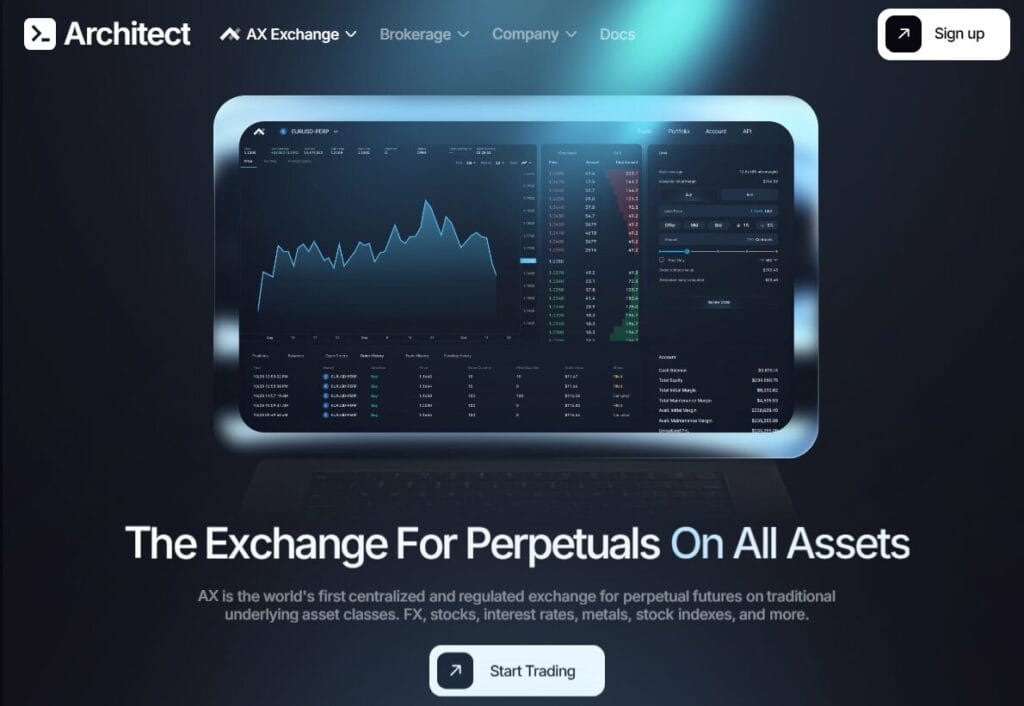
This Architect Exchange Review covers AX, the world’s first centralized and regulated exchange for perpetual futures on traditional underlying asset classes — FX, stocks, interest rates, metals, and stock indexes. In this article, we will explore Architect Exchange Review.
What is Architect Exchange?
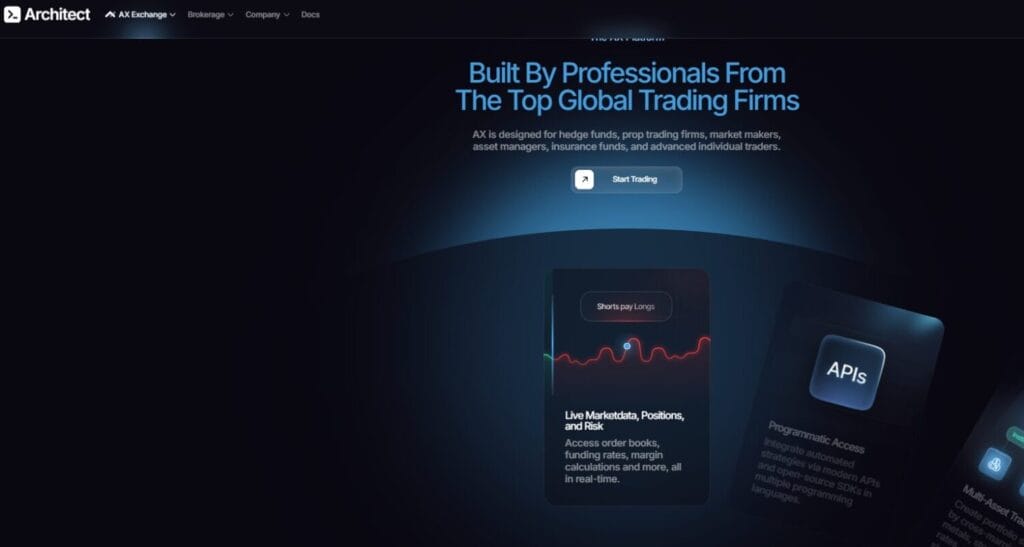
Architect.co which operates AX — the world’s first regulated exchange for perpetual futures on traditional assets. The platform lets users trade perpetual contracts on FX, gold, silver, stocks, and more, all on a single regulated venue. Perpetuals never expire, so traders can hold exposure without the cost, complexity, and contango of rolling traditional futures. AX is licensed under the Bermuda Monetary Authority and is backed by Connamara Technologies, providing a matching engine, real-time margin calculations, and integrated clearing. It targets hedge funds, prop firms, market makers, asset managers, and advanced individual traders, with API and SDK accounts.
Architect Exchange Review: Features and Products
AX takes a familiar crypto-perp design — a 24/7 order book with funding payments — and applies it to traditional asset classes that have historically required dated futures contracts and broker relationships. The documentation is unusually transparent about plumbing.
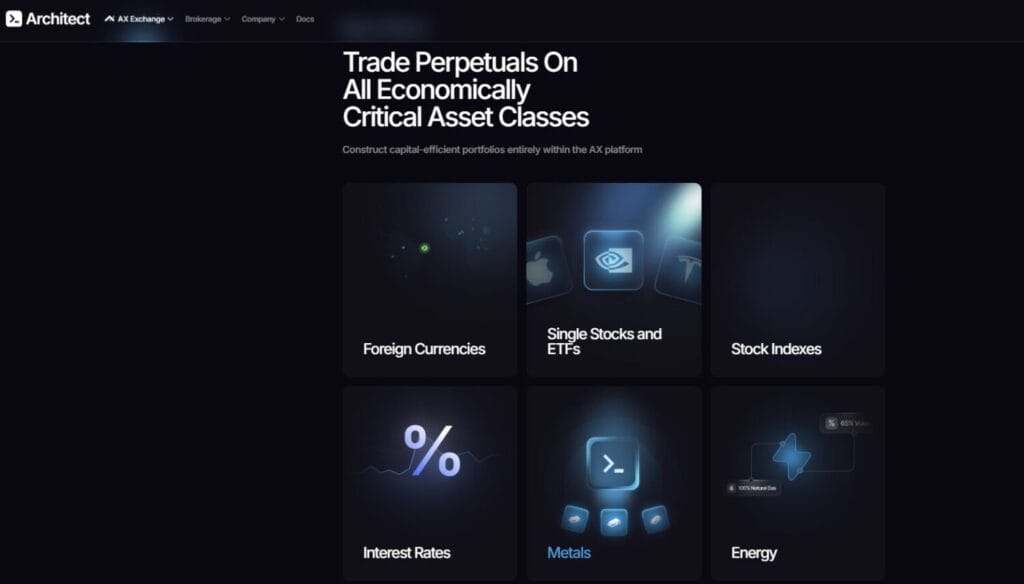
- Perpetual futures on traditional assets. AX lists perpetual contracts on FX, stocks, interest rates, metals, and stock indexes. Contracts have no expiration date and trade 24/7, with funding payments keeping them aligned with the underlying benchmark.
- Order book with price-time priority. Better prices match first; for the same price, earlier orders match before later orders.
- Dutch Auction opens. When a symbol transitions from PRE-OPEN to OPEN, a Dutch Auction determines a single opening price. Symbol states are SUSPENDED, PRE-OPEN, and OPEN.
- Real-time mark-to-market. Positions are marked to market in real time, so collateral updates as prices move.
- Daily funding payments. Funding is calculated from a Mark Price (a VWAP over a specific window such as 3:45–4:00 PM London time, derived from public orderbook data) versus an Underlying Price sourced from independent benchmark providers including LSEG, S&P, ICE, and NASDAQ. If Mark > Underlying, longs pay shorts; if the reverse, shorts pay longs. A Funding Rate Cap limits the maximum payment per cycle.
- USD-denominated everything. All contracts, balances, and funding payments are USD, regardless of how a customer deposits.
- Stablecoin and USD wire deposits. Customers can fund accounts via USD wire or major stablecoins such as USDC on Ethereum.
- Per-product Initial and Maintenance Margin. Each product publishes its own margin levels, with maximum leverage equal to 1 / Maintenance Margin Percent on positions and 1 / Initial Margin Percent on open orders.
- Price Bands. Orders are only accepted within a published percentage band above and below the previous settlement price, resetting at each settlement — a structural protection against fat-finger and runaway-order risk.
- Sandbox environment. A dedicated sandbox at sandbox.architect.exchange lets institutions test integrations before going live.
- API and developer surface. The docs include an API Reference, a Changelog, and an llms.txt index designed to be machine-readable
Architect Exchange Review: Pricing
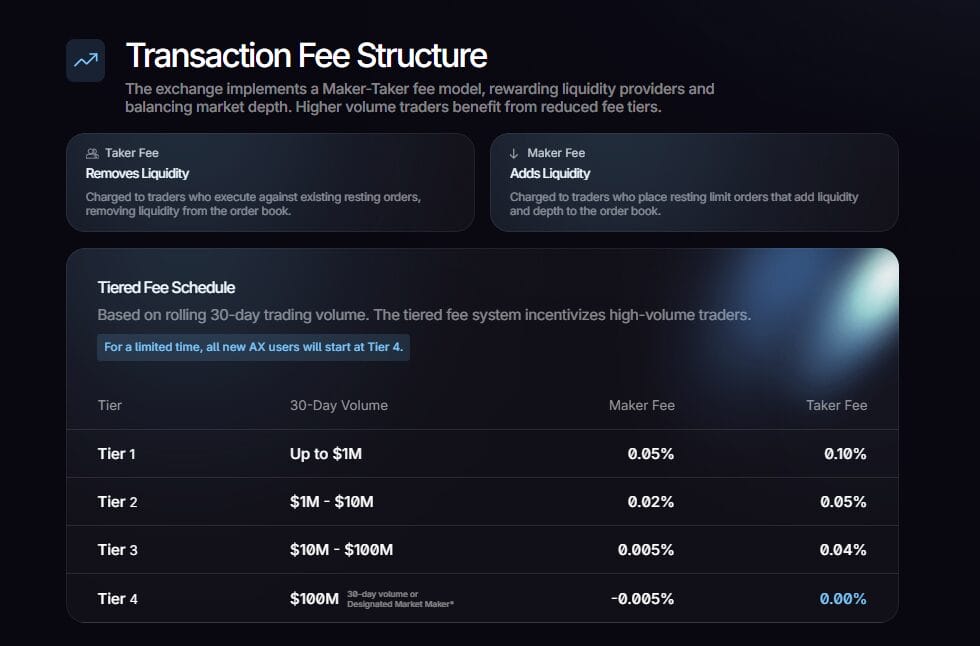
| Fee component | What the docs document | Notes |
| Taker Fee | Charged for removing liquidity (crossing the book) | Maker-Taker model |
| Maker Fee | Charged for providing resting liquidity | Maker-Taker model |
| Volume-based tiers | Tiered fee system that rewards high-volume traders | Specific tier breakpoints in the Pricing Policy |
| Funding payments | Credited or debited in USD per the Mark vs Underlying mechanism | Capped per cycle by the per-product Funding Rate Cap |
In other words, AX uses the same maker-taker plus volume-tier blueprint as most institutional derivatives venues. Traders evaluating economics in detail should read the linked Pricing Policy for live numbers.

Architect Exchange Review: Mobile App
There is no dedicated native iOS or Android application. The platform is structured around two endpoints called out in the docs: the production exchange and the sandbox at sandbox.architect.exchange, both web-based, plus an API surface for programmatic access. Mobile traders effectively reach AX through a phone browser or by routing through their own broker’s front end, since brokers may layer their own interfaces on top of AX. For institutional users this is consistent with how most regulated derivatives venues operate — execution typically goes through OMS/EMS systems and APIs rather than retail-style mobile apps.
Architect Exchange Review: Security and Regulation
This is where AX differentiates most clearly from offshore perp venues, and the docs are precise about it.
- Operating entity. AX is operated by Architect Bermuda Ltd, a Bermuda exempted company, which is a wholly-owned subsidiary of Architect Financial Technologies Inc., a Delaware corporation.
- Regulator. AX operates under the oversight of the Bermuda Monetary Authority (BMA).
- Two named licences. Architect Bermuda Ltd holds a Class F Digital Asset Business Licence under the Digital Assets Business Act, 1981 (as amended) from the BMA, and an Investment Business Act Licence under the Investment Business Act, 2003.
- USD custody at partner banks. USD funds are held with partner banks for secure collateral management.
- Stablecoin custody at Anchorage. Stablecoin custody and USD/stablecoin conversions are supported via Anchorage.
- Liquidation safeguards. Liquidations are triggered by automated monitoring for margin breaches combined with human manual review, which the docs frame as a safeguard for consistency and reliability rather than a pure algorithmic kill-switch.
- Independent benchmark sourcing. Underlying prices come from third-party benchmark providers (LSEG, S&P, ICE, NASDAQ), not from AX itself, which reduces venue manipulation risk on the funding leg.
Architect Exchange Review: UI and UX
The trader-facing experience documented in the AX docs is built around a Trade page that exposes a Product Specs tab on every symbol, complete with trading hours in both UTC and local time, current price bands, and funding schedules. Symbol states (SUSPENDED, PRE-OPEN, OPEN) are surfaced clearly, and the Dutch Auction at the open removes the “first-print lottery” common to thinner venues. The developer surface is equally polished: a public API Reference, a changelog, a sandbox endpoint, and a llms.txt index meant to be machine-consumed.
Architect Exchange Review: Typical Users and Use Cases
The platform is explicitly identified for three user archetypes: Speculators expressing price opinions, Hedgers managing exposure and risk, and Market-Makers and Arbitrageurs exploiting short-term inefficiencies. Institutional onboarding is open today via [email protected], while individual accounts are noted as not yet supported but planned for the intermediate future.
Architect Exchange Review: Conclusion
AX positions itself as something genuinely new: a perpetual-futures venue with crypto-style 24/7 trading and funding mechanics, but on FX, equity indexes, metals, and rates, run by a Bermuda-regulated entity rather than an offshore derivatives shop. The docs are unusually transparent about plumbing — Mark Price methodology, Price Bands, Dutch Auction opens, funding examples, named benchmark providers, and named custodians — which is exactly what institutional desks need to underwrite a new venue. The trade-offs are equally clear: institutional onboarding only at launch, no native mobile app, and exact fee numbers that live in a separate Pricing Policy document. For market-makers, hedgers, and quantitative funds looking to trade traditional perpetuals on a regulated venue with USD-denominated contracts and a working sandbox, AX is genuinely worth a serious technical evaluation today.
How are deposits handled?
USD wire transfer or major stablecoins such as USDC on Ethereum. Balances are always credited as USD.
How does funding work?
Daily (or as scheduled, excluding holidays). The Mark Price comes from a VWAP of public orderbook data, the Underlying from third-party benchmarks; the difference drives a USD credit or debit between longs and shorts, capped per cycle.
What can I trade on AX?
Perpetual futures on traditional asset classes including FX, stocks, interest rates, metals, and stock indexes. All contracts are USD-quoted with no expiration date.