Disclosure: CoinCodeCap earns a referral fee if you sign up to Delta Exchange through links here. This page used to argue Delta was simply the best choice for Indian options traders. It is not that simple, and the maths below shows exactly where that claim stops holding.
How we reviewed Delta. Fees come from Delta’s own fee page, the licence details from FIU-IND records, and the tax rules from the Union Budget 2026 and the Income Tax Act 2025. We then priced the same option on Delta and Deribit across a range of premiums to find the point where Delta stops being the cheaper venue. That number is the heart of this review.
TL;DR. Delta Exchange India is FIU-registered, settles in rupees, and caps option fees at 3.5% of premium, the lowest cap in crypto options. That makes it dramatically cheaper than Deribit on small trades: $8.26 against $25.00 on a $200 premium. But 18% GST sits on top, and at $100,000 notional Delta stops being cheaper once the premium passes about $726, after which it costs 18% more.
The $726 Line
Delta charges 0.03% of notional on options, falling to 0.01% at volume, capped at 3.5% of the premium. Then 18% GST goes on the fee. Deribit charges 0.03% capped at 12.5% of premium, with no GST.

On a cheap option Delta’s tighter cap wins easily, because 3.5% of a small premium is a much smaller number than 12.5% of it. As the premium climbs, Delta’s cap stops binding, the flat 0.03% takes over, and the GST is suddenly sitting on a fee that is no longer being discounted. Here is where the two lines cross, priced at $100,000 of notional.
| Premium | Delta (incl. GST) | Deribit | Difference |
|---|---|---|---|
| $50 | $2.06 | $6.25 | Delta 67% cheaper |
| $200 | $8.26 | $25.00 | Delta 67% cheaper |
| $400 | $16.52 | $30.00 | Delta 45% cheaper |
| $726 | $29.98 | $30.00 | Level |
| $1,200 | $35.40 | $30.00 | Deribit 18% cheaper |
| Trade cheap options here. Trade costly ones elsewhere. Check Delta’s live fee card → | |||
Past $726 the gap settles at a flat 18%, which is exactly the GST. That is the whole story: Delta’s cap is the best in the market and India’s tax code takes the advantage back on large premiums.
What Delta Exchange India Actually Is
Delta Exchange India launched in 2024 and is run by Excelium Technologies Pvt Ltd, on India’s FIU register under PMLA, entity VA00041101. That licence is the reason it can offer rupee deposits, rupee margin and rupee settlement while venues abroad cannot.
The products are European-style calls and puts on Bitcoin and Ether, with daily, weekly and monthly expiries, plus futures and spot. Deposits and withdrawals cost nothing.
| Product | Maker | Taker | Notes |
|---|---|---|---|
| Options | 0.03% to 0.01% | 0.03% to 0.01% | Capped at 3.5% of premium |
| Futures, perps | 0.02% | 0.05% | 0.025% taker on the scalper offer |
| Spot | 0% to buy, 0.1% to sell | Free in and out | |
| GST | 18% on trading fees | Applies on top of everything above | |
The Tax Bill Is Bigger Than the Fee Bill
⚠️ India taxes crypto gains at a flat 30% with no offset for losses, plus 1% TDS on each trade and 18% GST on fees. A losing month does not reduce the tax on a winning one. For an active options trader, that structure costs far more than the difference between any two venues’ fee cards, and it applies wherever you trade, not just on Delta.
The Union Budget 2026 left the 30% rate and the 1% TDS alone. It added Section 446 of the Income Tax Act 2025, which fines platforms ₹200 per day for failing to hand over trade statements and ₹50,000 for filing them wrong. That is aimed at exchanges rather than traders, and the practical effect for you is that a licensed Indian venue now has a legal reason to get your statements right.
That is the honest case for Delta over a venue abroad, and it rests on paperwork rather than fees. Your trades arrive in your tax records already squared up, in rupees, from a reporting entity that now faces a penalty for filing them wrong.
How It Compares
| Feature | Delta Exchange India | Deribit | Derive |
|---|---|---|---|
| Premium cap | 3.5%, lowest available | 12.5% | 12.5% |
| Tax on fees | 18% GST | None | None |
| Rupee funding | Yes | No | No |
| Indian licence | FIU-IND, VA00041101 | No | No |
| Book depth | Modest | About 85% of the market | Modest |
| Who holds your coins | Delta does | Coinbase does | You do |
| Assets | BTC and ETH | BTC, ETH, SOL | BTC and ETH |
| Trade Options in Rupees → | |||
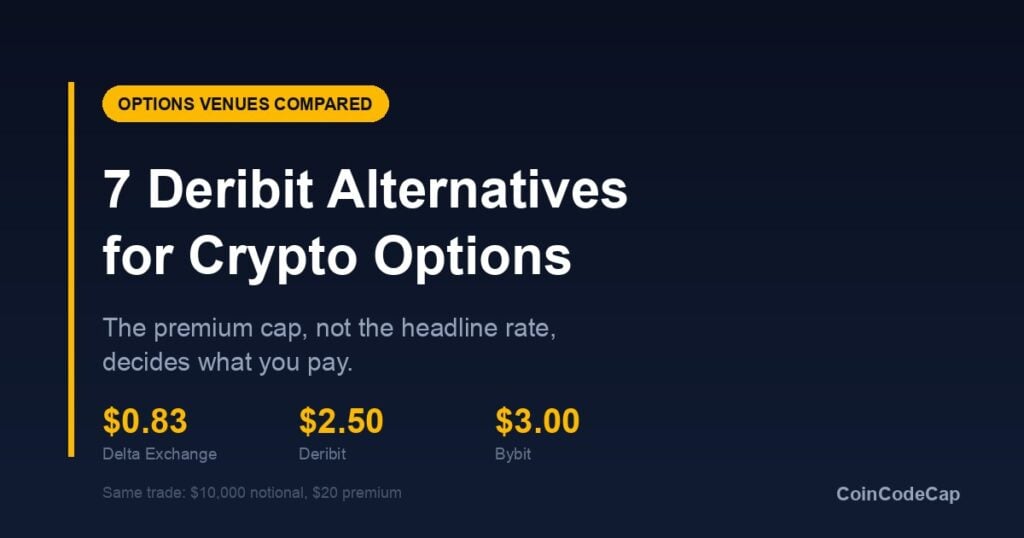
Depth is the trade-off nobody mentions. Deribit runs about 85% of crypto options open interest, and on a large order a thin book costs you more in spread than Delta’s cap saves you in fees. Our seven Deribit alternatives and the live fee calculator across ten venues both cover that.
Pros and Cons
- ✅ The 3.5% premium cap is the lowest in crypto options, by a wide margin
- ✅ FIU-registered, so rupee deposits, margin and settlement all work
- ✅ Deposits and withdrawals cost nothing
- ✅ Tax records arrive already squared up in rupees
- ✅ Spot buys cost nothing
- ❌ 18% GST wipes out the cap advantage above roughly $726 of premium
- ❌ Book depth is modest next to Deribit’s
- ❌ Only Bitcoin and Ether options
- ❌ India’s 30% flat tax with no loss offset hurts active traders badly
- ❌ 0.05% futures taker fee is high unless you qualify for the scalper rate
Expert tip. Work out your median premium before you decide. Weekly far-out contracts usually sit far below the $726 line, so a trader who mostly buys those saves real money here. Anyone buying near-the-money monthly contracts on six figures of notional is above it on most trades and is paying 18% over the odds. The same trader can sensibly use both venues for different parts of their book.
6 Frequently Asked Questions
Is Delta Exchange legal in India?
Yes. Delta Exchange India is operated by Excelium Technologies Pvt Ltd and sits on the FIU register under PMLA, entity VA00041101. That is what allows rupee deposits, margin and settlement.
Is Delta Exchange cheaper than Deribit?
Below about $726 of option premium at $100,000 notional, yes, and by a lot: $8.26 against $25.00 on a $200 premium. Above that line Delta costs 18% more, which is exactly the GST that applies once its 3.5% cap stops binding.
What are Delta Exchange’s fees?
Options are 0.03% of notional falling to 0.01% at volume, capped at 3.5% of the premium. Futures are 0.02% maker and 0.05% taker, with 0.025% taker on the scalper offer. Spot is free to buy and 0.1% to sell. 18% GST applies to all trading fees, and deposits and withdrawals cost nothing.
How is crypto options trading taxed in India?
Gains are taxed at a flat 30% with no offset for losses, there is 1% TDS on each trade, and 18% GST applies to trading fees. The Union Budget 2026 left the 30% and the TDS unchanged. This applies wherever you trade, not only on Delta.
What can I trade on Delta Exchange India?
European-style calls and puts on Bitcoin and Ether with daily, weekly and monthly expiries, plus futures, perpetuals and spot. The options range is narrower than Deribit’s, which also lists Solana.
Is Delta Exchange good for beginners?
The rupee funding and reconciled tax statements remove the two things that usually trip up new Indian traders. The products themselves do not: options can lose the whole premium, and India’s 30% flat tax with no loss offset punishes frequent trading wherever you trade.
Bottom line. Delta Exchange earns its place for Indian options traders, but not for the reason it usually gets recommended. The 3.5% cap is genuinely the best in the market and it makes cheap contracts far cheaper here than anywhere else. Past roughly $726 of premium the GST hands that advantage back, and the book is thinner than Deribit’s the whole way. The strongest argument is the boring one: rupee settlement and tax records that square themselves up, from a licensed entity.
Fees come from Delta Exchange’s own fee page in September 2026 and the table is those rates with the sums done. Tax rules reflect the Union Budget 2026 and the Income Tax Act 2025. Rates and rules change; confirm both before you trade. Nothing here is investment or tax advice.
Related Reading
Compare the venues
- 7 Deribit alternatives (the premium cap priced across seven venues)
- Deribit review (what the Coinbase deal changed)
- Best crypto options platforms (a live fee calculator across ten venues)
- Derive review (the self-custodial option)
Trading from India
- CoinDCX vs Pi42 vs Delta Exchange (the three Indian venues compared)
- Delta Exchange futures trading (lot sizes and the futures product)
- Trading US stocks on margin from India (the same venues, stock tokens)
Wider derivatives
- Best derivatives exchanges (futures and perps compared)
- Perpetual contract exchanges (where to trade perps)
- Bybit review (options and perps on one account)