Disclosure: CoinCodeCap may earn a commission when you sign up through links on this page. That never changes what we publish. API pricing, credit costs and rate limits move fast, and several providers here cut or killed their free tiers during 2026, so check the provider’s own pricing page before committing a project to one.
Picking a crypto API is the kind of decision you only get to make cheaply once. Choose well and prices, balances and on-chain history arrive in one schema. Choose badly and you spend the next year writing adapters, reconciling two sources that disagree about the same token, and discovering that your “free” tier bills credits instead of requests.
So we did the thing none of the pages currently ranking for best crypto API for developers bothered to do. We called them. Bitquery came out on top, and the rest of this guide shows the working. Every latency number you’ll read below came from 225 timed requests we sent ourselves, not from a vendor’s marketing page. We also read the changelogs, and found that two of the APIs most commonly recommended in 2026 round-ups have quietly changed the rules underneath their users.
How we tested this
We sent 25 sequential requests to each provider’s cheapest public endpoint and recorded full wall-clock response time, including DNS and TLS setup. Requests came from a consumer broadband connection in India on 12 September 2026, spaced roughly 120 ms apart, cache headers disabled. Every figure below is a median (p50) and 95th percentile (p95) from that run. Pricing, credit costs and rate limits were read off each provider’s own docs and changelog the same day, never from a comparison site. Where a number is the vendor’s own claim rather than something we could measure, we say so in the sentence.

This is a single-region test on a consumer line, so read it as a floor for what your users in South Asia will feel rather than a datacentre benchmark. Providers behind an API key could only be measured to their authentication edge, which says something about their network and nothing about their query engine. Those rows are labelled.
TL;DR — the short version
- Best overall, and the one most teams should start with: Bitquery. 40+ chains indexed, 30+ data products on one GraphQL schema, and you write a single query where an RPC provider would have you build an indexer. Binance, Chainalysis and Nansen buy their on-chain data here.
- Adding swaps to an app: ChangeNOW. It’s an execution API, not a data API, and it’s free to integrate on a revenue share.
- Wallet balances, DeFi positions and portfolio maths: CoinStats API. Pass an address, get normalised holdings back across 120+ chains, plus an MCP server if an AI agent is doing the asking.
- Just prices, no budget, no signup: CoinPaprika answered fastest of everything we timed and still needs no API key.
- Two things changed in 2026 that break older guides: CoinDesk retired the CryptoCompare free tier on 21 May, so every keyless
min-apisample now returns a 401, and CoinStats cut its own free tier by 98% across two changelog entries.
Pick a Layer Before You Pick a Provider
Most bad API decisions start the same way: someone searches for “crypto API”, gets a list that mixes an RPC node provider with a sentiment feed, and picks whichever one has the nicest docs. Those products don’t compete with each other. They sit at different layers of the stack, and forcing one to do another’s job is where the integration debt comes from.
There are five layers, and you almost certainly need one or two of them, not all five:
- Market data. Prices, market caps, volume, OHLCV candles. Read-only, exchange-sourced. CoinPaprika, CoinDesk Data, CoinMarketCap, CoinAPI.
- RPC nodes. Raw JSON-RPC access to a chain. You get blocks and receipts, and you build everything else yourself. Alchemy, NowNodes, Crypto APIs.
- On-chain indexers. Decoded, queryable blockchain history covering DEX trades, transfers and holder sets. Teams routinely ask an RPC provider to serve this layer, then end up writing the indexer themselves. Bitquery owns this layer, and it’s the layer most crypto products actually need.
- Portfolio and wallet aggregation. Address in, normalised balances and DeFi positions out, already priced. CoinStats is the clearest example.
- Execution. Actually moving funds. Swaps, quotes, order routing. ChangeNOW.
A memecoin launch scanner needs layers one and three. A price ticker needs layer one and nothing else. A trading bot usually needs layers one and five. A tax tool or a portfolio tracker needs layer four, and will burn months rebuilding it from layers two and three if it starts in the wrong place. Work out your layer first, then read the list.
We Timed 225 Requests. Here’s What Came Back
Every crypto API round-up quotes latency. Almost none of them measured it. The numbers repeated across 2026 round-ups (“25 ms”, “sub-100 ms”) are lifted from vendor marketing pages, which quote server-side processing time inside their own datacentre and quietly leave out the network your users actually sit on.
Here’s what nine of these endpoints did when we called each one 25 times from an ordinary broadband line:
| Endpoint tested | p50 | p95 | Key needed? | What we saw |
|---|---|---|---|---|
| CoinPaprika /tickers/btc-bitcoin | 181 ms | 464 ms | No | Fastest median of the run. 25/25 returned 200. |
| DefiLlama /prices/current | 196 ms | 395 ms | No | Tightest spread of anything we tested. |
| DexScreener /dex/tokens | 199 ms | 520 ms | No | Quick for a DEX-wide token lookup. |
| Binance /ticker/price | 337 ms | 571 ms | No | Consistent, but slower than the aggregators from here. |
| Kraken /public/Ticker | 387 ms | 808 ms | No | One request of 25 failed outright. Worst tail in the run. |
| Messari /metrics/v2/assets | 878 ms | 1,249 ms | No | Slowest by a wide margin. Research data, not hot-path data. |
| CoinDesk Data (ex-CryptoCompare) | 187 ms | 355 ms | Yes | Auth edge only. Returns 401 without a key now. |
| CoinStats /coins | 471 ms | 882 ms | Yes | Auth edge only. Not a measure of query speed. |
| CoinAPI /exchangerate | 563 ms | 767 ms | Yes | Auth edge only. |
Read those last three rows carefully. We don’t hold API keys for every provider here, so for the key-gated ones all we can honestly report is how fast their edge rejected us. That tells you something real about their network and CDN, and nothing at all about how fast they run a query. Anyone publishing a full latency league table across gated APIs without disclosing keys is guessing.
The useful takeaway sits in the top half. A keyless aggregator answered a Bitcoin price request in about 180 ms from South Asia, while a research-grade API took nearly a second for a comparable call. If you’re rendering a price on first paint, that gap decides whether your page feels instant. And Kraken dropping one request in 25 is a reminder to write retry logic before you need it.
12 Best Crypto APIs Compared
Free-tier figures change most often, so these were read off each provider’s own docs on 12 September 2026. Three of the twelve turned out to have no standing free plan at all, only a trial or a one-off credit grant. Watch the units: credits, compute units and requests are three different things, and the column headings below say which each provider bills in.
| # | API | Layer | Interface | Free tier | Paid from |
|---|---|---|---|---|---|
| 1 | Bitquery | On-chain indexer | GraphQL, WebSocket, gRPC, Kafka | 7-day trial, 1,000 API points | $39/mo |
| 2 | ChangeNOW | Execution | REST | Free, no call quota | Revenue share from 0.4% |
| 3 | CoinStats API | Portfolio & wallet | REST, MCP, x402 | 20,000 credits/mo, 2 req/s | $49/mo |
| 4 | Alchemy | RPC nodes | JSON-RPC, REST, webhooks | 30M compute units/mo, 25 req/s | $0.525/1M CU |
| 5 | NowNodes | RPC nodes | JSON-RPC, WebSocket, gRPC | 100,000 requests, 1-month trial | €20/mo |
| 6 | CoinAPI | Market data | REST, WebSocket, FIX | $25 metered credits, card required | $79/mo |
| 7 | CoinPaprika | Market data | REST | 20,000 calls/mo, no key, personal use | $99/mo |
| 8 | CoinMarketCap | Market data | REST, WebSocket | 15,000 credits/mo, commercial OK | $29/mo |
| 9 | CoinDesk Data | Market data | REST, WebSocket, FIX | Capped lifetime calls, not renewing | Sales-led |
| 10 | Crypto APIs | Blockchain infra | REST, JSON-RPC, webhooks | 100,000 credits/mo, AML locked | $49/mo |
| 11 | Messari | Research | REST, WebSocket | Free key, 200 req/min | $4,500/yr |
| 12 | LunarCrush | Social & sentiment | REST, MCP | Market data only, 4 req/min | $90/mo |
| Start free with the CoinStats API → | |||||
Look twice at the CoinDesk Data and CoinStats rows. CoinDesk Data is the API formerly known as CryptoCompare, and its free tier stopped existing in May 2026, which quietly invalidates a lot of tutorials. CoinStats bills credits rather than requests, and a single DeFi position read costs 400 of them, so that 20,000 is nowhere near 20,000 calls. Both are covered further down.
1. Bitquery: The Best Crypto API Overall for On-Chain and DEX Data
BEST OVERALL
If you only read one entry on this page, read this one. Bitquery answers the questions an RPC node makes you build for yourself. Every swap on a pair last week, every holder of a token, every transfer touching an address, returned by one GraphQL query instead of a loop over eth_getLogs and a decoder you have to keep alive. That’s the on-chain indexer layer, and it’s where most teams land after months of trying to make a node provider do the job.
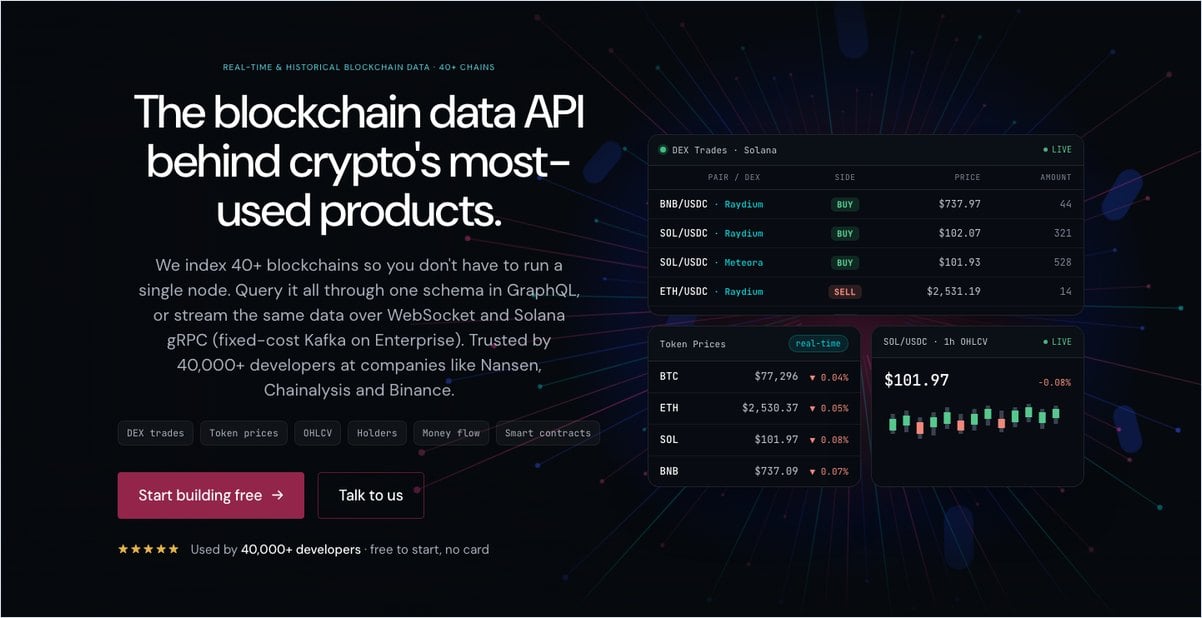
The scale behind it is the part most round-ups skip. Bitquery indexes 40+ blockchains and over a petabyte of chain data, serves more than 10 billion API calls a month, and is used by 40,000+ developers. Its customer list is the tell: Binance, Chainalysis, Nansen, Bybit, 0x, Nexo and TRM all pull from it. When compliance firms and exchanges buy their on-chain data from a vendor rather than indexing it themselves, that vendor is usually worth a look.

One query instead of an indexer
Here is the part no competing round-up will show you, because showing it means admitting how much work the other layers leave on your desk. This is a complete, runnable query for the last ten SOL trades across every Solana DEX, sent to streaming.bitquery.io/graphql with your key in an Authorization: Bearer header:
{
  Solana {
    DEXTradeByTokens(
      limit: {count: 10}
      orderBy: {descending: Block_Time}
      where: {Trade: {Currency: {MintAddress:
        {is: "So11111111111111111111111111111111111111112"}}}}
    ) {
      Block { Time }
      Trade {
        Amount
        PriceInUSD
        Currency { Symbol MintAddress }
        Dex { ProtocolName }
      }
    }
  }
}
Getting the same result from an RPC provider means subscribing to logs on every Solana DEX program, decoding each instruction layout yourself, joining the result against a price feed, and maintaining all of it every time a protocol ships an upgrade. That gap is the whole argument for the indexer layer, and it’s why Bitquery beats Codex and Birdeye on breadth for most teams.
What you can query
- 30+ data products on one schema: DEX trades, token prices, OHLCV, holders, money flow, smart contract calls, NFT activity and trending feeds.
- 9 core chains on self-service plans: Solana, Ethereum, Tron, Base, Arbitrum, Optimism, BSC, Polygon and Robinhood Chain, with 40+ and full history on Enterprise.
- Four delivery modes: GraphQL for queries, WebSocket subscriptions for live data, Solana gRPC streams for low latency, and fixed-cost Kafka topics plus S3 exports on Enterprise.
- An on-chain price index that prices tokens from real DEX liquidity rather than a thin-volume exchange print.
- MCP credits on paid plans, so an AI agent can write and run the queries itself.
Bitquery pricing
Free to start, no card needed. Paid plans run Personal at $39/month billed annually ($49 monthly), Pro at $79, Scale at $239, and Enterprise on a flat platform fee rather than metering, which is unusual and genuinely useful once your volume is unpredictable.
Two details worth checking first: the free allowance is a 7-day trial with 1,000 API points rather than a standing free plan, and the Personal tier does not permit commercial use, so a product ships on Pro at $79. Points aren’t calls either, since 100,000 points works out to roughly 20,000 calls, so price your query mix rather than your request count. History beyond the rolling 30-day trade window is a separate add-on at $70 to $150 a month per chain.
✅ Pros
- One GraphQL schema replaces an indexer you would otherwise build and maintain
- 40+ chains and 1PB+ of indexed history, with 30+ ready-made data products
- GraphQL, WebSocket, Solana gRPC and Kafka all read the same data
- Used in production by Binance, Chainalysis, Nansen, Bybit and 0x
- Flat-fee Enterprise pricing instead of per-call metering
- MCP credits included, so AI agents can query it directly
❌ Cons
- No standing free tier, only a 7-day trial with 1,000 points
- The $39 Personal plan bans commercial use, so real products start at $79
- Self-service covers 9 chains; the other 30+ need Enterprise
- Deep history is a per-chain add-on on top of the plan
- Points-based billing takes a spreadsheet to forecast
Expert tip: run your heaviest real query against the trial before you compare anyone’s pricing. Points are consumed by the shape of the query, not the number of requests, so a wide holder query and a narrow price lookup can differ by two orders of magnitude on the same plan. Ten minutes in the playground tells you which tier you actually need, and it’s the same test that will expose whether a cheaper competitor can return the data at all.
Bitquery also publishes head-to-head cost breakdowns worth reading before you commit: what real-time streaming actually costs, why unlimited streaming changes the maths at scale, and how it compares on Solana gRPC against Helius, QuickNode and Shyft.
2. ChangeNOW: Best for Adding Swaps to Your App
ChangeNOW sits at the execution layer rather than the data layer. Its exchange API lets your product quote and execute a non-custodial swap without you holding funds, registering as a money transmitter, or building liquidity routing. For a wallet, a bot, or a portfolio app that keeps losing users to an external exchange at the moment of purchase, that gap is where the conversions leak.
Wiring it in is free, and you earn a share of every swap instead of paying for calls. That inverts the usual API relationship, and it’s why ChangeNOW sits this high despite doing nothing a data API does. Read our full ChangeNOW review for how the exchange itself behaves.
- 1,500+ assets plus fiat on-ramp options available through a single integration.
- Free to build in, with revenue share on every completed swap rather than a monthly bill.
- Non-custodial flow, so funds never sit with you and the regulatory surface stays small.
- Fixed-rate and floating-rate quotes, which matters when you’re showing a user a number before they commit.
- 110+ blockchains and a 1,800 requests-per-minute ceiling, with no call quota to buy.
There’s a conflict baked into that model. Because you earn per swap, the incentive is to route volume rather than hand users the cheapest rate on every trade. If your product’s pitch is best execution, compare the quote against a DEX aggregator rather than hard-wiring one route. Treat the headline pair count with care as well: ChangeNOW advertises over 2,250,000 exchange pairs, while third-party counts land nearer 50,000.
3. CoinStats API: Best for Wallet, Portfolio and DeFi Data
EDITOR’S PICK — PORTFOLIO LAYER
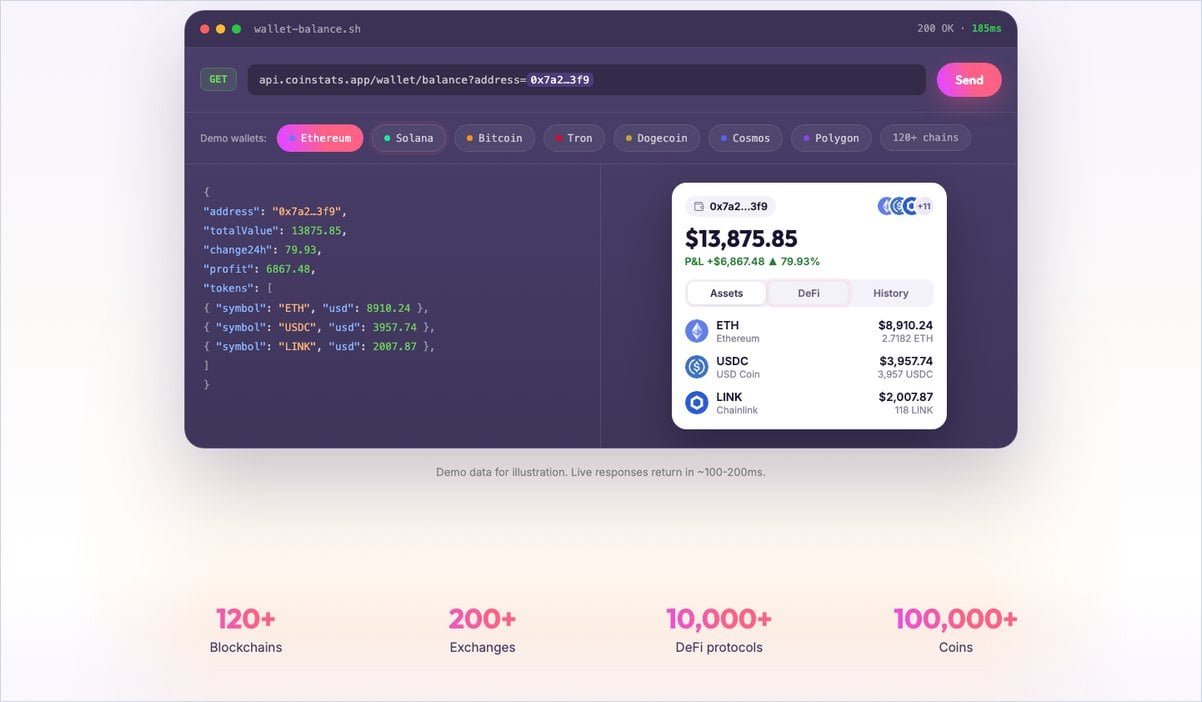
The two APIs above return data about markets and chains. CoinStats returns data about a holder. You pass a wallet address and get back that address’s token balances, transaction history, DeFi positions and profit-and-loss, already priced, already normalised, across 120+ blockchains. Building that yourself means an RPC provider per chain family, a price feed, a protocol decoder for every DeFi position you want to recognise, and a reconciliation layer to make them agree. That’s the job CoinStats is selling you out of.
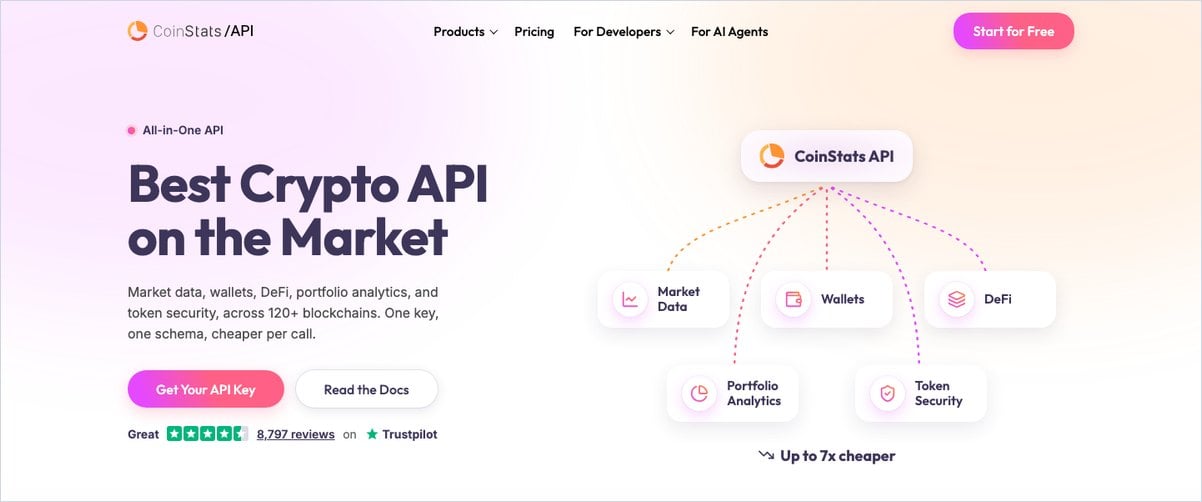
It’s also the only API on this list that writes as well as reads. POST /v1/portfolio/wallet and POST /v1/portfolio/exchange create server-side portfolios that CoinStats then keeps synced for you, which is a different product from a stateless lookup. If you’re building a portfolio tracker or crypto tax software, that distinction matters more than any coin-count claim.
CoinStats shipped an agent surface during 2026, and that’s the part worth attention. It runs a hosted MCP server at mcp.coinstats.app/mcp with OAuth 2.1 and around 20 tools, so a Claude or GPT agent can query crypto data without you writing a wrapper. Alongside it sits an x402 endpoint that takes payment per request in USDC on Base, with no account and no API key at all, starting at $0.001. Whatever you think of agentic payments, no other provider here has shipped it.
What CoinStats actually covers
- 120+ chains for wallet reads, covering tokens and NFTs, including Bitcoin xpub/ypub/zpub with automatic HD derivation, which most competitors skip.
- 10,000+ DeFi protocols auto-detected per address: staking, lending, LP and yield positions resolved without you writing a decoder.
- 200+ exchanges for both ticker data and connected-account portfolio sync.
- 83 endpoints over REST/JSON, with a public OpenAPI 3.0 spec and code samples in curl, Python, JavaScript, PHP, Go and Java.
- Prediction markets covering Polymarket and Kalshi, added June 2026: order books, candles, trader leaderboards and per-trader P&L.
- Token risk scoring through Hexens’ Glider engine, flagging honeypots, mint functions, blacklists and hidden fees.
CoinStats pricing, and the part that catches people
CoinStats bills credits, not requests, and the two are nowhere near the same thing. Every tier gets identical data access; you’re only buying volume and rate limit.
| Plan | Price | Credits / month | Rate limit |
|---|---|---|---|
| Free | $0 | 20,000 | 2 req/sec |
| Starter | $49 | 1,000,000 | 30 req/sec |
| Pro | $199 | 5,000,000 | 30 req/sec |
| Business | $999 | 80,000,000 | 100 req/sec |
| Enterprise | Custom | Custom | Custom |
| Start on the CoinStats free tier → | |||
The per-endpoint costs are where budgets go wrong. A single coin lookup costs 1 credit. A wallet balance costs 40. A DeFi position read costs 400. A token-risk scan costs 5,000, which means the free tier buys you exactly four of them per month. The headline “from $0.05 per 1,000 calls” is true only for the cheapest market-data call, and the expensive endpoints are precisely the ones you came here for.
Budget off a paid tier from day one. CoinStats cut the free plan from 1,000,000 credits to 50,000 in March 2026, then to 20,000 in May, and dropped the rate limit from 5 req/sec to 2. Open-source projects that wired up CoinStats in mid-2026 hit the wall within weeks, and the API signals exhaustion with an HTTP 406 that still consumes a billable call. Handle that response explicitly, because a silent 406 shows up in your UI as a wallet worth zero dollars.
Expert tip: before you write a line of code, price your actual call pattern in credits, not requests. Take your expected daily volume, multiply each endpoint by its published credit cost, and see which tier that lands in. A dashboard refreshing DeFi positions for 500 users once an hour is 4.8 million credits a day, not 12,000 requests. Teams find this out in week three of a build, and it changes which one was cheapest.
Where CoinStats falls short
✅ Pros
- Address in, priced portfolio out, across 120+ chains in one schema
- DeFi positions resolved automatically across 10,000+ protocols
- Bitcoin xpub/ypub/zpub support that most rivals don’t offer
- Hosted MCP server and x402 pay-per-call for AI agents
- Longer free price history than most free tiers allow
- Same data on every plan, no feature gates
❌ Cons
- No WebSocket and no GraphQL, so real-time means polling
- Credit costs vary 1x to 5,000x by endpoint and are easy to underestimate
- Free tier cut 98% during 2026, and 2 req/sec is tight
- Returns HTTP 406 rather than 429 when credits run out
- No published SLA, and the status page was unreachable when we checked
- TypeScript SDK only, with no official Python client
The connected-exchange endpoints carry a risk worth weighing separately. That flow requires your users’ exchange API credentials to be sent to and stored by CoinStats. The company suspended its consumer app in June 2024 after a breach that compromised 1,590 wallets, roughly 1.3% of its users. Connected wallets and exchange keys were not affected in that incident, and it hit the consumer app rather than the API, but it’s the same company holding the keys. Read-only address lookups carry none of that exposure, so prefer them where your product allows.
4. Alchemy: Best for dApp and Wallet Infrastructure
If you’re shipping a dApp, a wallet front end, or anything that signs transactions, you need node access rather than a data feed. Alchemy is the default answer at that layer, and the free tier is genuinely generous: 30 million compute units a month at 25 requests per second across 100+ chains, mainnets and testnets included.
Beyond raw JSON-RPC you get the enhanced endpoints that make app development bearable: token and NFT APIs, a portfolio endpoint, webhooks, transaction simulation, and an account-abstraction bundler. Past the free tier the model is pay-as-you-go at $0.525 per million compute units, with extra throughput sold in blocks of 5,000 CU/s at $160/month. There is no fixed monthly tier below Enterprise any more; Alchemy retired its Growth and Scale plans in February 2025 and moved everyone onto metered billing. Signed SLAs are Enterprise only.
Alchemy’s own pages disagree about free-tier throughput, with the pricing page saying 25 requests per second and the support docs saying 300 CUPS, so test rather than plan around either. Compute units are weighted per method too, so a cheap eth_blockNumber and an expensive eth_getLogs draw very differently on the same 30 million. Teams that treat CU as “requests” overrun the free tier in days. If you mainly need websocket subscriptions, our guide to Alchemy WebSocket alternatives covers the cheaper options.
5. NowNodes: Best Budget Multi-Chain RPC Access
NowNodes rents you a node connection on a lot of chains, cheaply, and stops there. You don’t get the enhanced endpoints, the transaction simulation or the bundler that Alchemy wraps around the same JSON-RPC. When what you need is a reliable endpoint for a chain nobody else bothers to support, that narrow scope is the point. It runs 120+ full nodes and block explorers, with long-tail chains such as Kaspa and Monero that the larger platforms skip.
Read the Start plan carefully. It looks like a free tier and it is actually a one-month trial: 100,000 requests, 15 RPS, any five networks, one key, with webhooks, gRPC, WebSocket and the MCP server all excluded. After that month the floor is Pro at €20/month for a million requests, rising through €90, €200 and €300 to Enterprise at €500 for 100 million. Billing is in euros, so your dollar cost drifts with the exchange rate, and overage runs from €5 per 100,000 requests down to €0.50 at volume.
Pick NowNodes when chain breadth and cost per request matter more than tooling. Pick Alchemy when you want the platform. For Bitcoin specifically, compare against the options in our Bitcoin node providers guide first.
6. CoinAPI: Best for Institutional and Backtesting Data
CoinAPI is built for people who care about tick data, order books and normalised history across hundreds of venues, which is a different customer from someone rendering a price on a landing page. It’s also the only provider here offering FIX alongside REST and WebSocket, and FIX is what you ask for when the data feeds an execution system rather than a UI.
The ladder is priced in daily REST credits, and the word daily does a lot of work here. Startup at $79/month buys 1,000 credits a day with WebSocket access to trades and OHLCV, Streamer at $249 buys 10,000 and adds quote data, and Pro at $599 buys 100,000 with full order book. FIX sits at the top. The old free plan of 100 requests a day has gone: new accounts now get $25 in metered credits and must add a verified payment method to claim them. The parent company also renamed itself API Bricks Ltd, so the footer no longer matches the product name.
Daily caps rather than monthly ones are what catch people out. One backfill job can spend the whole day’s allowance before lunch, and there’s no borrowing against tomorrow. If you’re backtesting, budget for a paid tier from the first serious run, which is fair enough for 400+ exchanges and ten years of normalised history, Hyperliquid order data included. Teams needing lower latency than REST allows should read our gRPC streams guide.
7. CoinPaprika: Best Free Crypto API With No Key
CoinPaprika won our latency test, and it doesn’t ask for a signup. A Bitcoin ticker request came back in a median 181 ms across 25 calls, faster than Binance’s own public endpoint from the same machine, with every request returning a 200. For a price widget, a Discord bot, or the first version of anything, that combination is hard to argue with.
The free plan allows 20,000 calls a month across 2,000 assets with a year of daily history and a data refresh of up to 10 minutes. Read the licence before you ship, though: free is personal use only. Commercial use starts at Starter, $99/month for 400,000 calls and the full asset list, then $199 for a million, $799 for five million and $1,499 for ten. WebSockets and redistribution rights are Enterprise.
That 10-minute refresh will bite you long before the call cap does. Fine for a dashboard, not enough for anything trading on the number.
8. CoinMarketCap API: Best for Rankings and Listings
When your product needs the market’s canonical ranking, the same numbers your users see quoted everywhere else, this is the source. The Basic plan is free, carries 15,000 credits a month across 60-plus endpoints at 50 requests a minute, and, unusually for a free tier, permits commercial use. That last point is why it survives in production at small companies long after the data stops being the best available. The 60-second refresh, on the other hand, rules it out for anything trading.
Above it sits Builder at $29/month for 150,000 credits, Startup at $79 which is the first tier with WebSocket and all-time history, Growth at $299, Professional at $699, then Enterprise. Those first names are new. CoinMarketCap renamed Hobbyist to Builder and Standard to Growth, so a round-up still using the old labels was researched before 2026. It also shipped a keyless public API in April 2026, which is worth a look if all you need is prices. Our head-to-head on price APIs goes deeper on how the data itself compares.
9. CoinDesk Data: The One That Changed Under Everyone
You’ll still find CryptoCompare recommended in 2026 round-ups, usually with a keyless min-api code sample. Run that sample today and you get a 401 pointing at developers.coindesk.com. We checked it 25 times during testing, and it rejected every one.
CoinDesk acquired CCData, the company behind CryptoCompare, in late 2024 and rebranded the product to CoinDesk Data in February 2025. Then, on 21 May 2026, it retired the free API tier outright. That last change is what your 401 actually is, and the distinction matters: min-api has not been deprecated, and carries no sunset notice. It has been paywalled. The newer data-api.coindesk.com host returns the same 401 to the same keyless request.
The underlying data is still strong. CCData is an FCA-regulated benchmark administrator covering 10,000+ coins and 300+ centralised and decentralised exchanges, which is why institutions kept paying through the change. But choose it deliberately today, as the sales-led product it now is. Three tiers are published and not one of them shows a price: Personal is non-commercial with a capped lifetime call allowance, Start-Up and Enterprise both say “Contact”. A 2023 tutorial showing a free endpoint is not a reason. Anyone still running an old CryptoCompare build should plan the move now rather than find out during an incident.
10. Crypto APIs: Best for Unified Blockchain Infrastructure
Crypto APIs bundles node access, wallet-as-a-service, transaction broadcasting and blockchain events behind one REST interface, aimed squarely at fintech teams who want a vendor rather than a stack. If your requirement reads “let our users hold and send crypto” and nobody on the team wants to run infrastructure, this is the shape of product you’re looking for.
The free tier runs 100,000 credits a month but locks HD wallets, address history and AML screening, which are the features you’d pick this product for in the first place. Starter at $49/month unlocks them, then Scale at $299 and Pro at $799. Two things to weigh: coverage is 30+ networks, the narrowest on this page and roughly a quarter of what NowNodes carries, and a 2.1x cost multiplier applies to every plan, so credits don’t map to requests.
Treat the performance claims on their marketing pages with the same suspicion you’d apply to anyone else’s. The figures quoted across round-ups trace back to the vendor and have never, as far as we can find, been independently measured. Our older Crypto APIs review covers the product in more depth.
11. Messari: Best for Research and Fundamentals
Messari sells curated asset data rather than raw market plumbing: supply schedules, protocol metrics, funding and diligence-grade profiles. That’s what analysts and investment teams need, and it’s a poor fit for anything latency-sensitive. Our own test bears that out. The v2 metrics endpoint answered in a median 878 ms, several times slower than the price aggregators, with a p95 over 1.2 seconds.
Blockworks acquired Messari in June 2026 for around $10 million, down from a $300 million valuation four years earlier, and existing API access carried through unchanged. The pricing now has a cliff in the middle: a free key shares the same 200 requests a minute as paid users, and then there is nothing until Enterprise Individual at $4,500 a year. The roughly $29 Pro tier that older round-ups still quote stopped existing. Check your endpoints too, because the legacy data.messari.io/api/v1 paths now 404 and the live surface is api.messari.io.
12. LunarCrush: Best for Social and Sentiment Signals
LunarCrush measures what no price feed captures. It folds social posts, engagement and creator influence into scores you can query, so you can see how loudly a coin is being discussed and whether the tone has turned. Useful as one feature among several, and risky on its own.
The pricing gets awkward fast. The free Hobby tier gives you market-data endpoints at 4 requests a minute and 100 a day, with every social, creator and AI endpoint locked. Individual at $90/month is still endpoint-limited. Builder at $300/month is where the social data that is the entire reason to use LunarCrush actually unlocks.
Use it to enrich decisions you’re already making on price and on-chain data, not to replace them. Social volume spikes hardest around the exact events you’d want to trade against, and a sentiment score is a lagging measure of a crowd that is frequently wrong. As a feature column alongside the data from the other providers here, it earns its place.
Also Worth Knowing
Twelve entries is already a lot to hold in your head, and most teams will end up on Bitquery plus one other. Still, a few more providers show up often enough in production stacks to deserve a line each.
| Provider | Layer | Reach for it when |
|---|---|---|
| Moralis | Wallet & NFT data | You want wallet and NFT endpoints with an SDK-first developer experience. |
| QuickNode | RPC nodes | You need global node coverage with add-on marketplace tooling. |
| Codex | On-chain indexer | Token and DEX data with a GraphQL model, newer rival to Bitquery. |
| Glassnode | Analytics | Bitcoin and Ethereum network metrics for macro research. |
| DexScreener | DEX market data | Free keyless pair data. Answered in 199 ms in our test. See also Birdeye alternatives. |
| DefiLlama | Market data & TVL | Free prices and protocol TVL with no key. Tightest latency spread we measured. |
| Covalent / GoldRush | Portfolio | Unified wallet balances if CoinStats’ credit model doesn’t suit you. |
| Helius | RPC & indexer | Solana specifically, where general providers tend to struggle. |
| The Graph | Indexer | You want to define and host your own subgraph rather than query someone’s schema. |
| Kaiko | Institutional | Regulated-grade market data with the compliance paperwork attached. |
Nomics is absent from every list above on purpose. It still turns up in round-ups written in 2026, and its API shut down in 2023. A guide still listing it is telling you when it was actually researched.
Looking for a CoinAPI Alternative?
This comes up often enough to deserve its own answer. People search for a CoinAPI alternative for one of three reasons, and the right replacement depends on which one you are:
- The daily credit cap keeps biting. CoinAPI meters per day, not per month, so one backfill empties the bucket. If what you actually need is chain data rather than exchange ticks, Bitquery replaces it outright and bills points against query shape, so a heavy day doesn’t lock you out until midnight.
- $79 a month is too much for the stage you’re at. CoinPaprika answers keyless and was the fastest endpoint in our test at a 181 ms median. DefiLlama is free too. Neither gives you order books.
- You need DEX data, not centralised exchange data. This is the most common case and CoinAPI was never the right tool for it. Bitquery indexes DEX trades across 40+ chains with holder sets and money flow on the same schema.
Keep CoinAPI only if you genuinely need normalised tick-level order books across hundreds of centralised venues with FIX connectivity. That’s a real requirement for a trading desk and almost nobody else’s. For every other reading of “crypto market data”, one of the three above is cheaper and closer to what you’re building. We compare the price-data options directly in CoinMarketCap vs CoinGecko vs Bitquery.
7 Ways to Choose the Right Crypto API
Skip the feature lists. Find the row that describes what you’re building and start there.
| What you’re building | Start with | Runner-up | Why |
|---|---|---|---|
| Price ticker or widget, zero budget | CoinPaprika | DefiLlama | No key, no signup, fastest median we measured. |
| Portfolio tracker or tax tool | CoinStats | Covalent | Address in, priced holdings and DeFi positions out. |
| DEX analytics or token screener | Bitquery | Codex | Decoded trades across chains in one GraphQL query. |
| dApp or wallet front end | Alchemy | NowNodes | You need node infrastructure, not a data feed. |
| Swaps inside your product | ChangeNOW | 0x | Execution layer, revenue share instead of a bill. |
| Institutional or backtesting data | CoinAPI | CoinDesk Data | Normalised historical depth and streaming built for it. |
| An AI agent that queries crypto | CoinStats | Bitquery | Hosted MCP server plus pay-per-call with no API key. |
| Token screener or trending feed | Bitquery | Birdeye | Trending and holder data ship as ready-made products. |
| Wallet and holder analysis at depth | Bitquery | Covalent | Money-flow and holder queries across 40+ chains. |
| Low-latency Solana streaming | Bitquery | Helius | Solana gRPC on the same schema as your history. |
Two habits will save you more money than picking the “right” vendor. Price your call pattern in the provider’s own billing unit up front, because credits, requests and compute units are not interchangeable and vendors compare them as though they were. Then read the changelog, and keep reading it. Both free-tier cuts flagged in this guide were announced in a changelog nobody reads, and found by developers when production broke.
11 Frequently Asked Questions About Crypto APIs
What is a crypto API?
A crypto API is an HTTP service that hands your application blockchain or market data without you running the infrastructure behind it. Ask it for the price of Bitcoin, the balance of a wallet, or every trade on a DEX pair, and it answers in JSON. The category splits into five layers: market data, RPC nodes, on-chain indexers, portfolio aggregation, and execution. Working out which layer you need is the single most useful thing you can do before comparing vendors.
What is the best free crypto API for developers?
For plain price and market data with no signup, CoinPaprika is the strongest free option and returned the fastest median response of everything we timed, at 181 ms. DefiLlama is just as good for price lookups and needs no key either. If you need wallet and DeFi data rather than prices, CoinStats has a free tier, but it is 20,000 credits per month at 2 requests per second, and a single DeFi position read costs 400 credits, so treat it as an evaluation allowance rather than a production plan.
How much does a crypto API cost?
Entry-level paid plans across this list run roughly $29 to $99 a month, mid-tier production plans $199 to $999, and anything with redistribution rights or an SLA is priced on request. The number that matters is not the monthly fee but the billing unit. Providers that bill credits rather than requests can charge 1 credit for a price lookup and several hundred for a wallet or DeFi call, so two plans with identical headline quotas can differ by 50x in real cost depending on which endpoints you hit.
What is the difference between credits and requests?
A request is one API call. A credit is a unit of billing that a provider assigns per endpoint according to how expensive the query is to serve. On CoinStats, for example, a single coin lookup costs 1 credit, a wallet balance costs 40, and a DeFi position read costs 400. A plan advertising a million credits therefore buys a million cheap calls or 2,500 expensive ones. Always multiply your expected call mix by the published per-endpoint cost before comparing plans.
What is the difference between a crypto data API and an RPC node provider?
An RPC node provider gives you raw access to a blockchain: blocks, receipts, and contract calls, exactly as the chain stores them. A data API gives you decoded, indexed answers: this wallet holds these tokens, this pair traded this volume. Alchemy and NowNodes sit on the node side; Bitquery and CoinStats sit on the data side. Most integration pain comes from asking a node provider to answer an indexer’s question, which means writing and maintaining the indexer yourself.
Do crypto APIs support WebSocket streaming?
Some do and some do not, and it is worth checking before you design around it. CoinAPI and Bitquery both offer streaming interfaces for real-time data. CoinStats is REST only, with no WebSocket and no GraphQL, so real-time there means polling on a schedule and paying for every poll. If your product needs sub-second price updates, confirm the streaming interface exists on the specific plan you intend to buy, not just somewhere in the docs.
Can I use a crypto API without an API key?
A shrinking number of them, yes. CoinPaprika, DefiLlama and DexScreener all answered our test requests with no key and no account. The trend runs the other way, though. CryptoCompare’s keyless min-api endpoint now returns a 401 pointing developers at CoinDesk Data, and CoinCap’s free v2 API is gone entirely. If a tutorial shows you a keyless call, check the date before you copy it.
Which crypto API works with AI agents and MCP?
CoinStats is the clearest option today. It runs a hosted MCP server at mcp.coinstats.app with OAuth 2.1 and around 20 tools, so an agent can query prices, wallets and DeFi positions without a custom wrapper. It also exposes an x402 endpoint that accepts per-request payment in USDC on Base with no account and no API key, starting at $0.001 per call. Bitquery’s GraphQL interface works well with agents too, though you supply the tool definitions yourself.
What is the best CoinAPI alternative?
It depends why you are leaving. If the daily credit cap is the problem, or you need decoded DEX and on-chain data rather than centralised exchange ticks, Bitquery is the strongest replacement: 40+ chains on one GraphQL schema, with holder sets, money flow and OHLCV as ready-made products. If cost is the issue and you only need prices, CoinPaprika answers without an API key and returned the fastest median in our latency test at 181 ms. Stay on CoinAPI only if you specifically need tick-level order books across hundreds of centralised venues with FIX connectivity.
Which crypto API is best for trading bots?
Most trading bots need two APIs rather than one: a data source and an execution route. For the data half, Bitquery covers DEX trades, prices and liquidity across 40+ chains through a single schema, and streams the same data over WebSocket and Solana gRPC when you need it live. For the execution half you want an exchange API directly, or ChangeNOW if you are adding swaps inside your own product rather than trading on a venue. Check the rate limit on your data provider before the strategy, because a bot that polls hits caps far faster than a dashboard does.
What is the best blockchain API for developers?
For decoded, queryable blockchain data the answer is an indexer rather than a node provider, and Bitquery is the most complete one: 40+ chains, over a petabyte of indexed history, more than 10 billion API calls served monthly, and production use at Binance, Chainalysis and Nansen. If you need raw JSON-RPC access instead, because you are signing transactions or running a wallet front end, Alchemy and NowNodes are the right layer. The distinction matters more than the vendor choice, since asking a node provider for indexed data means writing the indexer yourself.
Bottom Line
There is no single best crypto API, and any page that tells you otherwise is usually selling one. There is a best API per layer, and the cheapest mistake you can make is buying from the wrong layer. Bitquery is the one to start with, and for most teams the one to finish with. It indexes 40+ chains behind a single GraphQL schema, serves over 10 billion calls a month, and is the on-chain source behind Binance, Chainalysis and Nansen. ChangeNOW is the one to reach for when you need to move funds rather than read them. CoinStats owns the portfolio layer outright: it is the only provider here that turns a bare wallet address into priced holdings and DeFi positions across 120+ chains, and the only one shipping an MCP server for AI agents.
If you only need prices and have no budget, CoinPaprika answered faster than anything else we timed and still asks for nothing. For node access, Alchemy at scale or NowNodes on a budget. For institutional history, CoinAPI. Most production apps end up running two or three of these together, so start on the free tiers, run your own numbers against your own call pattern, and only then sign anything.
Latency figures were measured by CoinCodeCap on 12 September 2026 from a consumer connection in India, 25 sequential requests per endpoint. Pricing, credit costs and rate limits were read from each provider’s own documentation and changelog on the same date. Providers change these without notice, so verify them yourself. CoinCodeCap holds affiliate relationships with some of the products listed, which has no bearing on the ranking or the measurements.
Related Reading
More API comparisons
- Best Crypto Market Data APIs (price and OHLCV providers compared in depth)
- 8 Best Cryptocurrency APIs for Developers (a broader sweep of the category)
- 10 Best CoinGecko API Alternatives (what to use when the free tier runs out)
- CoinMarketCap vs CoinGecko vs Bitquery (head-to-head on price data)
- 7 Best Crypto Trading APIs (execution rather than data)
Chain-specific and node APIs
- 8 Best Ethereum APIs (EVM data and node access)
- Best Solana APIs for Trading Bots (low-latency Solana feeds)
- 7 Best Tron APIs (Tron data providers)
- 8 Best Hyperliquid RPC Providers (HyperEVM and HyperCore access)
- Top Bitcoin Node Providers (running or renting Bitcoin infrastructure)
Specialist data feeds
- 10 Best Prediction Market APIs (Polymarket and Kalshi data)
- Best gRPC Streams for High-Frequency Trading (when REST is too slow)
- Best Trade APIs for Pump.fun (memecoin launch data)
- Best Blockchain Analytics Tools (dashboards over raw feeds)
What developers build with these
- Best Crypto Trading Bots (the biggest consumer of trading APIs)
- Free Open-Source Trading Bots (working code worth reading first)
- Free Crypto Portfolio Trackers (what a portfolio API powers)
- Best Crypto Tax Software (built on wallet and exchange data)
- Automate Crypto Trading via API and Telegram Bots (a practical build)
Developer tooling
- 5 Best API Documentation Tools (for documenting your own)
- 11 Best AI APIs for Developers (pairing crypto data with models)
- 10 Best n8n Workflows for Developers (wiring APIs together without code)
- Crypto APIs Review (our full review of the provider)